Category: Arts and Culture

  • Elizabeth Scott–June 13, 1776

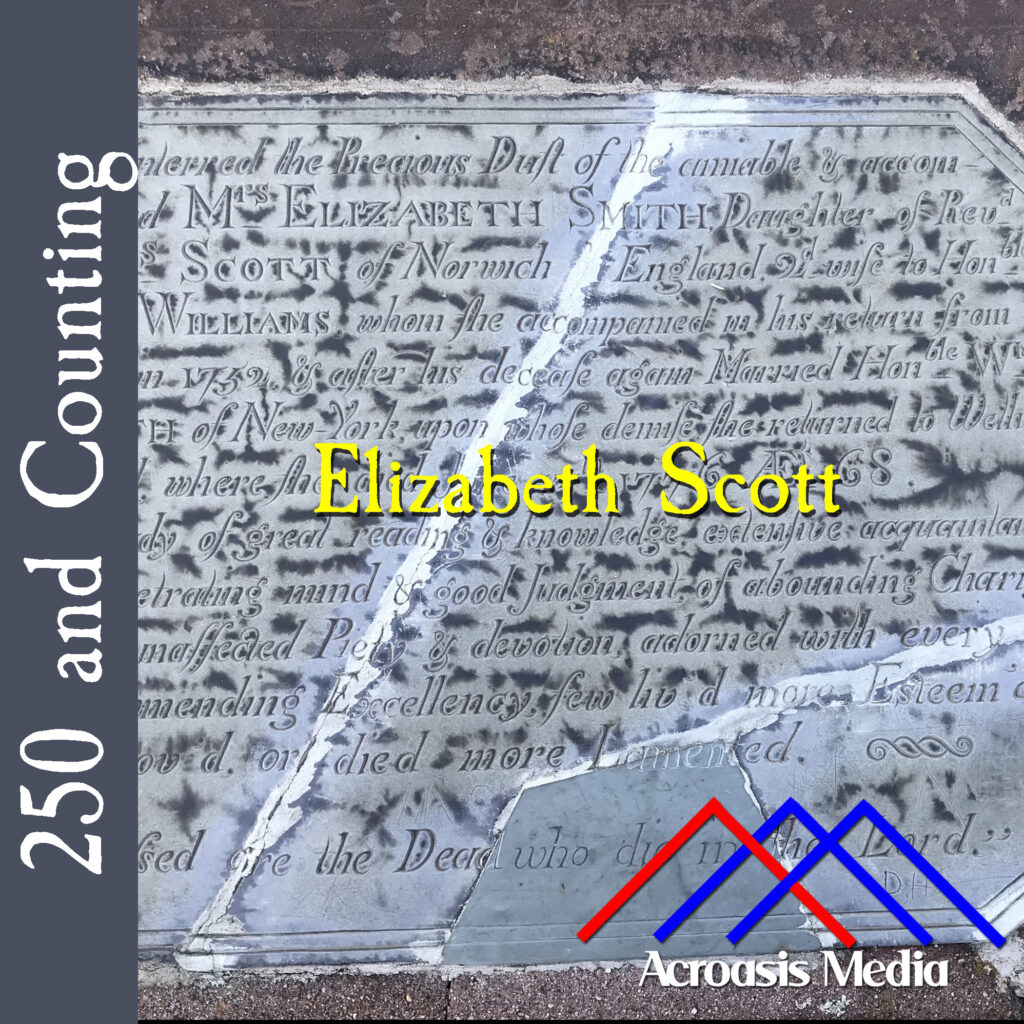
    Cover art for June 13, 1776: the tablet inset in the gravestone table for Elizabeth Scott Williams Smith.

    The life of Elizabeth Scott is an open book and is still quite mysterious.

    It’s not 100% clear when she was born, other than it was “probably” in 1708. Her personal life isn’t very well known, and her work as a hymnist is still a matter of speculation, since so many of her pieces didn’t have her name on them, for some reason. It’s only been through careful analysis of known pieces that we’ve been able to put her name to the unknown pieces. Many of her known works are in the hands of Yale College, and are in manuscript rather than print, so they date back to the 1740s. Most of them are signed simply “S” or “Scott” rather than “Elizabeth Scott,” but those pieces have had a good chain of custody that they can be considered authentic.

    Interestingly, the plate that appears in today’s cover art is mounted into a grave table, which is a stone table (i.e. a table top and four legs with some opening between it and the ground) standing over her grave. The grave of her second husband is nearby, but it’s marked with a simple stone.

  • George Schetky–June 1, 1776

    Cover art for June 1, 1776: Logo of the Musical Fund Society of Philadelphia. We do hope they get some extra attention and don't hold it against us for swiping this off their website.

    George Schetky came from a very musical family. As we mention in the episode, his father was also a cellist and composer who was originally from Vienna. As a result his home always had plenty of music present and was a regular hub of performances.

    In fact, one could say that the Schetky family was a musical dynasty, between George, his father, his uncle on his mother’s side (Alexander Reinagle) amd others. Thus, he was a virtuoso on the cello before he ever set foot in America.

    George came to America to stay with his uncle Alexander in Philadelphia, who was already well established there, and got himself into the local music scene as a performer and a teacher. This penchant for teaching also led him to theater programs including educational pamphlets so that patrons would understand the importance of the piece they were about to hear.

    And, of course, Schetky was important in the founding of the Musical Fund Society of Phladelphia, which is dedicated to artistic advancement and musician welfare even now, over 200 years later.