A war map of New York City from 1776. This was almost the entire city at that time.
OK, I’ll admit I cheated the title a little bit. The fact is, both General Charles Lee, who was part of George Washington’s inner circle, and General Henry Clinton, who was a British general, did arrive in New York City on the same day.
The odds are pretty low that, despite how small New York City is compared to today, they actually encountered one another on this day.
Aerial view of Fort McHenry. The curved earthworks wall along the bottom third of the picture is a remnant of Fort Whetstone. via Wikimedia Commons.
I was actually rather disappointed not to be able to find any images of Fort Whetstone. Surely there are some pictures from that time, but the Internet was not in a giving mood today.
In today’s artwork you can see some remnants of the original fort (most of what you see is modern-day Fort McHenry). Those are along the bottom of the photo, but there are other artifacts that are tough to see from aerial photos. For instance, the location of the original barracks is visible at ground level. They’re marked out by the bricks which are still embedded in the ground.
The end of Whetstone/Locust Point is just out of picture range to the left. And if you visit, look out across the water to the remnants of the Francis Scott Key Bridge. That’s about where the British ships were when they were bombarding Fort McHenry during the War of 1812. It’s also about where Francis Scott Key himself was at that same time. You’re looking at roughly four miles of distance as the crow flies. Those ships’ cannons had some range.
Fun Fact: as recently as November 2025, an unexploded cannonball, likely from the 1814 battle, was found in the ground. The park had to be closed for a day while the Baltimore Bomb Squad came in and rendered it safe.
A typical iron factory setup, This image is generally used to represent the Salisbury Furnace. via National Park Service.
In early 1775 when hostilities first broke out, the Salisbury Iron Furnace was owned by an Englishman named Richard Smith. By the end of the year he’d cleared out and gone back home to England, and remained there for the rest of the war.
After an inspection in early January, the Committee of Safety formally recommended that the Salisbury Iron Furnace be confiscated and made ready for the production of cannon. The first cannon rolled out on May 27, and by the time the war ended, about 850 cannon—about 75% of all the cannons made in the colonies—had come from Salisbury, not to mention ammunition and other armaments.
Portrait of William Montgomery Crane. By Unknown author – The National Cyclopaedia of American Biography, Volume XII, 1904, page 422, via Wikimedia Commons.
If you’re going to have a kid in 1776, you’re probably going to be feeling a little patriotism when you do so. Such was the case with William Montgomery Crane, who got his middle name from General Richard Montgomery, under whom his father served around this point in the Revolutionary War.
Crane’s father was General William Crane, but at that time he was a lieutenant in the expedition to Quebec, and was part of the New Years Eve assault on that city. Crane was badly wounded in the ankle, an injury that bothered him for decades and eventually led to the foot being amputated, and his eventual death in 1814.
As far as his son William is concerned, we had to gloss over this, but Crane spent a few years in the Mediterranean during the Barbary War, working on protecting ships from piracy. After the Revolution, American ships naturally lost protection from the British Navy and were vulnerable to pirate attacks when they refused to pay protection. President Thomas Jefferson relied on a strategy of using the US Navy to put together blockades, patrols and even direct assaults on the pirate ships. Eventually the tactic worked and Crane was recognized for his efforts when his gunboat endured heavy fire to destroy a battery’s walls in Tripoli in just a couple of hours.
Etching of William Alexander, Lord Stirling, as a Major General. Etching by H.B. Hall, 1892. via New York Public Library.
The capture and ultimate disposition of the HMS Blue Mountain Valley and her crew was, in the bigger scheme of things, a relatively minor event in the American Revolution, however it did suddenly bring both New Jersey and New York into more active participation in the war.
And even though the Blue Mountain Valley was beset by storms that they couldn’t possibly control, the fact that the ship was so easily captured despite the protections they’d put in place so far became a major point of debate back in England. It led to a policy prohibiting the use of transport ships to America unless they had a Naval escort.
A policy like that is pretty good for keeping the ship and cargo losses down, but it wreaks havoc on the Naval resources. So this event was a win in the short run for the Americans, but it was a long-run win as well because of the way it inconvenienced the British over the next several years.
“Colonial Blacksmith, 1776”. Wood engraving, attributed to “Granger” though this may be the name of the collection.
While we’re talking about enlisting apprentices today, it should be noted that there was precious little difference between an apprentice and an indentured servant, except maybe their age. Thus, the rules that applied to apprentices when it came to enlistment could also be applied to indentured servants, especially inasmuch as some of those rules seemed designed more for them than apprentices.
Also: Mike mentioned James Mease and his ketchup recipe. To clarify, ketchup had been around for hundreds of years, originating in China (or Vietnam; it’s a little fuzzy). What Mease did was add a tomato base, giving us the ketchup that we’re used to putting on our cookout foods. The Chinese stuff, commonly called “kê-chiap” was a fish-based sauce.
Mease’s recipe involved brandy and spices; no sugar or vinegar. Here’s the recipe he published:
Slice the apples* thin, and over every layer sprinkle a little salt; cover them, and let them lie twenty-four hours; then beat them well, and simmer them half an hour in a bell-metal kettle; then add mace & allspice. When cold, add two cloves of raw shallots cut small, and half a gill of brandy to each bottle, which must be corked tight, and kept in a cool place.
*Mease called them “apples” because he was using the French word for tomatoes, “pommes d’amour” or “love apples.”
Letters from John Hancock to George Washington weren’t especially scarce, nor were letters going the other way. However, today’s letter takes on a few important topics for Washington that one hopes came greatly appreciated.
There was commendation that Washington had the foresight to send troops to New York, there was some good financial news, there was also good news in the realm of troop recruitment, and there was a warning about likely military action coming fairly soon.
All in all, it was a letter packed with information, and if we had to guess (because we don’t know), it was likely conveyed by courier rather than the postal system, which was still prone to interception by the British.
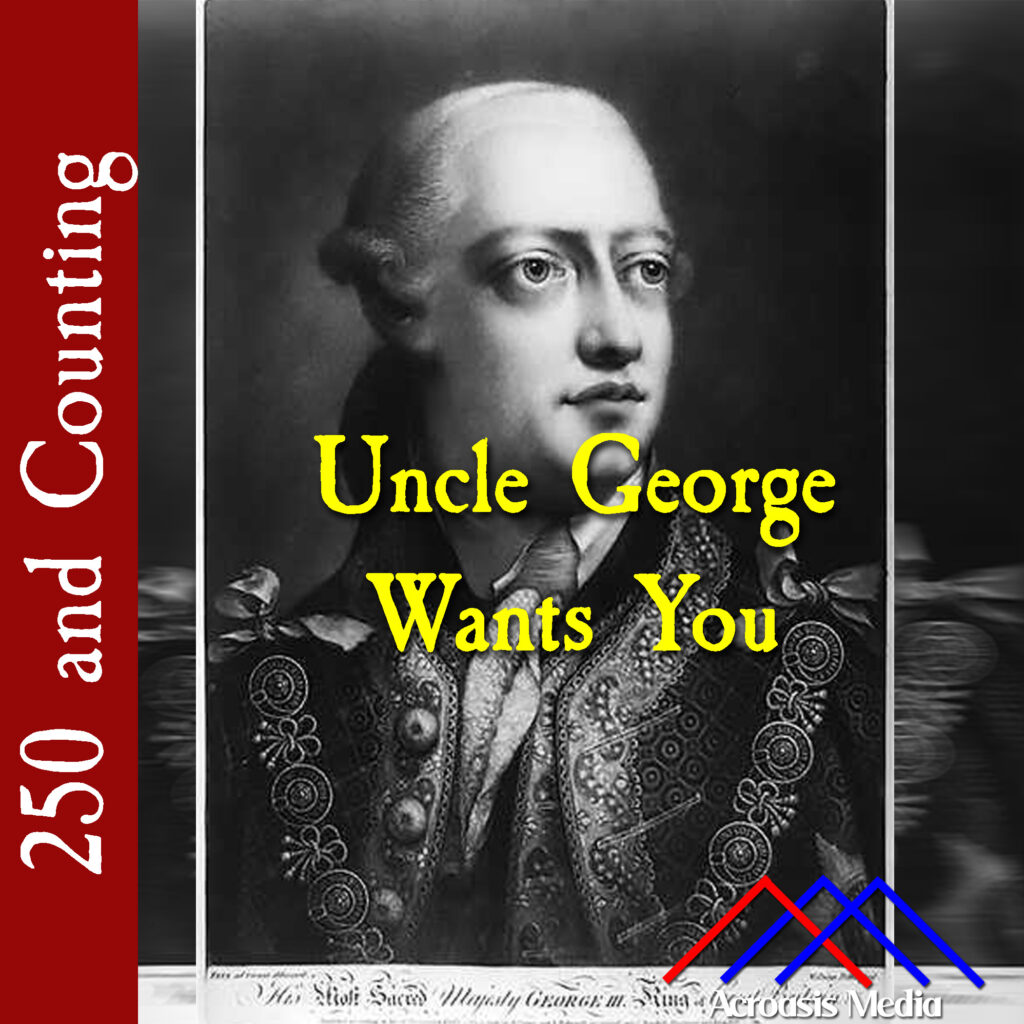
Portrait of William Franklin, 1790, attributed to Mather Brown. via Wikimedia.
It used to be rumored that Benjamin Franklin had over 30 children out of wedlock, but that’s since been debunked. (And there goes a perfectly good “lightning rod” joke.)
But William Franklin was considered illegitimate, though he was raised by his father and his common-law wife Deborah Read. There are some breadcrumbs here and there that lead some historians to believe that Deborah was, in fact, William’s mother, but nothing thick enough exists to confirm that.
At any rate, William was one of the last great Loyalists, and while his arrest and move to Connecticut was alluded to in the play 1776, it didn’t quite happen the way it was described there. Or at the time the viewer was led to believe. Tune in to get the real story from Mike.
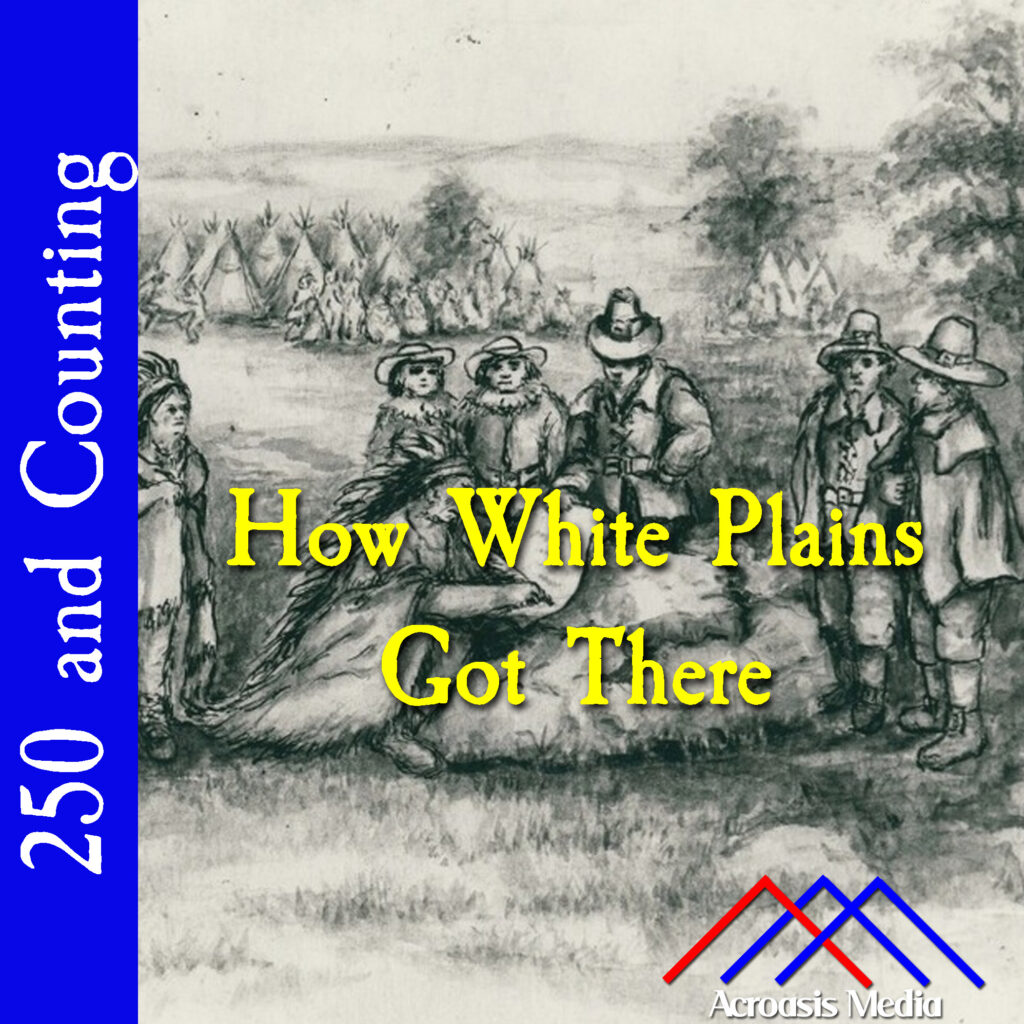
Engraving titled Washington and Fairfax and a War-Dance by John Rogers, 1857. The event depicted actually took place in 1779.
As noted in the episode, there were several different rules laid down for trading with Native Americans at that time, and some of them were designed to ensure that they remained on our side or, at worst, that they remained neutral in Revolution-based matters.
But the rules wound up working out well for both sides: the various tribes were able to get the materials they wanted, and trade was conducted under better-controlled conditions.
In addition, they led to trade-related treaties with several tribes up and down the coast during the next year or so. And with over 80 tribes east of the Mississippi River at that time, that’s a lot of treaties to negotiate.
“Knox entering camp with artillery” by William H. van Ingen, c. 1831. via Library of Congress. Depicts Henry Knox on horseback with soldiers transporting a disassembled canon on a sled through the snow, winter 1775-76, following his famous capture of artillery at Fort Ticonderoga. Wood engraving, hand-colored.
The Noble Train of Artillery has finally arrived!
Given that it was over 150 miles from Ticonderoga NY to Cambridge, MA, and that it was wintertime, and that Interstate 90 was still over 150 years in the future, it’s pretty amazing that Henry Knox was able to move so much artillery so efficiently.
As Mike notes in the episode, the arrival date is largely a guess, since Knox’s diaries ended the last time we checked in with him, about two weeks ago when he was in western Massachusetts and, it appears, nobody else kept accurate notes on the event. There are, however, notes on the disposition of the materiel, so that makes this a pretty good guess. And it allowed the Continental Army to maintain the Siege of Boston until the British finally bailed out two months later.