Category: Diplomacy

  • Deane Gets Busy–October 6, 1776

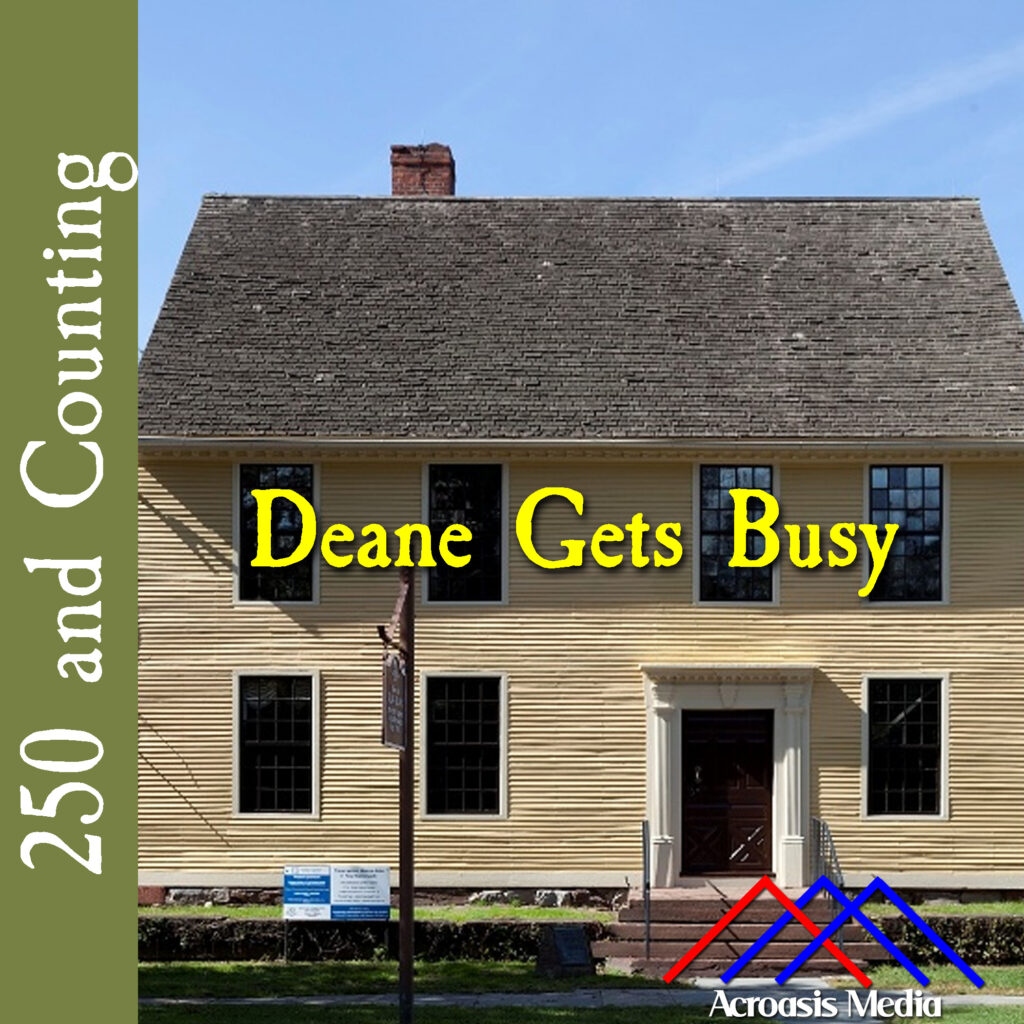
    Cover art for October 6, 1776: Silas Deane House in Wethersfield, Connecticut. via Library of Congress.

    We’ve talked so much about Silas Deane that I don’t have much new to share in this space, so I’ll tell you a little about his house.

    The house in today’s cover art was completed in 1769. It’s located in Wethersfield, Connecticut. The facade is asymmetrical because there was a porch at one time.

    Deane designed the house specifically to impress people and to project an image of power. It has two parlors: one for entertaining and one for family dining, and the kitchen is oversized specifically to allow for preparation of larger meals when there were guests.

    Elizabeth Deane entertained important people when Silas was away for one reason or another, whether it was performing his Congressional duties or engaging in diplomatic missions overseas, as he was during this episode. Among those VIPs would be John Adams and George Washington, on separate occasions. Elizabeth died in 1777, while Silas was still in Paris.

    After Deane’s death overseas in 1789, house and possessions were sold to satisfy his creditors. It passed through many different owners until 1874, when the Fenn family took it over. Then in 1938 they bequeathed the house to the National Society of the Colonial Dames of America, and it’s been a historic site for visitors since then.

  • The French Commission

    Cover art for September 26, 1776: 1785 portrait of Arthur Lee by Charles Willson Peale. via Independence National Historical Park in Philadelphia.

    The Continental Congress, in the wake of Washington’s recent letter, finally realized that they weren’t going to be able to defeat the British on their own. Some outside assistance would be needed.

    So on this day in 1776, they appointed a three-man commission to undertake a diplomatic mission to France, seeking money, arms and other materials.

    France, as we’ve mentioned before, was a good country to hit up. They were still salty about the way the French and Indian War ended up, and they’d already been assisting America through gray and black markets, in order to give themselves plausible deniability should someone get caught. Should this mission succeed, the activity would be much more overt, and could be perceived as France’s official recognition of the United States as a sovereign nation.

    It ultimately didn’t work out that way; that particular distinction went to Morocco and France became the second nation to officially recognize the US.

    As Mike notes, the trip itself wouldn’t get underway for another few months, but there’s no doubt that the meeting with French authorities marked a critical turning point for the American Revolution.

  • The Staten Island Peace Conference–September 11, 1776

    Cover art for September 11, 1`776: The Billop House on Staten Island, where the aborted peace conference took place. Via Wikimedia Commons.

    The Staten Island Peace Conference was a bust almost from the beginning. Not because the sides were so opposed, but because one side didn’t have the authority to do any real negotiation.

    John Adams, Edward Rutledge and Benjamin Franklin had to row over from Perth Amboy, New Jersey to get to the Totten House, which is near the southernmost tip of New York State, on Staten Island. At the narrowest point I could find from the vicinity of the house, that’s nearly a half-mile across the mouth of the Arthur Kill River where it opens into Raritan Bay and ultimately the Atlantic Ocean.

    Unfortunately, Admiral Howe was so limited from a diplomatic standpoint that there wasn’t a lot he could do at that point, so after a few hours they broke up and the delegation was allowed to return to New Jersey. The war would continue for another severn years before concluding.

    In retrospect, we have multiple attempts for Admiral Howe to meet with George Washington, which failed on the basis of protocol (Howe wouldn’t refer to Washington as a General), so now we have to wonder what direction negotiations would have gone had one of those attempts succeeded. Would things be different, or would it wind up the same, and the events of today be obviated? If a meeting in July had ended in no agreement, would John Sullivan even have been paroled to go to Philadelphia and present the plan?

    I’ll leave that for you to chew on. In the meantime I’m still sounding pretty sultry, so enjoy that.

  • Adams’ Model Treaty–July 18, 1776

    Cover art for July 18, 1776: The 1778 Treaty of Alliance with France, based on Adams' work of today. Via National Archives.

    Coming up with a model treaty wasn’t John Adams’ idea, but it turned out to be a very good idea that he was responsible for implementing.

    Once Adams had it in his head, he began to work on the model treaty along with the committee, and while it was intended to be used for commercial trade, it could be (and eventually was) adapted for soliciting military support in the form of weapons and other ordnance (rather than troops).

    Today’s artwork, incidentally, is the Treaty of Amity and Commerce from 1778 that the US signed with France. If you look closely you’ll see that the left side is in English and the right side is the French translation. This is just most of the first page, of course, but it’s interesting to see how such things were handled.