Just a couple of days ago we told you about the efforts on the part of the Continental Congress to get around its own rules in order to provide Washington’s army with the materials they needed to maintain the Siege of Boston.
This time around, John Adams takes steps to do what he needs to do without running afoul of the Intolerable Acts.
It’s like the legal equivalent of the obnoxious game your siblings played with you: “I’m not touching you…I’m not touching you…”
Peter Tondee and his wife Lucy ran Tondee’s Tavern in Savannah, Georgia. It was quite the location for revelry and such, and it was a popular meeting place up until it burned down in 1796, along with most of that city. Nowadays there’s a plaque in the side of the building where Tondee’s once stood.
And on this day in 1775, the Sons of Liberty got together to throw the King a little birthday part, without balloons, or cake and candles, or much other than a little food and a lot of fermented beverages, if you catch our drift.
And once again, we have someone (two someones, really) who manage to come up with a plan that will put all this unpleasantness between the Thirteen Colonies and the British Empire to rest, and once again the physical distance between the two threatens the success of those plans.
What’s more, it turns out that the more popular of the two plans has an almost-hidden ulterior motive…
Today we review two different pieces of correspondence—one local, the other trans-Atlantic—in which the letter writers are clearly coming to the conclusion that things are not going well between the British and the Colonies, and that preparing for war is probably inevitable at this point.
And that’s interesting on its own, but we also wanted to call your attention to the cover art for today’s episode. The person in the picture is Josiah Quincy II, who is discussed in the episode as a “side” character of sorts. The painting is by Gilbert Stuart, who is pretty famous for painting hundreds of American politicians and public figures, and perhaps most famous for the “unfinished” portrait of George Washington that served as the model for the one-dollar bill. There aren’t a lot of portraits of Quincy extant, but this one (which was painted after Quincy’s death in April 1775) gets a lot of attention from Stuart scholars because it provides a very candid representation of Quincy’s strabismus, or misalignment of the eyes. (It’s possible that he simply had amblyopia but we don’t know for sure nowadays.) Most people agree that it actually gives Quincy a little extra dignity and esteem.
Alexander Hamilton isn’t really considered one of the Founding Fathers, largely because he’d only arrived in America from Scotland around the same time that things started getting ugly between the Colonies and the Crown. But he quickly took up the cause, and it’s clear from his writing that he was of a similar mind as Jefferson, Franklin and the rest.
When he joined the Continental Army, he rose quickly through the ranks, becoming Washington’s staff aide and entered politics shortly after the war ended. So while he wasn’t on hand for the initial segment of American statesmanship, he was there when the basic framework of our government was laid down.
But back to his writing: he and the Reverend Samuel Seabury (we first heard from him on January 4) got into the habit of debating each other through pamphlets, written under pen names. They’re quite well-written and easy to understand, and because they’re only pamphlets, they don’t run especially long. They’re worth checking out.
We’ve mentioned in the past that the intent of most of the Intolerable Acts and the Coercive Acts were designed to punish the Massachusetts Province, but it had some effect on the other colonies as well. What’s more, there was a growing worry that, if Parliament could do things like this to Massachusetts, what’s going to stop them from doing it to us?
To that end, the city of Albany, NY, began making plans just in case war broke out. It was against the law, but their reasoning was that it was better to have a militia and not need it, than to need it and not have it.
The first week or two of February 1775 could best be described as a series of misunderstandings and communication breakdowns. Any attempts on both sides to reach out with some form of conciliation managed to fail for various reasons.
And during all these breakdowns, the situation on the American side of the pond only got worse as time went on, largely because each side thought that the other wasn’t being responsive.
In the end, however, it didn’t really matter, because as we’ve discussed with the episodes dealing with Massachusettensis and Novanglus debating one another in print, the one thing they agreed upon was that these attempts to reach out were always, at their heart, rooted in some attempt to wrest control from the other party. Both reaching for it, neither attaining it nor caring what the other side’s argument meant at the core.
As noted previously, the First Continental Congress composed a Petition to the King asking him for some relief from the Intolerable Acts. The petition arrived in London in mid-December, which turned out to be some bad timing for a number of reasons.
Benjamin Franklin was in town for diplomatic purposes, and he composed a letter to Charles Thomson, the Secretary of the Continental Congress, which summed up the problem: not only was the Petition but one among many, many other documents, it appeared that Parliament didn’t much care what the Colonies thought. And that’s the kind of thing that makes for bad relationships.
After the Boston Tea Party, Parliament enacted what they called the Coercive Acts and the Colonies called the Intolerable Acts. The Colonists were neither coerced, nor were the acts tolerated (hence the name). And you know that because we’ve told you this already several times.
In October 1774 the Continental Congress composed the “Petition to the King”, and as you’ll learn in greater detail tomorrow, it was pretty clear that the petition crossed an ocean and still managed to go nowhere. In fact…
At about the same time, King George III decided that New England needed some more “convincing” to fall into line. This was the beginning of the New England Restraining Act. As the name suggests, it affected mostly the New England colonies, but people in the other colonies took notice and wondered “Hey, this could happen to us too, couldn’t it?” As a result, everyone continued moving down the path they fervently hoped they wouldn’t travel.
After the Boston Tea Party, the government in Britain enacted what they called the Coercive Acts, or what the Colonists called the Intolerable Acts. (From here, it doesn’t feel like one name was any better-sounding than the other.)
Because the Colonists were still hoping to preserve a decent relationship with the Mother Country, the First Continental Congress met in Philadelphia and put together a letter to the king, which said in essence, “We’re very loyal to you, O King, but it’s been a year and enough is enough. Maybe you could prevail upon Parliament to dial it back a little bit, hm?”
That was in October of 1774. Of course, documents moving slowly and all that, the reply from the king didn’t come back for a couple of months, and at the heart of it was George affirming his faith in Parliament’s actions, and nothing’s going to change for the forseeable future.
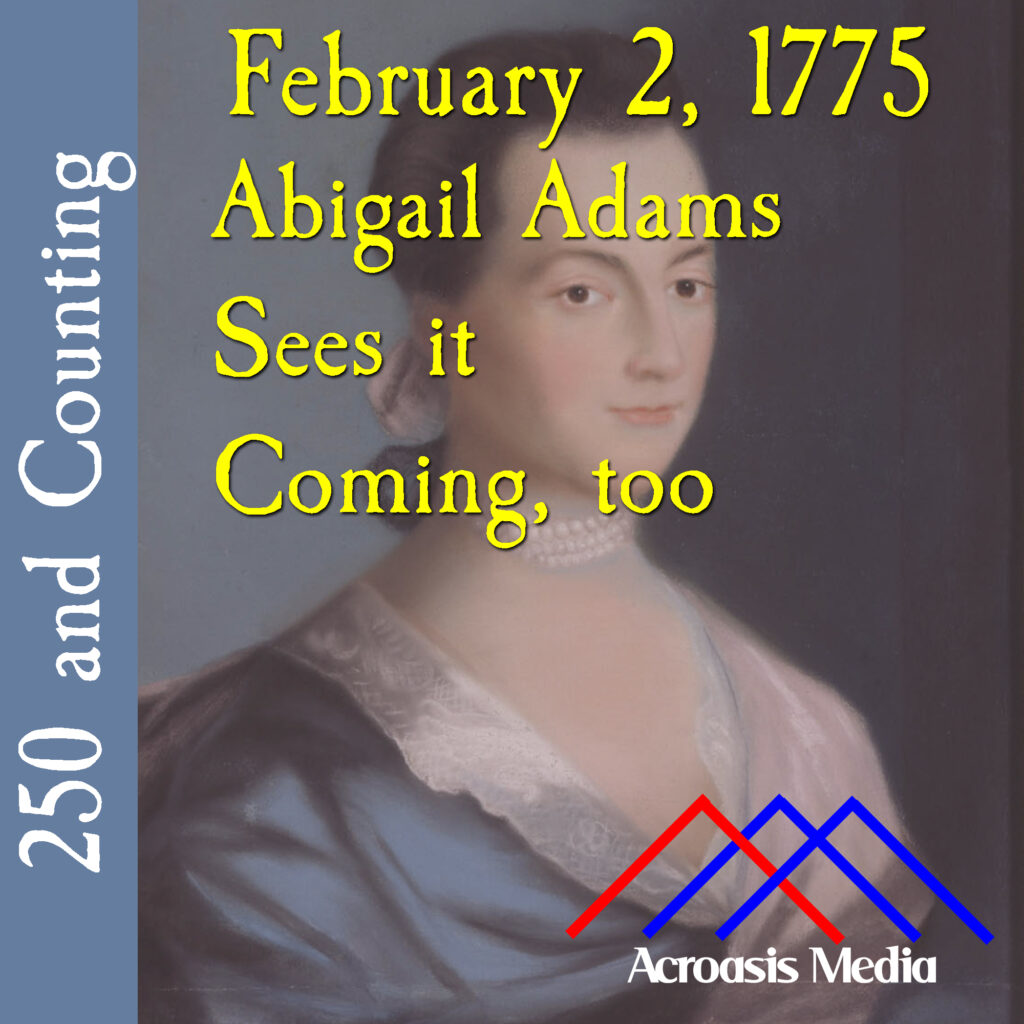
Both John and Abigail Adams, in different places at the time and in separate letters to friends, each relayed to friends their opinion that the tipping point had passed and that war was probably inevitable.
Guest Voice: Shannon Call, who needed a lot of convincing to get near a microphone.