It’s peculiar, sometimes, how we know a lot of stuff about famous people, but we don’t often know much about their relatives. Sometimes we don’t realize that they even existed,
John Adams had two brothers, one of whom died on this day in 1775. He wasn’t famous, but he did have some involvement with the Siege of Boston until illness struck. Something like that must have made the loss just that much more worse for John, and the war effort that much more personal.
Even when it’s Mike’s voice you hear on the episode, it’s Claude who takes the blame for the episode titles.
It wasn’t a bad thing for members of the Continental Congress to disagree, but some level of decorum was still expected from those members. And almost certainly, one of the commandments was Thou Shalt Not Trash Talk Thy Fellow Delegate. (I may have softened the language a little bit, there.)
Still, Adams had a right to express whatever frustration he had with John Dickinson, unfortunately the letter in which he did it got intercepted by the British and publicly published; the mere suggestion that there was some dissention among the ranks of a group that typically presented its work as a united front was certainly a Big Deal.
And it certainly didn’t grease the skids between Adams and Dickinson, nor was that rift ever truly healed.
John Adams wrote to his wife twice on this day in 1775. What did you do for your spouse that was such a big deal?
In these letters, the sparks don’t fly the way they do in many others, but the affection he feels for her is still present nonetheless. That he took the time to write a second, more thoughtful letter after dashing off the first one is a nice measure of his esteem for her, and his ability to use her as a sounding board, even when she’s 300 miles and several days’ travel apart.
As noted a couple of days ago, Abigail and John Adams wrote to each other quite frequently. Their relationship was not only deep with love, but with admiration for one another. If you get an opportunity, read David McCullough’s biography of John or, better yet, the Library of America’s volume of Abigail’s letters (not just to John but to many others). Their writing is florid without being mawkish. There’s a LOA volume of John’s correspondence as well.
In today’s episode, they’re not pining for one another (as they so frequently are). Abigail is relaying to John the details of her meeting with George Washington. Spoiler alert: she found him impressive, despite what she knew about him before meeting him.
Oof, that’s a mouthful of title. Oh well, what’s done is done.
As noted in today’s episode, James Warren was not related to Joseph Warren. On the other hand, he is related to Mercy Otis Warren, because he’s her husband.
James and John Adams had a few ideas in common; the hard part was convincing a few others that they were in the right.
Meanwhile, did you know there’s another Long Island? That sort of thing really plays havoc with our research. This one is in the Boston Bay, and it’s a familiar story because something similar happened a few weeks ago. But tune in anyway.
As you’ll hear today, I have a huge sinus infection and it took a lot of effort to get today’s episode recorded, so I hope you’ll excuse this part being rather brief.
John and Abigail Adams was probably one of the best documented relationships of the Colonial Era, and it’s a ridiculously touching love story. It’s clear that they hated being apart, and you’d do well to watch the HBO/Max miniseries about him.
In future episodes we’ll have to dedicate some portion to the literal language between the two. In the meantime, enjoy my Barry White impression.
The Second Continental Congress has only been convened for about five days and things are already heating up for them.
Delegates are still arriving. Lexington and Concord has upset their original plans so they’re making alternate plans. And even the alternate plans they made five days ago are being amended.
And then Virginia comes in with some crazy idea about Independence? Will the madness never end?
(Spoiler alert: it doesn’t, but we’ll tell you if it ever does.)
Today’s episode marks the end of Women’s History Month. We’ve noted a few episodes since this adventure first started that involved women taking political action as groups, but Mercy Otis Warren was one of the most influential individual women to take a political stand in the Revolution era.
She was self-educated, and married a man who was both enlightened and politically active himself, and she used her position as her husband’s hostess to develop and maintain connections of her own. She was also able to use what she learned to develop some of the pieces she wrote, whether they were factual or thinly-disguised fiction pieces.
Claude and his wife Shannon did the extra-touristy thing of visiting Plymouth, Massachusetts during Thanksgiving weekend several years ago, and we did see the Mercy Otis Warren statue, but frankly at that time we still had a lot to learn about her. (If you go, be warned that Plymouth Rock is even more disappointing than everyone tells you it is.)
And because it’s an episode celebrating Mercy Warren, we talked Shannon into recording the episode. Enjoy.
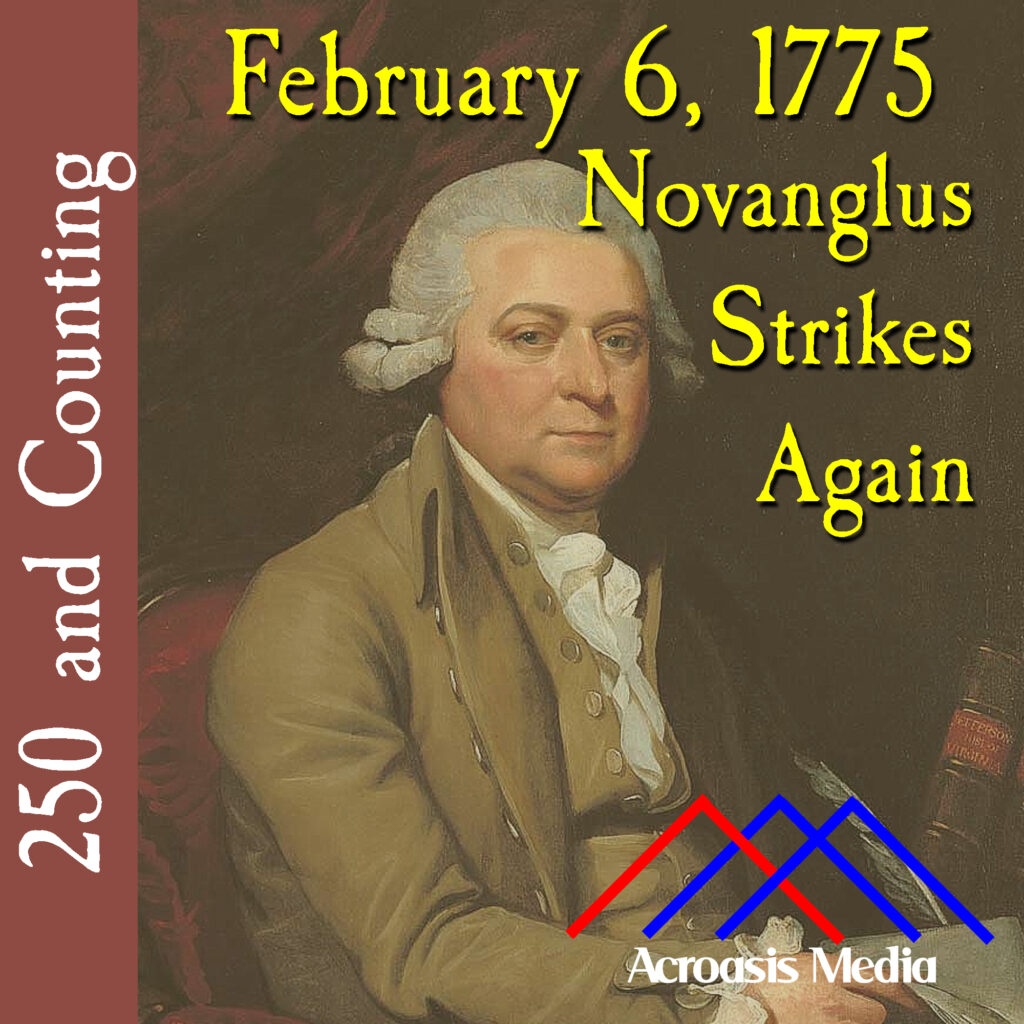
John Adams and Daniel Leonard had an interesting relationship. They were great friends at first, until the British started cracking down on the Colonies. Adams chafed under the Crown’s pressure, while Leonard remained loyal. Ultimately it created a rift between the two men which never quite healed, and it broke Adams’ heart.
When Leonard began submitting essays to the Boston Gazette under the pen name “Massachusettensis,” Adams felt compelled to respond in kind, choosing a pen name of his own, “Novanglus.” It’s not entirely clear that each man knew who the other one was—certainly they did not at that time, but sources appear to differ on whether Adams knew it was Leonard later on—but what is clear is that neither man wrote from the standpoint of the troubles between Britain and the Colonies arising from a simple case of misunderstanding. They both viewed it as each side making a calculated effort to maintain control.
After the Boston Tea Party, the government in Britain enacted what they called the Coercive Acts, or what the Colonists called the Intolerable Acts. (From here, it doesn’t feel like one name was any better-sounding than the other.)
Because the Colonists were still hoping to preserve a decent relationship with the Mother Country, the First Continental Congress met in Philadelphia and put together a letter to the king, which said in essence, “We’re very loyal to you, O King, but it’s been a year and enough is enough. Maybe you could prevail upon Parliament to dial it back a little bit, hm?”
That was in October of 1774. Of course, documents moving slowly and all that, the reply from the king didn’t come back for a couple of months, and at the heart of it was George affirming his faith in Parliament’s actions, and nothing’s going to change for the forseeable future.
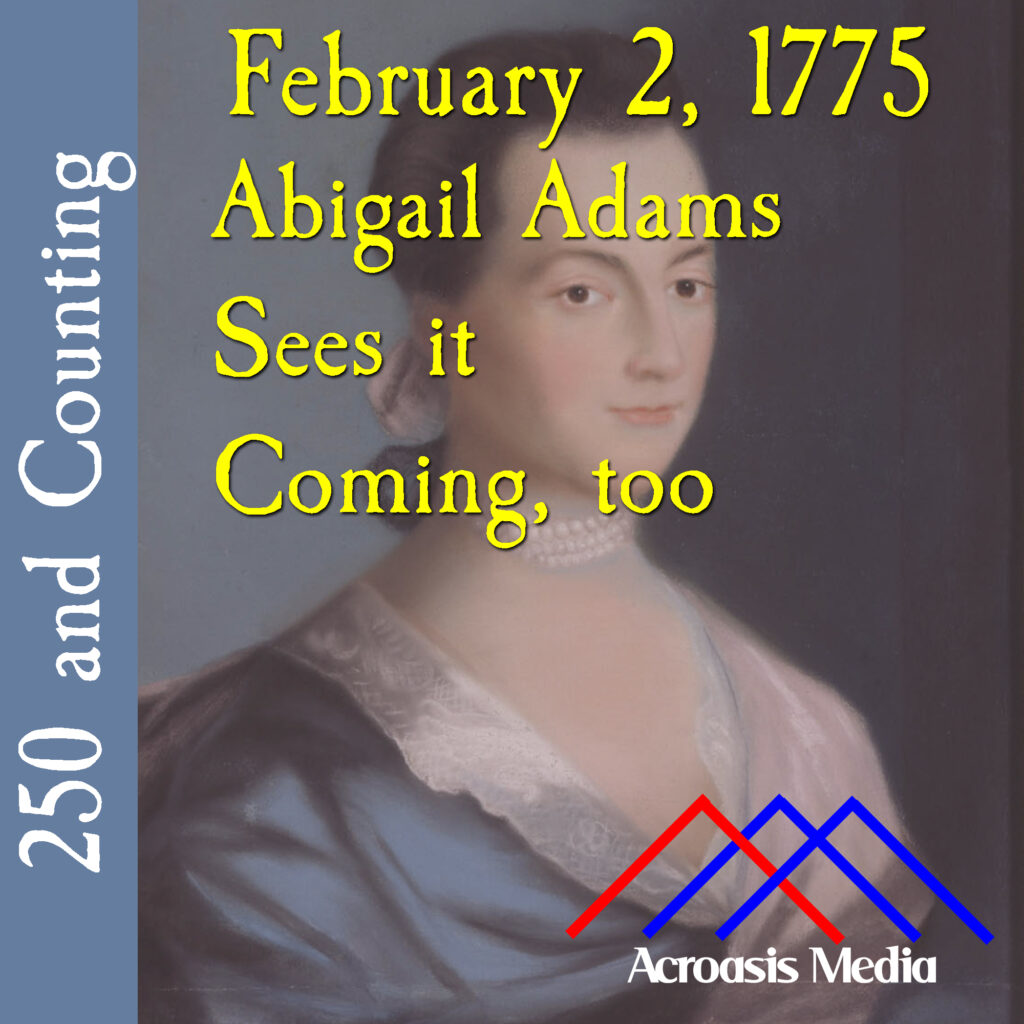
Both John and Abigail Adams, in different places at the time and in separate letters to friends, each relayed to friends their opinion that the tipping point had passed and that war was probably inevitable.
Guest Voice: Shannon Call, who needed a lot of convincing to get near a microphone.