Category: Mercy Otis Warren

  • John and Mercy–April 16, 1776

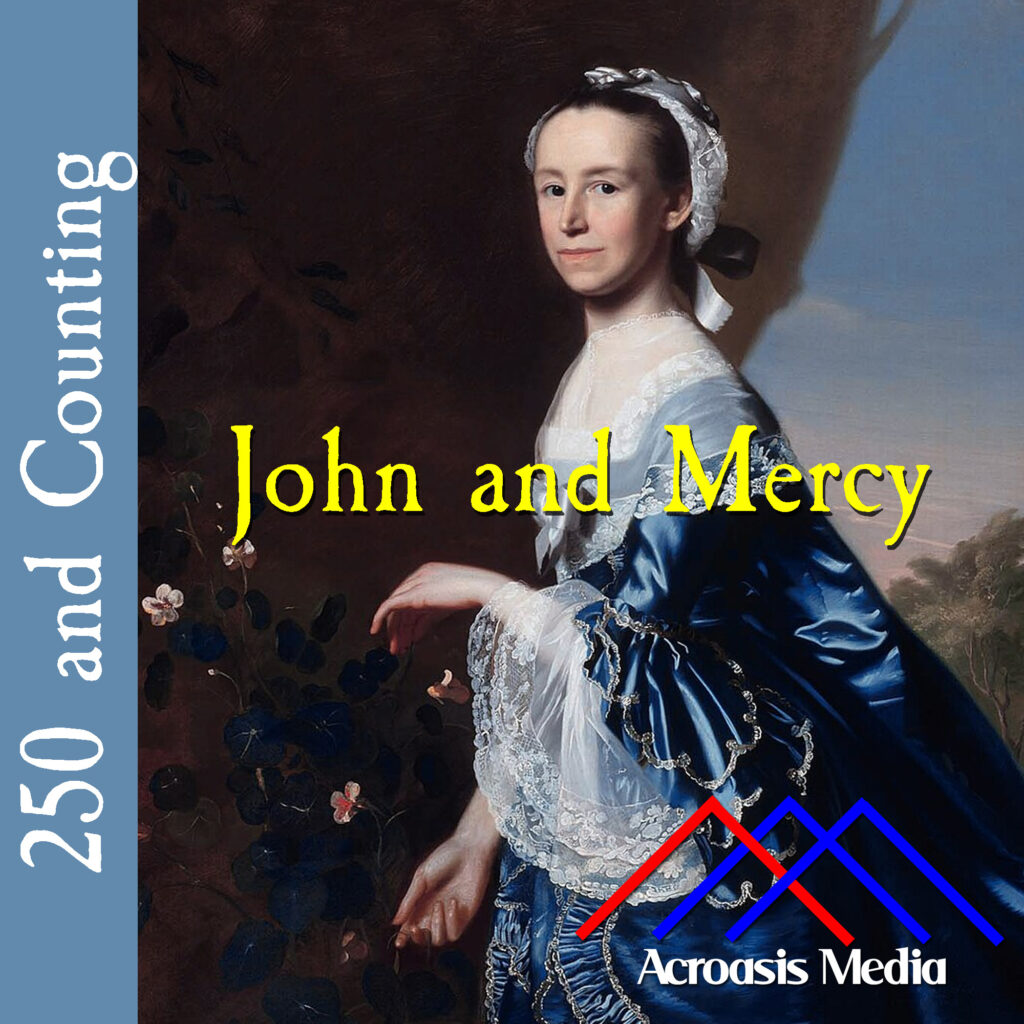
    Cover art for April 16, 1776: portrait of Mercy Otis Warren by John Singleton Copley, ca 1763. via Museum of Fine Arts in Boston.

    Mercy Otis Warren doesn’t get nearly enough love in our history books, and barely enough of it here, besides. Having said that, our episode a little over a year ago was a fun little tribute.

    Mercy Otis Warren was a playwright, a pamphleteer and a poet before, during and after the Revolution. Some of her plays were thinly veiled attacks on the British. She was self-taught and pretty brilliant at it, considering that she was one of the first to advocate for a Bill of Rights (though nobody knew she’d written the piece advocating one until her great-great-grandson found a document tying the pamphlet to her).

    And while this episode focuses on correspondence between her and John Adams, she frequently exchanged letters with George Washington, John Hancock, Patrick Henry, Samuel Adams, and Thomas Jefferson. But her best relationship was with John Adams, who she looked to as a wiritng mentor. It was at his suggestion that she began writing a history of the Revolution while it was still being fought. She didn’t need primary sources to write her history, she was the primary source. At worst, she was getting it second-hand from the members of the Continental Congress and local leaders.

    Mercy was married to James Warren, and I mention that here because oftentimes she’s thought to be the widow of Dr. Joseph Warren, who died at Bunker Hill. In fact, despite having the same name, Joseph was not related to James, nor to Mercy.

    Incidentally, Mike gives a shout-out to the Massachusetts Historical Society, which is a fascinating repository of documents and items related to the history of the state, but which has a special lens on the Revolution, especially this year. So I figured I’d do the same here, along with a link. If you’re in town, it’s not to be missed. And it’s free, though donations are encouraged. Go check them out and from there it’s a short walk to Fenway Park, where you can catch a Red Sox game. (Alas, they were playing away games while we were in town.)

  • July 11, 1775: From John to James, and The Other Long Island

    Cover art for July 11, 1775: Portrait of James Warren, 1763 by John Singleton Copley. Now in the Museum of Fine Arts, Boston.

    Oof, that’s a mouthful of title. Oh well, what’s done is done.

    As noted in today’s episode, James Warren was not related to Joseph Warren. On the other hand, he is related to Mercy Otis Warren, because he’s her husband.

    James and John Adams had a few ideas in common; the hard part was convincing a few others that they were in the right.

    Meanwhile, did you know there’s another Long Island? That sort of thing really plays havoc with our research. This one is in the Boston Bay, and it’s a familiar story because something similar happened a few weeks ago. But tune in anyway.

  • March 31, 1775: Mercy Otis Warren, Ignoring the Rules

    Cover art for March 31, 1775: photo of the statue of Mercy Otis Warren that stands outside the County Courthouse in Plymouth, Massachusetts. Photo by Kenneth C. Zirkel,. Other than cropping to fit, used without changes under the Creative Commons License.

    Today’s episode marks the end of Women’s History Month. We’ve noted a few episodes since this adventure first started that involved women taking political action as groups, but Mercy Otis Warren was one of the most influential individual women to take a political stand in the Revolution era.

    She was self-educated, and married a man who was both enlightened and politically active himself, and she used her position as her husband’s hostess to develop and maintain connections of her own. She was also able to use what she learned to develop some of the pieces she wrote, whether they were factual or thinly-disguised fiction pieces.

    Claude and his wife Shannon did the extra-touristy thing of visiting Plymouth, Massachusetts during Thanksgiving weekend several years ago, and we did see the Mercy Otis Warren statue, but frankly at that time we still had a lot to learn about her. (If you go, be warned that Plymouth Rock is even more disappointing than everyone tells you it is.)

    And because it’s an episode celebrating Mercy Warren, we talked Shannon into recording the episode. Enjoy.

  • 250 and Counting: February 2, 1775

    Cover art for February  2, 1775: portrait of Abigail Adams by Benjamin Blyth, in 1766.

    After the Boston Tea Party, the government in Britain enacted what they called the Coercive Acts, or what the Colonists called the Intolerable Acts. (From here, it doesn’t feel like one name was any better-sounding than the other.)

    Because the Colonists were still hoping to preserve a decent relationship with the Mother Country, the First Continental Congress met in Philadelphia and put together a letter to the king, which said in essence, “We’re very loyal to you, O King, but it’s been a year and enough is enough. Maybe you could prevail upon Parliament to dial it back a little bit, hm?”

    That was in October of 1774. Of course, documents moving slowly and all that, the reply from the king didn’t come back for a couple of months, and at the heart of it was George affirming his faith in Parliament’s actions, and nothing’s going to change for the forseeable future.

    Both John and Abigail Adams, in different places at the time and in separate letters to friends, each relayed to friends their opinion that the tipping point had passed and that war was probably inevitable.

    Guest Voice: Shannon Call, who needed a lot of convincing to get near a microphone.

  • 250 and Counting: January 23, 1775

    Cover Art for January 23, 1775: A portrait of Mercy Otis Warren

    Awhile back we talked about a Loyalist who wrote an opinion piece under the pen name “Massachusettensis” (which we may have mocked a little bit but it’s just the Latin word for the Colony/State). His rhetoric angered John Adams to the point where he felt compelled to respond in kind, and he did so using a pen name of his own: Novanglus.

    We’ll learn about Adams’ first response to Massachusettensis, but we’ll also discover that there may be another reason this particular essayist caught Adams’ imagination.

    Also on this day, Mercy Otis Warren opens a new play whose plot may lie a little too close to real life.