Category: North Carolina History

  • Common Sense Comes to NC–February 10, 1776

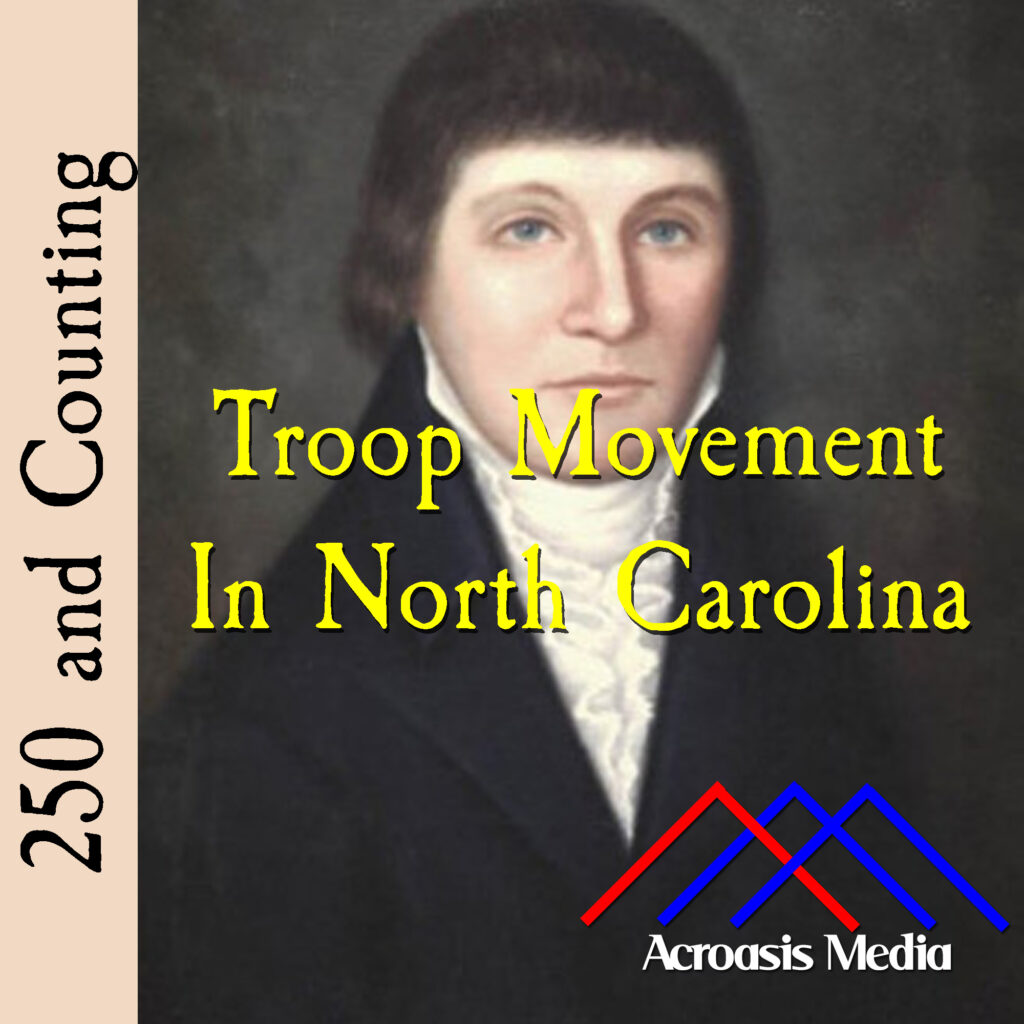
    Cover art for February 10, 1776: Portrait of John Penn, ca. 1776. Artist unknown. Now at the Guilford Courthouse National Military Park. via Wikimedia.

    As the ideas behind Common Sense spread through the country, it’s an interesting coincidence that Common Sense came to both North and South Carolina a day apart. What’s curious is the way it caught on very quickly in South Carolina, but was more of a slow burn in North Carolina.

    It’s possible that the difference is as simple as Christopher Gadsden presenting the pamphlet orally before the Provincial Congress, whereas John Penn took more of a backdoor approach, giving a copy to a colleague and hoping word gets out. Sure enough it did, and while there was no hard line of “Wow! We need to act on this!,” it proved to be quite the influential pamphlet that led to a gradual changing of minds regarding whether or not the Colonies should be free from England.

  • A Plan Is Hatched–January 9, 1776

    Cover art for January 9, 1776: a miniature portrait of Josiah Martin, artist unknown, circa 1775.
    A miniature portrait of Josiah Martin, artist unknown, circa 1775.

    Josiah Martin was the last Royal Governor of North Carolina, and while he spent the first few months of the job in New York, he probably wouldn’t have a reputation as an especially bad governor if he hadn’t been hampered so much by circumstances that were in place before he got the job.

    There were money issues that his predecessor had left behind, and the rest of the government was plagued by internal squabbling that pretty much ensured nothing got done. It’s actually kind of amazing that there were any Loyalists left in North Carolina by the time 1776 rolled around.

    But there were, and so Josiah Martin began to put together a nearly foolproof plan to get himself back in power.

    Nearly.

    P.S. You know you watched a lot of The West Wing when you hear the name “Josiah” and your mind immediately goes to “Bartlet.” Just sayin’.

  • Homesickness Sets In–December 2, 1775

    Cover art for December 2, 1775: Portrait of Joseph Hewes, 1775. Author unknown; now hanging at Guilford Courthouse National Military Park, Greensboro, NC

    All of the men who were part of the Second Continental Congress were serious men who had businesses of their own back at home. So spending so much time in Philadelphia had to have been taxing on them, especially since the days were so long. Of course many of them were going to be homesick. Read the letters between John and Abigail Adams as an excellent example.

    And remember: to go home to, say, Boston could take about a week in 1775. So they’d be away for two weeks at a minimum, and that’s entirely traveling time. Taking care of whatever they needed to only added to the absence.

    We do know that many of them did go home from time to time, but they were obliged to return and continue the business of running a country while simultaneously ducking interference from the British.

    Joseph Hewes’ letter to Samuel Johnston has a special poignancy about it.

  • Considering North Carolina–November 24, 1775

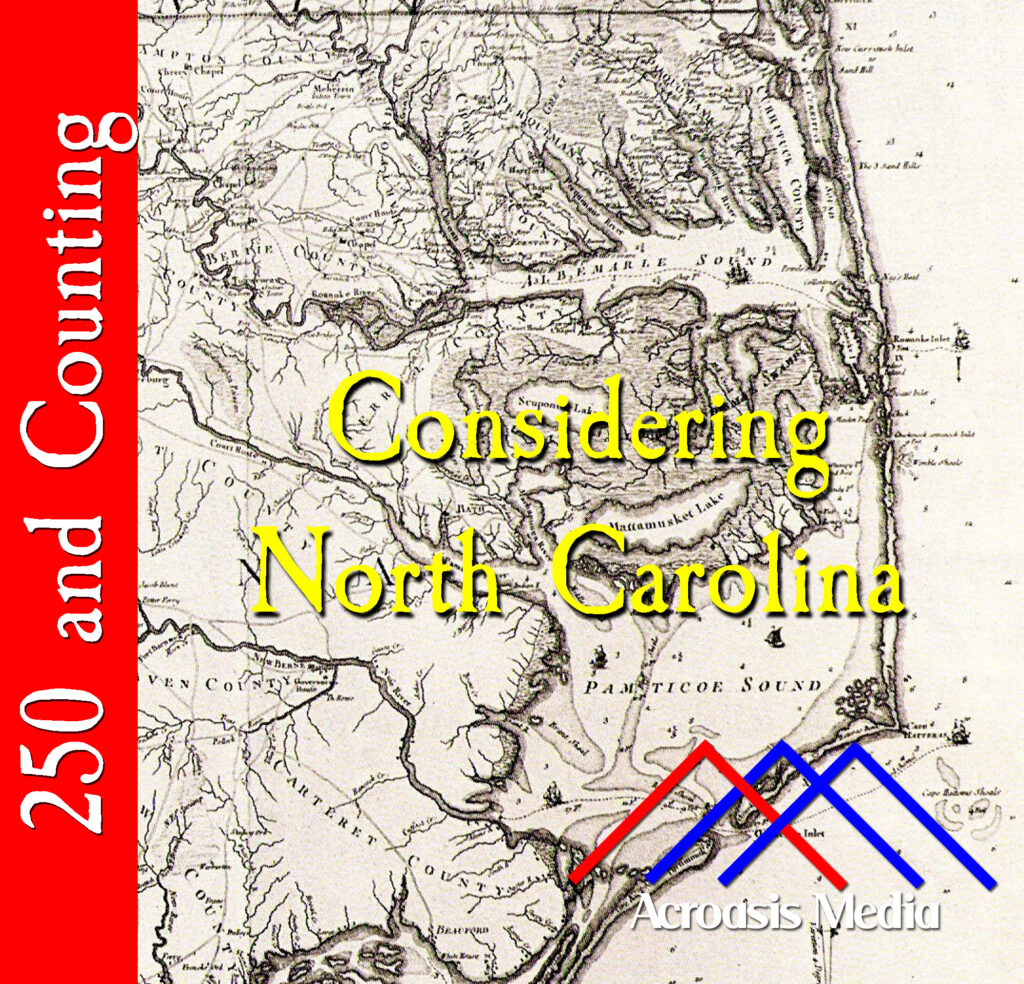
    Cover art for November 24, 1775: Crop of a map by Henry Mouzon of the northeastern portion of North Carolina in 1775. via Library of Congress Maps website.

    Two days ago, Mike had a case of the Martian Flu or something, so I needed to record in his place. today he sounds as good as ever. Since I could never bounce back from anything affecting my voice that quickly, I think it’s necessary to hurl invective his way. But I won’t ’cause I’m classy.

    Where were we? Oh yeah. One of the interesting things about the American Revolution is that even though there were major, busy ports up and down the coast, only a few of them captured Britain’s attention. Boston MA and Portsmouth NH caught a lot of grief. New York wasn’t much of a shipping powerhouse yet. New Jersey, ditto. And most of the Jersey coast wasn’t conducive to shipping anyway. But Delaware and Maryland had some deep-water ports but were largely overlooked during the war. Virginia caught a little bit, Georgia was ignored, South Carolina…well, we’ve already talked about that quite a bit, haven’t we?

    But North Carolina, which had bays and sounds protected by barrier islands, had a great deal of attractive waterways, but it seemed like nobody really thought about it, until today. That’s when the Second Continental Congress decided that there were too many governments replacing the British one originally there, and therefore everyone needed to get their boats steered in the same direction, you should excuse the expression.

  • October 1, 1775: The Adams Family Letters

    Cover art for October 1, 1775: Page 1 of the letter Abigail Adams sent to John on this date. (Blurred to keep the MHS off our tails.)

    We have two fun events for you today: first up, North Carolina reaches an important deadline it had set back in August.

    Then, by sheer coincidence, John and Abigail Adams each wrote a letter to the other. Of course, they wrote to one another quite frequently, so this probably happened more often than you’d think. But remember also that any news they received was probably two weeks old by the time the letter landed in their hands.

    I will close today’s notes with an amusing anecdote that John Adams used to close his letter. He wrote:

    A few days ago, in Company with Dr. Zubly, somebody said, there was nobody on our side but the Almighty. The Dr. who is a Native of Switzerland, and speaks but broken English, quickly replied “Dat is enough.—Dat is enough,” and turning to me, says he, it puts me in mind of a fellow who once said, The Catholicks have on their side the Pope, and the K[ing] of France and the K. of Spain, and the K. of Sardinia, and the K. of Poland and the Emperor of Germany &c. &c. &c. But as to them poor Devils the Protestants, they have nothing on their side but God Almighty.

  • July 18, 1775: The Burning of Fort Johnston

    Cover art for July 18, 1775: Photo of Fort Johnston taken in 2008, via Wikipedia. Photographed by User Dincher and available under Creative Commons Attribution.

    Although Fort Johnston was originally a British fort, a few years into the Revolutionary War, the Colonies recognized that it could be a valuable place to have a fort, and in 1778 they appropriated the money to have it rebuilt. That fort was also destroyed and, although reconstruction began in 1794, it took many years to complete the project.

    Time and again Fort Johnston was destroyed or abandoned, and then repaired or refurbished. The fort regained importance during the Civil War but was officially removed from seacoast defense in 1881. For many years it held multiple military-adjacent agencies or tasks, until it was finally decommissioned altogether in 2004.

    Today it holds the North Carolina Maritime Museum at Southport.

  • June 20, 1775: The Liberty Point Resolves

    Cover art for June 20, 1775: historical marker denoting the place where the Liberty Point Resolves were developed.

    Mike has already mentioned the location of the historical marker in today’s art. It’s tough to read even when you’re standing there, so here’s the text:

    At or near this place
    ever since known as

    “Liberty Point”
    was promulgated in
    June 1775,
    by patriots of the Cape Fear
    A Declaration of Independence
    of the British Crown.

    This was an extremely historic neighborhood, should you choose to visit. There are at least eight other historical markers within a short walking distance of this one, not all of them are connected to the American Revolution. In fact, one of them dates back to living memory of some of the locals.

  • May 20, 1775: The Mecklenburg Declaration

    Cover art for May 20, 1775: Detail of the Mecklenburg Declaration.

    When the folks in Mecklenburg County, North Carolina, heard about the events at Lexington and Concord a month earlier, they were quite incensed. So much so that they decided they were going to declare independence from Britain.

    Maybe. Maybe not. Tune in as Mike explains the controversy.

  • April 27, 1775: Skullduggery and Rebellion Here & There

    Cover art for April 27, 1775: Robert Eden, by Florence Mackubin after Charles Willson Peale (1914)

    The war was hot in Massachusetts, but it was still cold elsewhere. But that didn’t mean that there wasn’t rebellious activity going on, since by this point everyone knew what was going on up north.

    It manifested itself in different ways. In Maryland, it appeared that Patriots were straight-up lying to the Royal Governor in order to deprive the British troops of some of their arms and gunpowder stores.

    And in North Carolina, the Royal Governor loudly declaimed his disdain for anyone who didn’t agree with him. Unfortunately for him, that included the entire North Carolina Assembly. Their response was to do exactly the opposite of everything he asked.

  • April 13, 1775: North Carolina Raises the Dragoons

    Cover art for April 13, 1775: Private in the Light Dragoons. Painting by Charles Lefferts, 1910.

    It seems fitting that groups like this changed names and designations quickly, given that events in the Colonies were also moving quickly. In two events this week, we’ve told you stories of armies that were raised to defend individual colonies but quickly became part of the Continental Army. The Light Dragoons of North Carolina would be one of those groups.

    Likewise, the rest of this episode is a throwback to TWO earlier episodes, as the activities are formally recorded in the Virginia Gazette.