Category: Paul Revere

  • September 21, 1775: RIP Abel Prescott

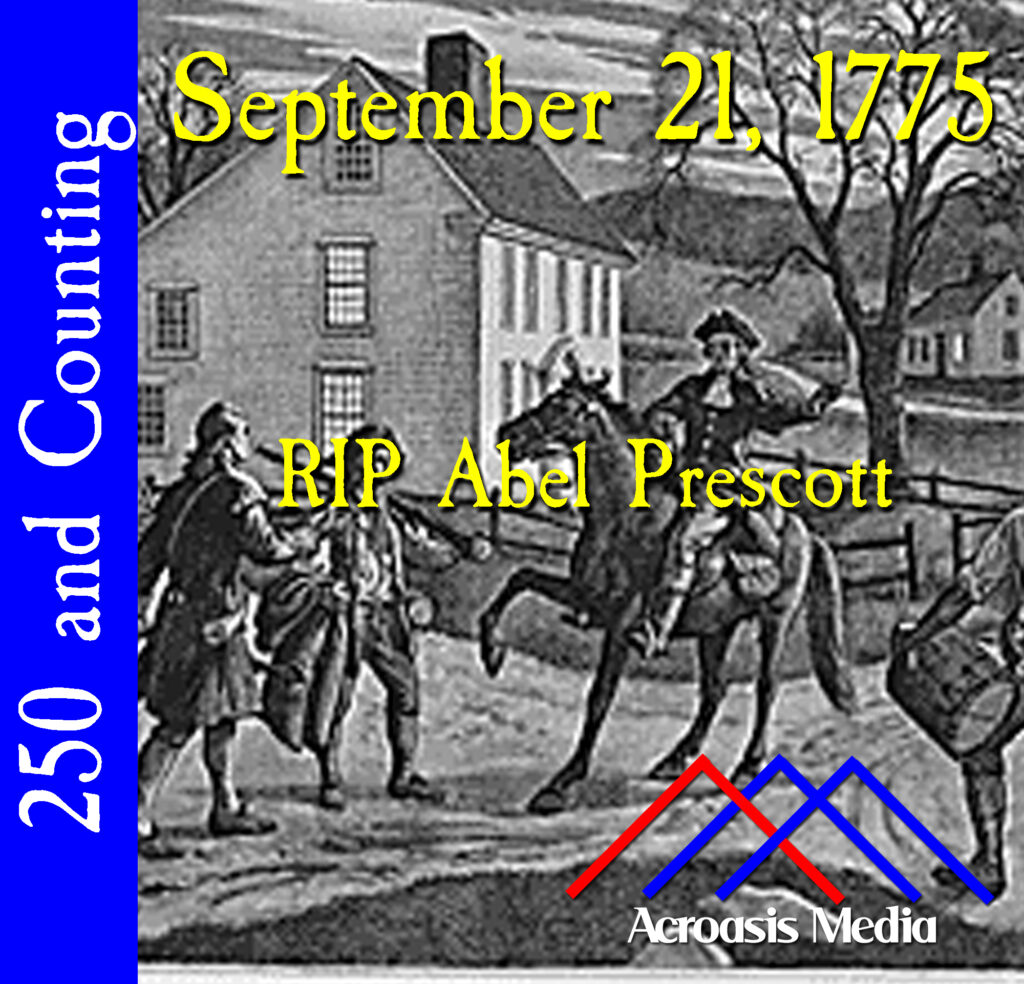
    Cover art for September 21, 1775: this might be Paul Revere. It might be William Prescott or Samuel Dawes. It's definitely not Abel Prescott.

    In the episode itself I took the time to hammer home the point that many of our historical legends aren’t quite what they seem to be.

    But also important is the forgotten people of our history as well. Not just the faceless folks who fought and died (or didn’t but remained in obscurity), but the people who were an important part of some events, yet go unnoticed today. And Abel Prescott is one of those people.

    Not a lot is known about him, other than that he was William’s younger brother. And while William Prescott, along with William Dawes and Paul Revere, were intercepted by the British, Abel Prescott did manage to get away, albeit with a bullet in his side. Five months later, that bullet killed him.

  • May 2, 1775: Meet Rachel Revere

    Cover art for May 2, 1775: portrait of Rachel Walker Revere by Gilbert Stuart, 1812.

    Rachel Walker Revere was Paul Revere’s second wife. When he married her, he’d only been a widower for a few months, so clearly she made a big impression on him, especially since they remained together until her death in 1813 (one year after the portrait in today’s artwork was painted), and he didn’t remarry after that.

    Rachel was a very supportive wife to Paul, by most accounts, but she was also willing to give him grief when he deserved it, as you’ll learn in today’s episode.

  • April 22, 1775: Who Shot First?

    Cover art for April 22, 1775: "North Bridge, Concord, April 19, 1775", by Frank T. Merrill (dated 1909)

    In the aftermath of the battles at Lexington and Concord, the Massachusetts Provincial Congress held a series of hearings to determine who fired the first shot.

    The purpose of the hearings was partially to find out exactly what had happened, but it had another purpose: if it turned out that the British had fired first, then the Assembly could turn to England and say “SEE? It wasn’t us!”

    Even 250 years ago, Congressional hearings had a second agenda attached to them. (*sigh*) In the end, despite getting lots of testimony, the answer was still somewhat murky. But the Assembly still had enough information to give reconciliation one last shot.

  • April 18, 1775: Paul Revere’s Midnight Ride

    Cover art for April 18, 1775: "Paul Revere Bringing News to Sullivan," by Howard Pyle, 1886

    Once in awhile, we fear that students of history don’t necessarily put things into the appropriate perspective when it comes to dates. We offer them some facts regarding what happened and when, but the events still kind of mush together.

    That’s how we get the Simpsons joke: “Let’s take a look back at the year 1928- the year when you might have seen Al Capone dancing the Charleston on top of a flagpole!”

    To that end, students might place the Boston Massacre, say, as quite close in the timeline to the start of the Revolutionary War, when in fact they happened several years apart. But at this specific period of time, things were in fact moving quickly and closely together: Colonies were lining up behind Massachusetts, various areas began to prepare for all-out war, General Gage was doing his best to control the colonists based on the orders that were sent to him several weeks earlier from London, and Lord North was in fact hoping to provoke the colonists into doing something that would give him a reason to crush them hard.

    So when word got out that the British were coming up the Charles river to make a move on Concord and Lexington, Colonist spies were wise to it and they got the word out as fast as they could. Listen, my children, and you will hear.