While the Second Continental Congress always had a lot going on, not creating “an animated address” to make the Independence movement appearent to everyone seems like an odd failure.
But sure enough, when it was recommended that such an address be created, this specific committee came up with nothing. Other committees appear to have presented addresses without problems, and many delegates worked on multiple committees, so was this an oversight? Was it overwork? Or perhaps the need to actually write a Declaration of Independence obviated the need for creating “an animated address”?
You may also remember that motions by the Second Continental Congress needed to be voted on unanimously in order to pass, so they could “speak as one voice.”
To that end, the Congress recommended today that Colonies with a government that wasn’t in favor of independence, form a new government that would be more likely to endorse independence. It’s not entirely clear how they expected the individual Colonies to effect this recommendation, but before long it wouldn’t be difficult at all.
Reverend Samuel Cooper has an interesting item in his family history. His grandfather was Samuel Sewall, a judge in the Province of Massachusetts Bay who was involved with the Salem witch trials in 1692-3. Now, to be fair, Sewall did apologize for his part in that bit of foolishness, and he’s also known for writing an essay in 1700 criticizing slavery.
As far as Cooper himself, he was an active Patriot of the Revolutionary Era, who was good friends with many of the Founding Fathers. According to our friends at the Massachusetts Historical Society, when letters written by Governor Thomas Hutchinson and Lt. Governor Andrew Oliver were stolen in 1773, they wound up in Benjamin Franklin’s hands.
Franklin in turn sent them to Samuel Cooper, who gave them to Thomas Cushing, the speaker of the Massachusetts assembly. Samuel Adams was the clerk of the Assembly and got to see them. They all knew that the letters were a bit of a bombshell (essentially, Hutchinson and Oliver were misleading Britain regarding conditions in the colonies), but because they were under strict orders not to copy or publish them, their hands were tied.
Samuel Adams, however, came up with the idea of leaking the contents by way of a propaganda campaign in the Assembly that didn’t actually disclose the letters themselves. That was enough to create a political firestorm in Massachusetts, which led to General Gage implementing the Coercive Acts.
Who stole the letters in the first place? It’s still not clear.
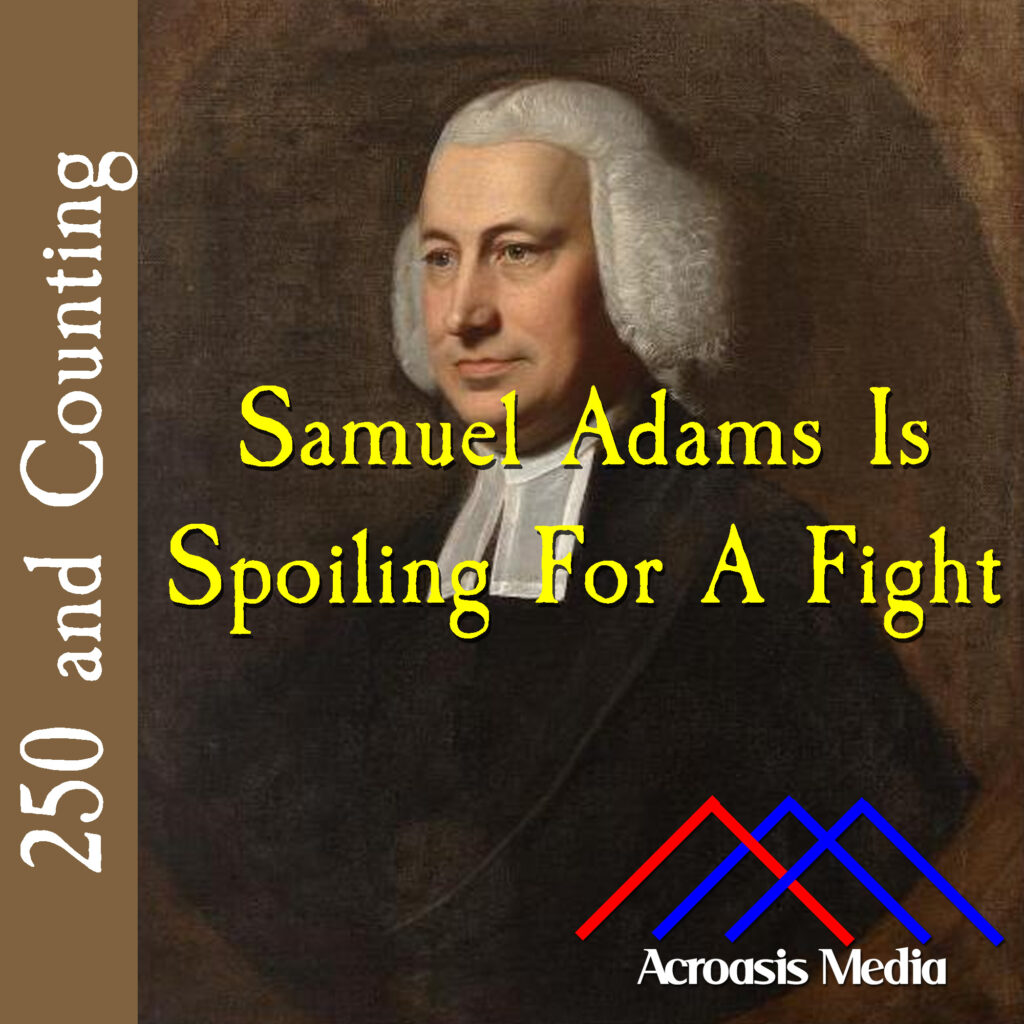
Samuel Adams in 1772, painted by John Singleton Copley. via Wikimedia Commons and the Museum of Fine Arts in Boston.
Samuel Adams made a point of telling his second cousin John Adams that he didn’t have a lot of time to write. Then he cranked out 570 words of worries about the language in the New Hampshire constitution, which had been ratified ten days earlier.
Then the next day he tacked on another 250 words. If he’d typed all 820 words out, it would be about three pages (double-spaced). The script for this episode is 219 words; even when Adams was in a hurry he was verbose.
But Samuel Adams kinda-sorta had a point, in that the New Hampshire constitution hedged its bets a little bit. Clearly he had this in mind when he worked on the original Articles of Confederation (the document that preceded the US Constitution), and when he joined the Constitutional Convention for Massachusetts a couple of years later.