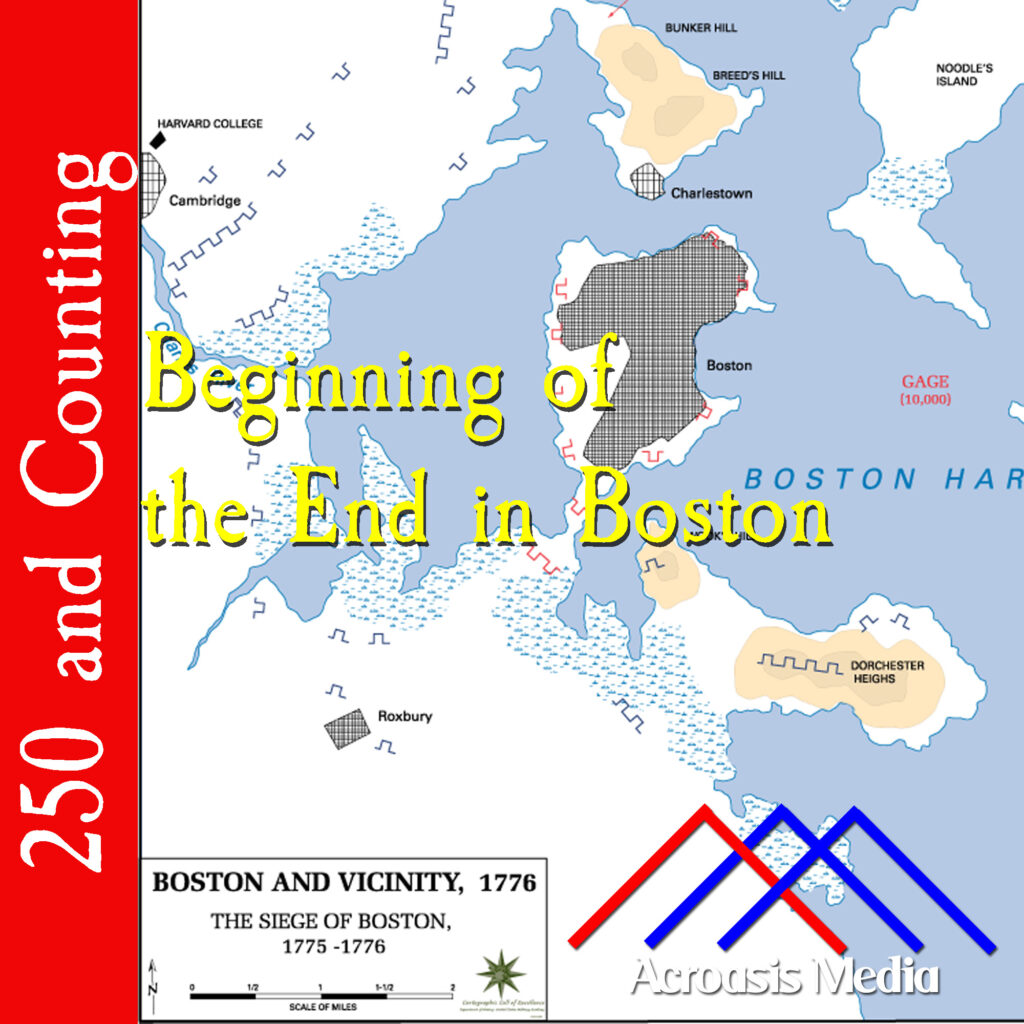
The occupation of Dorchester Heights, just across the river from Boston, was perhaps the final step that George Washington needed to end the siege that had gone on for nearly a year.
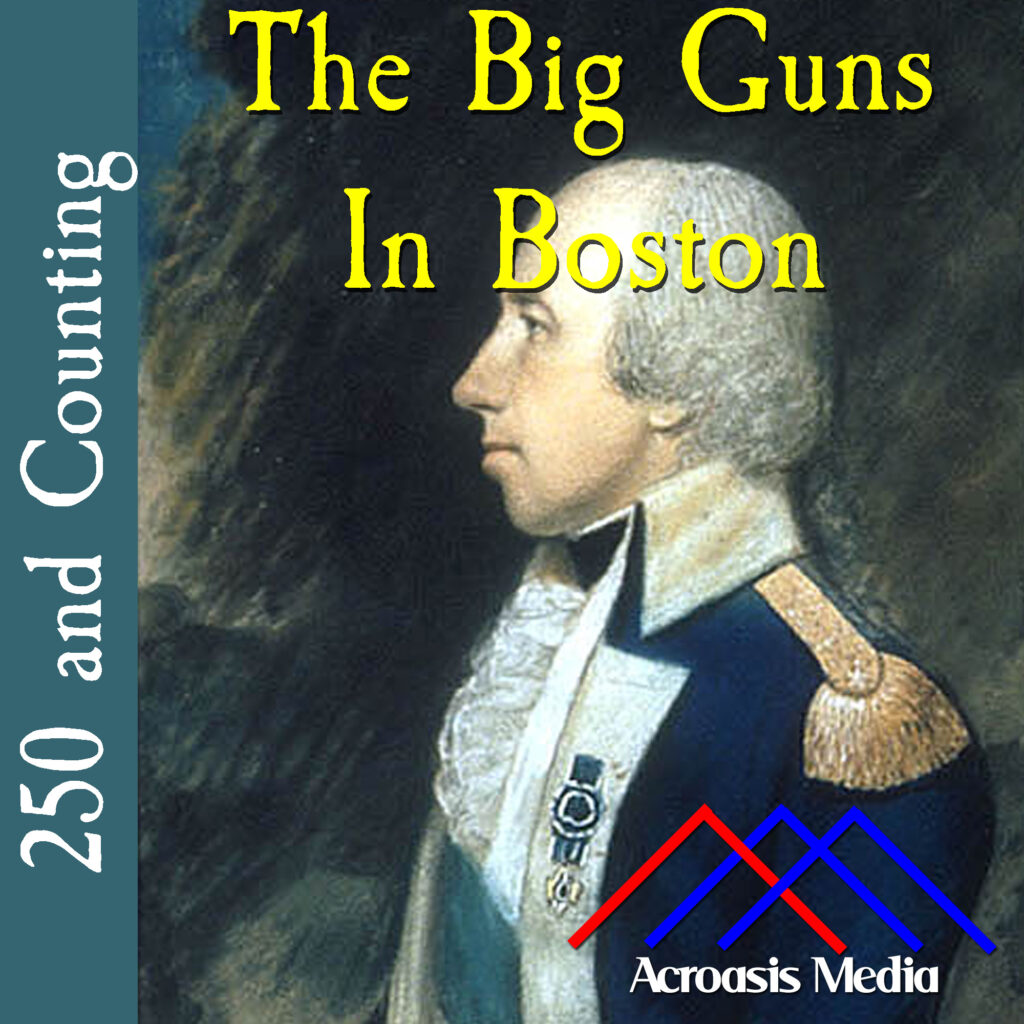
Of course, it wasn’t just occupying Dorchester Heights; Washington could have pretty much done that at any time. It was occupying them with a terrifying speed, thanks to Rufus Putnam (the guy in today’s cover art, by the way) and his clever plan for assembling the defenses there. And thanks also have to go to the big cannons that had been brought down from Ticonderoga. These guns had the range that Washington needed to not only shoot at Boston if he needed to, but to fire upon British ships in Boston Harbor.
Howe had a couple of moves left, but it was nearly over.
When Samuel Tweedy moved from Dutchess County, NY to Danbury, CT, it was a fortuitous time to do something like that. Danbury was undergoing an economic expansion as part of a post-war boom, which gave him extra opportunities to gain access to trade and manufacturing that he never would have seen back in New York, which was a largely agrarian economy at the time.
Tweedy’s marriage to Ann Burr had both social and economic benefits, since Danbury was rather tight-knit as a community, and his having Ann for a spouse gave him an “in” where some of that was concerned.
One of Danbury’s biggest products was hats, and Samuel Tweedy established his own business with the assistand of his father-in-law. He immersed himself in the craft of making hats, and ultimately established himself as a man capable of building smaller-scale workshops dedicated solely to producing unfinished hat blanks, which could then be sold to hatmakers. Since an efficient shop could only turn out a few dozen hat blanks in a week, having several shops meant that Tweedy could turn out more blanks than anyone else. Tweedy’s shops also specialized in making hat blanks with fur linings. And Tweedy benefitted from protective tariffs, which reduced the number of British imports when it came to hats.
Congress had a lot of military-related activities to tend to, and one of them was Isaac Melchior. (If you look him up you’ll see an alternate spelling of him as “Melcher.” We’re sticking with “Melchior” because we saw that first.)
March 7 was a Thursday, so the Congress was figuring out what do do about Melchior’s apparent insubordination the previous Saturday when he loudly and rudely insulted Congress in general, and John Hancock in particular, because he felt that the captaincy they’d offered him was inadequate.
They actually considered banning him from future service, but the next day decided that his apology was sufficient, so he was dismissed without further punishment. Later on, he served as a brigade major for General Richard Montgomery, so at some point he managed to earn some additional rank.
So in Isaac Melchior we have someone who is notable for his service to America, but whose historical reputation is tarnished because of his actions a week earlier. There’s a fictionalized version of this story in a book by Lars D.H. Hedbor called The Will: Tales From a Revolution—Pennsylvania, which is part of the “Tales from a Revolution” series. If you like historic fiction laid atop real-life events, you may enjoy these books.
The Pennsylvania State Rifle Regiment, also known as Miles’ Regiment, also known as the Pennsylvania 13th Regiment first came about when the Pennsylvania State Battalion of Musketry merged with Miles’ Reigment. We know it’s confusing, largely because there were so many names involved and that’s not even where the names ended.
Samuel Miles was their commander when they were first raised, and he was their commander in 1777 at the Battle of Long Island. It’s especially notable because he allowed himself to be captured by British troops who thought he was George Washington, a ruse that allowed the real George Washington and many of his troops to escape. It was nearly two years before he would be released in a prisoner exchange.
As for the regiment itself, that eventually got absorbed into the Continental Army in June of 1777, but they were still informally called the Pennsylvania 13th.
So here’s a fun story about Charles Carroll. As I’ve mentioned many times before, lots and lots of place names in Baltimore have strong historical connections and Charles Carroll is no exception.
There is, of course, a Carroll Street, which starts in the southeast neighborhood of Morrell Park. It doesn’t go quite through that neighborhood though; it gets broken up by a couple of blocks’ worth of houses and resumes again. There’s another break as a railroad right-of-way comes through—but there’s no train crossing; the road just terminates. Carroll Street resumes (we’re still in Morrell Park) on the other side, however, before it’s interrupted yet again.
Now as I understand it, this particular part of the neighborhood was wiped out completely by Hurricane Agnes in the early 1970s, so the rebuild was kind of haphazard. Plus, I-95 was first constructed through this part of Baltimore City around this time, so you have to jump almost 3500 feet before Carroll Street resumes again.
But now you’re not in a residential neighborhood; it’s series of warehouses and industrial buildings for a stretch until it gets back into a residential neighborhood known as Pigtown, so called because on Market days, pigs would be led through the streets to the market for sale and eventual slaughter. Carroll Street meets with Cross Street in that neighborhood, and that’s the northern terminus.
However.
There’s an elementary school in the area that’s also named after Charles Carroll. It’s not on Carroll Street (of course) but is about two blocks away, in Pigtown. Now, remember, Charles Carroll was a lawyer, or a “barrister” as the old-timey types like to say. So Elementary School #34 is officially “Charles Carroll, Barrister Elementary School”. Except everybody forgets the comma is there and says it like one long name. And chances are, they think there was a guy actually named Charles Carroll Barrister somewhere in history.
And wasn’t that a long walk for a short drink of water.
Colonel Henry Knox took about ten weeks to get from Ticonderoga to Cambridge rather than the two he anticipated. But his arrival meant the siege’s end in Boston would come soon.
Knox had brought something like 60 tons worth of material overland using hand-built sledges and carts drawn by oxen. The last leg of the trip is still a mystery, because Knox’ diary ends about two weeks early. What is known is that as he passed through the occasional town, people would line up to watch. So we know when he was where, but the usual stuff that ran through Knox’ head for that portion of the trip is gone.
Still, his arrival at Cambridge meant that Washington now had what he needed to fortify his position and do what he needed to drive the British out of Boston. After nearly a year, the siege’s end was actually in sight.
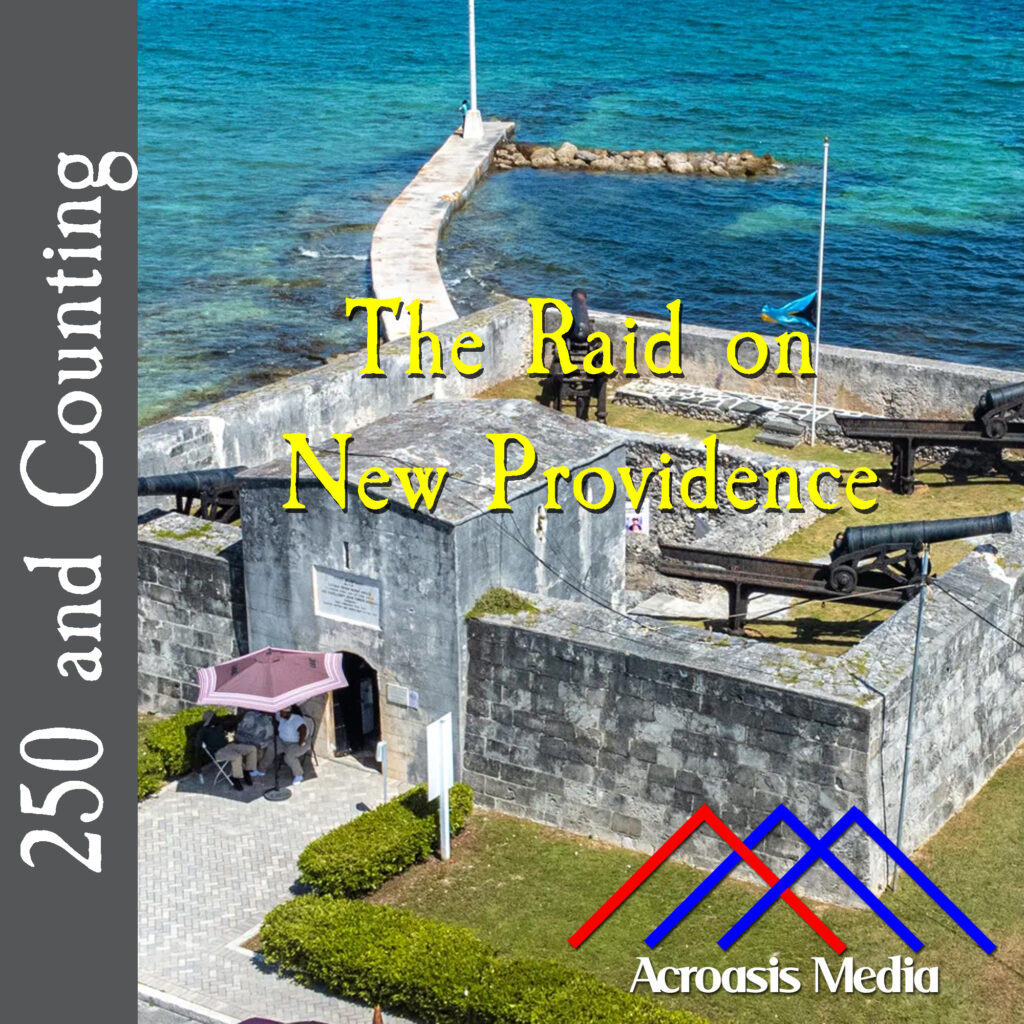
The raid on New Providence is probably one of those situations where we couldn’t really represent everything that was going on on this particular island, because there were a lot of moving parts. We especially overlooked the part at the end.
Two of the ships went to St. Augustine, laden down mostly with gunpowder. Of the others, they headed further north, where they encountered the HMS Hawk and then the HMS Bolton. They ended up caputuring both ships.
Then they bumped into the HMS Glasgow off the coast of Long Island. Despite being outnumbered, the Glasgow got away while simultaneously damaging one of the Navy ships.
Initially, the Navy was given kudos for the raid, but the failure to capture Glasgow, plus complaints about some of the captains in the fleet led to investigations and courts-martial. One ship’s captain, that of the Providence, lost his command and it was given to John Paul Jones. Division of the spoils was also disputed. The commander of the entire action, Esek Hopkins, was censured for not patrolling the Virginia and Carolina Coasts (never mind he was secretly told to do so), and he was eventually dismissed from the Navy.
What’s more, Nassau remained poorly defended and was subject to capture several times throughout the war.
Oh, that Royal Governor Josiah Martin. He might be defiant, he might be delusional. He might be in denial.
What he was not, apparently, was cognizant of the effect that the Battle of Moore’s Creek Bridge had on Loyalist morale. Or, perhaps he did. At any rate, his order to raise the British flag anywhere a flag could be raised was more performative than anything else.
This was Martin’s second big push to restore North Carolina to British control, but it wasn’t his last. Many months later the Carolina Campaign began. It went on for a long time and they very nearly succeeded. However, Martin finally had to leave, first for Long Island and then for Britain.
We bumped into a little dilemma when putting together this episode. Specifically, what do we do when 1776 doesn’t match up with 2026?
As it turns out, 1776 was a leap year, so that year had a February 29, whereas 2026 does not. So we decided to do what most Leap Babies seem to do: mark the day on March 1.
To that end, today marks two events: first, we take a look at an arrangement that France and Spain made to trade with America on a kind of gray market. That arrangement was first presented to King Louis XVI on February 29, 1776.
From there we jump to March 1, the date that the Royal Navy began enforcing the Prohibitory Act in earnest. It was supposed to go into effect on January 1, but presumably the Navy didn’t know about it until after that date, so March 1 became the agreed-upon start date. Under the terms of the Prohibitory Act, the Colonies were banned from trading with other nations, in addition, any Colonial ships were considered enemy vessels and were subject to being captured and retained. Likewise, any sailors aboard those ships were enemies of the Crown and to be treated as such.
This was almost certainly the last straw for many in the Colonies.
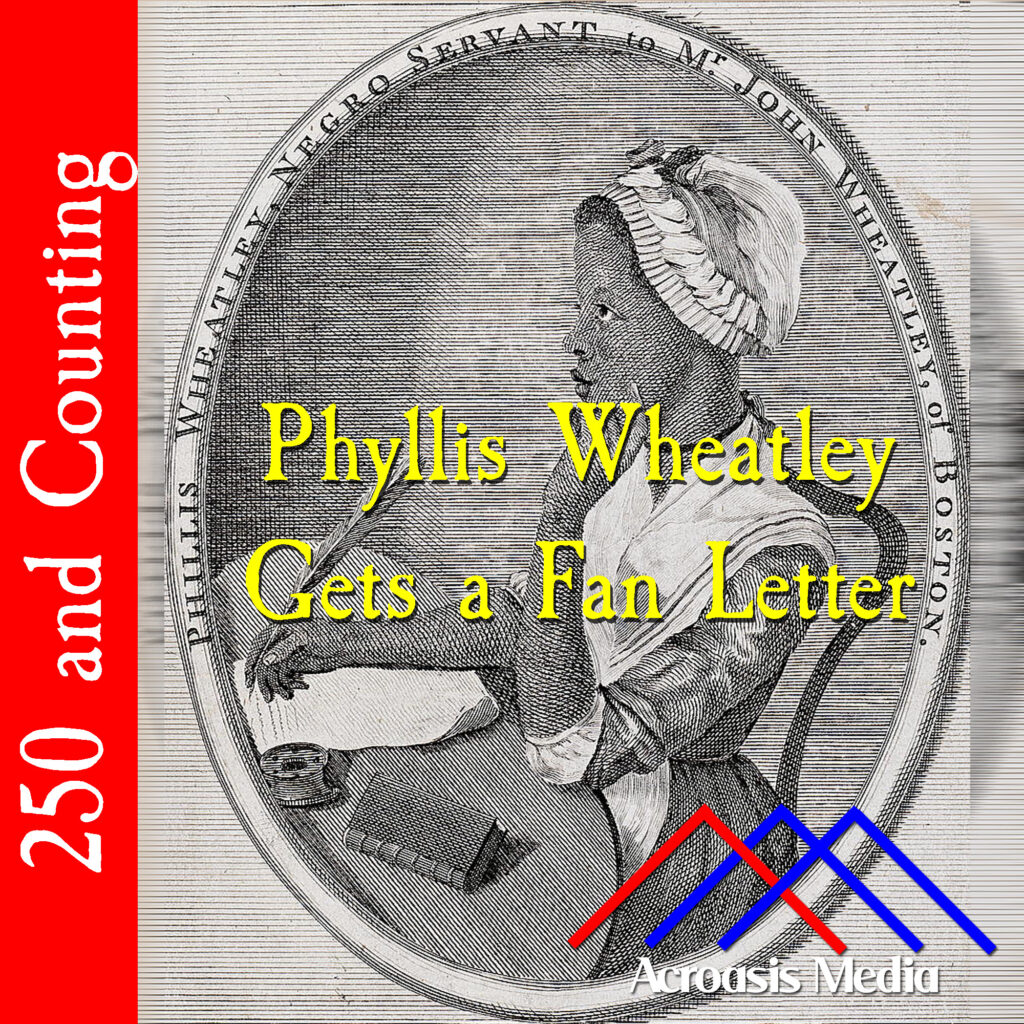
Phyllis Wheatley was an 18th century poet who was born in West Africa and sold into slavery as a small child, living with the Wheatley Family in Boston.
Phyllis wrote a book of poems which was published in 1773, after which she was emancipated. This makes her the first African-American author of a published book of poetry.
Phillis Wheatley married a grocer named John Peters around this same time. They had three children, but unfortunately all of them died quite young. Phyllis herself died in of pneumonia in 1784, not long after giving birth to a daughter, who also died that day.
Celestial choir! enthron’d in realms of light, Columbia’s scenes of glorious toils I write. While freedom’s cause her anxious breast alarms, She flashes dreadful in refulgent arms. See mother earth her offspring’s fate bemoan, And nations gaze at scenes before unknown! See the bright beams of heaven’s revolving light Involved in sorrows and veil of night!
The goddess comes, she moves divinely fair, Olive and laurel bind her golden hair: Wherever shines this native of the skies, Unnumber’d charms and recent graces rise.
Muse! bow propitious while my pen relates How pour her armies through a thousand gates, As when Eolus heaven’s fair face deforms, Enwrapp’d in tempest and a night of storms; Astonish’d ocean feels the wild uproar, The refluent surges beat the sounding shore; Or thick as leaves in Autumn’s golden reign, Such, and so many, moves the warrior’s train. In bright array they seek the work of war, Where high unfurl’d the ensign waves in air. Shall I to Washington their praise recite? Enough thou know’st them in the fields of fight. Thee, first in peace and honours,—we demand The grace and glory of thy martial band. Fam’d for thy valour, for thy virtues more, Hear every tongue thy guardian aid implore!
One century scarce perform’d its destined round, When Gallic powers Columbia’s fury found; And so may you, whoever dares disgrace The land of freedom’s heaven-defended race! Fix’d are the eyes of nations on the scales, For in their hopes Columbia’s arm prevails. Anon Britannia droops the pensive head, While round increase the rising hills of dead. Ah! cruel blindness to Columbia’s state! Lament thy thirst of boundless power too late.
Proceed, great chief, with virtue on thy side, Thy ev’ry action let the goddess guide. A crown, a mansion, and a throne that shine, With gold unfading, WASHINGTON! be thine.