
Category: War of 1812

  • John Frederick Frelinghuysen–March 21, 1776

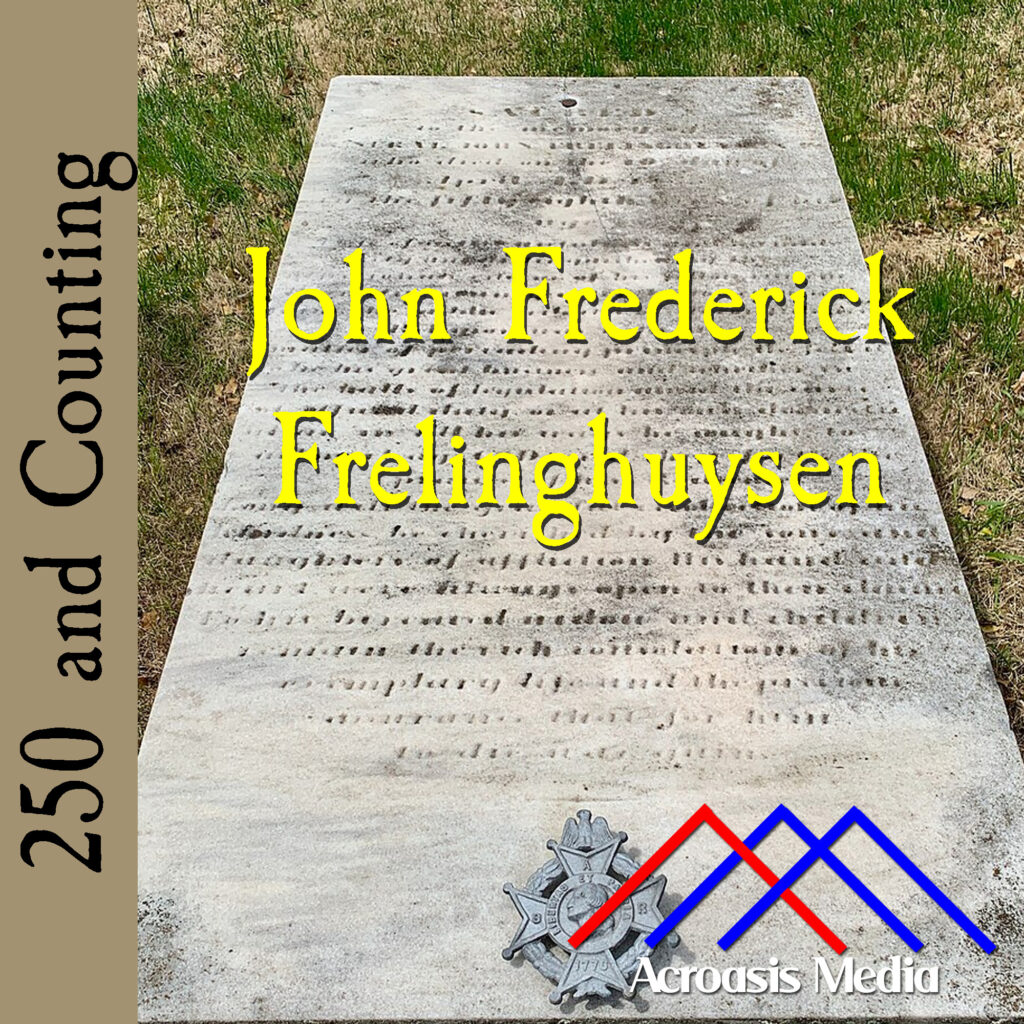
    Cover art for March 21, 1776: John Frelinghuyser's gravestone in the Old Somerville Cemetery. via WIkimedia Commons.

    John Frelinghuysen was born on this day in 1776 (hey! Cake and Candles for this man!) and died in 1833. Like many people of the time, he never permanently left the area where he was born. Born there, lived and worked there, died there.

    He probably went to Trenton on business a few times, and he was stationed at Sandy Hook while in the Army, but that appears to be about all as far as travel.

    John Frelinghuysen married Louisa Mercer in 1797, and they had two daughters: Gertrude and Mary Ann. Louisa died around 1809 and John married Elizabeth Mercereau Van Vechten on November 13, 1811. They had eight children: Louisa, Theodore, Frederick J., Catharine, Sallie, Sophia, and Elizabeth LaGrange Frelinghuysen.

  • Mary Pickersgill–February 12, 1776

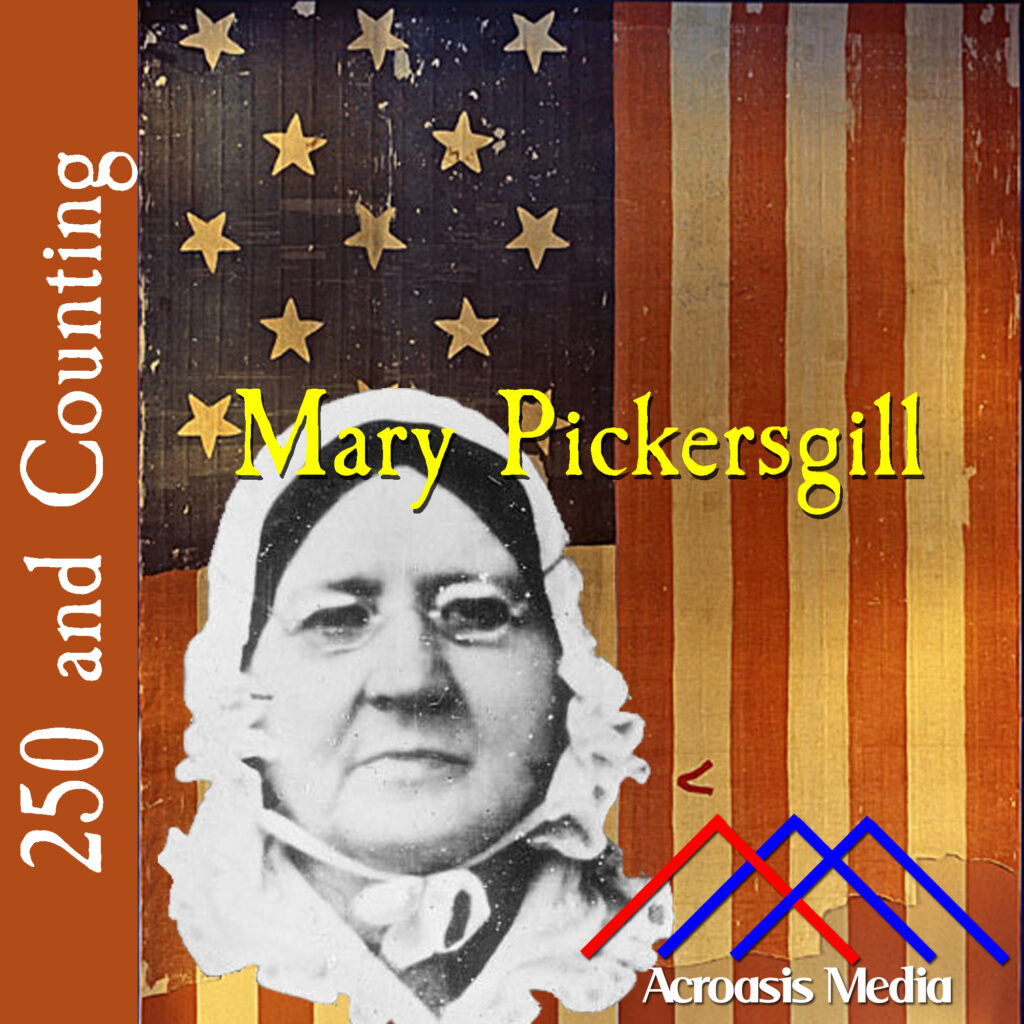
    Cover art for February 12, 1776: Mary Pickersgill and the Star-Spangled Banner flag, now on display at the Smithsonian Museum of American History.

    The thing that’s hard to understand when considering the flag that Mary Pickersgill put together, and that inspired our National Anthem, is that it’s huge. Mike says specifically that this flag is 17 feet by 42 feet, but that’s hard to picture.

    When the flag was first displayed at the Smithsonian, it hung out in the open, against the atrium wall. But a flag that big, and that old, eventually begins to give in to gravity. So the Smithsonian folks took it down and spent a couple of years restoring it. Part of the work involved undoing the restoration job from 1914:

    Now, a lot of it had been cut away for souvenirs (you can see the frayed bottom partially disguised by the painted stripes in the cover art today), and that red “V” shape is really meant to be an “A” for General Armistead. But the flag is back on display, lying flat at an angle making it easier to see, in a temperature- and humidity-controlled setting.

    The parts that have been cut away are still missing, and the “A” has been removed. but even with nearly half of it gone, this thing is still enormous. And an original-size replica often flies over Fort McHenry, weather permitting.

  • William Montgomery Crane–February 1, 1776

    Cover art for February 1, 1776: Portrait of William Montgomery Crane. By Unknown author - The National Cyclopaedia of American Biography, Volume XII, 1904, page 422, via Wikimedia Commons.
    Portrait of William Montgomery Crane. By Unknown author – The National Cyclopaedia of American Biography, Volume XII, 1904, page 422, via Wikimedia Commons.

    If you’re going to have a kid in 1776, you’re probably going to be feeling a little patriotism when you do so. Such was the case with William Montgomery Crane, who got his middle name from General Richard Montgomery, under whom his father served around this point in the Revolutionary War.

    Crane’s father was General William Crane, but at that time he was a lieutenant in the expedition to Quebec, and was part of the New Years Eve assault on that city. Crane was badly wounded in the ankle, an injury that bothered him for decades and eventually led to the foot being amputated, and his eventual death in 1814.

    As far as his son William is concerned, we had to gloss over this, but Crane spent a few years in the Mediterranean during the Barbary War, working on protecting ships from piracy. After the Revolution, American ships naturally lost protection from the British Navy and were vulnerable to pirate attacks when they refused to pay protection. President Thomas Jefferson relied on a strategy of using the US Navy to put together blockades, patrols and even direct assaults on the pirate ships. Eventually the tactic worked and Crane was recognized for his efforts when his gunboat endured heavy fire to destroy a battery’s walls in Tripoli in just a couple of hours.

  • September 24, 1775: Captain Nathan Heald

    Cover art for September 24, 1775: Photograph of Nathan Heald, date unknown.

    It could be argued that Captain Heald’s biggest claim to fame is that he was on hand for the disastrous outcome at Fort Dearborn, but at least he doesn’t eat the blame for it; it just happened to be the guy who was there.

    On the bright side (such as it is), the events at Dearborn were soon overshadowed by President Madison declaring war on the British, thus beginning the War of 1812. Heald and his wife, who were both injured at Fort Dearborn, were released back to the Americans. Heald was promoted shortly thereafter and given a disability discharge in 1814. And isn’t that always the way.

  • June 29, 1775: Thomas Boyle, Privateer

    Cover art for June 29, 1775: Picture of Thomas Boyle, source unknown

    Thomas Boyle wasn’t born in Baltimore, Maryland, but when he was a young man he made it his home and became quite successful there, as a merchant marine and an overall businessman.

    And, of course, given Baltimore’s penchant for naming streets after historic people and events, there is a Boyle Street. It’s not very long; in fact you see the entire road in the photo below.

    In this picture the viewer is standing on Fort Avenue looking down toward Key Highway. The green structure in the background is the Baltimore Museum of Industry, and the Inner Harbor is just beyond that. Based on my research, Boyle didn’t live near this location; he’d settled in a part of town called Fell’s Point, which is on the other side of the harbor and about a mile to the east. If a person standing where the camera was for this photo turned to the right, they could probably see the entrance to Fort McHenry.

  • May 9, 1775: Jacob J. Brown

    Art for May 9, 1775: portrait of Jacob Jennings Brown by James Herring, ca. 1835.

    When it comes to the War of 1812, Baltimore and the Fort McHenry get to eat for free for a long time, because they get most of the good stories: the star-spangled banner and Francis Scott Key, the battle at North Point, the Shot Tower being briefly the highest structure in America, and so on.

    But there was a lot of fighting going on elsewhere, particularly in upstate New York, around the Great Lakes area, and General Jacob Brown was in the thick of it. He was a nationally-recognized war hero back in the day, but nowadays he’s largely forgotten. And more’s the pity.

    Listen in on a brief review of General Brown’s life.

  • May 5, 1775: Alexander McNair, First Governor of Missouri

    Cover art for May 5, 1775: undated portrait of Alexander McNair, artist unknown.

    Alexander McNair wasn’t especially well-educated, but he became a judge and a governor of a territory and then that same area when it became a state, so he must have had something going on besides high-level friends.

    Then again, as governor, he wasn’t able to get a ton of stuff done, and when his term ended he took on a Federal job just for the money. So, for a guy who spent so much time in the “Show-Me State”, he didn’t really have much to show.

  • April 7, 1775: Francis Cabot Lowell

    Cover art for April 7, 1775: a silhouette of Francis Cabot Lowell. There are no portraits extant of Lowell, so this profile is typically used to represent him.

    It’s cake and candles today for Francis Cabot Lowell, a manufacturer who helped modernize the textile industry in the United States, largely through industrial espionage: in the middle of a trade war with Europe, Lowell visited England and memorized the processes they were using so that he could bring them back to this side of the pond, helping us to break the hold on imported goods from Europe by innovating the cradle-to-grave manufacturing process for fabrics.

    Yet, despite his prominence in the industry, and despite the statue that stands in his name in the town of Lowell, Massachusetts, the silhouette seen in today’s cover art is the only hint that we have regarding what he might have looked like. There are no portraits extant that we know of.

  • April 2, 1775: Calvin Jones–Physician, Soldier, Benefactor

    Cover art for April 2, 1775: Portrait of Calvin Jones (details not known to us at time of publication)

    Calvin Jones may have looked like an unassuming fellow, but that unassuming look concealed a very powerful mind and a strong moral compass.

    And today we’ve got Cake and Candles for him, since this day in 1775 was the date of his birth. Jones was a physician before his teenage years ended, and he began to design criteria that would separate good doctors from bad ones. He organized militias even though he was under no orders to do so. And then when the War of 1812 broke out, he became a major general with a reputation for excellence, to the point where nobody really worried about whether North Carolina would fall to the British.

    After the war he basically helped shepherd the development of a brand-new field of medicine, and after his death, much of his land became Wake Forest University. What’s more, it was because of Jones that the school has a head-scratcher of a name rather than an incomprehensible one.

  • March 17, 1775: Ninian Edwards and His Illinois Doings

    Cover art for March 17, 1775: Portrait of Ninian Edwards, artist unknown, currently hanging in the Illinois State Capitol's Hall of Governors.

    (Yeah, we couldn’t fit all that on the title card and have the artwork still visible.)

    Happy St. Patrick’s Day, if you’re the type to celebrate! We have a little Easter Egg (shamrock?) in this episode for you.

    Ninian Edwards was an interesting character in that he tried very hard to make the best choices for the people he represented, and while he succeeded in some respects, in others it seems he left a trail of hard feelings and broken plans.

    But with a single exception he doesn’t seem to have acted out of malice, or greed. It’s just that most of the things he’s known for didn’t quite work out the way he hoped. And yet, he still remains in the record book for a job he held in his youth, and for being one of Illinois’ first senators.