
Tag: 1846 deaths

  • Joseph Lee Smith–May 28, 1776

    Cover art for May 28, 1776: Joseph Lee Smith's home (Later Kirby Smith's) in St. Augustine, Florida. Uploaded to Wikipedia by user WhisperToMe.

    There’s a cool thing about Joseph Lee Smith that Mike doesn’t cover in his story today, probably because he is SO JEALOUS OF ME.

    Nah, I’m kidding. But the fact is, Joseph Lee Smith is tied up a little bit in my distant family history.

    I mentioned once before that my family can trace back to a common ancestor, Thomas Call, who arrived in America sometime in the 1640s. Thus, anyone with the surname Call is related, however distantly. There were Calls who were among the first Mormons to go west with (the other) Joseph Smith, so the name is about as common in Utah as it is uncommon pretty much everywhere else.

    Smith moved to Florida in 1821 and from 1823 to 1832 he was a territorial judge. In 1823 a delegate from Florida named Richard K Call introduced a resolution calling for the US House Judiciary Committee to investigage Smith on charges that he took bribes and kickbacks. The resolution was adopted and the investigation went on for at least seven years, but no charges were ever filed to impeach Smith.

    There are a few Calls in Florida history, and a couple of towns have a Call Street, including Starke, which has a “Call Street Historic District“. This area was named specifically for Richard K Call.

    Hm. My brother is named Richard Call, though he has a different middle initial. I may have to let him know about this…

  • William Montgomery Crane–February 1, 1776

    Cover art for February 1, 1776: Portrait of William Montgomery Crane. By Unknown author - The National Cyclopaedia of American Biography, Volume XII, 1904, page 422, via Wikimedia Commons.
    Portrait of William Montgomery Crane. By Unknown author – The National Cyclopaedia of American Biography, Volume XII, 1904, page 422, via Wikimedia Commons.

    If you’re going to have a kid in 1776, you’re probably going to be feeling a little patriotism when you do so. Such was the case with William Montgomery Crane, who got his middle name from General Richard Montgomery, under whom his father served around this point in the Revolutionary War.

    Crane’s father was General William Crane, but at that time he was a lieutenant in the expedition to Quebec, and was part of the New Years Eve assault on that city. Crane was badly wounded in the ankle, an injury that bothered him for decades and eventually led to the foot being amputated, and his eventual death in 1814.

    As far as his son William is concerned, we had to gloss over this, but Crane spent a few years in the Mediterranean during the Barbary War, working on protecting ships from piracy. After the Revolution, American ships naturally lost protection from the British Navy and were vulnerable to pirate attacks when they refused to pay protection. President Thomas Jefferson relied on a strategy of using the US Navy to put together blockades, patrols and even direct assaults on the pirate ships. Eventually the tactic worked and Crane was recognized for his efforts when his gunboat endured heavy fire to destroy a battery’s walls in Tripoli in just a couple of hours.

  • Jeromus Johnson–November 2, 1775

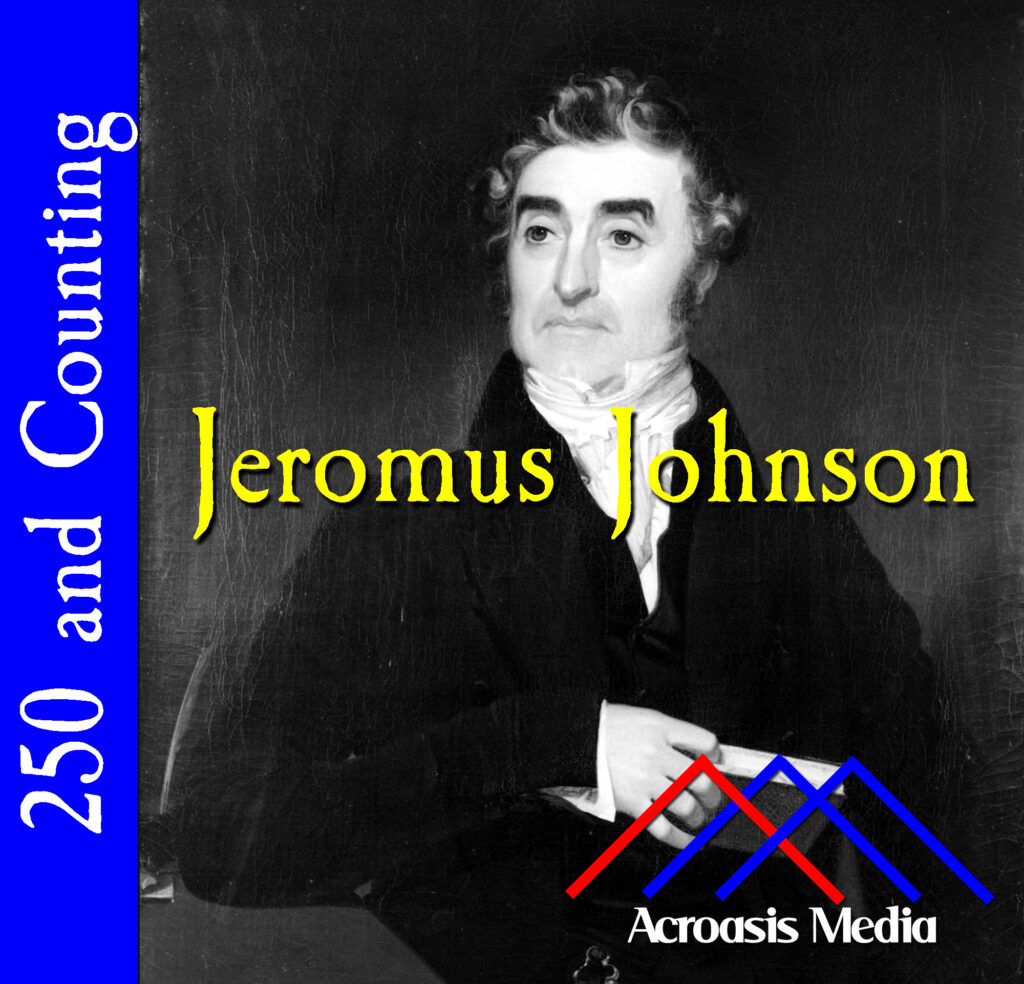
    Cover art for November 2, 1775: Jeromus Johnson, 1832. Oil on canvas portrait by William Sidney Mount. via the Brooklyn Museum.

    It’s noted that Brooklyn is the place where Jeromus Johnson was born, but to be more specific, Johnson was born in a neighborhood called Wallabout, which still exists but Johnson wouldn’t recognize it today. Wallabout got its name from the adjacent Wallabout Bay, which has been mostly filled in and is now occupied by the Brooklyn Navy Yard. “Wallabout” is a corruption of a French phrase meaning “bend in the harbor”.

    For all that, you rarely hear the name Wallabout anymore; the village has been largely absorbed by Fort Greene, Bedford-Stuyvesant and Clinton Hill.

    How do I know all this? I used to work a few blocks from there.

    Another personal connection: the town to which Johnson retired is Goshen, NY, in Orange County. My oldest daughter used to go to school up that way, and to avoid traffic I’d often visit her by driving a state highway that passed right through Goshen. It’s a lovely, rustic-looking village (at least it was ten years ago), and that area is a nice, relaxing drive.

    But what about Jeromus Johnson? Go listen to Mike.

  • April 2, 1775: Calvin Jones–Physician, Soldier, Benefactor

    Cover art for April 2, 1775: Portrait of Calvin Jones (details not known to us at time of publication)

    Calvin Jones may have looked like an unassuming fellow, but that unassuming look concealed a very powerful mind and a strong moral compass.

    And today we’ve got Cake and Candles for him, since this day in 1775 was the date of his birth. Jones was a physician before his teenage years ended, and he began to design criteria that would separate good doctors from bad ones. He organized militias even though he was under no orders to do so. And then when the War of 1812 broke out, he became a major general with a reputation for excellence, to the point where nobody really worried about whether North Carolina would fall to the British.

    After the war he basically helped shepherd the development of a brand-new field of medicine, and after his death, much of his land became Wake Forest University. What’s more, it was because of Jones that the school has a head-scratcher of a name rather than an incomprehensible one.