Tag: Battle of Moore’s Creek Bridge

  • The Battle of Moore’s Creek Bridge–February 27, 1776

    Cover art for February 27, 1775: Historical marker located near the restored bridge. Image via revolutionarywar.us

    As Revolutionary battles go, the Battle of Moore’s Creek Bridge was relatively minor. It didn’t last very long, there weren’t a ton of losses on either side (though definitely more on the Loyalist side), and it led to the capture of hundreds of Loyalists.

    However, it changed the way the British viewed the Carolinas through the rest of the war. Overall, the perception was that the Carolinas were poor, and weak, and a stronghold of Loyalist sympathizers. And this was an easy assumption to make, especially when you think back to the Siege of Ninety-Six and the way that finally ended. British confidence was pretty high at that point, especially given the fact that it ended pretty much in a draw.

    But the lasting effect of The Battle of Moore’s Creek Bridge was more in the way it affected recruitment of Loyalist troops, in that the numbers plummeted. And, only about two months later, North Carolina delegates were among the first to vote for Independence.

    To read about the battle in greater detail, check out this website, which is also the source of today’s cover art.

  • Things Heat Up in Wilmington–February 15, 1776

    Cover art for February 15, 1776: A map depicting troop movements in mid-February of 1776. Base map originally published in 1794, from the North Carolina Collection at UNC; overlay created by Wikipedia contributor Thomas Kitchin.

    We should confess that by the time we actually get to the Battle of Moore’s Creek Bridge, it’s not going to be as big a battle as anyone thought it was going to be. But the buildup was something else again. It seemed pretty clear to everyone involved that this was going to be epic and a veritable cast of thousands would be involved.

    But, things happen. Motivations change. Cynicism and even capriciousness sets in. And there’s still a battle, but it involves hundreds, not thousands. So from a battle standpoint, it wasn’t a lot. But by many other standards, which we’ll explore a little further down the line, there was a huge lasting impact.

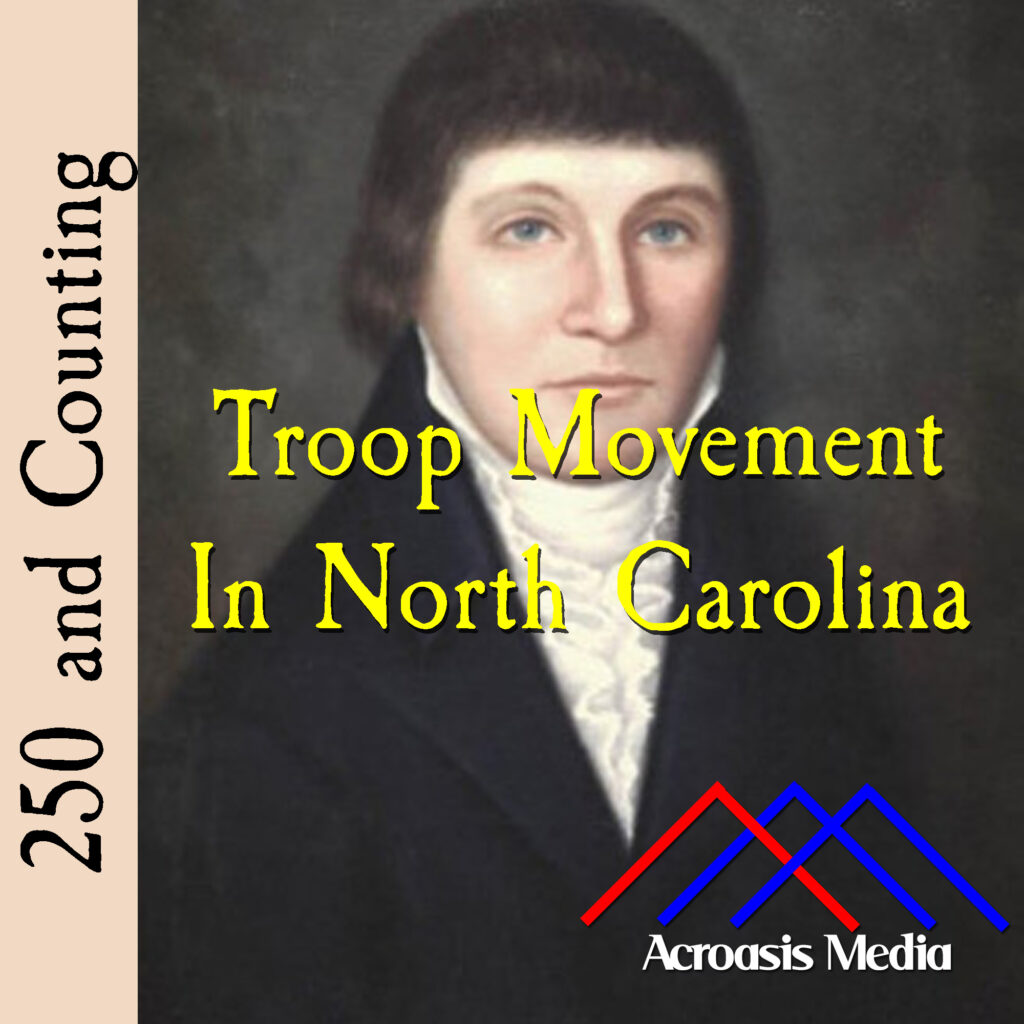
  • Troop Movement in North Carolina–February 11, 1776

    Cover art for February 11, 1776: image believed to be a portrait of Richard Caswell as Governor of North Carolina. via Wikimedia.

    Richard Caswell was in charge of the Minutemen in New Bern, North Carolina until the Battle of Moore’s Creek Bridge. Not long after that, the Provincial Congress did away with the Minutemen in favor of a more broadly-trained milita. From that point, his position in the Continental Congress was pretty much over for good.

    Caswell remained active in the military throughout the Revolution, and was in charge of the Provincial Congress when it came time to write their first State Constitution. Shortly thereafter he became the state’s first governor. And after a couple of one-year terms, he stepped down from that position, since he was term-limited. But he remained active in state politics until he died in 1789 at the age of 60.