
Tag: Benedict Arnold

  • The Battle of Quebec–December 31, 1775

    Cover art for December 31, 1775: The Death of General Montgomery in the Attack on Quebec (detail), by John Trumbull, 1786.
    The Death of General Montgomery in the Attack on Quebec (detail), by John Trumbull, 1786. Montgomery was struck in the head by grapeshot, so it probably wasn’t nearly as tidy as this.

    While hindsight is very much a 20/20 vision, it’s still worth exploring why the Battle of Quebec went so poorly for the American side:

    • While General Montgomery was clever enough to attack during a storm, he didn’t necessarily expect Nor’easter blizzard conditions, which made it tough for his men to see where they were going without lanterns…
    • …which meant that there were likely sentries who probably got curious about a bunch of lanterns coming their way.
    • Many of the men on the American side were literally on their last day of enlistment, so they probably weren’t motivated to give it their all.
    • In fact, only about 50 Americans (including General Montgomery) were killed, and 34 wounded (including Benedict Arnold), but over 400 men were missing or captured. “Missing” could easily mean “went home.”
    • Many of the Americans were probably unprepared for the relatively close quarters of fighting in a city, which meant that they were unprepared for attacks from above.

    Now, I am by no means a military expert, but these are the things that stood out for me just based on a quick read of the situation. It was hubris, and a brand of short-sightedness that this particular city got deep into the heads of Montgomery and Arnold, and they refused to let it go.

  • The Siege of Quebec–December 8, 1775

    Cover art for December 8, 1775: Benedict Arnold's forces moving in on Quebec. from a painting by F. C. Yohn, date unknown.

    The siege of Quebec was an event that was months in the making, and it was still just the penultimate act of the play.

    Benedict Arnold and his troops thought they could get to the American side of the St. Lawrence River within 21 days; instead it took several weeks. Along the way they lost about a third of their troop strength. Some of the men died of illness en route, but most of them finally gave up altogether and headed home.

    When they finally arrived they realized they didn’t have nearly what they needed to effect a decent attack on the city, so they had to hunker down and wait for supports to arrive. They were able to institute a couple of blockades, but that wasn’t nearly enough.

    Finally General Montgomery showed up, and after an attempt at getting the city to surrender, they began the shooting. Unfortunately that didn’t do a lot of good, so the Continental Army had to settle for placing the city under siege. At this point, however, the clock was ticking because a big chunk of the Colonial soldiers were due to have their enlistments end on December 31. Something had to give, and soon.

  • Montgomery Arrives at Quebec–December 1, 1775

    Cover art for December 1, 1775: "Gen. Richard Montgomery." via the New York Public Library Digital Collections.

    The events at Lexington and Concord were only about a month in the rear-view mirror when it occurred to both the Americans and the British that the Canadian provinces were colonies, too, and that they might have some kind of interest in the activities going on further south.

    Quebec, being perhaps the largest city close to the border, was the natural target for everyone involved. So it was always in the back of minds in the Thirteen Colonies, and in England. And slowly, each side began to think about either converting Canada to the American side, or defending Canada from American invasion.

    And on this day in history, everyone moved a giant step closer to what eventually became the Battle of Quebec.

  • Arnold’s March to Canada Ends–November 9, 1775

    Cover art for November 9, 1775: "Quebec from the Pointe Lévis Side" by James Pattison Cockburn, Watercolor and pencils, 1827

    We gotta give Benedict Arnold this: he set a goal and he stuck to it.

    Given the opportunity to take men and help invade Quebec through a kind of pincer move with General Montgomery, Benedict Arnold took 1100 men through the wilds of Maine to the St. Lawrence River, a trip that he thought would take 20 days over 180 miles.

    But they ran into problems almost immediately involving weather, leaky boats, bad maps, bad terrain, illness and almost half the men turning back.

    But make it he did, still with 600 men in tow, and with the help of the locals he got the sick ones healthy, the hungry ones fed, and established a base of operations for the next step, which we’ll talk about in just a few days.

  • The Great Carrying Place–October 11, 1775

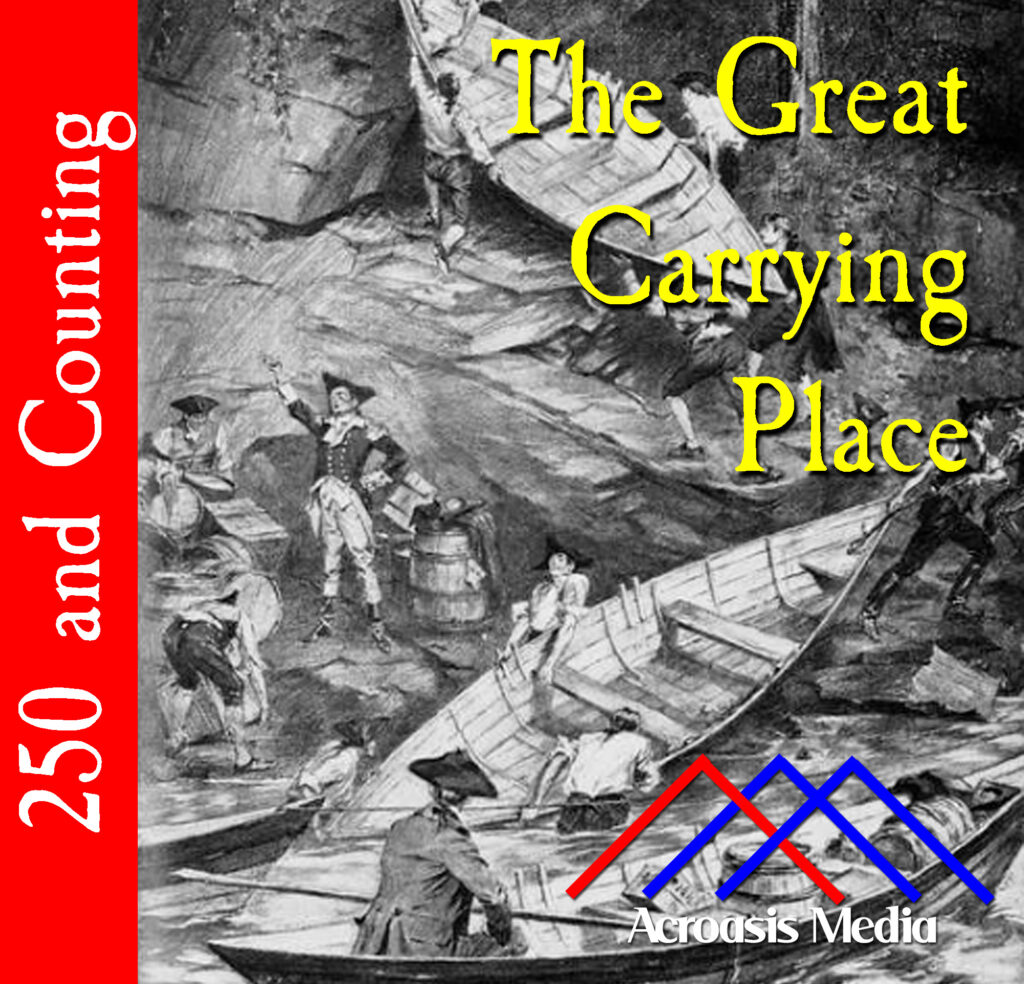
    Cover art for October 11, 1775: "Carrying the bateaux at Skowhegan Falls", drawn by Sydney Adamson; halftone plate engraved by CW Chadwick, 1903.

    Benedict Arnold and Company are still on the move toward Quebec. Over a three-week period they’ve moved fewer than 90 miles, with only…300 to go. Today they’ve reached The Great Carrying Place, a 13-mile walk alternating between woods and knee-deep mud, all while carrying everything they’ll need to get to Canada.

    Back in the Colonies proper, General Gage is being replaced by General Howe. Gage was largely responsible for the Siege of Boston, especially since they weren’t able to break that siege. And then Bunker Hill came along. Sure, the British won but at great cost—a Pyrrhic victory. Once word got back to Britain about that, Lord Dartmouth appointed Howe within a couple of days. Of course, it took several weeks for the news to get back to America, and on September 26 he learned he was being replaced. By this days’ end, Gage was on his way back to Britain.

  • October 2, 1775: Whoa…We’re Halfway There!?

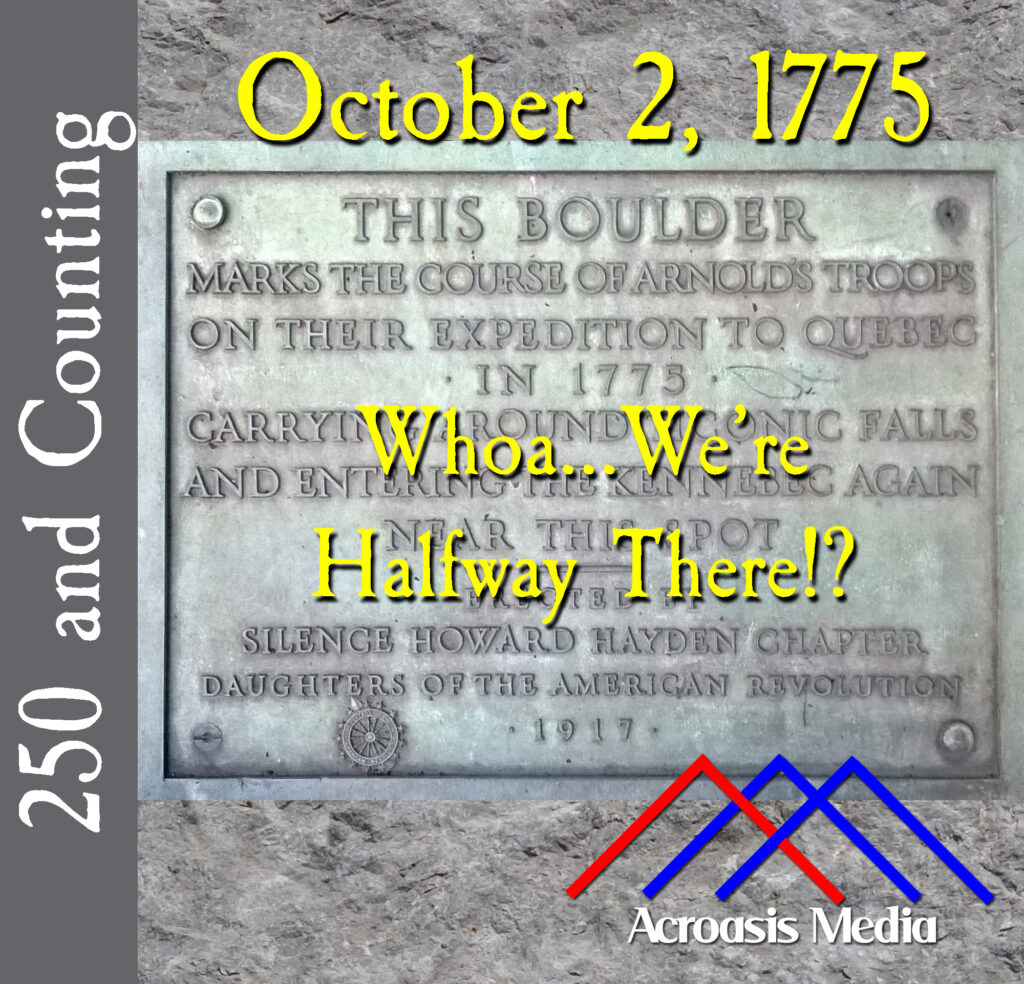
    Cover art for October 2, 1775: one of several markers commemorating stops for Benedict Arnold and his soldiers. This one is near Ticonic Falls, which is the modern name for Norridgewock Falls.

    It was not so very long ago that some of us sought directions from Mapquest. Then we printed them out in order to make a trip of some kind.

    It was only a little bit longer ago that we depended on physical maps to get places. In fact, if you’re a fan of the HBO show The Wire, you may recall a plot point that revolved around printed maps. A secret code led to a point on the map.

    Back in the 18th Century, maps were very important resources for the overland traveler. And if a map had a mistake on it, you could be hopelessly lost. It’s not as though you could pull into Ye Olde Gas Station and get directions.

    So the bad news for Benedict Arnold and Company is that the map he used to get to Quebec was terribly inaccurate. The good news is that it was largely incorrect from a distance standpoint. It could have genuinely been much worse.

  • September 19, 1775: Up the River

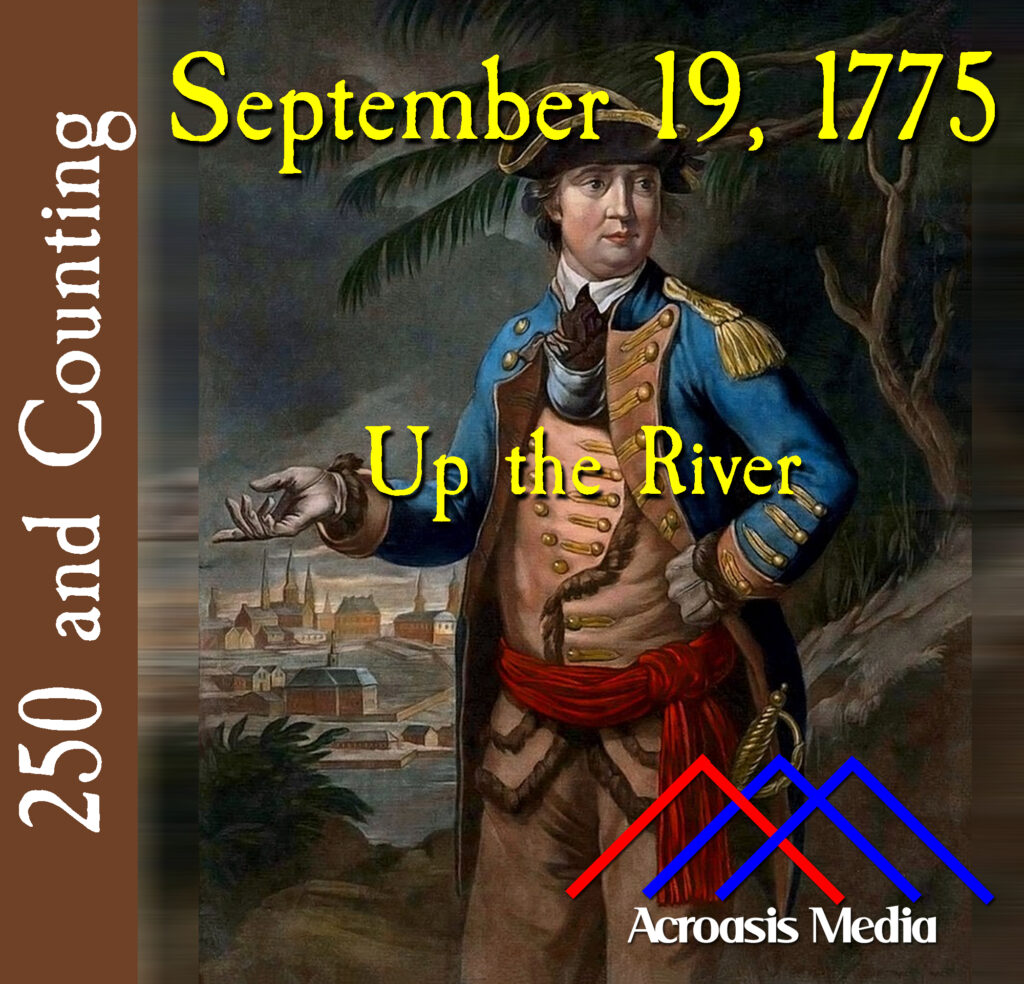
    Cover art for September 19, 1775: Color Mezzotint of Benedict Arnold, 1776 by Thomas Hart. From the Anne S. K. Brown Collection at Brown University. URL at time of upload: http://dl.lib.brown.edu/repository2/repoman.php?verb=render&id=1194635475812500&view=showmods # Call Number: UMP1776mf-1 (ASK Brown Call No.)

    We think of “Benedict Arnold” and the word “Traitor” comes immediately to mind. The two are essentially synonymous. Say one, and you’ve said the other.

    But Benedict Arnold was quite loyal to the Independence cause in the early days of the war. In fact, he was often eager to show what he could do. And why he switched sides is quite complicated and can’t really be answered quickly.

    There were times when he felt that injustices were suffered upon him by other generals and by the Continental Congress. Some of them were real but others, imagined.

    He had two painful battlefield wounds in a leg that was already plagued with gout. Was it a psychological issue?

    Was it a midlife crisis, during which his politics shifted? Given that he married a very young, very pretty and very Loyalist woman named Peggy Shippen, maybe he just did it for the nookie.

    Peggy Shippen is actually the most common explanation.

    At any rate, in 1775 Arnold was still on our side and embarked on an expedition to Canada that turned out to be far more complicated than anyone suspected it would be.

  • May 10, 1775: The Capture of Fort Ticonderoga

    Cover art for May 10, 1775: "Capture of Fort Ticonderoga" by Alonzo Chappel, 1858

    Mike has done a pretty good job of covering the basic story in today’s episode, so I thought I’d spend a minute with you on the cover art.

    This image, which had to be cropped to fit the parameters of podcast art, is called a “conjectural work”, because it was created many years later based on accounts of people who were there. I’ve also seen the phrase “idealized depiction,” but I think “conjectural work” is more value-neutral.

    The original artist was named Alonzo Chappel, and he created this image in 1858, 78 years after the original event. It was converted to an engraving by Thomas Philbrown. And I know all this because it’s part of the New York Public Library’s Digital Collection.

    How accurate is it to actual events? It may be pretty close, since there are several different images available, each depicting all the same people in similar poses (though one appears to be flipped from the others, so that everyone is facing the other way). So I think there’s a pretty high degree of confidence that it looked a lot like this.

    Enjoy.

  • May 1, 1775: Invasion of Quebec, and a Fort is Destroyed

    Cover art for May 1, 1775: a map used by Benedict Arnold to plan his invasion of Quebec.

    Wellll….ordered to be destroyed. But it didn’t happen. Oddly, it was also quite susceptible to the foibles of weather, so when the British took South Carolina back five years later, it was assumed that the garrison had been destroyed on purpose, but nobody knows for sure.

  • April 25, 1775: Benedict Arnold Wasn’t All Bad

    Cover art for April 25, 1775: Benedict Arnold engraving by Henry Bryan Hall after John Trumbull, published 1879.

    Benedict Arnold was a pretty smart guy who chose the wrong friends…and, as we’ll discover later on, the wrong enemies as well.

    But for the time being, here’s a peek into some of Arnold’s activities when he was still on our side in both body and spirit.