Tag: Blacks in the American Revolution

  • Washington Has A Change Of Heart–December 30, 1775

    Cover art for December 30, 1775: Soldiers at the siege of Yorktown, by Jean-Baptiste-Antoine DeVerger (cropped), watercolor, 1781.

    Back on October 8, the Continental Army determined that Blacks were no longer to be permitted to enlist, and that existing soldiers would not be allowed to re-enlist.

    But on this date, George Washington changed his mind. Was he suddenly an abolitionist? Not a chance. He owned slaves until the day he died. This was a more pragmatic decision. It was borne of the fact that he and his staff suddenly realized that a lot of soldiers were going to end their enlistment come January. That October decision was starting to look rather short-sighted.

    Add to that the fact that word had gotten about about Lord Dunmore’s offer to free slaves who fought on the British side. Now, he really couldn’t do anything for slaves who came from anywhere other than Virginia, but the offer was still hanging out there.

    Finally, it was quite apparent that there was a growing number of Blacks, whether slave or free, who had shown interest in fighting for the Patriot cause.

    It suddenly looked like a whole lot of bodies were getting turned down by the Continental Army for no good reason.

  • October 8, 1775: The War Gets Whiter

    Cover art for October 8, 1775: Portrait of James Fayette in 1784 by John Blennerhasset Martin. Fayette joined the Continental forces as a spy under Lafayette.

    When the war first started, the Continental Army took on all comers, largely because they didn’t have a lot of choice. Frankly, they needed whatever bodies they could get.

    But it was around this time in 1775 that George Washington and his advisers decided that they could afford to get choosier about their recruits, So they decided not to take on any more Black soldiers. What’s more, soldiers who were already there would not be permitted to re-enlist.

    Eventually—in a couple of years—they’d reverse their stance, for the same reason they took on the Black soldiers in the first place. They were getting low on manpower,

  • February 14, 1775

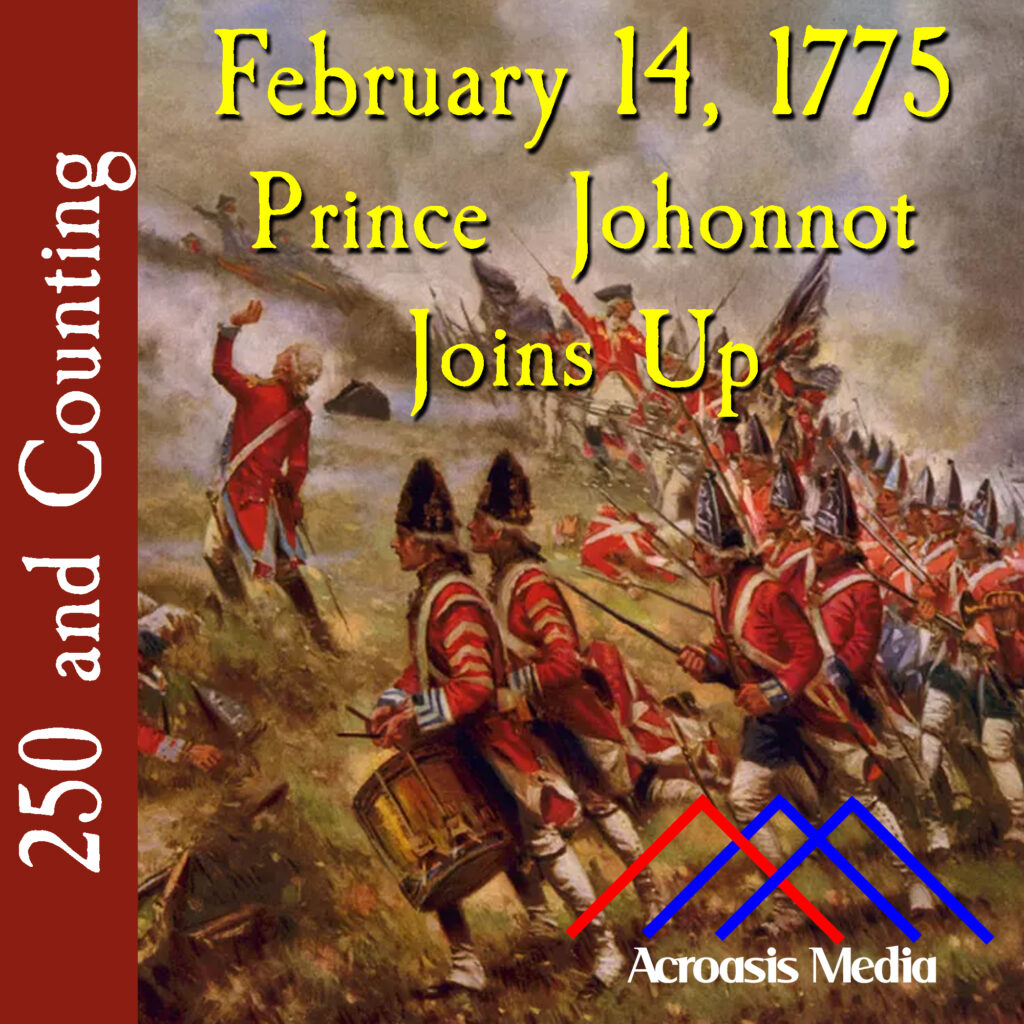
    Cover art for February 14, 1775: Depiction by Percy Moran circa 1909 of British Grenadiers and Light Infantry scaling today's "Breed's Hill."

    When it comes to Black people and their role in the American Revolution, the one name that most people appear to remember is that of Crispus Attucks, largely because he was the first person killed in the Boston Massacre, and that event is thought of as the beginning of the Revolutionary War, therefore it’s significant that the first person to die in the name of American freedom was a person of color.

    Other people, more fussy about events, would say that Lexington & Concord was the beginning of the war. The reasoning behind that is that it’s the first event in a series of hostile actions that took place close to one another. But the real argument is that most historical events of this nature don’t have definitive “beginning” and “ending” points; it’s much like a roll of paper towels. Sure, there are perforations marking each sheet, but you know for a fact that when you pull one off, it’s going to tear at an oddball angle and those perfectly rectangular sheets are a rarity.

    The fact is, however, that over 100 Black men fought as part of the militia in the opening battles of the Revolution. Here’s the story of one of the first.