Tag: Boston History

  • September 3, 1775: The British Move To Break the Siege

    Cover art for September 3, 1775: Early map of Boston showing the neck. From the collection of Historic New England. The blue line shows present-day Washington Street.

    Anyone who’s been to Boston in the modern day has a hard time recognizing that the city of Boston was just the segment in the top center of the map. The area called Boston Neck is clearly marked at the bottom left, and wasn’t part of the city. The Continental Army’s line ran about where the blue line ends. (The blue line is modern-day Washington Street.)

    It was the city having that kind of geography that made the Siege of Boston relatively easy for the Patriots. Unfortunately for them, the British were still able to use the surrounding waterways.

    This made the siege not the battle of attrition that it could have been, since supplies were able to get in via water. Consequently it was an ongoing battle of wits, as we learn today.

  • August 31, 1775: The Liberty Tree Dies

    The cover art for today’s episode may be one of the most famous art pieces depicting an event of the American Revolution, and it happened under the Liberty Tree, which is clearly marked here.

    This event, the tarring and feathering of Loyalist John Malcolm, took place about 18 months earlier and shows Malcolm already tarred and feathered, and now he’s having (also marked) tea poured into his mouth. The Stamp Act is nailed to the tree, upside down. Really, there’s a lot to unpack in this picture. So it makes sense that people were upset that the tree had been cut down.

  • July 30, 1775: A Battle at Charlestown Neck

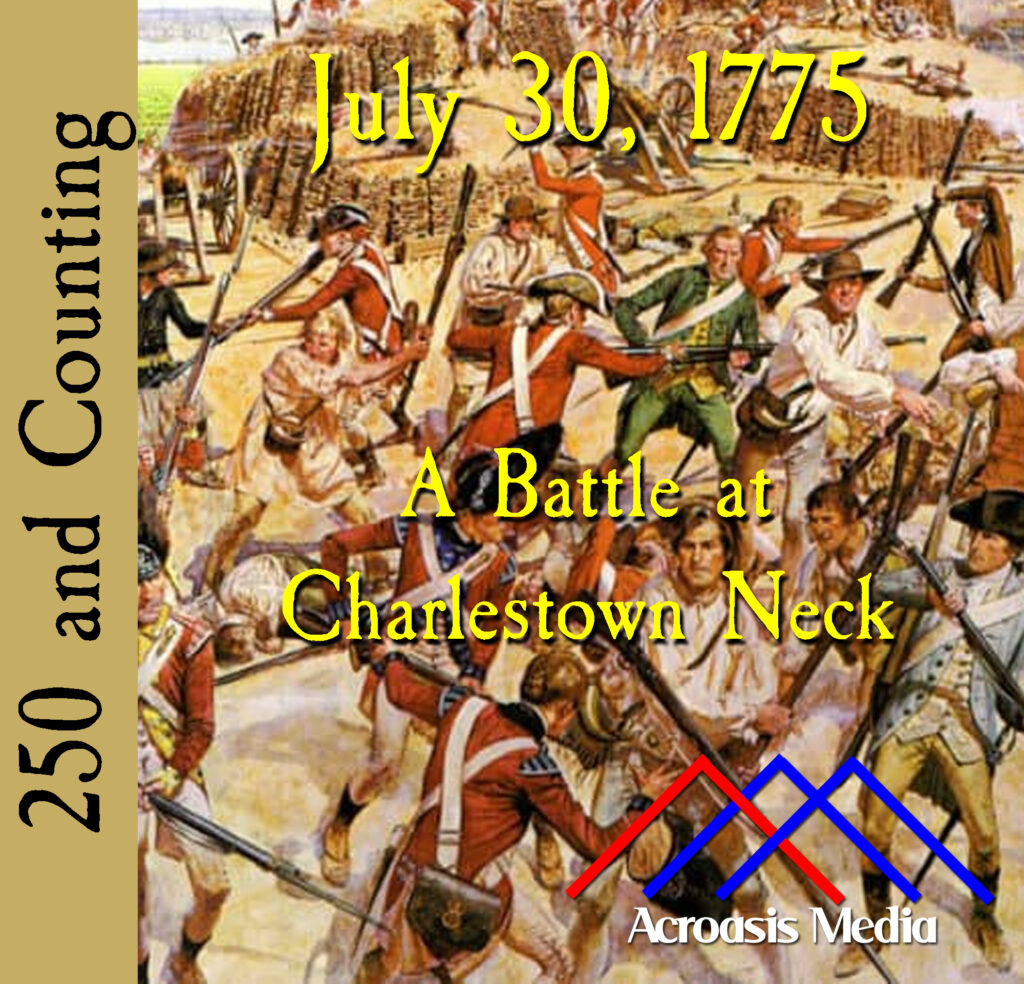
    Cover art for July 30, 1775: OK, we'll level with you. This is a painting of the Battle at Bunker Hill from June. There are no significant images of the battle described today.

    Boston had been under siege since Lexington and Concord. Of course the British felt that they needed to break out of it from time to time, and today was one of those attempts.

    Now, this was a success for the Continental Army, but the fact is, few people realized at that time just how close they were to losing that battle, and badly. But that’s for a couple of days from now, on August 1st.

    Coincidentally, August 1st is the day that this podcast begins airing on Hamilton Radio!

    Tune in to HamiltonRadio.net to hear our show, and a bunch of others. We’re in good company over there.

  • March 5, 1775

    Cover art for March 5, 1775: Portrait of Joseph Warren by John Singleton Copley, 1765

    Joseph Warren’s life as a Patriot was rather brief (in fact his life overall was relatively short), but it was quite important to the cause. Warren was part of the committee that investigated the Boston Massacre, he sent Paul Revere on his midnight ride (just go with it for now), he wrote a song called “Free America,” which was based on a British melody called “The British Grenadiers”, he fought at Lexington and Concord, and he died at Bunker Hill.

    And he was one of only two men who was asked to speak more than once on the anniversary of the Boston Massacre. And this second time was the one that really sold the crowd.