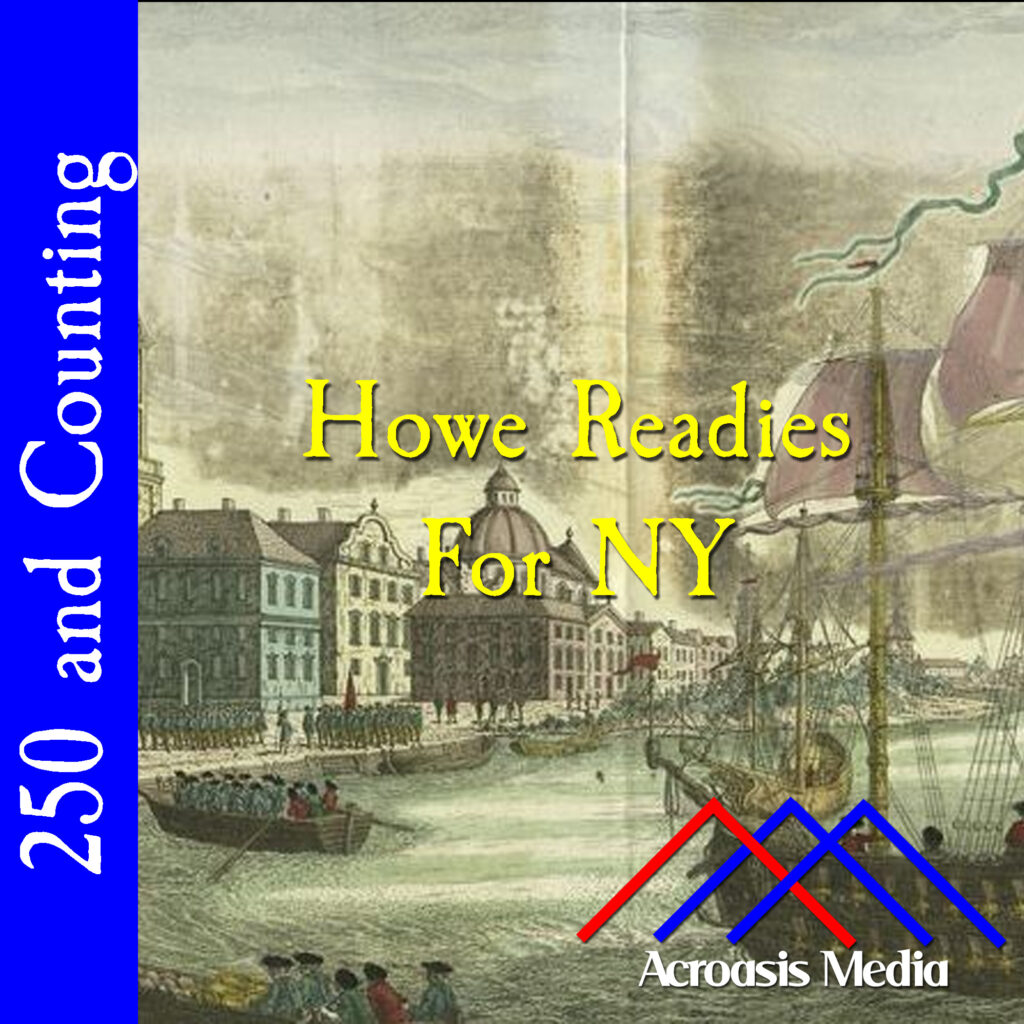
That Admiral Richard Howe maintained some sympathies for the Colonists in the earlier years of his career might be overselling it a little bit.
Howe did have some sympathies, but when he and his brother, General William Howe, met with the Committee of Safety headed by Benjamin Franklin, the idea was to quash the idea of revolution and effect a return to status quo. When that failed, Admiral Howe was the first to hoist the Jolly Roger.
Okay, he didn’t do that exactly, but he was fully prepared to do whatever he needed to do to end the situation. And that’s probably why he moved up in the ranks so quickly between 1770 and 1776. He’d already shown his competence in the Seven Years’ War, and now he was proving himself again.
Howe’s plan to blockade ships entering major harbors might have worked in the long run, but those plans were interrupted when John Burgoyne’s troops were captured, forcing Richard Howe to winter in Rhode Island.
In recent years there have been suggestions that Howe’s blockades were less successful in the northern colonies because he was allowing ships to get through, accidentally on purpose as they say. Is it possible that he was letting those sympathies get the better of him? It’s actually tough to say for sure.
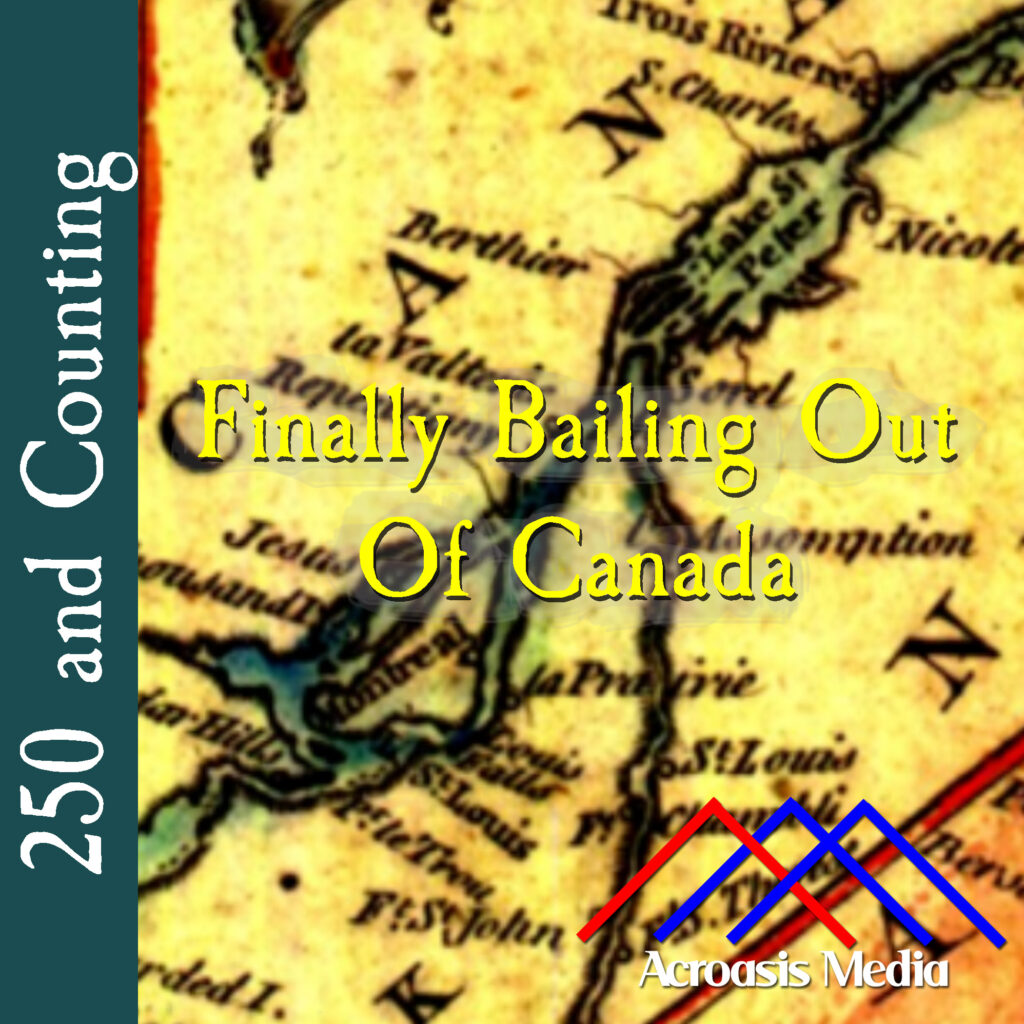
As a nation, we should be able to face our failures as squarely as we crow our triumphs, and make no mistake: the invasion of, and withdrawal from Canada was a botched effort from one end to the other.
Perhaps the only thing that kept it from being a bigger deal was the distraction a few weeks later of the Colonies delcaring themselves to be states independent from Great Britain.
We barely had an army that had any idea of how to provision its forces, yet we sent a bunch of them to the north anyway, far from home and no easy way to get there or back. We started this invasion in a blizzard! And, perhaps even worse, our withdrawal from Canada suddenly left us open to a potential invasion from the north by British troops.
I realize that I have the benefit of 250 years of hindsight on this, but this really does feel like one of those things where people said “We have to see this through to the end, which will be glorious,” and then nearly six months later, when it all falls apart, the same people say, “Wow, it was so obvious.”
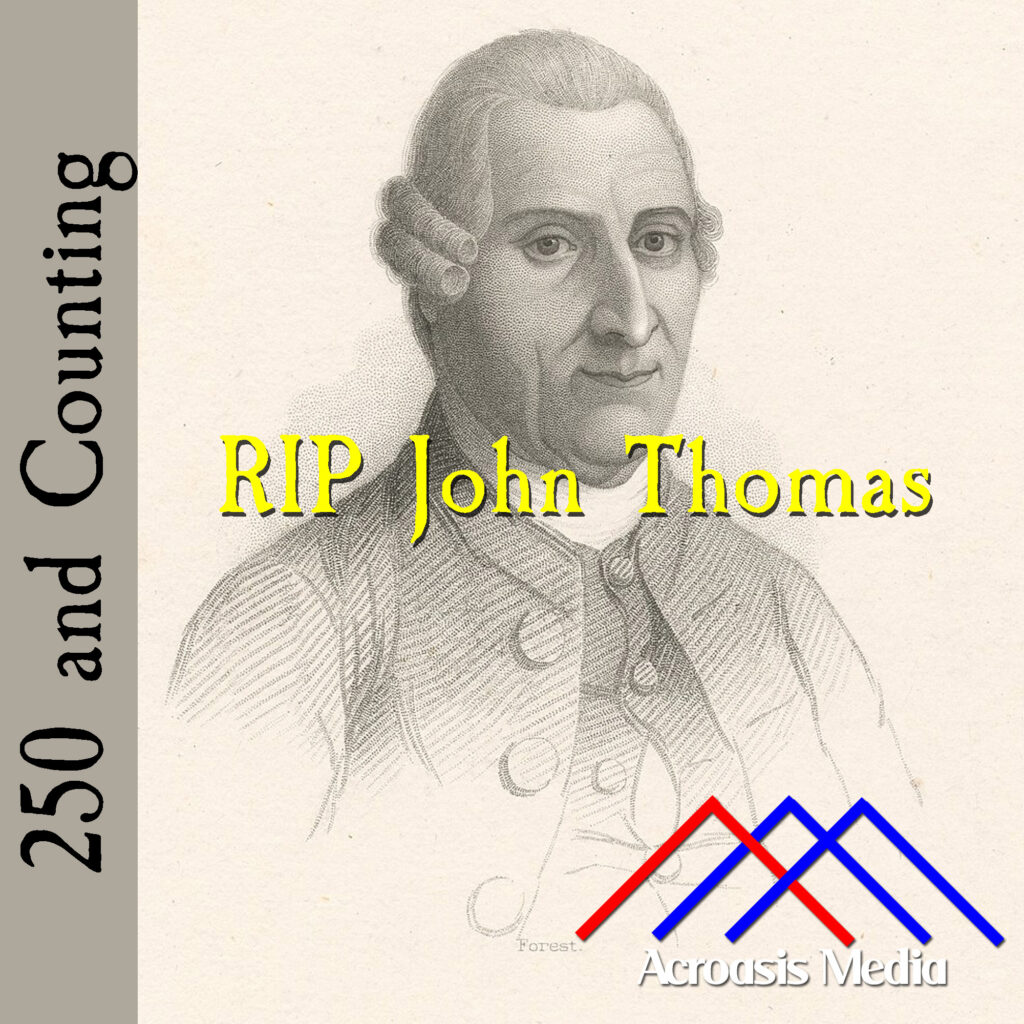
John Thomas was a doctor and a soldier from Massachusetts who was in Quebec during the attempted invasion and was in charge of the withdrawal until he got smallpox and died on this day in 1776.
Thomas discovered he liked military service about as much as he liked being a surgeon, so in 1747 he became a lieutenant in the British army. A few years later he served as a surgeon for a different regiment.
In the early days of the Revolution, Thomas nearly quit the Continental Army because he wasn’t named as a major general. At the time, Congress was trying to avoid having all its generals come from the same place, and Artemis Ward got the nod instead. It was only because both George Washington and Charles Lee both talked him into staying that he remained in the army and returned to service. Shortly thereafter he was assured that he would get top priority for advancement.
It was that which led directly to his being assigned to command in Canada when Richard Montgomery was killed. Unfortunately for him, what he found when he arrived in Quebec was a mess: the army was far outnumbered (plus the city had walls), about a third of the Continental soldiers were due—or overdue—for discharge, and smallpox was making its way through the camp.
Also unfortunately, as the smallpox moved through the camp, it made a stop at Roberts’ tent, and he died just a few weeks after arriving in Canada.
If nothing else, the tenacity of the Continental Congress has to be admired, because sending a delegation to Canada, especially after the recent New Year’s Eve disaster in Quebec, and then the “who knows how well it went” trip in March, was a sign of either eternal optimism or an inability to get the hint.
It was probably a little of Column A and a little of Column B.
At any rate, Ben Franklin, Samuel Chase and Charles Carroll headed up to Montrèal to see if relations with Canada could be smoothed over a little bit. And perhaps they could, but the Canadians still weren’t interested in the events going on to their south.
When you have seven ships and you encounter a single ship belonging to the enemy, the Battle of Block Island teaches us that it’s still possible to be overconfident.
Some people tried to frame the Battle of Block Island as a draw, but those people really weren’t paying attention. The HMS Glasgow took some damage, but far more damage was done to the ships that engaged her: The Cabot had its steering disabled and mostly just got in the way, the Alfred lost its tiller as well and also served as an obstacle. Providence held back and was undamaged; Columbus came in late and her fire was ineffective; likewise the Andrew Doria, which got stuck behind the Alfred. And the Glasgow got away, besides.
Between Esek Hopkins’ earlier disobeying of his orders and now this debacle, among other transgressions, he was formally censured. By 1778 he had been dismissed altogether from the Navy.
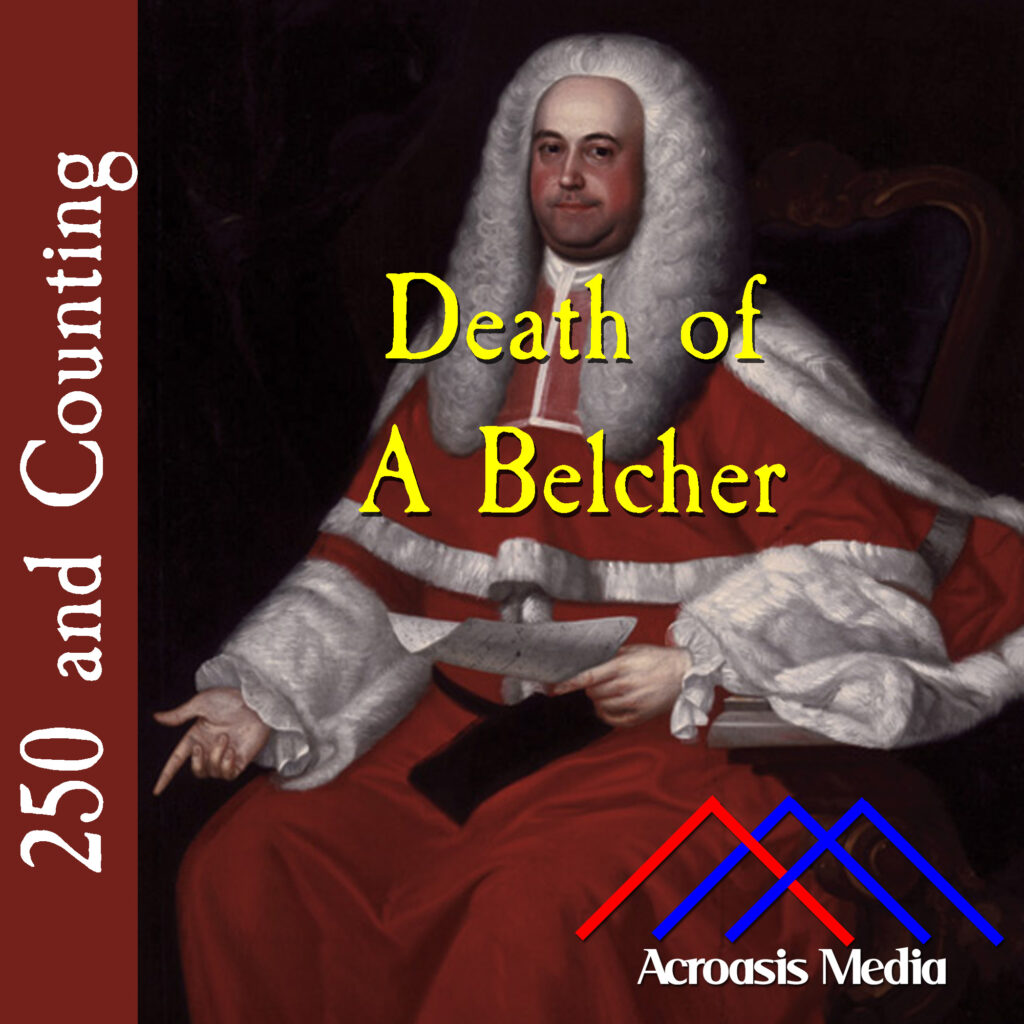
Jurist Jonathan Belcher was born in Boston. He was the second son of Jonathan Belcher and Mary Partridge,
Belcher entered Harvard College, where in 1728 he received a Bachelor of Arts degree in Divinity Studies. In 1730 he entered the Middle Temple, London, to read law, and in 1734 was called to the English bar.
In the meantime he had been admitted as a fellow-commoner to Trinity College, Cambridge, where in 1733 he received another master’s degree, this time in mathematics. He later received a third master’s degree from the College of New Jersey (now Princeton University).
In 1754, Belcher was sent to Nova Scotia to become the first Chief Justice of the Nova Scotia Supreme Court. Prior to Belcher’s arrival Nova Scotia had no formally trained law officers. This meant that he was not only interpreting the law there, he was oftentimes writing it.
Belcher also served on the Nova Scotia Council. On July 28, 1755, he published a document which concluded that deportation of the Acadians was both authorized and required under the law. This is the decision that got him in hot water.
From 1761 to 1763, he was also Lieutenant Governor of Nova Scotia, spending the last three years of that period as Acting Governor when Henry Ellis did not fulfill his duties. He negotiated the peace that led to the Burying the Hatchet ceremony in Nova Scotia.
Jonathan Belcher died in office in 1776, and is buried in the Old Burying Ground in Halifax.
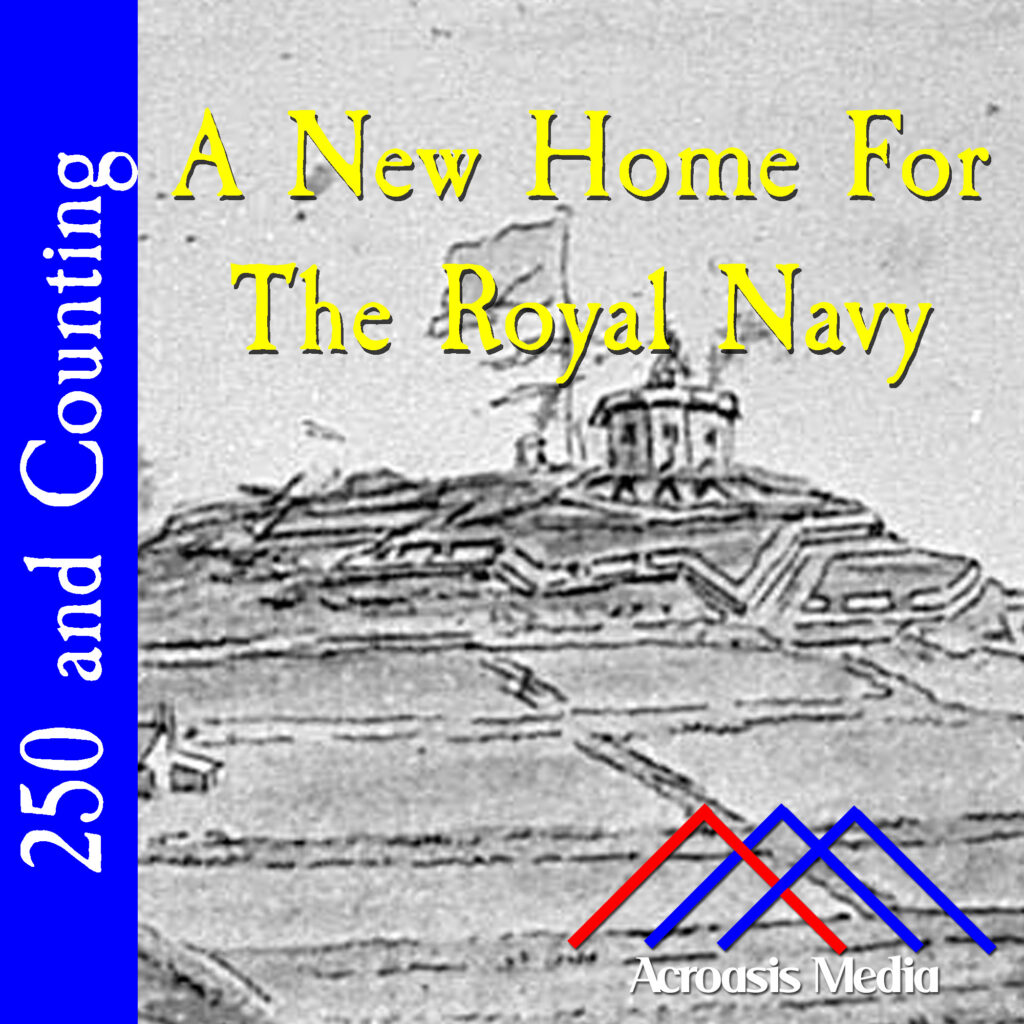
The image in today’s cover art is an engraving of Citadel Hill, around 1780.
Citadel Hill is a very popular historic site in Halifax, and while four forts have been built on this site, none of them have ever had to withstand a direct attack. In a couple of instances, structures near the Citadel were attacked, but never the building itself. It’s possible that the forts that were erected on the site served as deterrents.
The first Citadel was built in 1749. Fortifications were constructed on this hill to protect against raids by the French, colonial Akadians, and local tribes, especially the Mi’kmaq (pronounce it “MicMac”). By 1761 the fort was in ruins and a second, larger Citadel was built in 1776. This is the one in the artwork. While the garrison was always on alert, again it was never attacked, and by 1784 it was again in ruins. The third Citadel was built starting in 1796, when the old one was dismantled. This one was larger still and looked much like the current model, except it had more earthworks. During the War of 1812 some quick renovations were made in case the Americans attacked, but again the whole thing fell to ruin by 1825.
Construction for the current Citadel began in 1828. It was a huge masonry-construction star-shaped fort that took 28 years to finish. An incident in the nearby waters nearly dragged the Citadel into the American Civil War but again there were no attacks on the fort. Eventually it was restored by historians and in 1956 it opened as a historic site and home to the Halifax Army Museum. In the 1990s it was restored again to its 1869 appearance and is maintained as such.
The grounds of the Halifax Citadel are open year round. From spring to fall, a living history program features re-enactors portraying the 78th Highland Regiment (stationed at Halifax between 1869 and 1871), the 78th Highlanders (Halifax Citadel) Pipe Band, the Third Brigade of the Royal Artillery, soldiers’ wives, and civilian tradespeople. Parks Canada also hosts several re-enactment events each year by volunteers of the Brigade of the American Revolution and the two living history associations.
The Citadel’s role in the history of Halifax and North America is communicated through guided and self-guided tours, audio-visual presentations, and various exhibits. On average, the citadel sees over 200,000 visitors annually. A ceremonial firing of the noon gun is conducted daily by staff, and continues year-round, even when the site is closed to visitors. The artillery is also used for formal occasions such as 21-gun salutes.
The “Army Museum”, located in the Citadel’s Cavalier Block, displays a rare collection of weapons, medals, and uniforms exploring Nova Scotia’s army history. It is an independent non-profit museum, and staff work in close partnership with the Citadel staff and Parks Canada.
In July 2006, the Halifax Citadel celebrated the 100th anniversary of the withdrawal of the last British military forces from Canada. The Citadel hosted over 1,000 re-enactors from around the world. Approaching the Christmas season, Citadel Hill annually hosts a “Victorian Christmas”. Visitors are treated to crafts, carolers, and games, as well as a visit from Santa Claus.
Ghost tours are held at the fort in the weeks leading up to Halloween. Ghost tours! Nobody ever died in battle there, but we’re doing ghost tours. Fantastic.
The monument erected to honor Richard Montgomery outside St. Paul’s Chapel at Trinity Church. The inscription reads: This Monument is erected by the order of Congress, 25th, Janry, 1776, to transmit to Posterity a grateful remembrance of the patriotism conduct enterprise & perseverance of Major General Richard Montgomery Who after a series of successes amidst the most discouraging Difficulties Fell in the attack on Quebec. 31st, Decbr, 1775. Aged 37 Years.
We weren’t even a nation yet and Congress had already commissioned the Richard Montgomery Memorial. And while the memorial itself was completed rather quickly by the commissioned artist, the war interfered with its transport and it took nearly ten years to find all the pieces.
(Dirty Secret: they never found all of them; the urn at top center was a reproduction.)
Montgomery was generally known to be a good general even if his death was practically inevitable, given the circumstances. But that didn’t stop people from turning him into a martyr for the cause of Independence.
PS. Trinity Church’s website has a page dedicated to the monument, which aided my research for this episode. There’s a huge, fascinating segment dedicated to the 2011 restoration process for this memorial.
The Death of General Montgomery in the Attack on Quebec (detail), by John Trumbull, 1786.Montgomery was struck in the head by grapeshot, so it probably wasn’t nearly as tidy as this.
While hindsight is very much a 20/20 vision, it’s still worth exploring why the Battle of Quebec went so poorly for the American side:
While General Montgomery was clever enough to attack during a storm, he didn’t necessarily expect Nor’easter blizzard conditions, which made it tough for his men to see where they were going without lanterns…
…which meant that there were likely sentries who probably got curious about a bunch of lanterns coming their way.
Many of the men on the American side were literally on their last day of enlistment, so they probably weren’t motivated to give it their all.
In fact, only about 50 Americans (including General Montgomery) were killed, and 34 wounded (including Benedict Arnold), but over 400 men were missing or captured. “Missing” could easily mean “went home.”
Many of the Americans were probably unprepared for the relatively close quarters of fighting in a city, which meant that they were unprepared for attacks from above.
Now, I am by no means a military expert, but these are the things that stood out for me just based on a quick read of the situation. It was hubris, and a brand of short-sightedness that this particular city got deep into the heads of Montgomery and Arnold, and they refused to let it go.
The siege of Quebec was an event that was months in the making, and it was still just the penultimate act of the play.
Benedict Arnold and his troops thought they could get to the American side of the St. Lawrence River within 21 days; instead it took several weeks. Along the way they lost about a third of their troop strength. Some of the men died of illness en route, but most of them finally gave up altogether and headed home.
When they finally arrived they realized they didn’t have nearly what they needed to effect a decent attack on the city, so they had to hunker down and wait for supports to arrive. They were able to institute a couple of blockades, but that wasn’t nearly enough.
Finally General Montgomery showed up, and after an attempt at getting the city to surrender, they began the shooting. Unfortunately that didn’t do a lot of good, so the Continental Army had to settle for placing the city under siege. At this point, however, the clock was ticking because a big chunk of the Colonial soldiers were due to have their enlistments end on December 31. Something had to give, and soon.