Tag: General George Cornwallis

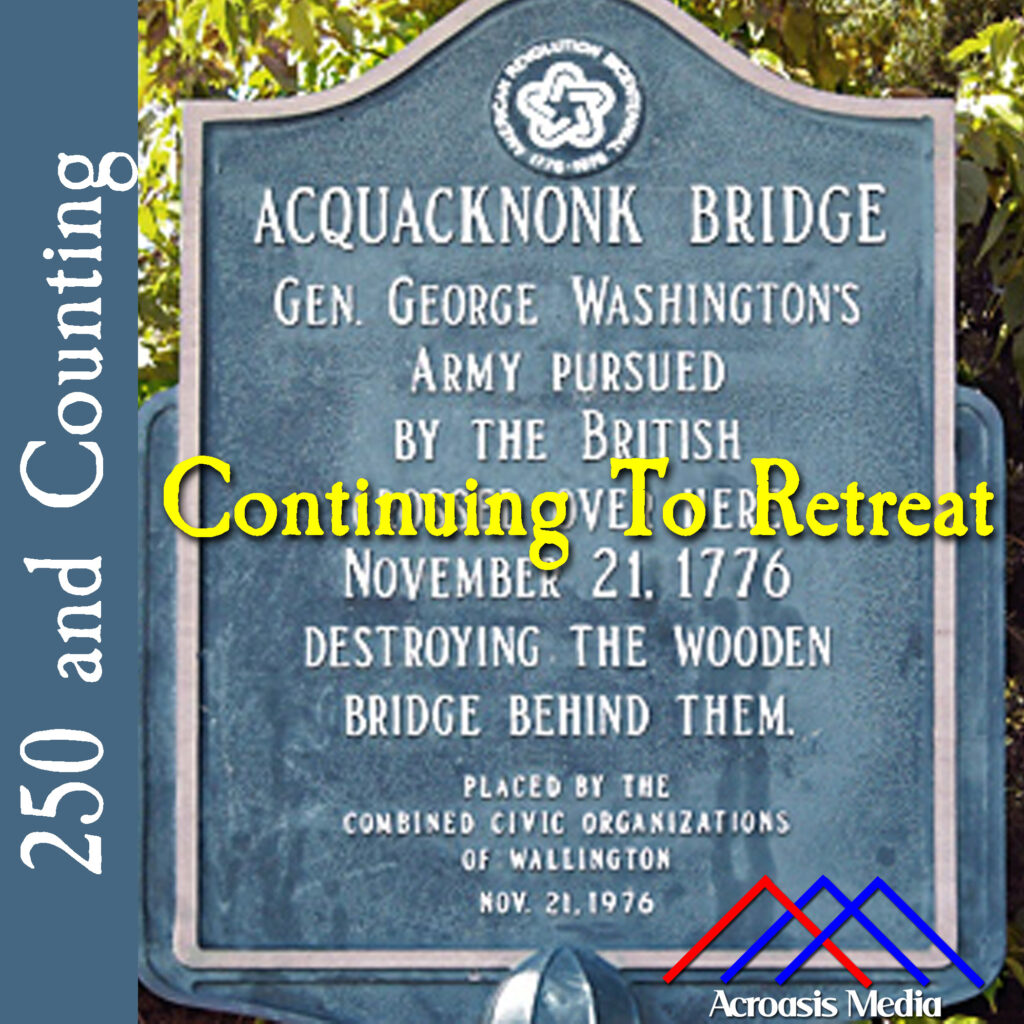
  • Continuing to Retreat–November 21, 1776

    Cover art for November 21, 1776: Historical marker--one of several--placed at the Passaic River crossing in 1976.

    When I lived in northern New Jersey, as I mentioned a couple of days ago, I was just a few blocks from the Passaic River. But the river wasn’t quite as large there as it was where Washington’s army crossed it.

    There is a modern-day bridge at that crossing spot, and the (misspelled) sign in today’s cover art marks that spot, on the east side of the river. On the west side of the river is River Drive, which (surprise!) runs along the river for a ways. There’s a second marker there.

    But wait! There’s more!

    Maybe a hundred yards away, in Armory Park on Main Street, there’s a third sign, which is an exact replica of an earlier sign at the same spot that had been placed in 1932. The interesting thing is that the two signs on the west side of the bridge are worded almost identically, though one refers to “Blanchard House” and the other refers to “The Tap House.” However, both signs are referring to the same tavern, which is no longer extant but is the home of Saints Peter and Paul Church. Having said that, there are several markers around the church, marking the Blanchard House’s location, a monument to George Washington, and a couple of significant grave markers.

    And—this I found weird-but-interesting—near the second bridge marker there’s a Burger King. And in the parking lot there’s a memorial to Lord Stirling, who was with the Continental Army during the crossing and set up the headquarters at Blanchard House. We’ll hear more from Stirling around Christmas time, shortly before this show ends.

  • Fort Lee Falls To The British–November 20, 1776

    Cover art for November 20, 1776: "Washington and Staff at Fort Lee, Watching the Battle of Fort Washington, 1776" (1929), painted by John Ward Dunsmore. Via the Fraunces Tavern Museum collection.

    Calling it “The Battle of Fort Lee” feels like a misnomer, largely because it was more like “The Continentals Get The Hell Out of Town Before the British Arrive.”

    As noted in yesterday’s episode, General Cornwallis actually began moving on the fort the night before. His troops struck camp and crossed the Husdon River, landing in Closter, a hamlet otherwise so insignificant that I actually lived in Bergen County for several years (not far from where a lot of The Sopranos exteriors were filmed) and still had to look up its location. It’s only ten miles (as the crow flies) from where I lived!

    Anyway.

    About 4000 troops had landed at Closter, and since nobody knew they were there, they managed to make their way up the Palisades without anyone interfering. Not long after dawn, an American soldier on patrol spotted them and raced back to the fort to raise the alarm.

    George Washington had already begun plans to evacuate the fort and begin moving the army across New Jersey, but this news meant that whatever plans were already underway had to be abandoned, and everybody just dropped everything and left. So much for The Battle of Fort Lee.

    Things were looking pretty bleak for the Continental Army, but the escape meant that the army was able to survive and score a couple of decisive wins just a few weeks later at Trenton and Princeton.

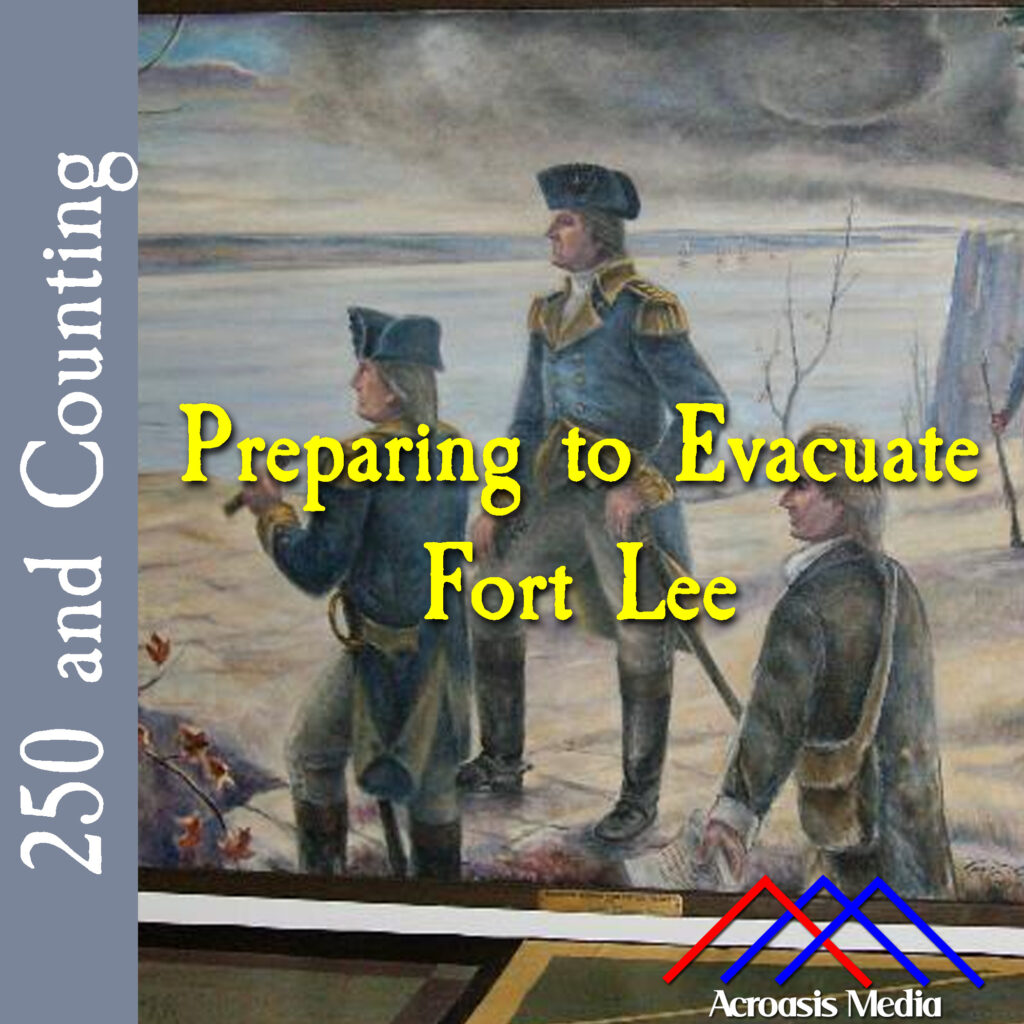
  • Preparing to Evacuate Fort Lee–November 19, 1776

    Cover art for November 19, 1776: "Washington at Fort Lee", one of four murals painted by Henry Schnakenberg in 1941. Originally in the now-demolished Fort Lee Post Office, they're now in the Fort Lee Community Center.

    Nathanael Greene recommended defending Fort Washington, but once that fell, the evacuation of Fort Lee was pretty much a foregone conclusion.

    George Washington determined, not unreasonably, that Fort Lee was mostly useful in conjunction with Fort Washington: being approximately across the Hudson River from one another, they could harass any British movement up or down the river. With one fort gone, there was no point in sticking around for the other one.

    And once again, in getting out when he did, George “The Fox” Washington managed to escape capture by the British once again.

  • Landing In Brooklyn–August 22, 1776

    Cover art for August 22, 1776: portrait of Henry Clinton, attributed to Andrea Soldi, ca. 1762-65

    One fine Thursday morning in August of 1776, about 4000 British troops, led by General Henry Clinton and General George Cornwallis, landed at Gravesend Bay in Brooklyn. By the end of the day, their number had swelled to over 16,000.

    George Washington’s problem was that he only heard about the initial 4000 later that day and decided that his guess regarding any invasion of Brooklyn was little more than a feint. Washington was no fool, but he was definitely wrong about this one.