Tag: General Montgomery

  • Our First Memorial–January 25, 1776

    Cover art for January 25, 1776: the monument erected to honor Richard Montgomery outside St. Paul's Chapel at Trinity Church. via Wikimedia Commons.
    The monument erected to honor Richard Montgomery outside St. Paul’s Chapel at Trinity Church.
    The inscription reads: This Monument is erected by the order of Congress, 25th, Janry, 1776, to transmit to Posterity a grateful remembrance of the patriotism conduct enterprise & perseverance of Major General Richard Montgomery
    Who after a series of successes amidst the most discouraging Difficulties Fell in the attack on Quebec. 31st, Decbr, 1775. Aged 37 Years.

    We weren’t even a nation yet and Congress had already commissioned the Richard Montgomery Memorial. And while the memorial itself was completed rather quickly by the commissioned artist, the war interfered with its transport and it took nearly ten years to find all the pieces.

    (Dirty Secret: they never found all of them; the urn at top center was a reproduction.)

    Montgomery was generally known to be a good general even if his death was practically inevitable, given the circumstances. But that didn’t stop people from turning him into a martyr for the cause of Independence.

    PS. Trinity Church’s website has a page dedicated to the monument, which aided my research for this episode. There’s a huge, fascinating segment dedicated to the 2011 restoration process for this memorial.

  • The Battle of Quebec–December 31, 1775

    Cover art for December 31, 1775: The Death of General Montgomery in the Attack on Quebec (detail), by John Trumbull, 1786.
    The Death of General Montgomery in the Attack on Quebec (detail), by John Trumbull, 1786. Montgomery was struck in the head by grapeshot, so it probably wasn’t nearly as tidy as this.

    While hindsight is very much a 20/20 vision, it’s still worth exploring why the Battle of Quebec went so poorly for the American side:

    • While General Montgomery was clever enough to attack during a storm, he didn’t necessarily expect Nor’easter blizzard conditions, which made it tough for his men to see where they were going without lanterns…
    • …which meant that there were likely sentries who probably got curious about a bunch of lanterns coming their way.
    • Many of the men on the American side were literally on their last day of enlistment, so they probably weren’t motivated to give it their all.
    • In fact, only about 50 Americans (including General Montgomery) were killed, and 34 wounded (including Benedict Arnold), but over 400 men were missing or captured. “Missing” could easily mean “went home.”
    • Many of the Americans were probably unprepared for the relatively close quarters of fighting in a city, which meant that they were unprepared for attacks from above.

    Now, I am by no means a military expert, but these are the things that stood out for me just based on a quick read of the situation. It was hubris, and a brand of short-sightedness that this particular city got deep into the heads of Montgomery and Arnold, and they refused to let it go.

  • The Siege of Quebec–December 8, 1775

    Cover art for December 8, 1775: Benedict Arnold's forces moving in on Quebec. from a painting by F. C. Yohn, date unknown.

    The siege of Quebec was an event that was months in the making, and it was still just the penultimate act of the play.

    Benedict Arnold and his troops thought they could get to the American side of the St. Lawrence River within 21 days; instead it took several weeks. Along the way they lost about a third of their troop strength. Some of the men died of illness en route, but most of them finally gave up altogether and headed home.

    When they finally arrived they realized they didn’t have nearly what they needed to effect a decent attack on the city, so they had to hunker down and wait for supports to arrive. They were able to institute a couple of blockades, but that wasn’t nearly enough.

    Finally General Montgomery showed up, and after an attempt at getting the city to surrender, they began the shooting. Unfortunately that didn’t do a lot of good, so the Continental Army had to settle for placing the city under siege. At this point, however, the clock was ticking because a big chunk of the Colonial soldiers were due to have their enlistments end on December 31. Something had to give, and soon.

  • Montgomery Arrives at Quebec–December 1, 1775

    Cover art for December 1, 1775: "Gen. Richard Montgomery." via the New York Public Library Digital Collections.

    The events at Lexington and Concord were only about a month in the rear-view mirror when it occurred to both the Americans and the British that the Canadian provinces were colonies, too, and that they might have some kind of interest in the activities going on further south.

    Quebec, being perhaps the largest city close to the border, was the natural target for everyone involved. So it was always in the back of minds in the Thirteen Colonies, and in England. And slowly, each side began to think about either converting Canada to the American side, or defending Canada from American invasion.

    And on this day in history, everyone moved a giant step closer to what eventually became the Battle of Quebec.

  • Reinforcements Arrive in Quebec–October 15, 1775

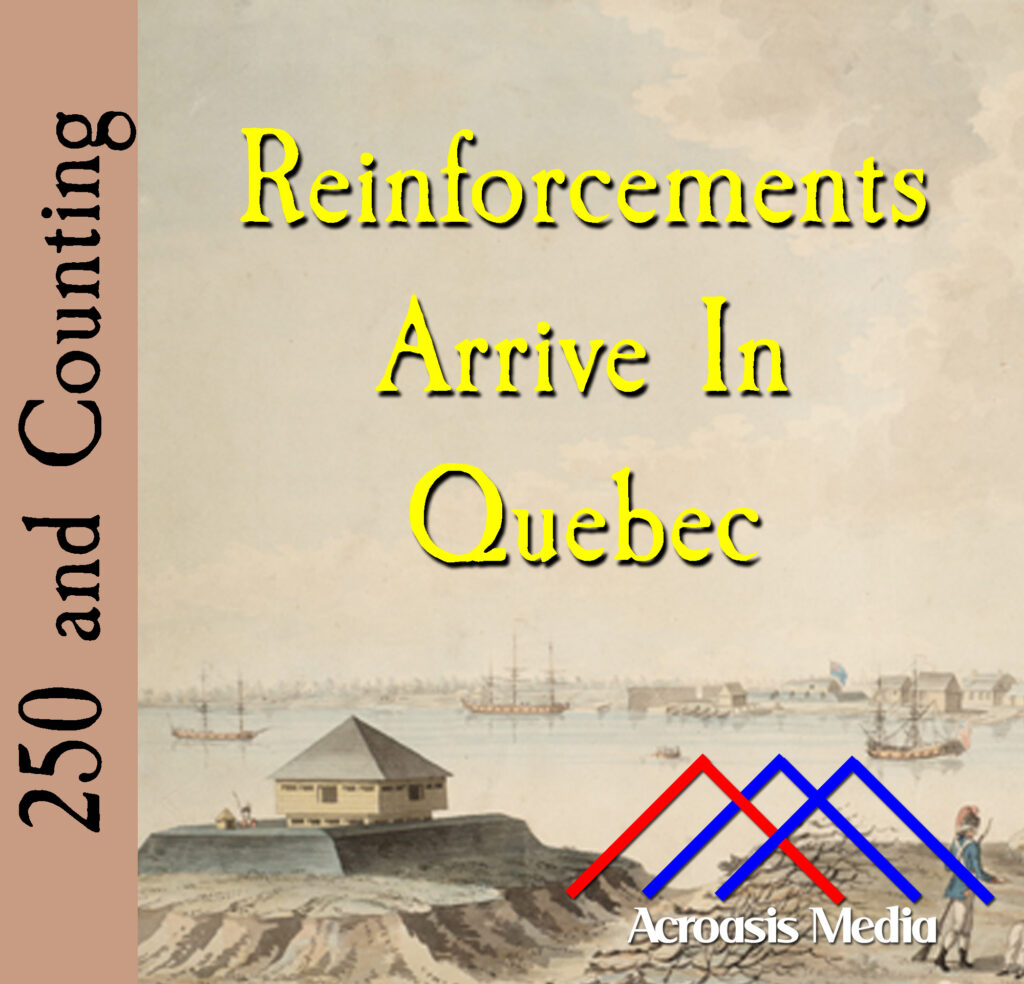
    Cover art for October 15, 1775: Fort St. Jean (near the right edge) around the time of the siege. Watercolor, pen and ink by James Peachey.

    Fort St. Jean was a relatively soft target compared to Boston. Plus, it wasn’t as well fortified because the British weren’t holed up there. Sooner or later something would come along to break up the stalemate.

    On this day, a couple of somethings arrived, from Fort Ticonderoga and Crown Point. The big guns that Montgomery had hoped for finally arrived. And not long behind that, Montgomery was able to take Fort Chambly, which wouldn’t have been a huge deal had its commander not forgotten an important detail while he was high-tailing it out of there.