
Tag: General Philip Schuyler

  • The Schuyler Is Falling–July 24, 1776

    Cover art for July 24, 1776: portrait of Philip Schuyler by John Trumbull, 1792. Currently housed at the New York Historical Society.

    Philip Schuyler was part of a prominent New York family, enough that if you have any familiarity with that state’s history, you realize that the Schuyler name keeps popping up, especially during and shortly after the Revolution. (Similarly, the names Schermerhorn and Burr also manage to crop up a lot; Burr is probably the most famous name of the three but there are more Burrs than just Aaron.)

    Schuyler was born in Albany but moved to New Rochelle when he was eight years old, shortly after his father died. He fought in the French and Indian War, and was sent to England for three years afterward to help settle some expenses related to the war.

    Philip Schuyler was elected to the Second Continental Congress but left to become a general in the Continental Army, where he was involved with the failed invasion of Quebec. His health forced him to turn command over to General Montgomery, and in 1777 he returned to Congress.

    Later in life, he served as a Semator in the First US Congress, but lost his bid for re-election to Aaron Burr. (See? Popping up everywhere.) He did return to the Senate a few years later, and remained there until he resigned due to his health.

    Schuyler died at the Schuyler Mansion in Albany on November 18, 1804, four months after his son-in-law, Alexander Hamilton, was killed in a duel (by Aaron Burr) and two days before his 71st birthday. He is buried at Albany Rural Cemetery in Menands, New York, about 500 feet away from President Chester A. Arthur. It’s really a lovely place to visit and see the graves of several notable figures, not all of whom were “big” names historically unless you like to deep-dive into such things.

  • September 11, 1775: One Siege Begins, Another Continues

    Cover art for September 11, 1775: "Siege of Boston" wood engraving (detail), created 1879, artist not cited. via the New York Public Library digital collection.

    As the winter of 1775 approached, George Washington had to think about the state of the siege of Boston. In short, housing and clothing thousands of men in a New England winter is a very different proposition than doing it in the summer.

    So Washington convened his War Council to discuss the possibility of breaking the siege by attacking the city from a different direction.

    Meanwhile up in Canada, General Philip Schuyler takes another run at Fort St. Jean.

  • August 17, 1775: The Six Nations Summit

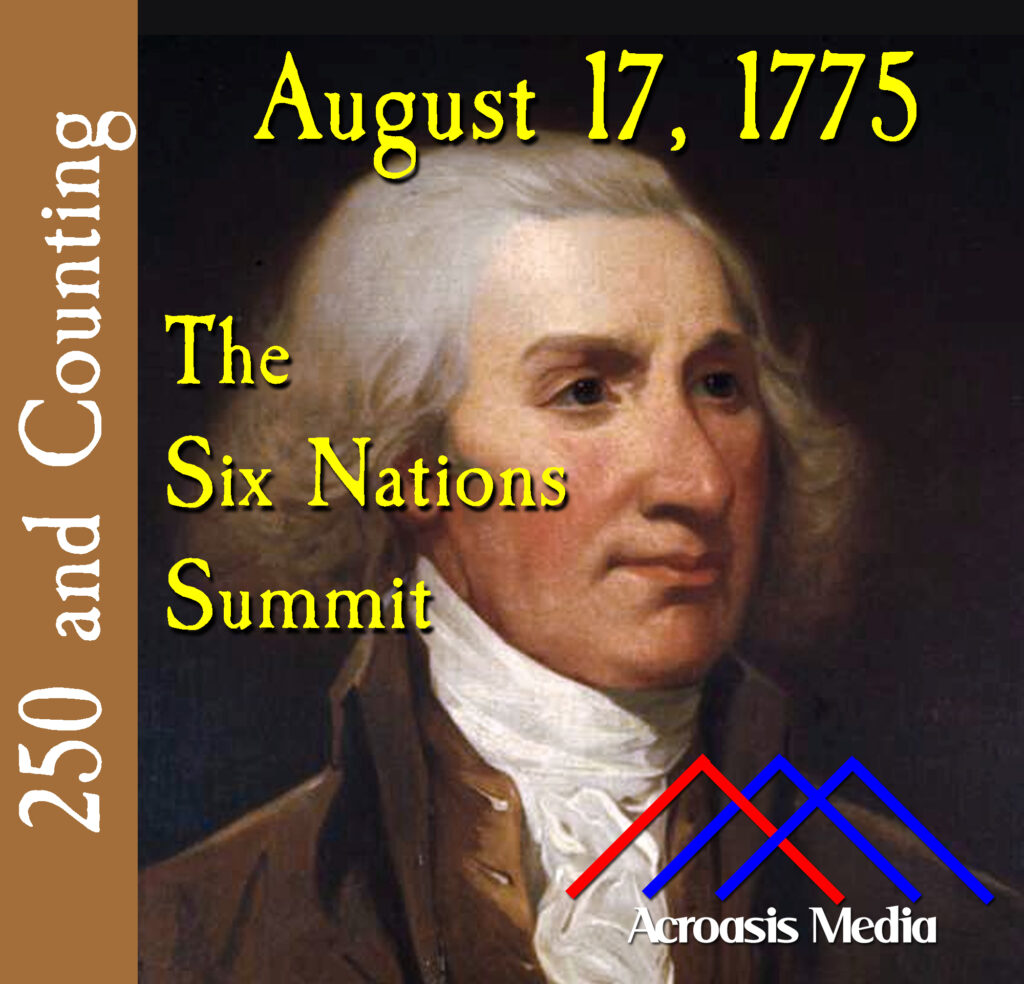
    Cover art for August 17, 1775: Mirror-image copy of a portrait of Philip Schuyler. Painted by Jacob H. Lazarus from a miniature painted by John Trumbull. via Wikimedia.

    Philip Schuyler served as a delegate from New York to the Continental Congress until June 1775 when he was appointed a major general to the Continental Army. We’ll hear more about him as we start to delve into the Invasion of Quebec later this year.

    Schuyler was on his way to Saratoga, NY when he got word that the tribes of the Six Nations—the Mohawks, Oneidas, Tusscaroras, Onondagas, Cayugas, and the Senekas (spelled that way then)—had taken Congress up on its offer of a summit and were on their way to Albany. What’s more, he was needed for the summit.

    What happened next came as a surprise to…well, nobody, really. But at least everyone knew where everyone else stood. And if that was the locals’ attitude, it wasn’t their fault; the Speech to the Six Nations laid out their argument for them.