Washington was on the brink of retreating from New York City, but he was getting pushback from some of his generals regarding how it should be done.
Fortunately for him, this Gordian Knot was cut by a letter arriving from John Hancock on behalf of the Continental Congress.
Nathanael Green and William Heath weren’t necessarily in agreement with Hancock’s recommendations, but orders are orders and everyone prepared to move out based on those.
But about a week later, something happened to render part of those orders moot.
He was already a Brigadier General in Massachusetts before Lexington & Concord, and as the siege in Boston started, he worked at training the troops. When the Continental Army officially formed, he retained his title and was promoted to Major General in August 1776.
Unfortunately (as Mike notes), George Washington didn’t think much of him and kept him largely sidelined. And the one time Washington did ask him to do something important, it didn’t go well at all.
Washington wrote two letters today: one to General William Heath, and the other to Congress.
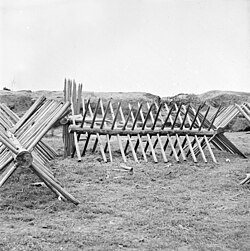
To Heath, he basically gave a little bit of an “attaboy” in agreeing with Heath’s assessment regarding the British Army’s next move. So he recommended that chevaux de frise be sunk in the waters nearby the next likely target (Huntspoint), to thwart the British ships moving in. Other than that, some reinforcements are on their way, so until the British arrive, just hurry up and wait.
Now, a cheval de frise (“chevaux” is plural) was tough for me to explain during the show, but picture a sawhorse with long spikes protruding from it. That’s a basic cheval de frise. (The one in the picture is from the Civil War.) But they’re not limited to this specific design; some stone walls had broken glass, or sharp rocks embedded in their tops to make it tougher to climb over them; those are also considered to be a cheval de frise. The ones that Heath were expected to sink in the East River looked more like boxes with angled spears pointed in the direction the ships were likely to be coming from.
Washington’s other letter, to the Continental Congress, wasn’t so much to inform them of his loss on Long Island as it was to assure them that he was alive and well, and that most of his troops had gotten away despite the magnitude of the loss. It would be several months before Washington could truly notch one in the “Win” column against the British.