Tag: Henry Knox

  • Letters From New England–April 21, 1776

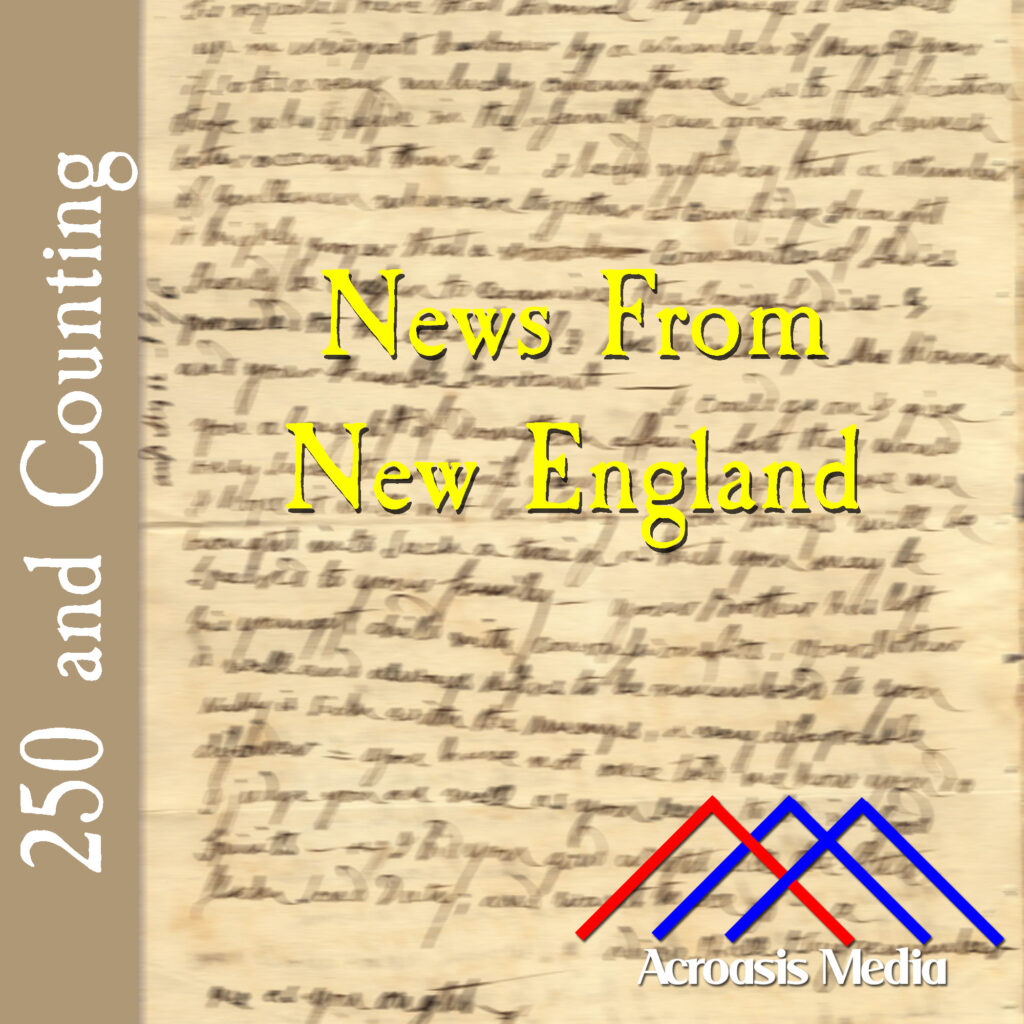
    Cover art for April 21, 1776: Page Four of the letter Abigail Adams sent to her husband John on this day. via Massachusetts Historical Society.

    When Henry Knox wrote to George Washington apologizing for getting to Noweich,Connecicut so late, he had a pretty good excuse: he spent a bunch of money on hiring people to move materials down; and those people had trouble getting the job done.

    But then Henry Knox also tells the story of leaving the caravan briefly to look at Newport RI and determine whether it’s defensible. Imagine how he felt when, after he spent two days figuring out the five best places to stand when defending Newport, he has to explain why he lost those two days afterward. But he did take the time to frame it as an activity that surely would make the Commander-in-Chief look better.

  • The Noble Train Pulls Into The Station–January 26, 1776

    Cover art for January 26, 1776: "Knox entering camp with artillery" by William H. van Ingen, c. 1831. via Library of Congress.
    “Knox entering camp with artillery” by William H. van Ingen, c. 1831. via Library of Congress. Depicts Henry Knox on horseback with soldiers transporting a disassembled canon on a sled through the snow, winter 1775-76, following his famous capture of artillery at Fort Ticonderoga. Wood engraving, hand-colored.

    The Noble Train of Artillery has finally arrived!

    Given that it was over 150 miles from Ticonderoga NY to Cambridge, MA, and that it was wintertime, and that Interstate 90 was still over 150 years in the future, it’s pretty amazing that Henry Knox was able to move so much artillery so efficiently.

    As Mike notes in the episode, the arrival date is largely a guess, since Knox’s diaries ended the last time we checked in with him, about two weeks ago when he was in western Massachusetts and, it appears, nobody else kept accurate notes on the event. There are, however, notes on the disposition of the materiel, so that makes this a pretty good guess. And it allowed the Continental Army to maintain the Siege of Boston until the British finally bailed out two months later.

  • The Noble Train Of Artillery–December 17, 1775

    Cover art for December 17, 1775: One of many, MANY images mistakenly showing the Ticonderoga artillery being transported on ox-drawn sleds. Author unknown, National Archive Collection number 111-SC-100815.
    One of many, MANY images mistakenly showing the Ticonderoga artillery being transported on ox-drawn sleds. Author unknown, National Archive Collection number 111-SC-100815.

    Colonel Henry Knox was just about ready to begin moving the Noble Train of Artillery (a phrase he coined, incidentally). He’d have everything he needed to move by the 20th or 21st of December, and then just seventeen days later, he’d be marching into Cambridge.

    As we all know, he was wrong about how long it would take. But that sort of thing happened frequently.

    What we don’t know is why he said he had the animals he needed to transport the materiel when he didn’t. And even though there are numerous images of the Noble Train of Artillery involving oxen, there weren’t any at all: everything was moved using horses.

    On a personal note: today would have been my grandmother’s 103rd birthday. A lot of things have changed since I was born, but a lot more things changed from the time she was born. The mind boggles.

  • Mister Knox Goes to Ticonderoga–November 16, 1775

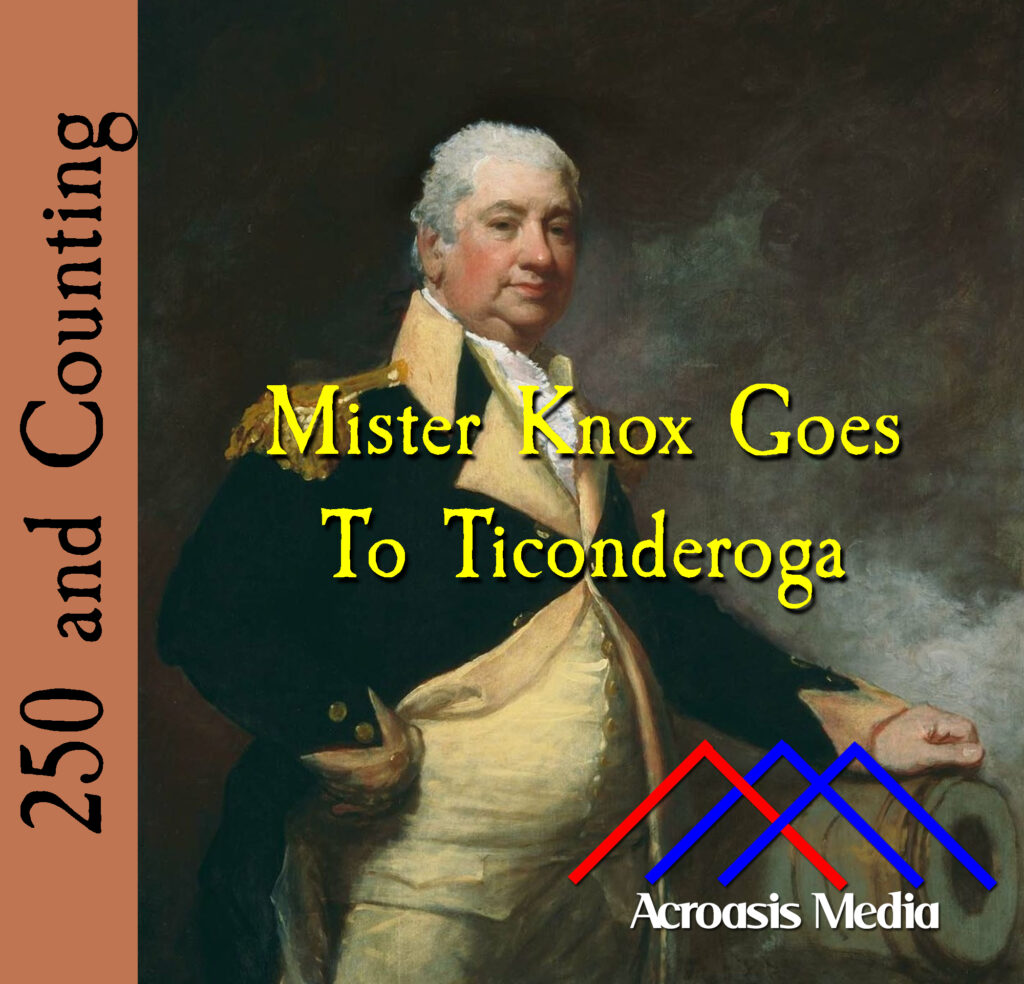
    Cover art for November 16, 1775: Portrait of Henry Knox by Gilbert Stuart, 1806

    It’s a little bit unfair using this portrait to represent Henry Knox, because it was painted many years after his involvement in the Revolution, which began when Knox was 25 years old. As it turns out, this painting is from 1806, the year Knox died.

    Henry Knox ran a bookstore in Boston as a young man, and he was on-hand for the carnage of the Boston Massacre in 1770. So by the time the war officially broke out, Knox was fully radicalized and ready for action. Because of his actions at Ticonderoga, he rose quickly through the ranks and became the Chief Artillery Officer of the Continental Army, and later the Secretary of War under George Washington, though at that point he was mostly dealing with Indian affairs.

    Fort Knox in Kentucky is named after him, but we’re talking about the military installation, not the national depository which is practically next door.