Tag: John DIckinson

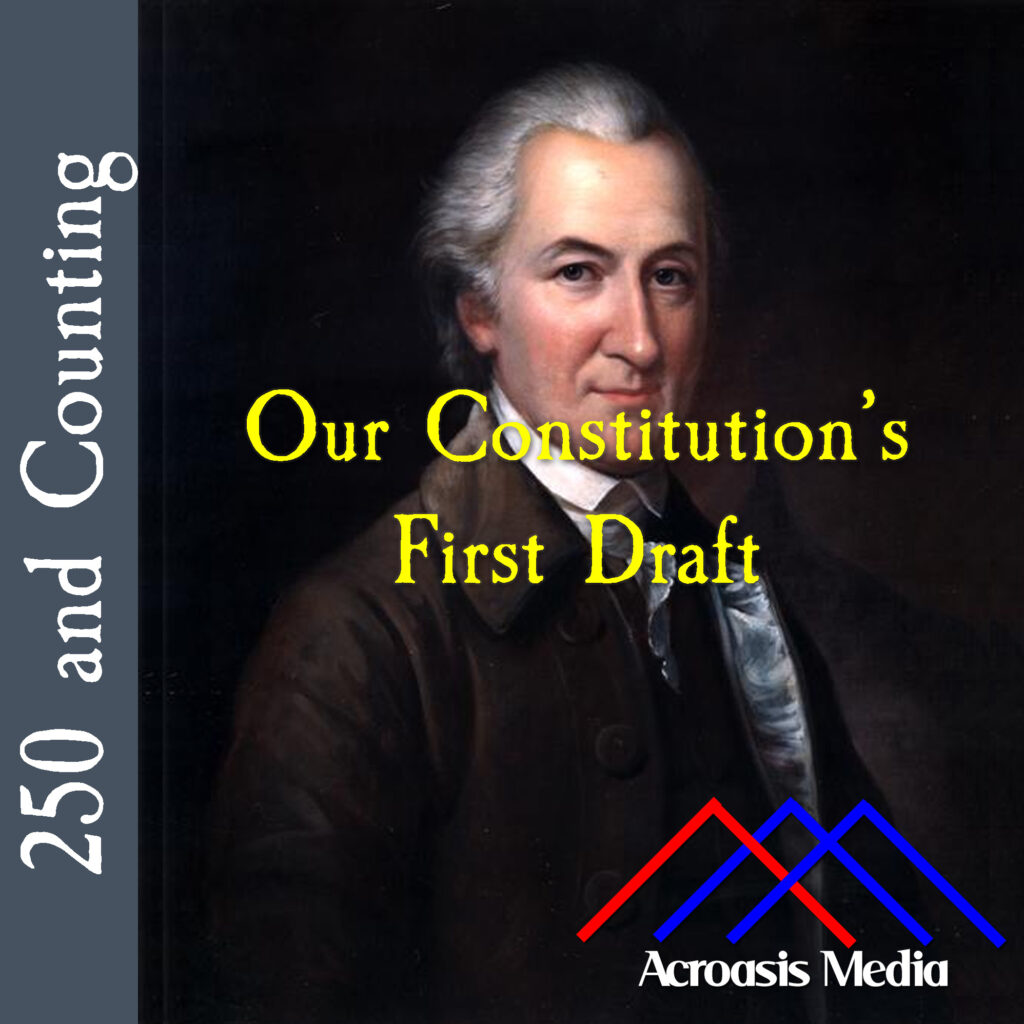
  • The Constitution’s First Draft–July 12, 1776

    Cover art for July 12, 1776: Portrait of John Dickinson by Charles Willson Peale, ca. 1782-3. via Independence National Historical Park in Philadelphia.

    In the play/film 1776, John Dickinson is portrayed as a Loyalist from the Pennsylvania Colony whose goal is to obstruct any efforts at achieving Independence. When his efforts fail, he resigns from the Congress and leaves, though John Adams publicly admires his integrity before Dickinson departs.

    (Leave us alone; 1776 is a delightful film and we both like it, plus it’s many people’s only lens for viewing the story of that time.)

    As usual, however, the truth is far more complicated than could be well-conveyed, especially when cramming several weeks’ worth of story into 168 minutes. So let’s dive in a little bit.

    Dickinson, to begin with, actually represented the Delaware colony, whose delegates were divided on the cause of Independence. But remember that Delaware and Pennsylvania were the same colony as far as Britain was concerned.

    Now, Dickinson argued that while the British Parliament had the right to regulate trade in Europe, they did not have the right to raise revenue via taxing the Colonies; furthermore if the Colonies didn’t resist this, then Parliament would only push their agenda further. But while he felt that the Colonies had the right to seek redress for whatever grievances they had, AND he felt that the Colonies were right in defending themselves against the British, they did not have the right to separate themselves from Britain. Part of this stand involved the fact that Dickinson was immersed in Quaker beliefs for most of his life, though he never officially joined a Quaker meeting.

    Now, because it had been previously agreed by the Congress that no man could serve without signing the Declaration, Dickinson stuck to his principles and voluntarily left, but he did join the Pennsylvania/Delaware militia afterward, though he never actually saw combat. It’s also worth reminding you that the Declaration was still largely unsigned at this point, and would remain so for a few more weeks, so it’s not a contradiction that he was working on a new Constitution at this point.

    Dickinson was re-appointed to the Continental Congress in 1779 and he did sign the Articles of Confederation, which arose from the document submitted by his committee on this day in 1776.

    John Dickinson was a complex and fascinating man, and you can learn a lot about him by visiting the John Dickinson Plantation, part of First State National Historical Park.

  • Congress Has A Busy Day–November 6, 1775

    Cover art for November 6, 1775: portrait of John Langdon by Hattie Elizabeth Burdette, 1916.

    There are going to be days when no truly big events happen, but that wasn’t going to stop the Second Continental Congress from getting stuff done.

    Today we have a bit of an image of that group as a bunch of men who are hard-drinking philosophers, ready—and maybe eager—to burst into fisticuffs, or perhaps the occasional song, depending on where you got your impressions.

    So for that reason, we do like to remind you that the Continental Congress, for all their weird little squabbles, was a serious group of men. They took their jobs seriously, and put a lot of thought into everything they did. They often put in long hours, working until after darkness fell many days, and they typically worked six days a week.

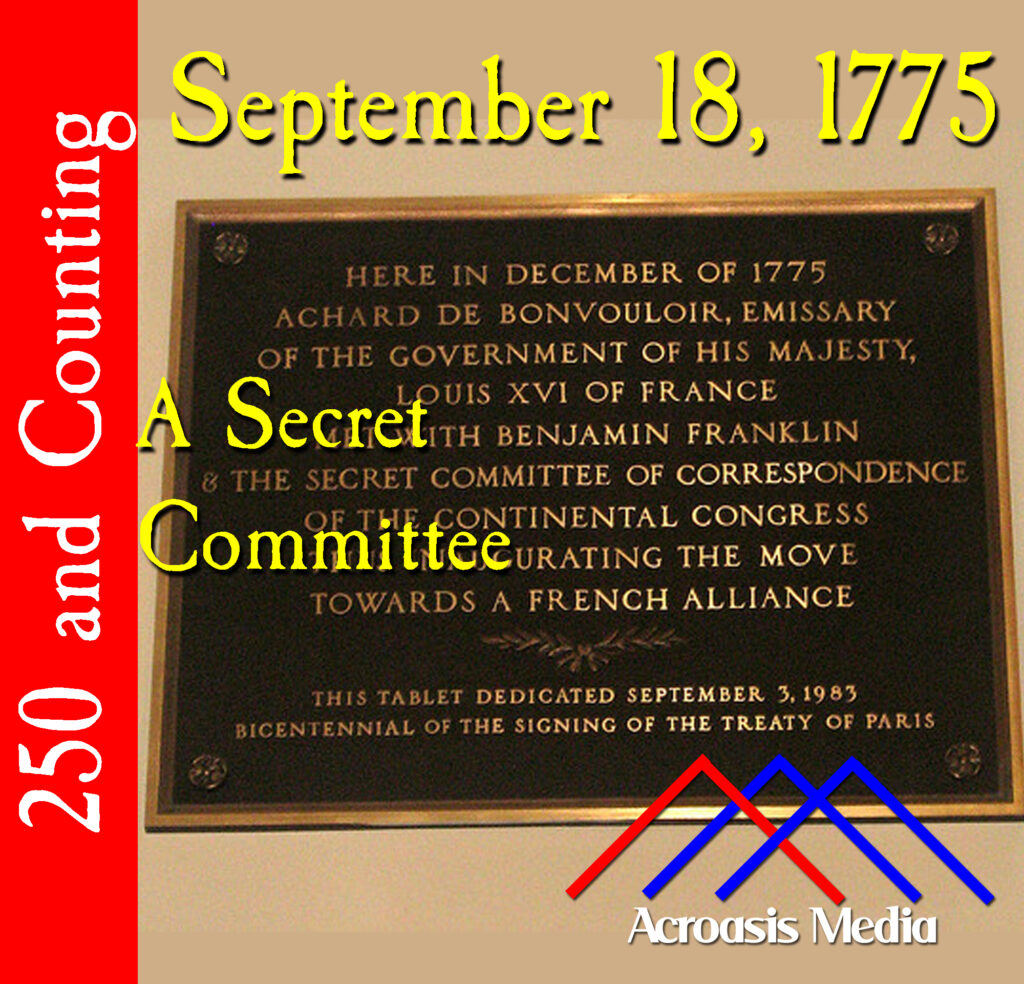
  • September 18, 1775: A Secret Committee

    Cover art for September 18, 1775: Theplaque in Carpenter's Hall (Philadelphia) designating the location where the Committee of Secret Correspondence met with Julien Alexandre Achard de Bonvouloir.

    The Committee of Secret Correspondence is one of those names that sounds like they should be on Double Secret Probation or something. However, when you look at their purpose, the name makes sense.

    The Committee of Secret Correspondence was formed to seek out support from other nations. They reached out to France, Spain, and a few others to get supplies, food, munitions…pretty much anything they could get. Oftentimes they had to use a third party to give everyone plausible deniability.

    And fortunately, their tactics were mostly successful.

  • July 24, 1775: A Leaked Letter From Someone Who Knows Better

    Cover art for July 24, 1775: Engraving of John Dickinson, approximately mid-1770s, from the New York Public Library Digital Collection.

    Even when it’s Mike’s voice you hear on the episode, it’s Claude who takes the blame for the episode titles.

    It wasn’t a bad thing for members of the Continental Congress to disagree, but some level of decorum was still expected from those members. And almost certainly, one of the commandments was Thou Shalt Not Trash Talk Thy Fellow Delegate. (I may have softened the language a little bit, there.)

    Still, Adams had a right to express whatever frustration he had with John Dickinson, unfortunately the letter in which he did it got intercepted by the British and publicly published; the mere suggestion that there was some dissention among the ranks of a group that typically presented its work as a united front was certainly a Big Deal.

    And it certainly didn’t grease the skids between Adams and Dickinson, nor was that rift ever truly healed.

  • July 5, 1775: The Olive Branch Petition

    When the Second Continental Congress convened in May, there was a large faction of delegates who thought that peace with England was still possible, and made a specific effort to draft a message of reconciliation with King George III.

    They finished their document and presented it to the whole body of Congress on this day in 1775, which approved it and it was subsequently prepared and sent to Great Britain. In a few weeks we’ll talk a little bit about what happened at the other end.

    Note: I realize that the file reads “July 7,” as did the headline on this post originally. That was a typo that got carried over from one to the other via copy and paste. This was in fact the July 5 file and apologies for any confusion.

  • May 26, 1775: One More Attempt at Peace

    Cover art for May 26, 1775: Portrait of John Dickinson, ca. 1780 by Charles Wilson Peale

    Despite everything that had already happened, there was still a sizeable chunk of the Second Continental Congress who thought that some form of reconciliation with England was possible.

    Under their logic, the fact that there had been fighting at Lexington and Concord should have provided King George with ample proof that his policies were unpopular, and maybe he could back off on them a little bit.

    In retrospect, we can see that this was rather short-sighted, and that those people truly didn’t understand the motivations that the English leadership had for their actions. Plus, England had history on their side: someone’s acting up? Squash them like bugs and get them all back in line.