
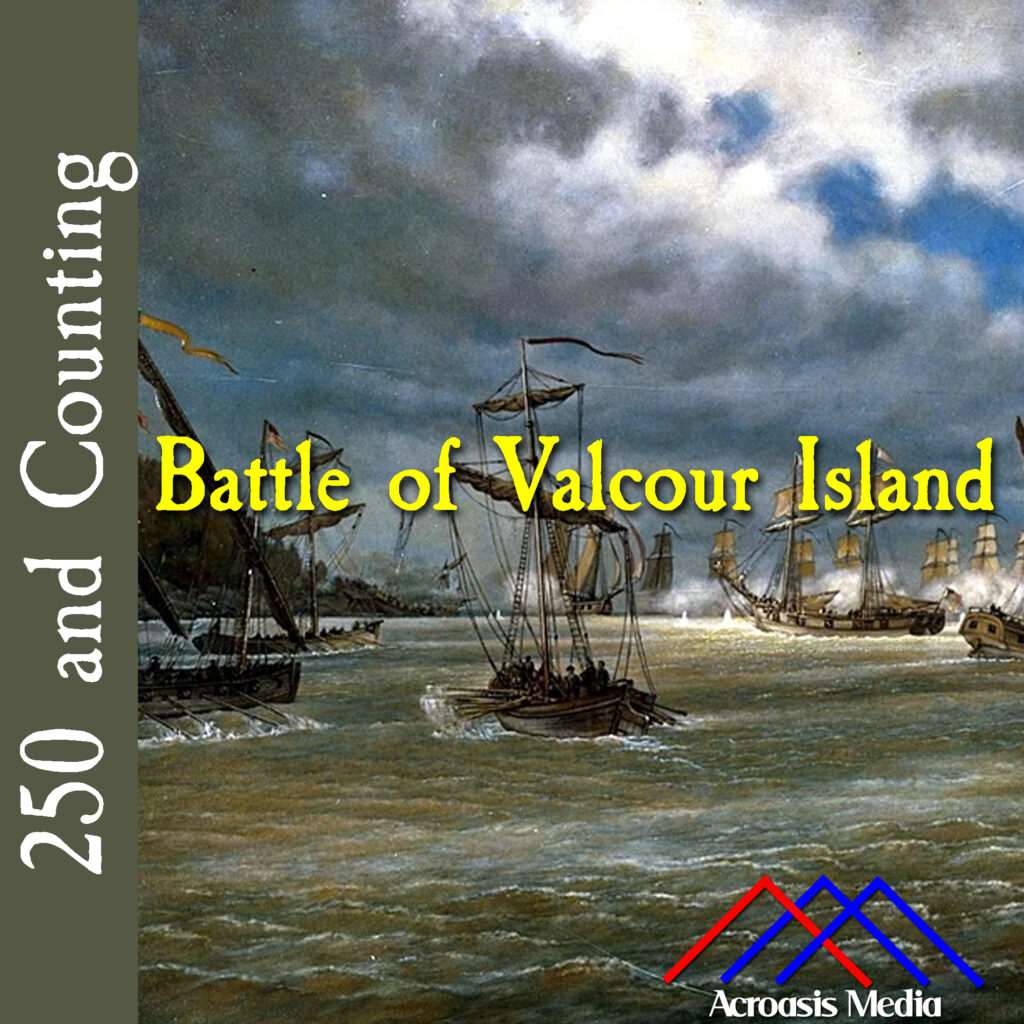
The Battle of Valcour Island didn’t really take place on the island; rather it was in Valcour Bay, a strait between New York and Valcour Island, in Lake Champlain.
After the failed invasion of Quebec the Continental forces retreated south to Fort Ticonderoga, at the south end of Lake Champlain. As they retreated they destroyed materiel they couldn’t use and left it behind in the relatively shallow, relatively narrow lake. This made navigating the lake tough for the British, so they took their time to get more reliable ships to assist with their next move.
That turned out to be a mistake.
As both sides prepared for the next conflict, the Americans scouted the lake and determined that they could effectively steer the British ships into Valcour Bay, where they would have ships waiting to fight them off. In addition, the wind was blowing the “wrong” way for British navigation, making things even tougher. Some British ships actually ran aground near the island but the battle itself was pretty brutal, with ships on both sides being badly hit. One British vessel’s powder magazine was struck and the entire ship exploded.
In the long run, however, darkness began to fall and both sides backed off. The Americans retreated, and the British basically stopped their attack largely because they were getting low on ammunition.
Benedict Arnold realized that Crown Point was no longer a viable defense point, so he destroyed and abandoned the fort, moving the forces to Ticonderoga. The next day, the British took Crown Point and remained there for about two weeks. Unfortunately, cold weather was already settling in and the decision was made to winter back up in Canada.
Remember when I said that taking their time was a mistake? Had they acted more quickly, they’d have beaten the weather AND caught the Americans by surprise. General Carleton and other officers recognized this in hindsight. Hessian commander Baron Riedesel noted, “If we could have begun our expedition four weeks earlier, I am satisfied that everything could have ended this year.”
And in a weird way, this battle was the catalyst for Benedict Arnold turning against the Americans. He’d lost a lot of personal papers during the battle, and when he requested compensation for some of his expenses in and following Quebec, he couldn’t provide documentation. He’d already been secretly negotiating with the British to change alliances (this would have been in late 1779), but that incident pushed him into resigning his command in order to be transferred to West Point, which he’d planned to surrender to the British.
Fortunately his plot was discovered and he fled to New York City, which was still occupied by the British. Eventually he got passage for himself and his family to England. He never set foot in the United States again.
Podcast: Play in new window | Download | Embed