Engraving titled Washington and Fairfax and a War-Dance by John Rogers, 1857. The event depicted actually took place in 1779.
As noted in the episode, there were several different rules laid down for trading with Native Americans at that time, and some of them were designed to ensure that they remained on our side or, at worst, that they remained neutral in Revolution-based matters.
But the rules wound up working out well for both sides: the various tribes were able to get the materials they wanted, and trade was conducted under better-controlled conditions.
In addition, they led to trade-related treaties with several tribes up and down the coast during the next year or so. And with over 80 tribes east of the Mississippi River at that time, that’s a lot of treaties to negotiate.
“Knox entering camp with artillery” by William H. van Ingen, c. 1831. via Library of Congress. Depicts Henry Knox on horseback with soldiers transporting a disassembled canon on a sled through the snow, winter 1775-76, following his famous capture of artillery at Fort Ticonderoga. Wood engraving, hand-colored.
The Noble Train of Artillery has finally arrived!
Given that it was over 150 miles from Ticonderoga NY to Cambridge, MA, and that it was wintertime, and that Interstate 90 was still over 150 years in the future, it’s pretty amazing that Henry Knox was able to move so much artillery so efficiently.
As Mike notes in the episode, the arrival date is largely a guess, since Knox’s diaries ended the last time we checked in with him, about two weeks ago when he was in western Massachusetts and, it appears, nobody else kept accurate notes on the event. There are, however, notes on the disposition of the materiel, so that makes this a pretty good guess. And it allowed the Continental Army to maintain the Siege of Boston until the British finally bailed out two months later.
The monument erected to honor Richard Montgomery outside St. Paul’s Chapel at Trinity Church. The inscription reads: This Monument is erected by the order of Congress, 25th, Janry, 1776, to transmit to Posterity a grateful remembrance of the patriotism conduct enterprise & perseverance of Major General Richard Montgomery Who after a series of successes amidst the most discouraging Difficulties Fell in the attack on Quebec. 31st, Decbr, 1775. Aged 37 Years.
We weren’t even a nation yet and Congress had already commissioned the Richard Montgomery Memorial. And while the memorial itself was completed rather quickly by the commissioned artist, the war interfered with its transport and it took nearly ten years to find all the pieces.
(Dirty Secret: they never found all of them; the urn at top center was a reproduction.)
Montgomery was generally known to be a good general even if his death was practically inevitable, given the circumstances. But that didn’t stop people from turning him into a martyr for the cause of Independence.
PS. Trinity Church’s website has a page dedicated to the monument, which aided my research for this episode. There’s a huge, fascinating segment dedicated to the 2011 restoration process for this memorial.
Detail of an 1830 lithograph by Ducarme after a portrait by Legrand.
While the United States has had its share of international mishaps, not all of them have been created by Americans. Jean-Guillaume Hyde, more properly known as “Jean-Guillaume, baron Hyde de Neuville”, would be an early example of this.
Hyde was probably a textbook case of failing upward, as he appears to have suffered multiple setbacks and still managed to come out ahead later on. As early as 1793, when he was 17, Hyde liked to work behind the scenes, trying to nudge people into saying and doing things that would benefit France, and oftentimes failing. This eventually led to his being made to move to the United States in 1800. In 1814 when the Bourbons returned to power in France, he was allowed to return.
That’s where his diplomatic career began, and he spent six years as the ambassador to the US, where he was rather universally despised. From there he went to Portugal, where he was again a disaster as a diplomat. This time it only took about three years to kick him out.
In 1828 Hyde became Minister of the Navy and the Colonies where he did appear to have some luck improving the way the French Colonial Empire was organized and run, but he eventually resigned from the position as a symbol of protest.
Hyde was involved with the internal discussions to decide whether a new commercial treaty with the US was a worthy idea, though we don’t think he did any of the actual negotiating with America.
Hyde died in Paris in 1857 and the book of his “memoirs” is actually a collection of letters and notes compiled by his nieces.
“An English Ship at Sea Lying-To in a Gale,” painted by Willem van de Velde the Younger, late 17th century.
The HMS Blue Mountain Valley—which probably got its name from the place in eastern Jamaica—had rather a rough trip to America from London in late 1775 and early 1776.
They left London in mid-October 1775 and ran into multiple storms before arriving somewhere near Boston nine or ten weeks later. Damage to the ship was such that it was judged unsafe to enter the Massachusetts Bay because safe navigation there couldn’t be guaranteed. They decided to head further south, arriving near Egg Harbor, NJ on January 18.
Given that they were under orders not to approach the coast without an escorting warship (or reassurance from a warship that a given harbor was safe), they chose to take the Blue Mountain Valley a few miles north to Sandy Hook, where they could get a refit to navigate the ship safely. Bad luck for them; Patriot forces knew they were coming and laid a trap, capturing them easily. By that point, the sailors were hungry and thirsty, much of their cargo had died or gone rotten, and it’s entirely possible that the crew actually viewed capture as a kind of rescue. The ship was moved to Elizabethtown (now known as just Elizabeth, just south of modern-day Newark Airport) and the crew given parole in the town.
PS: much of my research for this episode came from Eric Wiser’s Journal of the American Revolution article “Blue Mountain Valley and the Rise of Lord Stirling,” which goes into much greater depth than I could provide either here or in the episode. It’s a pretty fascinating read.
Portrait of Francis Lightfoot Lee. Artist and date unknown, however the original painting is thought to have been created during his lifetime. This is the basis for many images of Lee.
Francis Lightfoot Lee is another one of those Founding Fathers who was there for much of the main action, but who doesn’t seem to get as much press as Jefferson, Franklin, Adams and a few others. That’s not to say he didn’t have any influence.
In fact, as we learn today, he was one of the first to suggest the inevitability of a clean break with Britain. At least, one of the first to actually put it in writing, which was pretty brave considering the British habit of reading people’s mail.
Portrait of Elisha Haley, artist unknown, created approximately 1860.
Elisha Haley wasn’t necessarily a lawmaker at either the State or the Federal level who made such a huge mark that he’s become a kind of household name, but he appears to have been solid enough that he could get elected multiple times at both levels.
I did discover, after recording the episode, that Haley is not, in fact, buried in Crary Cemetery but rather in the Wightman Cemetery, which is also in Groton. His wife and four of his children are also buried there.
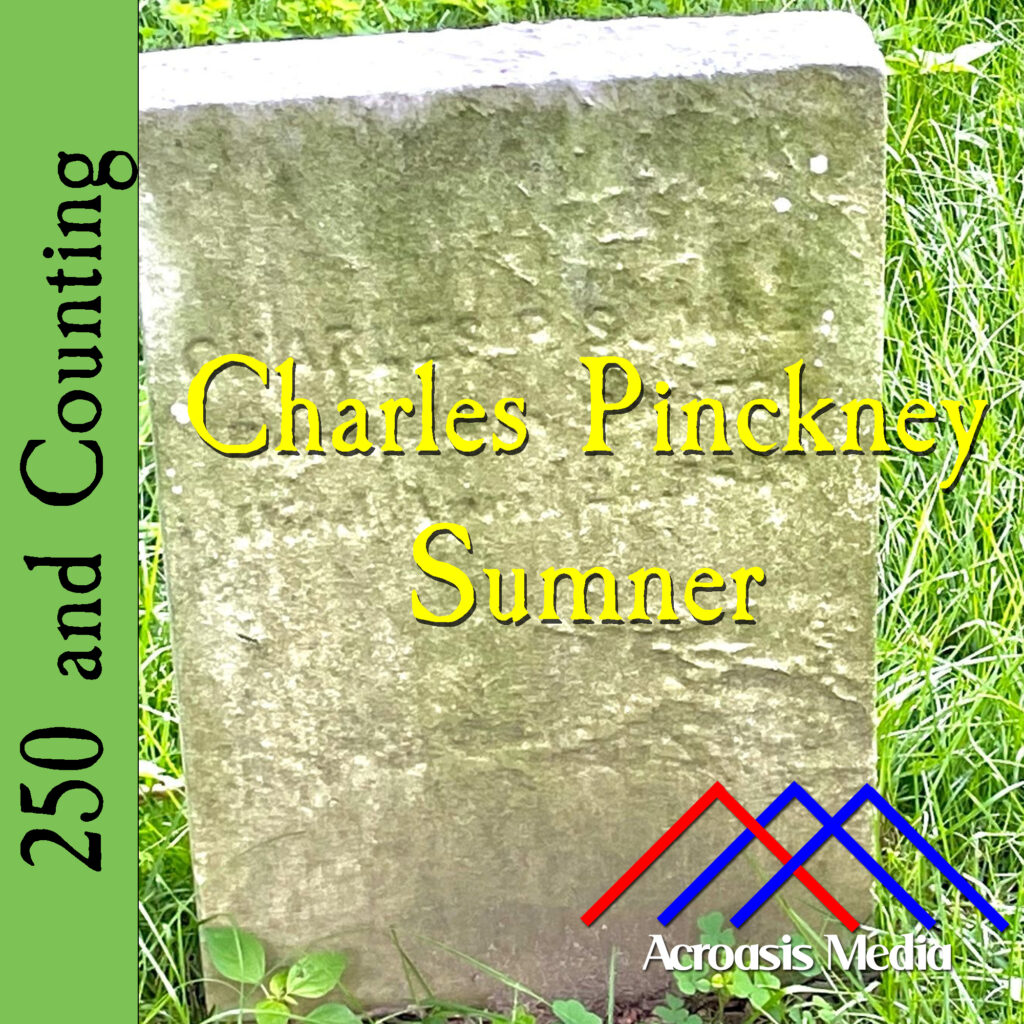
Charles Pinckney Sumner was a man ahead of his time, in the sense that he knew not only that slavery was wrong, but that slaves need not only to be freed, but to be treated as equal citizens.
He also carried a rather Utopian view of what society should be like, that Nature was at least as important as Nurture, if not more so.
Although he and his wife Relief Jacob had at least nine children, they were considered to be not especially demonstrative with one another, even described by some as “formal.”
Painting of the Continental Congress by John Trumbull, created around 1819. This painting depicts a date several months after today. Trumbull was especially insistent on painting subjects from life whenever he could.
The Second Continental Congress Committees, several of them anyway, reported out on this day in 1776 and it was starting to become clear that the individual colonies had some needs when it came to defense.
There were issues with prisoners possibly being mistreated, word had gotten back regarding what had happened in Quebec on New Year’s Day, South Carolina had some need for sailors to defend the Charleston Bay…there was a lot going on, and while we view the large number of committees, with names that are either too obvious or a little silly, to be a bit much, we’re also viewing it through a modern-day lens.
Not that life was simpler—though it was, in a sense—but that the Congress was quite pragmatic and direct in the way they operated.
Given that Benjamin Church was discovered to be a traitor long before Benedict Arnold was, it’s a little peculiar that Arnold’s name has carried down through history much more than Church’s was.
Maybe it’s because Church was a little less prominent in the Revolution before he was caught. Maybe “Benedict Arnold” has a better ring to it as something to hurl at someone who’s broken your trust.
It’s also possible that, at that time, nobody really knew the extent of the damage Benjamin Church had done, while Arnold’s treachery was immediately apparent.
(For what it’s worth, it’s been postulated that Benedict Arnold’s traitorous activities were pushed on him by his wife, but nobody gets called a “Peggy Shippen,” so in the end, who knows?)