John Frelinghuysen was born on this day in 1776 (hey! Cake and Candles for this man!) and died in 1833. Like many people of the time, he never permanently left the area where he was born. Born there, lived and worked there, died there.
He probably went to Trenton on business a few times, and he was stationed at Sandy Hook while in the Army, but that appears to be about all as far as travel.
John Frelinghuysen married Louisa Mercer in 1797, and they had two daughters: Gertrude and Mary Ann. Louisa died around 1809 and John married Elizabeth Mercereau Van Vechten on November 13, 1811. They had eight children: Louisa, Theodore, Frederick J., Catharine, Sallie, Sophia, and Elizabeth LaGrange Frelinghuysen.
While preparing to depart Boston for New York, George Washington appointed Nathaniel Greene to run things for awhile until everything was back in order.
Fortunately for both Greene and Washington, matters straightened out rather quickly, because Greene was called to join Washington just a few weeks later.
Nathaniel Greene was tasked with fortifying Brooklyn while Washington prepared to defend Manhattan. As a military leader, Greene had a bit of a mixed record, but more often than not it appears that he was the victim of poor timing when things didn’t go well for him.
Later on in the war, he took on the position of Quartermaster General, which on its surface looks like a demotion, but Washington still considered him “inner circle” and Greene would sit in on War Council meetings, even though he was considered a staff officer.
Later on, when things started looking gloomy in South Carolina and Georgia, Nathaniel Greene was put in charge of the Southern Department of the Continental Army, where he embarked on a campaign of guerilla warfare rather than pitched battles. His unconventional approach wasn’t always successful, but if the British won a battle it was at a much greater cost than it should have been.
Philemon Beecher is an unusual name (said the guy named Claude Call, sigh), but that’s on us for not recognizing it as a name from the Bible. Philemon was a man to whom the apostle Paul wrote while in prison. He was in prison more than once, but it’s not entirely clear which stretch Paul was doing when he wrote it.
Philemon was a leader in the Colossian Church, and Paul’s letter—one of a very few that scholars generally agree was actually written by Paul—touches on themes of reconciliation, forgiveness, and Christian fellowship, addressing themes of slavery, freedom, and ethical conduct within the Roman social context. While it doesn’t explicitly condemn slavery, it reframes master-servant relationships in spiritual terms, highlighting the moral and social transformation encouraged within early Christian communities.
But I digress. Philemon Beecher was a successful attorney and a semi-successful politician who was one of Ohio’s first House members once Ohio became a state. Beecher also got married in 1803, so that was a pretty good year for him. He was one of ten children, one of whom died at the age of three and who coincidentally was also named Philemon Beecher. They recycled that name two years later! Some of his other siblings also died relatively young but they had reached adulthood.
I don’t imagine he had an especially distinguished political career, given that I couldn’t find an image of him in any of my usual haunts. What’s more, I couldn’t ascertain whether he and his wife Susan had any children, though it appears the answer to that is “no.” Nevertheless, he remained a prominent citizen as an attorney and member of the board of the Lancaster, Ohio Bank. He also participated as a member of The Colonization Society in Lancaster, a group dedicated to repatriating Black people back to Africa as an alternative to slavery.
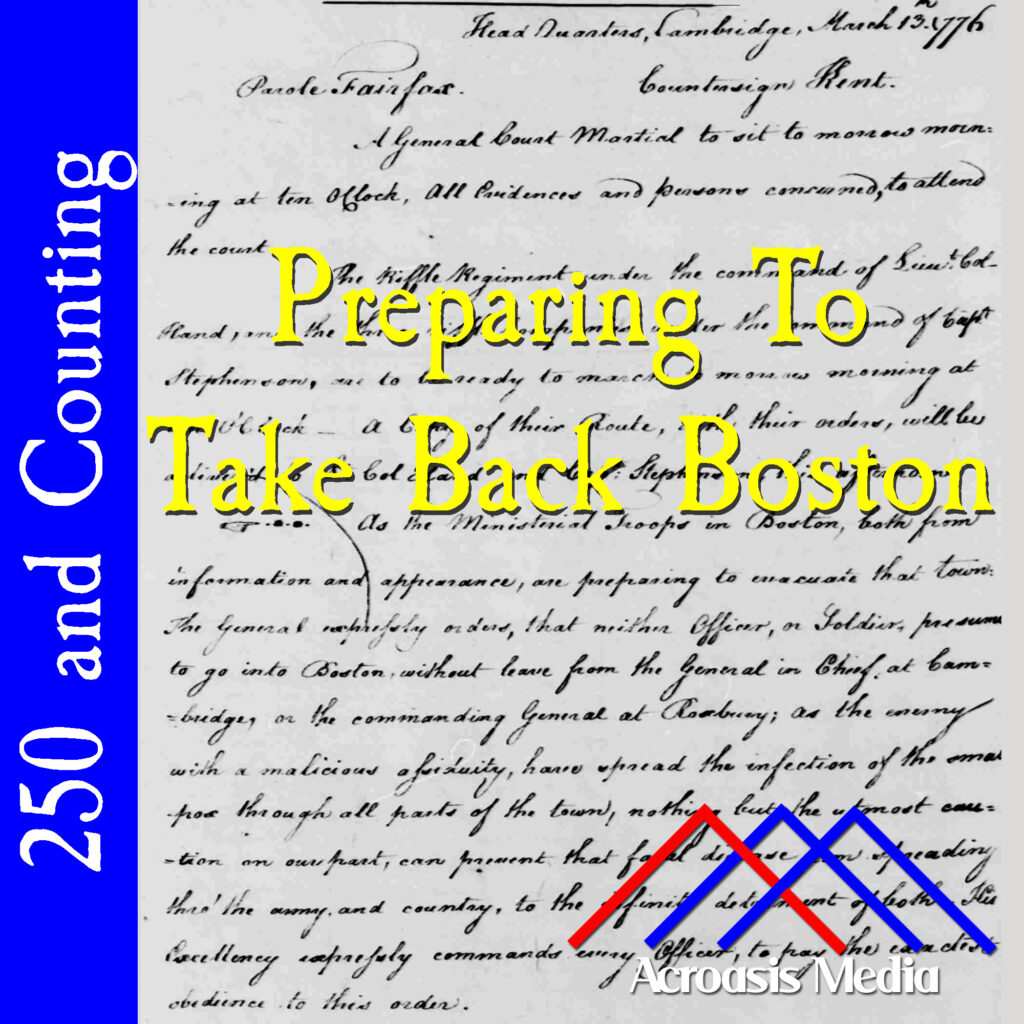
In the aftermath of the siege of Boston, it was incumbent upon George Washington and his men to re-enter the city and take stock of its condition.
Mike brings up Artemas Ward in today’s episode, and I’m pretty sure that was the first time his name has come up in the course of this podcast. Ward was a major general during the Revolutionary War, among others, and an effective political leader when he wasn’t being a soldier. It was Ward who sounded the alarm on Bunker Hill, and who took command of the New England area once Washington led most of the troops down to New York City. ‘
The statue in today’s cover art can be found in the center of a traffic circle in Washington, DC, where Massachusetts and Nebraska Avenues cross one another. Ward’s great-grandson donated four million dollars to Harvard on the condition that they build a statue of Artamis, and maintain his Shrewsbury home. Harvard apparently chose to purchase a statue but did not provide enough money to provide the general with a horse. Oddly enough, because it’s a traffic circle and therefore has no obvious way for a pedestrian to get to the center (i.e., no crosswalk), it’s quite difficult to get close enough to the pedestal to read the inscription:
ARTEMAS WARD 1727–1800 SON OF MASSACHUSETTS GRADUATE OF HARVARD COLLEGE JUDGE AND LEGISLATOR DELEGATE 1780–1781 TO THE CONTINENTAL CONGRESS SOLDIER OF THREE WARS FIRST COMMANDER OF THE PATRIOT FORCES
It’s been 333 days since Lexington and Concord, when the British were forced to retreat to Boston and were bottled up there by Colonial forces.
It’s been a week since the British said “enough” and decided to effect their departure from the city as soon as the weather cooperated.
But today, the day finally came.
It took about five hours to launch over a hundred ships, carrying thousands of soldiers, women and children from the city.
It was Washington’s first major win and the last time the British did anything of importance in New England. The war began to move south, to New York, New Jersey, and Pennsylvania. Virginia and the Carolinas also had their share of action, as we’ll see in the coming months.
Georgia delegates to the Second Continental Congress numbered exactly one until around this time. That would be Dr. Lyman Hall, who didn’t believe it was ethical for him to represent the entire colony when he knew that feelings were largely divided back home.
Then came the Battle of the Rice Boats, on March 2 and 3. After that, it seems, things moved very quickly for Georgians: the Royal Governor, who’d been in and out of custody, fled to a nearby warship, the Provincial Congress was left in charge, and they immediately began making plans to raise a more formal army than the militia that fought in the Battle of the Rice Boats, and Georgia delegates were sent to the Continental Congress with actual instructions.
In addition, pieces were put in place to write a constitution for Georgia, a good first step toward the document that was created later in the year and adopted the following February.
There’s a ninth season episode of The Simpsons called “Sideshow Bob’s Last Gleaming” in which Bart’s nemesis, Sideshow Bob, steals a nuclear bomb and threatens to detonate it unless the town disables all of its television broadcasts. He delivers this ultimatum via a Jumbotron screen. Before ending the transmission, he says, “By the way, I’m aware of the irony of appearing on TV in order to decry it…so don’t bother pointing that out.”
And to a certain extent, that’s what happened today in 1776 as well. The Colonies were protesting British oppression, but in order to do that successfully, they had to briefly resort to British tactics.
It’s an unfortunate truism that the “good” side often has to resort to the “bad” side’s means of doing things to achieve an objective. On the other hand, the difference between the “good” and the “bad” side is that the “good” side is willing to undo the thing they did.
I cited The Simpsons above, but I’m sure you could come up with your own specific television episodes in which this is what happens. (I’m sure you can because another one just came to mind, but I’m not sharing it.)
First: let me apologize for the slight change in sound quality for today’s episode. I’m not in my usual recording space and I’m not especially happy with the equipment I brought. At worst you’ll have to put up with it just one more time.
Next: George Washington was a gentleman through and through, so the fact that his general orders sometimes focused on the Continental soldier behavior shouldn’t be a surprise. In today’s episode he concerns himself specifically with that, but for two reasons. One is for the health and safety of the troops, but the other is because the Bostonians have been through enough, and he doesn’t want the Continental Army–the people supposedly on their side–to look like villains.
In the meantime he’s already standing down a big chunk of soldiers and sending them to New York, where the next big battle is going to be, he thinks. (Again, he’s right, but he didn’t realize it at the time.)
Of course it’s coincidental, but it’s kind of cool that we’re able to bring you this episode during Women’s History Month and the same week as International Women’s Day.
Believe it or not, Mike and I have struggled with the fact that there’s very little representation of anyone from this era who isn’t a white male. We’ve managed to touch on a few women and African-Americans from time to time, but after 435 episodes (including today) we’re probably still in the single-digit range.
Mike doesn’t concentrate very much on the newspaper notice that appeared in Baltimore this day; he gives us a little perspective on some of the ripples created by events we’ve talked about so far. Sometimes the women’s history angle comes from the things that are mundane in print, but vital to the success of the war.
It doesn’t make up for the lack of representation, but we hope it helps.
The focus today up in Cambridge, while waiting for the British to hightail it out of Boston, was getting the men ready to move to New York, and putting together Washington’s personal guard.
Washington didn’t really need a personal guard in Cambridge, at least not much of one, because he was in the driver’s seat while he was there. The British were bottled up, and he was the stopper. But to move to New York and then defend that territory? Well, that was another project entirely. New York had more access points, more deepwater harbor, and more territory overall to defend. This wasn’t like keeping the British locked up on the peninsula that was the entirety of Boston. And while Washington probably considered it a bit of vanity at first (that’s a guess on my part) to even have a group of men dedicated to being “Washington’s personal guard”, he likely began to understand the inevitability of needing the guard as the Continental Army’s Commander-in-Chief.