Tag: War of 1812

  • Joseph Lee Smith–May 28, 1776

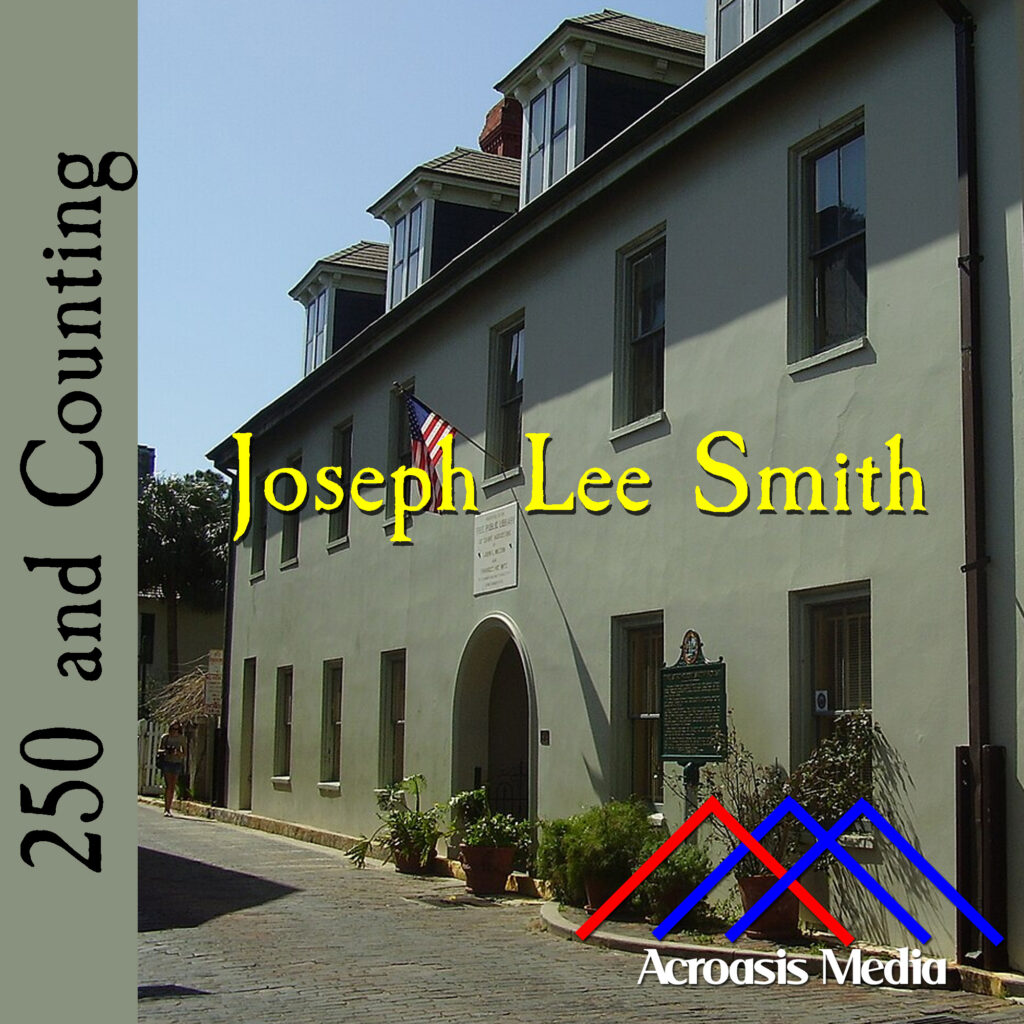
    Cover art for May 28, 1776: Joseph Lee Smith's home (Later Kirby Smith's) in St. Augustine, Florida. Uploaded to Wikipedia by user WhisperToMe.

    There’s a cool thing about Joseph Lee Smith that Mike doesn’t cover in his story today, probably because he is SO JEALOUS OF ME.

    Nah, I’m kidding. But the fact is, Joseph Lee Smith is tied up a little bit in my distant family history.

    I mentioned once before that my family can trace back to a common ancestor, Thomas Call, who arrived in America sometime in the 1640s. Thus, anyone with the surname Call is related, however distantly. There were Calls who were among the first Mormons to go west with (the other) Joseph Smith, so the name is about as common in Utah as it is uncommon pretty much everywhere else.

    Smith moved to Florida in 1821 and from 1823 to 1832 he was a territorial judge. In 1823 a delegate from Florida named Richard K Call introduced a resolution calling for the US House Judiciary Committee to investigage Smith on charges that he took bribes and kickbacks. The resolution was adopted and the investigation went on for at least seven years, but no charges were ever filed to impeach Smith.

    There are a few Calls in Florida history, and a couple of towns have a Call Street, including Starke, which has a “Call Street Historic District“. This area was named specifically for Richard K Call.

    Hm. My brother is named Richard Call, though he has a different middle initial. I may have to let him know about this…

  • Mary Pickersgill–February 12, 1776

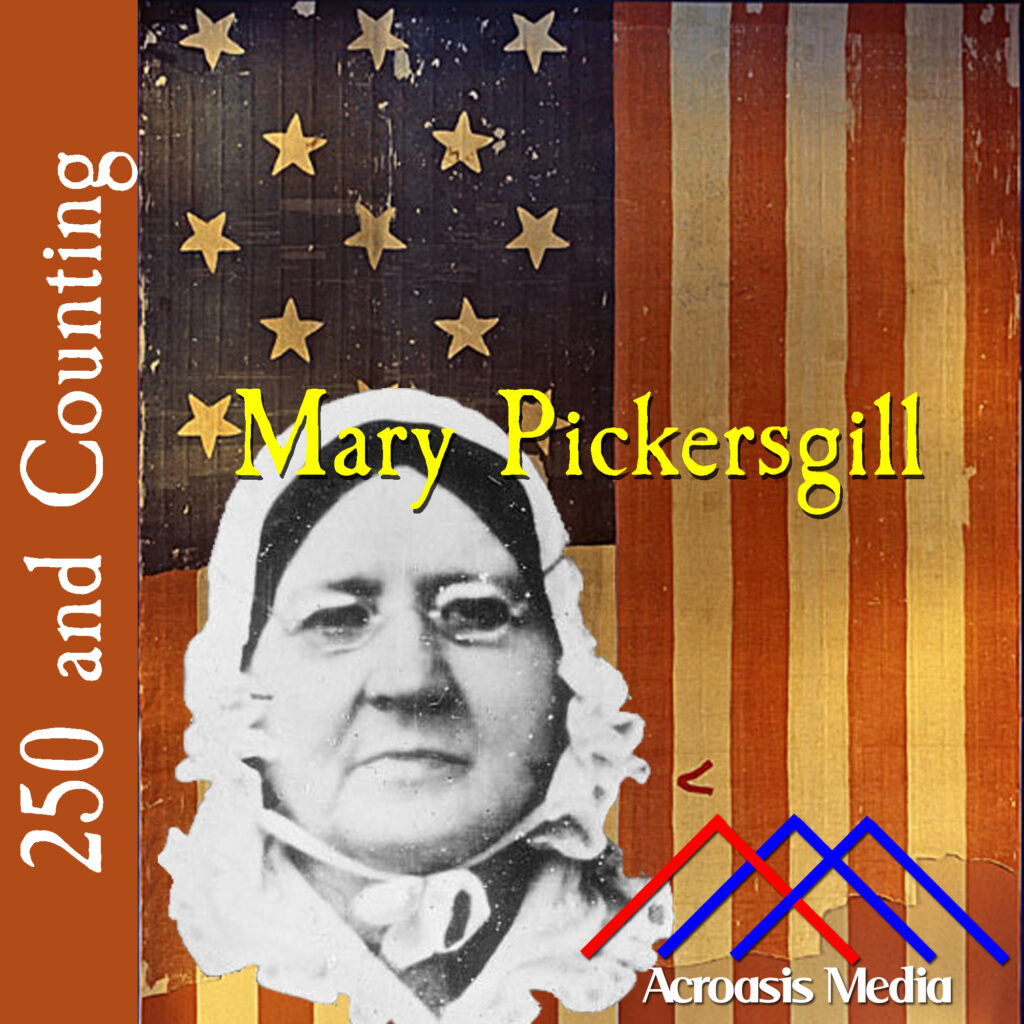
    Cover art for February 12, 1776: Mary Pickersgill and the Star-Spangled Banner flag, now on display at the Smithsonian Museum of American History.

    The thing that’s hard to understand when considering the flag that Mary Pickersgill put together, and that inspired our National Anthem, is that it’s huge. Mike says specifically that this flag is 17 feet by 42 feet, but that’s hard to picture.

    When the flag was first displayed at the Smithsonian, it hung out in the open, against the atrium wall. But a flag that big, and that old, eventually begins to give in to gravity. So the Smithsonian folks took it down and spent a couple of years restoring it. Part of the work involved undoing the restoration job from 1914:

    Now, a lot of it had been cut away for souvenirs (you can see the frayed bottom partially disguised by the painted stripes in the cover art today), and that red “V” shape is really meant to be an “A” for General Armistead. But the flag is back on display, lying flat at an angle making it easier to see, in a temperature- and humidity-controlled setting.

    The parts that have been cut away are still missing, and the “A” has been removed. but even with nearly half of it gone, this thing is still enormous. And an original-size replica often flies over Fort McHenry, weather permitting.

  • September 24, 1775: Captain Nathan Heald

    Cover art for September 24, 1775: Photograph of Nathan Heald, date unknown.

    It could be argued that Captain Heald’s biggest claim to fame is that he was on hand for the disastrous outcome at Fort Dearborn, but at least he doesn’t eat the blame for it; it just happened to be the guy who was there.

    On the bright side (such as it is), the events at Dearborn were soon overshadowed by President Madison declaring war on the British, thus beginning the War of 1812. Heald and his wife, who were both injured at Fort Dearborn, were released back to the Americans. Heald was promoted shortly thereafter and given a disability discharge in 1814. And isn’t that always the way.

  • June 29, 1775: Thomas Boyle, Privateer

    Cover art for June 29, 1775: Picture of Thomas Boyle, source unknown

    Thomas Boyle wasn’t born in Baltimore, Maryland, but when he was a young man he made it his home and became quite successful there, as a merchant marine and an overall businessman.

    And, of course, given Baltimore’s penchant for naming streets after historic people and events, there is a Boyle Street. It’s not very long; in fact you see the entire road in the photo below.

    In this picture the viewer is standing on Fort Avenue looking down toward Key Highway. The green structure in the background is the Baltimore Museum of Industry, and the Inner Harbor is just beyond that. Based on my research, Boyle didn’t live near this location; he’d settled in a part of town called Fell’s Point, which is on the other side of the harbor and about a mile to the east. If a person standing where the camera was for this photo turned to the right, they could probably see the entrance to Fort McHenry.

  • March 12, 1775: Henry Eckford, Shipbuilder

    Cover art for March 12, 1775: portrait of Henry Eckford, probably painted by John Wesley Jarvis

    Henry Eckford was born in Scotland on this day in 1775 and died in Constantinople in 1832. In between he spent a great deal of time in the Thirteen Colonies and then the United States, primarily in New York.

    Eckford also dabbled in politics, serving in the state legislature and as a delegate to the Electoral College, before moving to the Ottoman Empire to assist with rebuilding the fleet there. He died quite suddenly there, probably of cholera, and his body was brought back to America, where he was buried in the graveyard at St. George’s Episcopal Church in Hempstead, L.I., along with his wife.

    Coincidentally, many years ago I attended a wedding in that church. The weird bumps you make with history when you live on the East Coast, I tell you what.

    (At right: Eckford’s grave; picture via findagrave.com)

  • February 18, 1775

    Cover art for February 18, 1775: the grave of William Henry Winder, in Greenmount Cemetery in Baltimore MD.

    Maryland has a peculiar place in most of America’s major events. During the Revolution, the Continental Congress hid out there for a while. During the Civil War, the state mostly sat out the war because it was a “Southern” state occupied by the Union throughout.

    But the War of 1812? Well, that was Maryland’s time to shine, and today we meet one of the military men who fought in that war, though he wasn’t especially successful in the Battle of Bladensburg.

    We did have a portrait of Winder we were going to use in the cover art until we realized that Winder is buried in Greenmount Cemetery, in Baltimore, a short distance from Claude’s home. So he ran out and snapped a photo. Several famous historic figures are buried there, including John Wilkes Booth (it’s probably the best-known unmarked grave in America), so there may have to be a few more trips over there.