Category: Continental Army

  • Washington Arrives In New York–April 13, 1776

    Cover art for April 13, 1776: a 1776 map of New York City and the immediate area (detail). Fort Stirling would be just above the "A" in "Acroasis"; Fort Defiance is off the edge of the map to the south. via Library of Congress.

    When George Washington arrives in New York, things aren’t quite the way he’d like them to be, but he doesn’t really have time to worry about that.

    Construction of Fort Defiance had already begun, and before long the building of Fort Stirling would commence. Even though they were outmanned and outgunned, Washington was going to make sure that if a British victory were to happen in New York, it was going to be a Pyrrhic victory.

    About Fort Stirling: like Fort Defiance, nothing remains of the original structure. When the British evacuated the city in 1783, the locals destroyed whatever remained of the fort. It was originally named Fort Half-Moon because of its shape but it was renamed in honor of William Alexander, who was also known as Lord Stirling.

    There remains a historical marker in the ground for this fort, at the intersection of Clark Street and Columbia Heights; when traveling west on Clark Street it will be on your right, protected by an iron fence (it’s right behind the fence and easy to see). When the park was created and dedicated in 1925, the Fort Greene Chapter of the Daughters of the American Revolution donated the granite tablet that marks the fort’s site.

  • A Fort Grows in Brooklyn–April 10, 1776

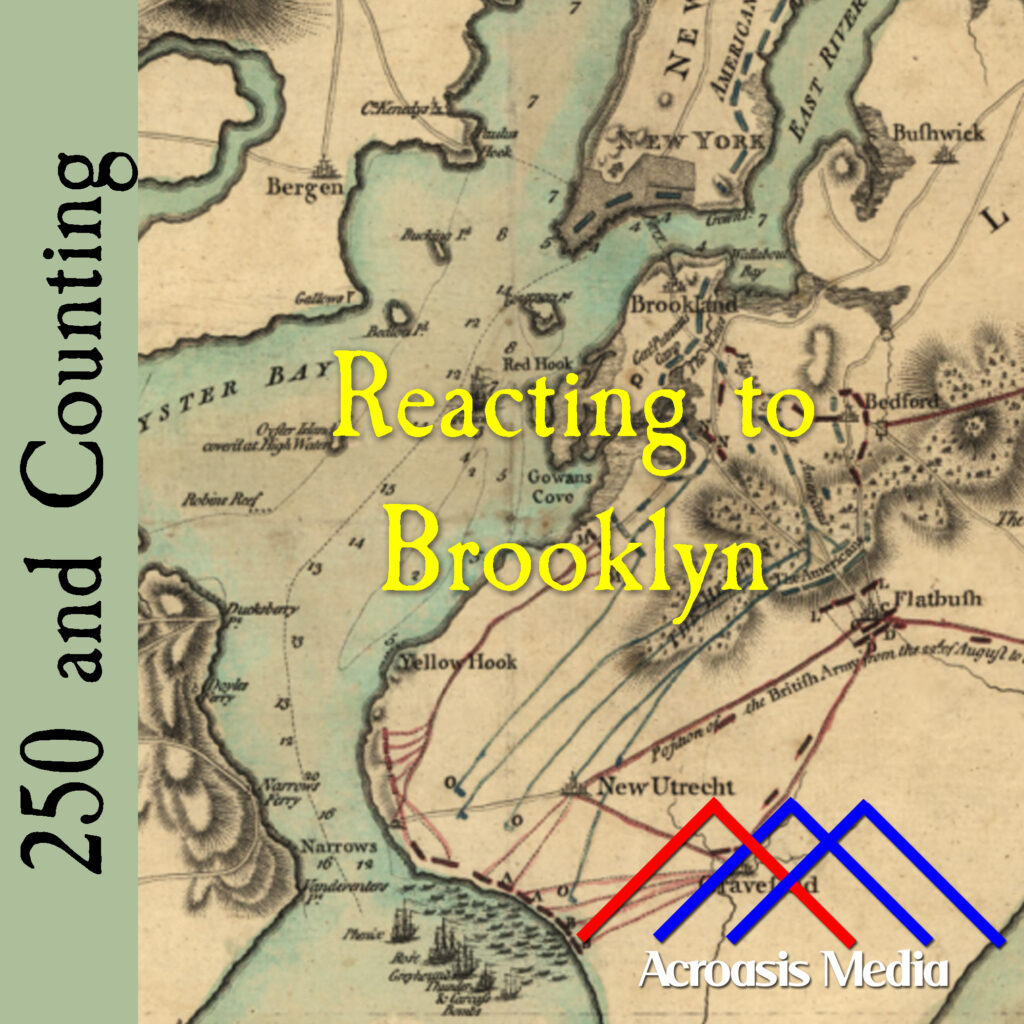
    Cover art for April 10, 1776: a contemporary map of Brooklyn. Red Hook is in the center of the picture, just below the "rt" in "Fort".

    The construction of Fort Defiance in the Red Hook section of Brooklyn made perfect sense. That part of the peninsula sticks out into New York Harbor and provides an excellent view of anything that might be sailing in or out.

    Red Hook comes from the Dutch Roode Hoek, “hoek” translating to “point”, which can still be seen in modern-day maps. The whole area, what we now call Red Hook and Gowanus, was settled by the Dutch in the 1630s.

    Red Hook was some swampy land when the Dutch moved in. But the Dutch know something about swampy land, and they got straight to work, filling in lakes and re-channeling waterways. They began farming the land, including orchards of fruit trees.

    After the war broke out and the Continental Army drove the British from Boston, George Washington sent Brigadier General William Alexander to Brooklyn to see what could be done defensively. A plan was developed to build two forts along the Brooklyn Heights, about a mile and a half apart. Fort Greene would be the furthest east, Fort Defiance would be the furthest west. Across the channel on Governor’s Island, another fort would be built, so that British ships could be fired on from both sides.

    Now, when we say “fort,” we’re not talking about something made of wood or stone. Plenty of those did exist, but not here. This was more like a breastworks built of earth and stone, which had a few cannons near the top. There were three of these breastworks connected by trenches, and they took up most of the island on which they stood. (Incidentally, Mike was correct about the island not existing anymore; the space was filled in and is now part of the larger land.) This took only a few days to put together; the fort at Governor’s Island was more like what one would expect to see.

    By the time the British arrived, the Continental Army was quite ready from a defensive standpoint. But the British were much larger in number and had a Navy besides. Stay tuned; it’s going to be an exciting summer.

  • The Siege Ends–March 17, 1776

    Cover art for March 17, 1776: The first Congressional Gold Medal, given to George Washington in 1790 for his first victory of the war in Boston. 1776 Washington Before Boston Comitia Americana Second Restrike (Baker-48G) Image credit to Heritage Auctions

    It’s been 333 days since Lexington and Concord, when the British were forced to retreat to Boston and were bottled up there by Colonial forces.

    It’s been a week since the British said “enough” and decided to effect their departure from the city as soon as the weather cooperated.

    But today, the day finally came.

    It took about five hours to launch over a hundred ships, carrying thousands of soldiers, women and children from the city.

    It was Washington’s first major win and the last time the British did anything of importance in New England. The war began to move south, to New York, New Jersey, and Pennsylvania. Virginia and the Carolinas also had their share of action, as we’ll see in the coming months.

  • Preparing To Take Back Boston–March 13, 1776

    Cover art for March 13, 1776: George Washington's General Orders for this day. via Library of Congress/National Archives.

    First: let me apologize for the slight change in sound quality for today’s episode. I’m not in my usual recording space and I’m not especially happy with the equipment I brought. At worst you’ll have to put up with it just one more time.

    Next: George Washington was a gentleman through and through, so the fact that his general orders sometimes focused on the Continental soldier behavior shouldn’t be a surprise. In today’s episode he concerns himself specifically with that, but for two reasons. One is for the health and safety of the troops, but the other is because the Bostonians have been through enough, and he doesn’t want the Continental Army–the people supposedly on their side–to look like villains.

    In the meantime he’s already standing down a big chunk of soldiers and sending them to New York, where the next big battle is going to be, he thinks. (Again, he’s right, but he didn’t realize it at the time.)

  • Beginning of the End in Boston–March 4, 1776

    Cover art for March 4, 1776: A map of the Boston area during the siege. from the History Department at the US Military Academy.

    Colonel Henry Knox took about ten weeks to get from Ticonderoga to Cambridge rather than the two he anticipated. But his arrival meant the siege’s end in Boston would come soon.

    Knox had brought something like 60 tons worth of material overland using hand-built sledges and carts drawn by oxen. The last leg of the trip is still a mystery, because Knox’ diary ends about two weeks early. What is known is that as he passed through the occasional town, people would line up to watch. So we know when he was where, but the usual stuff that ran through Knox’ head for that portion of the trip is gone.

    Still, his arrival at Cambridge meant that Washington now had what he needed to fortify his position and do what he needed to drive the British out of Boston. After nearly a year, the siege’s end was actually in sight.

  • Helping New York Help Itself–February 21, 1776

    Cover art for February 21, 1776: "Bowling Green, Broadway," by artist James Dakin and engraved by the firm Barnard and Dick, 1831. The house on the left became Washington's headquarters when he came to New York.

    There’s a line in the play 1776 about how everyone in the New York Legislature is very loud and talks very fast and as a result nothing ever gets done. This was likely a side effect of the fact that New York was so politically mixed at the time. Everyone hollering at rather than talking to each other means that nobody is truly connecting with anyone else. Thank goodness we’ve moved past THAT! <eyeroll>

    But New York and the Hudson Valley in particular held great strategic value for the various parties involved in the conflict we call the American Revolution. Britain taking that area would separate New England from the other Colonies. What’s more, George Washington knew it. So he devoted a lot of energy into ensuring that that territory remained defended, even while the British were nowhere in sight, because he knew it was a matter of time.

    And he was right: the British did show up ready for battle. It didn’t happen when he expected it to happen, and we’ll talk about that when things start heating up.

  • A More Organized War–February 13, 1776

    Cover art for February 13, 1776: a posthumous portrait of Patrick Henry by Thomas Sully, 1815. Sully was clearly cribbing much of this painting from a portrait of Captain Cook by his brother, made 20 years earlier.

    So nearly a year ago, in March 1775, Patrick Henry said “Give me Liberty or give me death.” Today the Continental Congress said “Bet,” and sent him to lead troops in Virginia.

    That was a coincidence, of course: practically anyone who showed any real leadership skills was given the opportunity to lead troops. Henry had the leadership and the oratory skills to get his troops into shape.

    We mentioned the various committees and their reports today. One of them was the committee that was directed to draft an address to the Colonies. John Dickinson wrote the first draft; James Wilson wrote the second. His version was much like the first, except he added the part about preparing for eventual separation from England. Dickinson was still mostly in denial about that but while Wilson wasn’t a strong personality, he was pragmatic in the end and figured he could see that ending coming.

  • Enlisting Apprentices–January 30, 1776

    Cover art for January 30, 1776: "Colonial Blacksmith, 1776". Wood engraving, attributed to "Granger" though this may be the name of the collection.
    “Colonial Blacksmith, 1776”. Wood engraving, attributed to “Granger” though this may be the name of the collection.

    While we’re talking about enlisting apprentices today, it should be noted that there was precious little difference between an apprentice and an indentured servant, except maybe their age. Thus, the rules that applied to apprentices when it came to enlistment could also be applied to indentured servants, especially inasmuch as some of those rules seemed designed more for them than apprentices.

    Also: Mike mentioned James Mease and his ketchup recipe. To clarify, ketchup had been around for hundreds of years, originating in China (or Vietnam; it’s a little fuzzy). What Mease did was add a tomato base, giving us the ketchup that we’re used to putting on our cookout foods. The Chinese stuff, commonly called “kê-chiap” was a fish-based sauce.

    Mease’s recipe involved brandy and spices; no sugar or vinegar. Here’s the recipe he published:

    Slice the apples* thin, and over every layer sprinkle a little salt; cover them, and let them lie twenty-four hours; then beat them well, and simmer them half an hour in a bell-metal kettle; then add mace & allspice. When cold, add two cloves of raw shallots cut small, and half a gill of brandy to each bottle, which must be corked tight, and kept in a cool place.

    *Mease called them “apples” because he was using the French word for tomatoes, “pommes d’amour” or “love apples.”

    Anyway, try it out and get back to us.

  • The Noble Train Pulls Into The Station–January 26, 1776

    Cover art for January 26, 1776: "Knox entering camp with artillery" by William H. van Ingen, c. 1831. via Library of Congress.
    “Knox entering camp with artillery” by William H. van Ingen, c. 1831. via Library of Congress. Depicts Henry Knox on horseback with soldiers transporting a disassembled canon on a sled through the snow, winter 1775-76, following his famous capture of artillery at Fort Ticonderoga. Wood engraving, hand-colored.

    The Noble Train of Artillery has finally arrived!

    Given that it was over 150 miles from Ticonderoga NY to Cambridge, MA, and that it was wintertime, and that Interstate 90 was still over 150 years in the future, it’s pretty amazing that Henry Knox was able to move so much artillery so efficiently.

    As Mike notes in the episode, the arrival date is largely a guess, since Knox’s diaries ended the last time we checked in with him, about two weeks ago when he was in western Massachusetts and, it appears, nobody else kept accurate notes on the event. There are, however, notes on the disposition of the materiel, so that makes this a pretty good guess. And it allowed the Continental Army to maintain the Siege of Boston until the British finally bailed out two months later.

  • Busy Day In Congress–January 19, 1776

    Cover art for January 19, 1776: painting of the Continental Congress by John Trumbull, created around 1819. This painting depicts a date several months after today.
    Painting of the Continental Congress by John Trumbull, created around 1819. This painting depicts a date several months after today. Trumbull was especially insistent on painting subjects from life whenever he could.

    The Second Continental Congress Committees, several of them anyway, reported out on this day in 1776 and it was starting to become clear that the individual colonies had some needs when it came to defense.

    There were issues with prisoners possibly being mistreated, word had gotten back regarding what had happened in Quebec on New Year’s Day, South Carolina had some need for sailors to defend the Charleston Bay…there was a lot going on, and while we view the large number of committees, with names that are either too obvious or a little silly, to be a bit much, we’re also viewing it through a modern-day lens.

    Not that life was simpler—though it was, in a sense—but that the Congress was quite pragmatic and direct in the way they operated.