
Category: Benjamin Franklin

  • Taking Canada’s Temperature–March 5, 1776

    Cover art for March 5, 1776: Charles Carroll by Michael Laty. Created 1846, making this a posthumous portrait.

    So here’s a fun story about Charles Carroll. As I’ve mentioned many times before, lots and lots of place names in Baltimore have strong historical connections and Charles Carroll is no exception.

    There is, of course, a Carroll Street, which starts in the southeast neighborhood of Morrell Park. It doesn’t go quite through that neighborhood though; it gets broken up by a couple of blocks’ worth of houses and resumes again. There’s another break as a railroad right-of-way comes through—but there’s no train crossing; the road just terminates. Carroll Street resumes (we’re still in Morrell Park) on the other side, however, before it’s interrupted yet again.

    Now as I understand it, this particular part of the neighborhood was wiped out completely by Hurricane Agnes in the early 1970s, so the rebuild was kind of haphazard. Plus, I-95 was first constructed through this part of Baltimore City around this time, so you have to jump almost 3500 feet before Carroll Street resumes again.

    But now you’re not in a residential neighborhood; it’s series of warehouses and industrial buildings for a stretch until it gets back into a residential neighborhood known as Pigtown, so called because on Market days, pigs would be led through the streets to the market for sale and eventual slaughter. Carroll Street meets with Cross Street in that neighborhood, and that’s the northern terminus.

    However.

    There’s an elementary school in the area that’s also named after Charles Carroll. It’s not on Carroll Street (of course) but is about two blocks away, in Pigtown. Now, remember, Charles Carroll was a lawyer, or a “barrister” as the old-timey types like to say. So Elementary School #34 is officially “Charles Carroll, Barrister Elementary School”. Except everybody forgets the comma is there and says it like one long name. And chances are, they think there was a guy actually named Charles Carroll Barrister somewhere in history.

    And wasn’t that a long walk for a short drink of water.

  • Arrest of a Franklin–January 28, 1776

    Cover art for January 28, 1776: Portrait of William Franklin, 1790, attributed to Mather Brown. via Wikimedia.
    Portrait of William Franklin, 1790, attributed to Mather Brown. via Wikimedia.

    It used to be rumored that Benjamin Franklin had over 30 children out of wedlock, but that’s since been debunked. (And there goes a perfectly good “lightning rod” joke.)

    But William Franklin was considered illegitimate, though he was raised by his father and his common-law wife Deborah Read. There are some breadcrumbs here and there that lead some historians to believe that Deborah was, in fact, William’s mother, but nothing thick enough exists to confirm that.

    At any rate, William was one of the last great Loyalists, and while his arrest and move to Connecticut was alluded to in the play 1776, it didn’t quite happen the way it was described there. Or at the time the viewer was led to believe. Tune in to get the real story from Mike.

  • Ben Franklin Analyzes the Snake–December 27, 1775

    Cover art for December 27, 1775: the Gadsden Flag, featuring a rattlesnake warning people away.
    Yeah, I cheated and used the same image from last week.

    While he didn’t use a rattlesnake, Benjamin Franklin was the guy who came up with the original “Join or Die” snake image [right]back in 1754. (At least most people give him credit for it.)

    It was based in a superstition that if you cut up a snake into pieces and then reassembled those pieces before sunset, the snake could be resurrected. In 1754, during the French and Indian War, Delaware was part of Pennsylvania and New England’s four colonies were simply grouped together. Georgia was altogether omitted and nobody knows why.

    At any rate, it’s only fitting that when the Gadsden Flag, which we talked about in the December 20th episode, made its debut, Franklin was the one who took the time to opine on why a snake was so appropriate; what’s more why a rattlesnake was the best choice. He published an essay in a local newspaper under a pen name, but his identity was figured out anyway.

  • Ben Franklin Wants A Friend–December 12, 1775

    Cover art for December 12, 1775: Portrait of the Infante Gabriel of Spain by Anton Raphael Mengs, 1767.

    Ben Franklin and Gabriel de Borbón had corresponded with one another previously, so while the letter that is the subject of today’s episode has a very specific (and relevant) ask in it, it was also just another in a chain of correspondence between the two.

    For his part, Prince Gabriel was probably receptive to Franklin’s suggestions, but he wasn’t likely to be in a position to act on them in the way that Franklin hoped. As the fourth son of Charles III, the throne was a long way off, though he was considered the heir apparent for some time.

    When Spain provided assistance the following year, they did so because Spain and France were allies and France was providing assistance to the Americans; furthermore they had their own bone to pick with the British, so Two Birds and all that. So they sent over lots of assistance, mostly in the form of money so that the Continental Army could purchase cannons, mortars, gun carriages and other ordinance.

    It’s possible that Prince Gabriel had some influence on his father, but more likely is that Charles III was simply maintaining existing alliances.

  • Congress Has A Busy Day–November 6, 1775

    Cover art for November 6, 1775: portrait of John Langdon by Hattie Elizabeth Burdette, 1916.

    There are going to be days when no truly big events happen, but that wasn’t going to stop the Second Continental Congress from getting stuff done.

    Today we have a bit of an image of that group as a bunch of men who are hard-drinking philosophers, ready—and maybe eager—to burst into fisticuffs, or perhaps the occasional song, depending on where you got your impressions.

    So for that reason, we do like to remind you that the Continental Congress, for all their weird little squabbles, was a serious group of men. They took their jobs seriously, and put a lot of thought into everything they did. They often put in long hours, working until after darkness fell many days, and they typically worked six days a week.

  • Washington Gets Some Relief–October 18, 1775

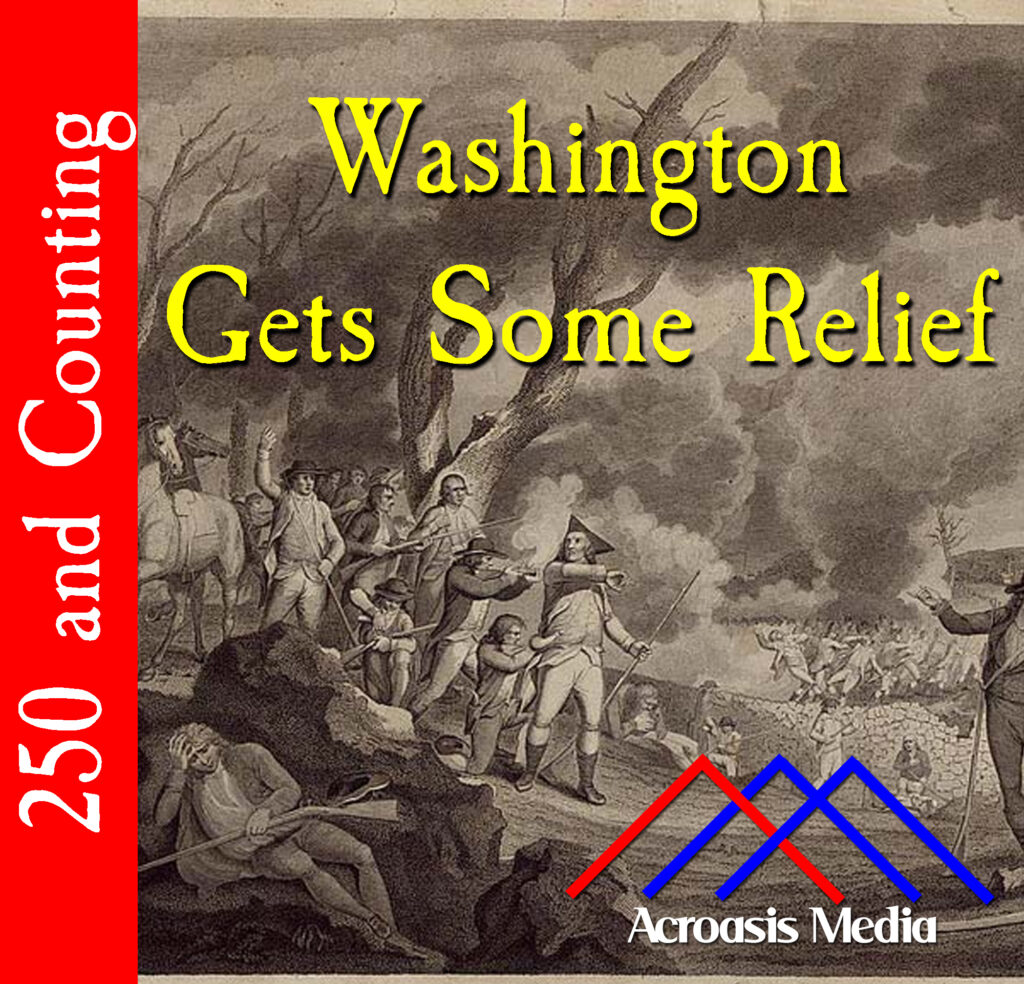
    Cover art for October 18, 1775: the Battle at Lexington, Amos Doolittle (engraver) and Ralph Earl (artist). via the New York Public Library and the Library of Congress.

    George Washington was a pretty smart guy. He knew exactly what his army needed, in all aspects. He had a handle on discipline, on supplies, on tactics and any number of other things. Washington surrounded himself with people who were smart, too. This went a long way toward ensuring his success.

    So when his army started to fall apart because some basic needs weren’t getting met, Washington took action. He knew that sending another letter to Congress wasn’t going to help. So instead he met with them directly. And like a dog savaging a toy, Washington grabbed Congress in his (not wooden!) teeth and shook them in a figure-eight.

    Metaphorically, of course. And while he didn’t get everything he sought, he managed to get the important stuff done and the rest of it…well. The rest of it, at least he knew he’d been heard. And he’d live to fight another day.

  • September 18, 1775: A Secret Committee

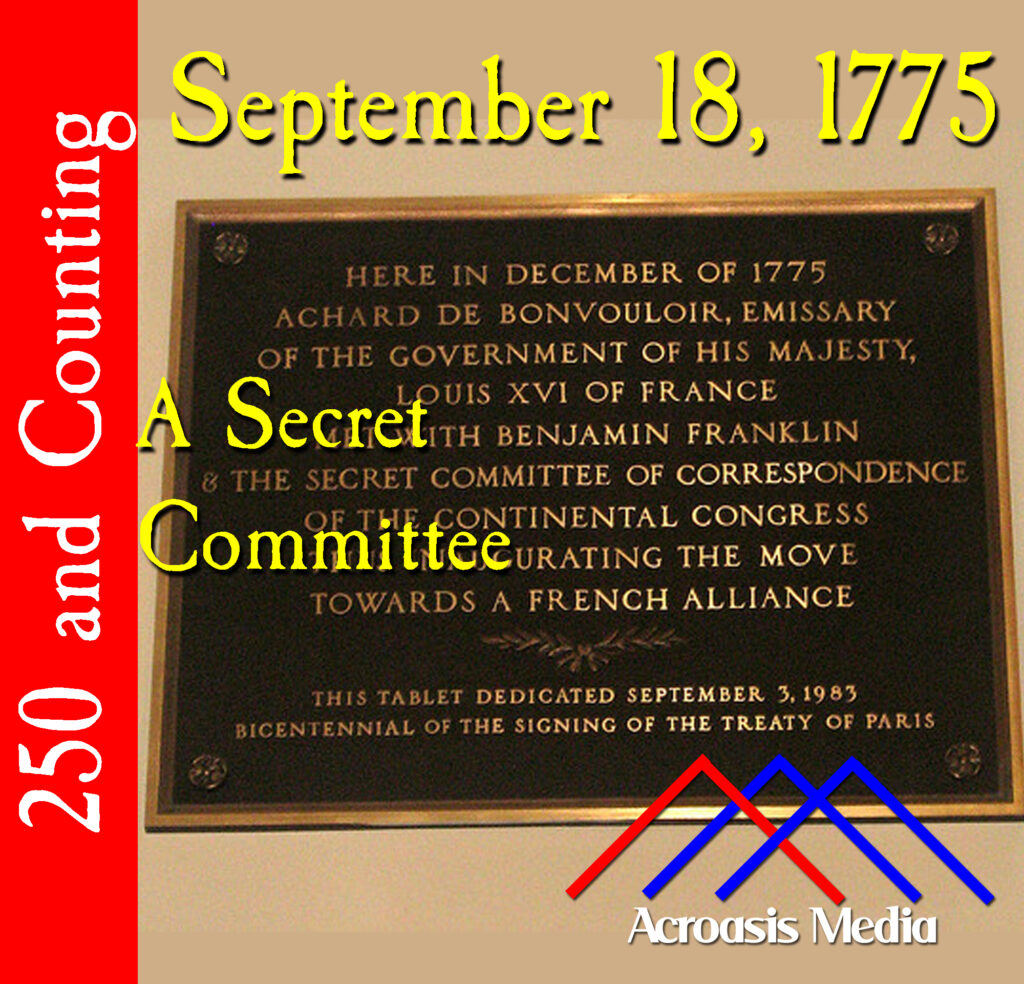
    Cover art for September 18, 1775: Theplaque in Carpenter's Hall (Philadelphia) designating the location where the Committee of Secret Correspondence met with Julien Alexandre Achard de Bonvouloir.

    The Committee of Secret Correspondence is one of those names that sounds like they should be on Double Secret Probation or something. However, when you look at their purpose, the name makes sense.

    The Committee of Secret Correspondence was formed to seek out support from other nations. They reached out to France, Spain, and a few others to get supplies, food, munitions…pretty much anything they could get. Oftentimes they had to use a third party to give everyone plausible deniability.

    And fortunately, their tactics were mostly successful.

  • September 1, 1775: Virginia Gazette Headlines

    Cover art for September 1, 1775: photo of a mullet, via Wikimedia.

    Nothing beats the speed of gossip, and apparently the Virginia Gazette on this day had plenty of it to share.

    A few of the stories were quite serious, relating to events in both Virginia and Massachusetts. They closed out with a local story that had a more humorous edge to it…though it’s likely that the people involved had a hard time seeing the humor in it all.

    PS Why is there a picture of a fish in today’s cover art? Well…mullet over a little and see if it comes to you.

  • July 26, 1775: Mailing It In

    Cover art for July 26, 1775: a 2006 stamp commemorating Benjamin Franklin as postmaster, one of over 130 stamps with his image on them.

    When the US Postal Service first began, it couldn’t even be called that, since there wasn’t a US yet. There was, of course, a postal service, but it was the Crown Post and it was subject to interception and investigation, and we really couldn’t have that and a revolution, now could we?

    In fact, there were competing services to the Crown Post, but there were also gaps in that service and general inefficiencies. For instance, most services transported parcels at a lower rate than letters. So, people worked around the rule by attaching letters to small, mostly empty parcels just to save money. One service, run by a man named Benjamin Mumford, carried both Royal Mail and that of his own service, which was cheaper than the King’s rates.

    About the artwork: that’s a picture of a 2006 stamp issued commemorating Ben Franklin’s tenure as the first Postmaster General. It’s marked “B. FREE FRANKLIN” because that’s how he often signed his name while in that position. Why? Because as the Postmaster General, he had franking privileges and didn’t have to pay his own postage. It was a privilege he took great advantage of.

  • July 15, 1775: Breakin’ the Law With Impunity

    Cover art for July 15, 1775: Portrait of Silas Deane by William Johnston, 1766.

    If you’re going to be in rebellion, you may as well do something rebellious.

    Thus was (presumably) the reasoning behind Ben Franklin putting forth a resolution that the Colonies would effectively ignore a ban on the importation of weapons and gunpowder to the Colonies.

    And while we’ve mentioned numerous times that the Congress doesn’t seem to do a lot more than form various Committees, again we need to stress that these were serious men, who gave serious thought to whatever they presented to the larger group, because they knew that any votes had to be unanimous. They took the job with great gravity, and in fact worked long hours. And in Philadelphia in the summer time…that is no joke, my friend. I mentioned it in a Baltimore context during the show, but remember that these cities aren’t very far apart, and thus have similar climates.