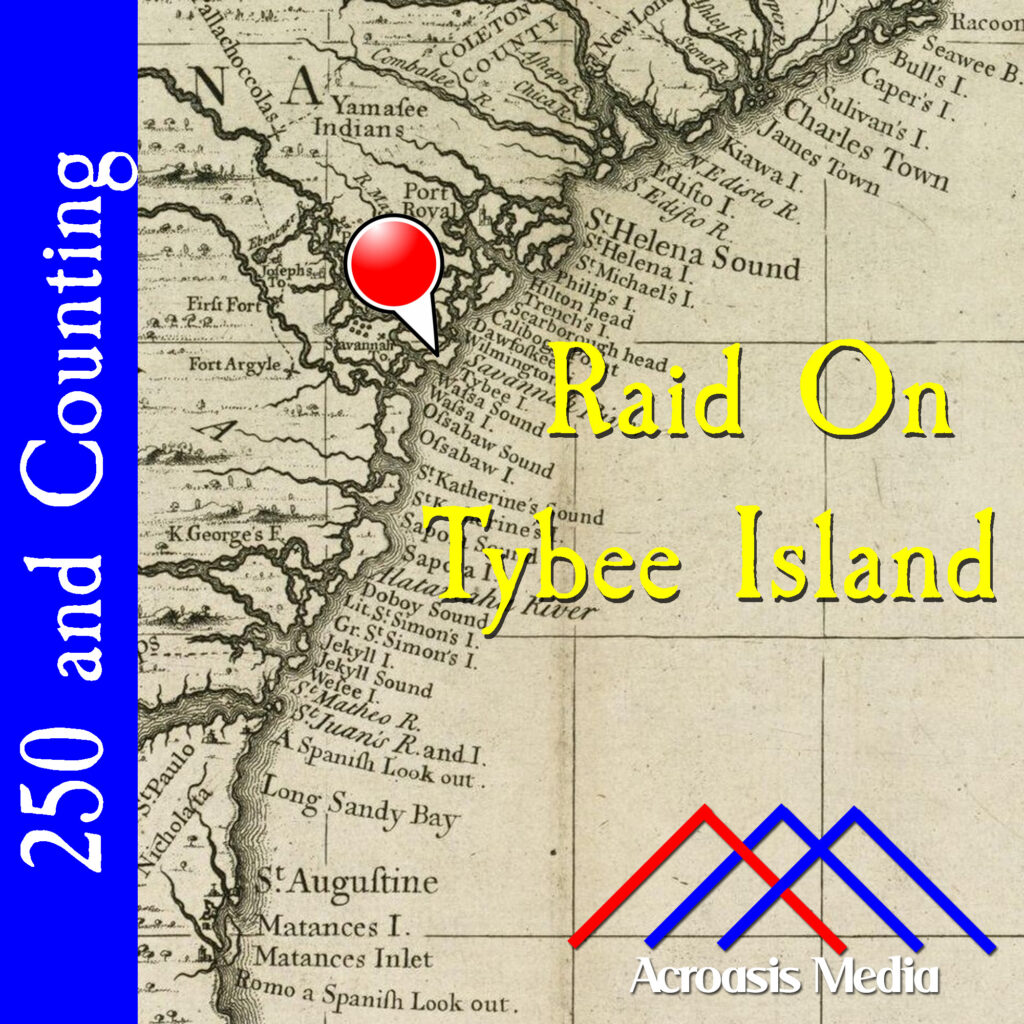
The raid on Tybee Island wasn’t the only one of its kind; in fact a similar action had been taken at Sullivan’s Island in South Carolina a few weeks earlier.
In that case there were many more runaway slaves involved, but like Tybee, very few were actually captured and the fate of most of the others is unknown, although there is one account that says fifty people had resisted capture and were subesquently killed.
But in both cases we see a raid that took place specifically to deny people their freedom, and the proclamation the led to these raids directly influenced the argument in the Declaration of Independence that King George incited “domestic insurrections.” So…the desire of slaves to be free…drove the Patriots to desire independence.
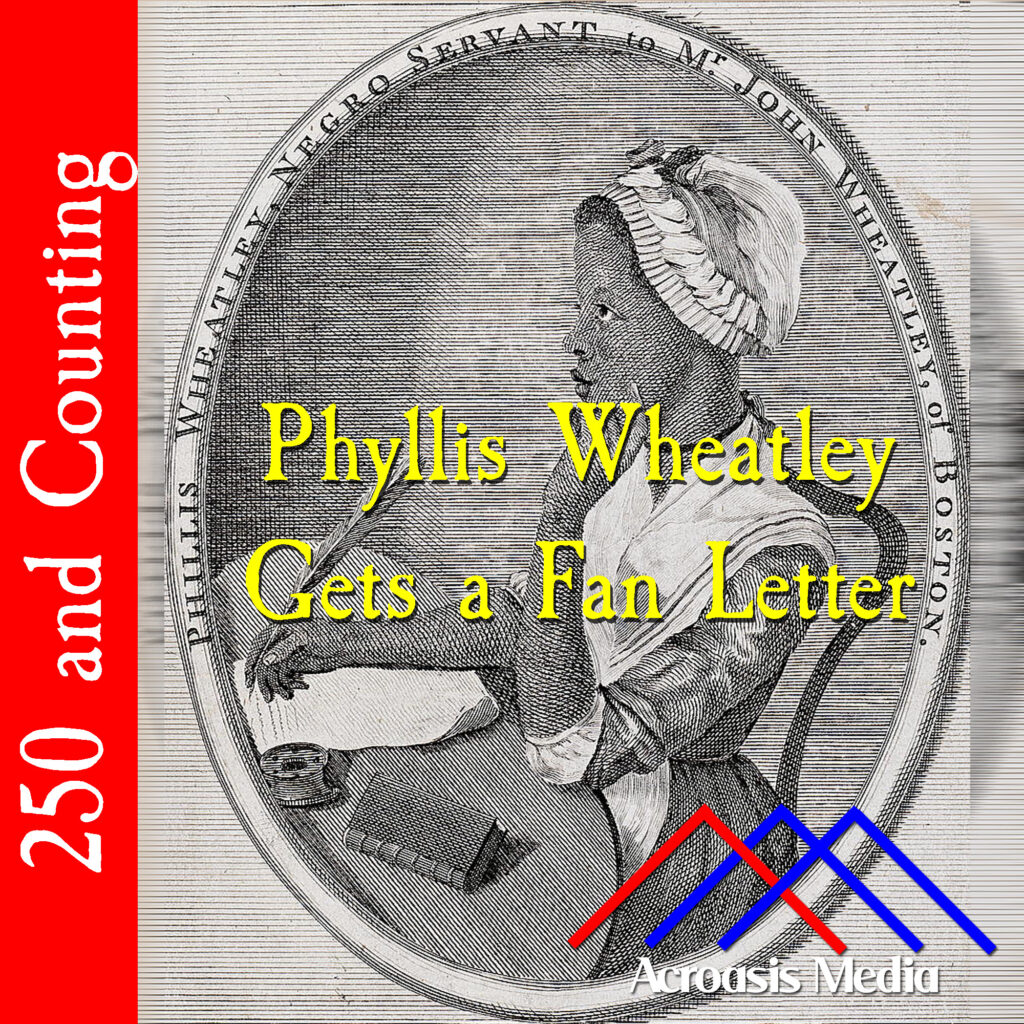
Phyllis Wheatley was an 18th century poet who was born in West Africa and sold into slavery as a small child, living with the Wheatley Family in Boston.
Phyllis wrote a book of poems which was published in 1773, after which she was emancipated. This makes her the first African-American author of a published book of poetry.
Phillis Wheatley married a grocer named John Peters around this same time. They had three children, but unfortunately all of them died quite young. Phyllis herself died in of pneumonia in 1784, not long after giving birth to a daughter, who also died that day.
Celestial choir! enthron’d in realms of light, Columbia’s scenes of glorious toils I write. While freedom’s cause her anxious breast alarms, She flashes dreadful in refulgent arms. See mother earth her offspring’s fate bemoan, And nations gaze at scenes before unknown! See the bright beams of heaven’s revolving light Involved in sorrows and veil of night!
The goddess comes, she moves divinely fair, Olive and laurel bind her golden hair: Wherever shines this native of the skies, Unnumber’d charms and recent graces rise.
Muse! bow propitious while my pen relates How pour her armies through a thousand gates, As when Eolus heaven’s fair face deforms, Enwrapp’d in tempest and a night of storms; Astonish’d ocean feels the wild uproar, The refluent surges beat the sounding shore; Or thick as leaves in Autumn’s golden reign, Such, and so many, moves the warrior’s train. In bright array they seek the work of war, Where high unfurl’d the ensign waves in air. Shall I to Washington their praise recite? Enough thou know’st them in the fields of fight. Thee, first in peace and honours,—we demand The grace and glory of thy martial band. Fam’d for thy valour, for thy virtues more, Hear every tongue thy guardian aid implore!
One century scarce perform’d its destined round, When Gallic powers Columbia’s fury found; And so may you, whoever dares disgrace The land of freedom’s heaven-defended race! Fix’d are the eyes of nations on the scales, For in their hopes Columbia’s arm prevails. Anon Britannia droops the pensive head, While round increase the rising hills of dead. Ah! cruel blindness to Columbia’s state! Lament thy thirst of boundless power too late.
Proceed, great chief, with virtue on thy side, Thy ev’ry action let the goddess guide. A crown, a mansion, and a throne that shine, With gold unfading, WASHINGTON! be thine.
Back on October 8, the Continental Army determined that Blacks were no longer to be permitted to enlist, and that existing soldiers would not be allowed to re-enlist.
But on this date, George Washington changed his mind. Was he suddenly an abolitionist? Not a chance. He owned slaves until the day he died. This was a more pragmatic decision. It was borne of the fact that he and his staff suddenly realized that a lot of soldiers were going to end their enlistment come January. That October decision was starting to look rather short-sighted.
Add to that the fact that word had gotten about about Lord Dunmore’s offer to free slaves who fought on the British side. Now, he really couldn’t do anything for slaves who came from anywhere other than Virginia, but the offer was still hanging out there.
Finally, it was quite apparent that there was a growing number of Blacks, whether slave or free, who had shown interest in fighting for the Patriot cause.
It suddenly looked like a whole lot of bodies were getting turned down by the Continental Army for no good reason.
When the war first started, the Continental Army took on all comers, largely because they didn’t have a lot of choice. Frankly, they needed whatever bodies they could get.
But it was around this time in 1775 that George Washington and his advisers decided that they could afford to get choosier about their recruits, So they decided not to take on any more Black soldiers. What’s more, soldiers who were already there would not be permitted to re-enlist.
Eventually—in a couple of years—they’d reverse their stance, for the same reason they took on the Black soldiers in the first place. They were getting low on manpower,
Prince Hall, who appears in today’s artwork in an undated and unattributed picture, became interested in becoming a Mason but was turned down because of his race. The British Masons, however, were perfectly willing to accept Blacks into their ranks…so long as they fought on the British side of the Revolution.
It wasn’t long before the Americans caught on to the scheme and reversed their decision. But Hall wasn’t done with simply joining the Freemasons. He had additional ambitions for himself, and others who looked like him.
When it comes to Black people and their role in the American Revolution, the one name that most people appear to remember is that of Crispus Attucks, largely because he was the first person killed in the Boston Massacre, and that event is thought of as the beginning of the Revolutionary War, therefore it’s significant that the first person to die in the name of American freedom was a person of color.
Other people, more fussy about events, would say that Lexington & Concord was the beginning of the war. The reasoning behind that is that it’s the first event in a series of hostile actions that took place close to one another. But the real argument is that most historical events of this nature don’t have definitive “beginning” and “ending” points; it’s much like a roll of paper towels. Sure, there are perforations marking each sheet, but you know for a fact that when you pull one off, it’s going to tear at an oddball angle and those perfectly rectangular sheets are a rarity.
The fact is, however, that over 100 Black men fought as part of the militia in the opening battles of the Revolution. Here’s the story of one of the first.