Category: Boston History

  • Patriots’ Day–April 19, 1776

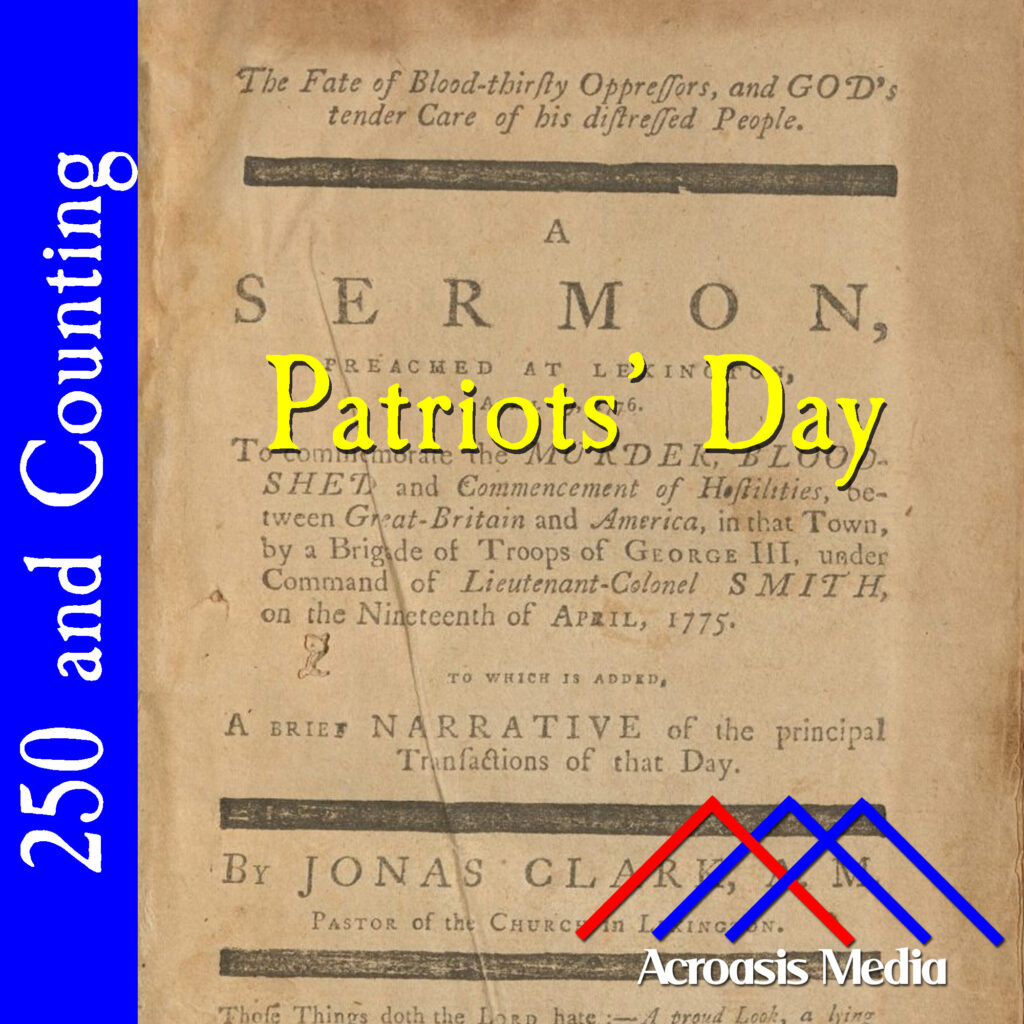
    Cover art for April 19, 1776: Jonah Clarke's published edition of his sermon marking the first anniversary of the battles at Lexington and Concord.

    It seems like only a year ago we were marking the date the war began at Lexington and Concord, and how it became Patriots’ Day.

    So we’re here once again: the battle ended with the British retreating into the city of Boston, and holding siege there for the better part of a year, until Washington was given several cannons brought down from Fort Ticonderoga, which vastly improved his shooting range.

    A year later, Reverend Jonas Clark marked the day with a sermon that is nearly 40 pages long in its published version. He used a lot of harsh rhetoric in his sermon, casting the British as though they were Satan’s owm minions:

    They approach with the morning’s light; and more
    like murderers and cut-throats, than the troops of a christian king, without provocation, without warning, when no war was proclaimed, they draw the sword of violence, upon the inhabitants of this town, and with a cruelty and barbarity, which would have made the most hardened savage blush, they shed INNOCENT BLOOD!

    The sermon does come back around to God, noting that:

    And from the nineteenth of April, 1775, we may venture to predict, will be dated, in future history, THE LIBERTY or SLAVERY of the AMERICAN WORLD, according as a sovereign God shall see fit to smile, or frown upon the interesting cause, in which we are engaged.

    So…God picks favorites, so long as we humble ourselves before Him and trust in His name.

    Incidentally, I first heard about the children walking from Acton to Concord on the Julie Mason Show, on SiriusXM’s POTUS Channel. she had very fond memories of this, so I dug around a little to discover whether this activity was still going on all these years later. If anything, it’s grown!

  • The Fate of War and Some Refugees–November 25, 1775

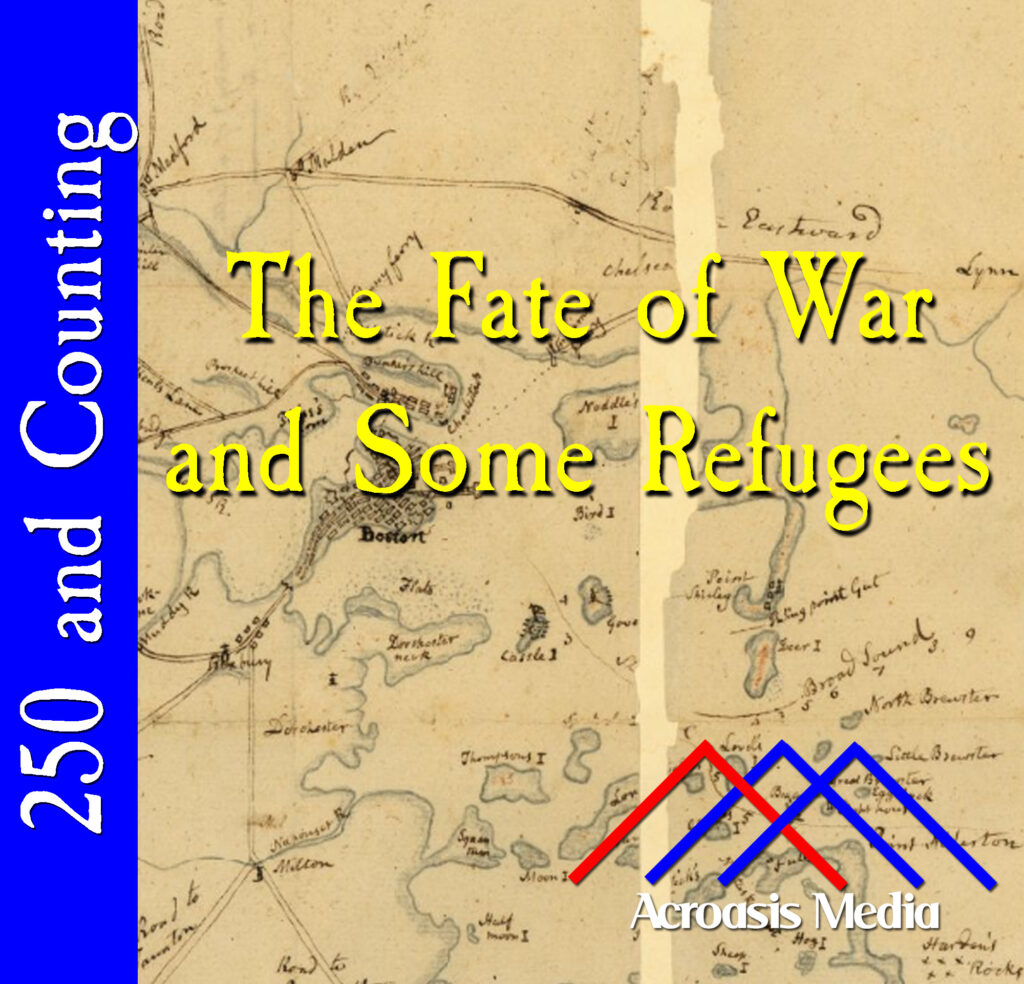
    Cover art for November 25, 1775: a manuscript map of Boston showing Point Shirley to the far right, away from the city. (It's under the "fu" in "refugees")

    It’s hard to emphasize just how remote Point Shirley is compared to the Boston. Let me try anyway. On most maps of Boston, Point Shirley isn’t even on the map. It’s so far to the east that it’s nearly in the ocean. I’m not sure it’s even possible to see Boston from Point Shirley.

    And given Point Shirley’s location at a place between the bay and the ocean, and the fact that it’s November, and you’ve got a cold, windy place where you’ve just dumped 300 sick, destitute people without provisions or a means of getting warm.

    Here’s a weird coincidence: if you look closely at this “manuscript” map from 1775, Point Shirley is at the center right. Need another hint? It’s just under the “fu” in the word “Refugees.” And if anyone got a big FU from the British, it was this group.

  • September 3, 1775: The British Move To Break the Siege

    Cover art for September 3, 1775: Early map of Boston showing the neck. From the collection of Historic New England. The blue line shows present-day Washington Street.

    Anyone who’s been to Boston in the modern day has a hard time recognizing that the city of Boston was just the segment in the top center of the map. The area called Boston Neck is clearly marked at the bottom left, and wasn’t part of the city. The Continental Army’s line ran about where the blue line ends. (The blue line is modern-day Washington Street.)

    It was the city having that kind of geography that made the Siege of Boston relatively easy for the Patriots. Unfortunately for them, the British were still able to use the surrounding waterways.

    This made the siege not the battle of attrition that it could have been, since supplies were able to get in via water. Consequently it was an ongoing battle of wits, as we learn today.

  • August 31, 1775: The Liberty Tree Dies

    The cover art for today’s episode may be one of the most famous art pieces depicting an event of the American Revolution, and it happened under the Liberty Tree, which is clearly marked here.

    This event, the tarring and feathering of Loyalist John Malcolm, took place about 18 months earlier and shows Malcolm already tarred and feathered, and now he’s having (also marked) tea poured into his mouth. The Stamp Act is nailed to the tree, upside down. Really, there’s a lot to unpack in this picture. So it makes sense that people were upset that the tree had been cut down.

  • July 30, 1775: A Battle at Charlestown Neck

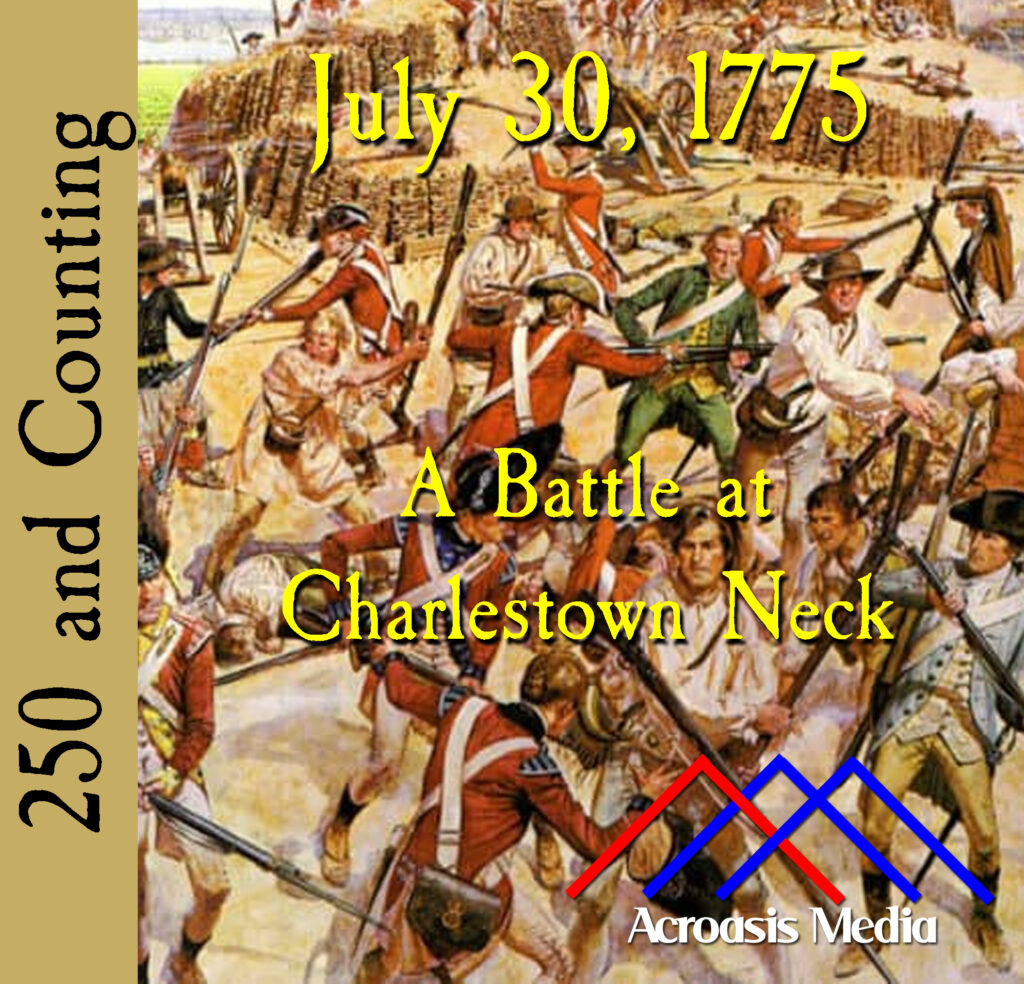
    Cover art for July 30, 1775: OK, we'll level with you. This is a painting of the Battle at Bunker Hill from June. There are no significant images of the battle described today.

    Boston had been under siege since Lexington and Concord. Of course the British felt that they needed to break out of it from time to time, and today was one of those attempts.

    Now, this was a success for the Continental Army, but the fact is, few people realized at that time just how close they were to losing that battle, and badly. But that’s for a couple of days from now, on August 1st.

    Coincidentally, August 1st is the day that this podcast begins airing on Hamilton Radio!

    Tune in to HamiltonRadio.net to hear our show, and a bunch of others. We’re in good company over there.

  • July 11, 1775: From John to James, and The Other Long Island

    Cover art for July 11, 1775: Portrait of James Warren, 1763 by John Singleton Copley. Now in the Museum of Fine Arts, Boston.

    Oof, that’s a mouthful of title. Oh well, what’s done is done.

    As noted in today’s episode, James Warren was not related to Joseph Warren. On the other hand, he is related to Mercy Otis Warren, because he’s her husband.

    James and John Adams had a few ideas in common; the hard part was convincing a few others that they were in the right.

    Meanwhile, did you know there’s another Long Island? That sort of thing really plays havoc with our research. This one is in the Boston Bay, and it’s a familiar story because something similar happened a few weeks ago. But tune in anyway.

  • April 26, 1775: Josiah Quincy II Dies at Sea

    Cover art for April 26, 1775: posthumous portrait of Josiah Quincy II by Gilbert Stuart, c. 1825

    Josiah Quincy—who we’ve talked about before; remember that portrait?—would have been one of the more prominent men we speak of when we use venerated tones about the Founding Fathers, had it not been for the fact that he died just as the war was getting started.

  • April 18, 1775: Paul Revere’s Midnight Ride

    Cover art for April 18, 1775: "Paul Revere Bringing News to Sullivan," by Howard Pyle, 1886

    Once in awhile, we fear that students of history don’t necessarily put things into the appropriate perspective when it comes to dates. We offer them some facts regarding what happened and when, but the events still kind of mush together.

    That’s how we get the Simpsons joke: “Let’s take a look back at the year 1928- the year when you might have seen Al Capone dancing the Charleston on top of a flagpole!”

    To that end, students might place the Boston Massacre, say, as quite close in the timeline to the start of the Revolutionary War, when in fact they happened several years apart. But at this specific period of time, things were in fact moving quickly and closely together: Colonies were lining up behind Massachusetts, various areas began to prepare for all-out war, General Gage was doing his best to control the colonists based on the orders that were sent to him several weeks earlier from London, and Lord North was in fact hoping to provoke the colonists into doing something that would give him a reason to crush them hard.

    So when word got out that the British were coming up the Charles river to make a move on Concord and Lexington, Colonist spies were wise to it and they got the word out as fast as they could. Listen, my children, and you will hear.

  • March 29, 1775: The Brits Head to Roxbury

    Cover art for March 29, 1775: The Auckward Squad, painted by George Cruickshank, ca. 1780

    There are plenty of scholarly books and articles out there regarding American History, but there are elements of British history that stick out, too. General Gage giving the order today that his troops begin to march on Roxbury. It was a relatively small gesture at the time, but many, many colonial events can be traced to that particular action.

    And as a result the Colonists determined that Britain can’t move numbers of men like that again without bumping into a few flintlocks along the way.

  • March 5, 1775

    Cover art for March 5, 1775: Portrait of Joseph Warren by John Singleton Copley, 1765

    Joseph Warren’s life as a Patriot was rather brief (in fact his life overall was relatively short), but it was quite important to the cause. Warren was part of the committee that investigated the Boston Massacre, he sent Paul Revere on his midnight ride (just go with it for now), he wrote a song called “Free America,” which was based on a British melody called “The British Grenadiers”, he fought at Lexington and Concord, and he died at Bunker Hill.

    And he was one of only two men who was asked to speak more than once on the anniversary of the Boston Massacre. And this second time was the one that really sold the crowd.