Category: George Washington

  • June 26, 1775: George Washington Visits New York City

    Cover art for June 26, 1775: “A south west view of the city of New York” drawn by British officer Captain Thomas Howdell and engraved by P. Canot. Specific date not known but believed to be during the early years of the war.

    In 1775, New York didn’t have a Times Square, nor a Statue of Liberty, nor even a Brooklyn Bridge. Bagels hadn’t made it to the new world, and pizza wasn’t a thing yet.

    So why did George Washington feel it necessary to stop in New York City on his way to Boston?

    Short answer: he knew that some of the locals were nervous about his taking command of the army.

    Longer answer: oh no, you don’t. You’re going to have to listen to Mike tell you.

  • June 16, 1775: Washington Officially Accepts Command

    Cover art for June 16, 1775: George Washington accepting command of the Continental Army (detail). From a print by Currier and Ives, c. 1876.

    Yesterday, George Washington was unanimously elected Commander in Chief of the Continental Army.

    Today he officially accepted the position.

    He won’t take actually begin until early July (we’ll get to that episode in a few weeks), but take a look at this image here. He’s already in the blue coat, and his hair is whiter than it was in yesterday’s art.

    The truth about his hair color is likely somewhere in between these two images, but of course he wasn’t wearing a coat like that just yet. This art is from a hundred years later, by Currier and Ives.

    What I found interesting is that some of the people in the background look a little put out by Washington, even though they’re the ones who elected him. I think Currier and Ives were trying to convey that it was a serious event, but everyone just looks angry. John Adams (in the dark blue to the right) appears especially annoyed, and he’s the one who nominated him in the first place.

    And check out the guy to Adams’ right, staring straight at us. There’s always one guy who can’t help but look at the camera.

  • June 15, 1775: The Original G-Man

    Cover art for June 15, 1775: Portrait of George Washington in 1775 by Samuel King

    Jeez, I gotta stop writing these titles late at night.

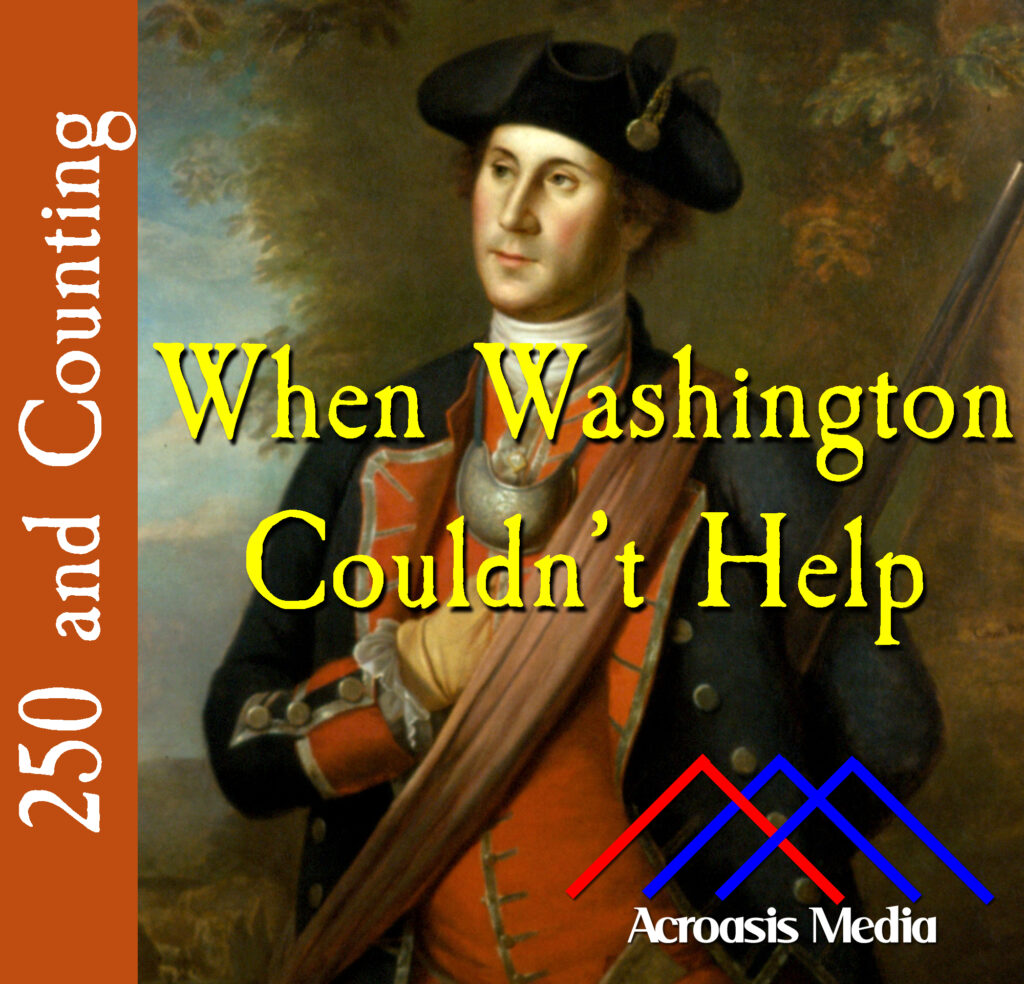
    Sometimes the history books make it sound like some people just appeared out of nowhere, but they did have pasts. George Washington would be a good example.

    Washington has been nearly invisible since this show started on January 1, but that doesn’t mean that the Congress hollered “Anyone wanna be a general?” and he stepped up first. In fact, he was a delegate to the First Continental Congress in 1774, and for some time he’d been a member of the Virginia House of Burgesses, often simultaneously with the Congress thing. And he did have a commendable military background dating back to the French and Indian War, so appointing him the Commander of Colonial forces wasn’t part of someone’s crazy scheme: they thought he could really do it.

    And do it, he did.

  • March 25, 1775: Letters to and From George

    Cover art for March 25, 1775: AI-generated image of George Washington writing a letter. Via Canva.

    George Washington was a frequent letter writer, something that the creators of the stage play 1776 would poke some fun at. But the documentation he kept plays an important part not only in the history of the American Revolution, but in the more mundane details of life during that time in American History. What’s more, we’re fortunate that so much of the correspondence both to and from Washington remains extant to this day. (Not all of it, as you’ll hear today, but it appears that most of it does.)

    Today we present two letters: one written from the Second Virginia Convention from George to his brother, and another written to George the same day by a merchant he frequently dealt with. The merchant died not long after writing the letter, so it’s not known whether Washington received it before the merchant died. What we do know is that the death resulted in an unexpected expense for Washington.

  • March 16, 1775: The Augusta Resolves

    Cover art for March 16, 1775: the original broadside of the Augusta Resolves, on display in the Augusta County courthouse.

    Over the last few days we’ve heard from several counties in Virginia sending delegates and instructions to the Second Virginia Convention, which would meet in another few days. Many of these counties published their instructions, called “Resolves,” in newspapers, so that anyone who was literate would know where the freeholders of those counties stood.

    And today it’s Augusta County which weighed in by publishing their Resolves in the Virginia Gazette. Augusta County is quite close to both Fincastle and Botetourt counties, at what is now the western edge of the state. And we have to think that it’s meaningful that these communities, which were relatively far from where anything meaningful was taking place, was taking notice of those events and acting proactively, when only a few weeks earlier they would have been indifferent to it, because after all, it didn’t really affect them. Not yet, anyway.

  • 250 and Counting: February 3, 1775

    Cover art for February 3, 1775: "The Death of General Mercer at the Battle of Princeton, January 3,1777" by John  Trumbull

    Hugh Mercer is one of those people who was terribly important to the cause of Liberty during the American Revolution, yet his story goes untold largely because he died early in the effort.

    But if Mercer hadn’t come to America because he was on the losing side of a battle in Scotland, he wouldn’t have become a doctor in Pennsylvania.

    And he wouldn’t have joined up in the French and Indian War.

    And if he hadn’t been wounded, then he wouldn’t have been rescued, transferred and promoted to Major.

    And if he hadn’t been transferred, he wouldn’t have met George Washington.

    And Washington wouldn’t have gotten the idea to invade Trenton, New Jersey at Christmastime 1776.

    And Mercer wouldn’t have been killed the following month. Which is bad, but…

    If Mercer hasn’t sacrificed himself so publicly, Washington’s troops wouldn’t have been inspired to re-enlist and continue the fight.

    Also, the county surrounding Trenton, New Jersey would have a name other than “Mercer County,” so there’s that.

  • 250 and Counting: January 6, 1775

    Cover art for January 6, 1775: A map of the New York area from that year

    The impression that most people have of John Adams, it seems, comes from one of two places. It’s either William Daniels’ portrayal of him in the play and film 1776 (and we’re big fans of that particular bit of cinema), or it’s Paul Giamatti’s portrayal in the seven-part miniseries on cable TV. Both stories had their charms, and both took some liberties with the facts. (Oddly, both of them showed Benjamin Franklin being carried in to the Second Continental Congress, but that didn’t happen until the Constitutional Conventions eleven years later.) The bottom line is that Adams was a complex man and a very smart one who had the ability to see the bigger picture, as they say.

    George Washington was also a well-rounded person, as you no doubt discovered in the January 1 episode. Early in 1775 Washington wore multiple hats. He was a delegate to the First Continental Congress, he was responsible for training militiamen in Virginia, and he was unofficially the Commander-in-Chief of the army, except there wasn’t one quite yet.

    Today we’re looking at some correspondence from Adams to Washington, and we’ll learn in a future episode just how seriously Washington took his warnings.

  • 250 and Counting: January 1, 1775

    Welcome to the inaugural episode of 250 and Counting!

    This is a daily podcast, but don’t worry—it only runs about four or five minutes per day. Those of you of a certain age (ahem) may remember the Bicentennial Minute.

    For those of you who don’t: As the 200th anniversary of the United States approached, our country was absolutely immersed in Bicentennial stuff. Anything that could get the Bicentennial logo slapped on it, had the logo slapped on it. And absolutely everyone had a little extra dash of American pride in them.

    And every night at 8:00 PM, on CBS Television, we’d get what was informally called the Bicentennial Minute. A celebrity of some level (some were big names and others weren’t) would come on and tell us what happened 200 years ago on that day. They’d tell us about the events that led up to the Revolutionary War. They’d talk about the people who signed the Declaration of Independence. They’d talk about the aftermath of these events. And they did it in just a couple of minutes. For two years, we’d get a little snippet of the history of the United States.

    Now, it’s 2025 and the 250th anniversary (July 4, 2026) of our country is coming. America isn’t feeling that pride anymore, we don’t think. And that’s a shame because we do need a win. We need to feel like we understood what our ancestors fought for. 250 years isn’t quite as exciting a marker as a nice round number like 200 or 300, but most of the people involved in this project aren’t likely to live that long. (We’re still trying to face it, but dangit, it’s true.)

    Also, we can’t afford celebrities, so you have us, instead. “Us” is Claude Call and Mike Messner, with a little help from Serena Gaylord and Lorene Childs. (You can read more about everyone on the “About Us” page.)

    250 and Counting will be available in your favorite podcatcher, but if you prefer listening to it here on the website, here it is for your enjoyment.