Category: Naval History

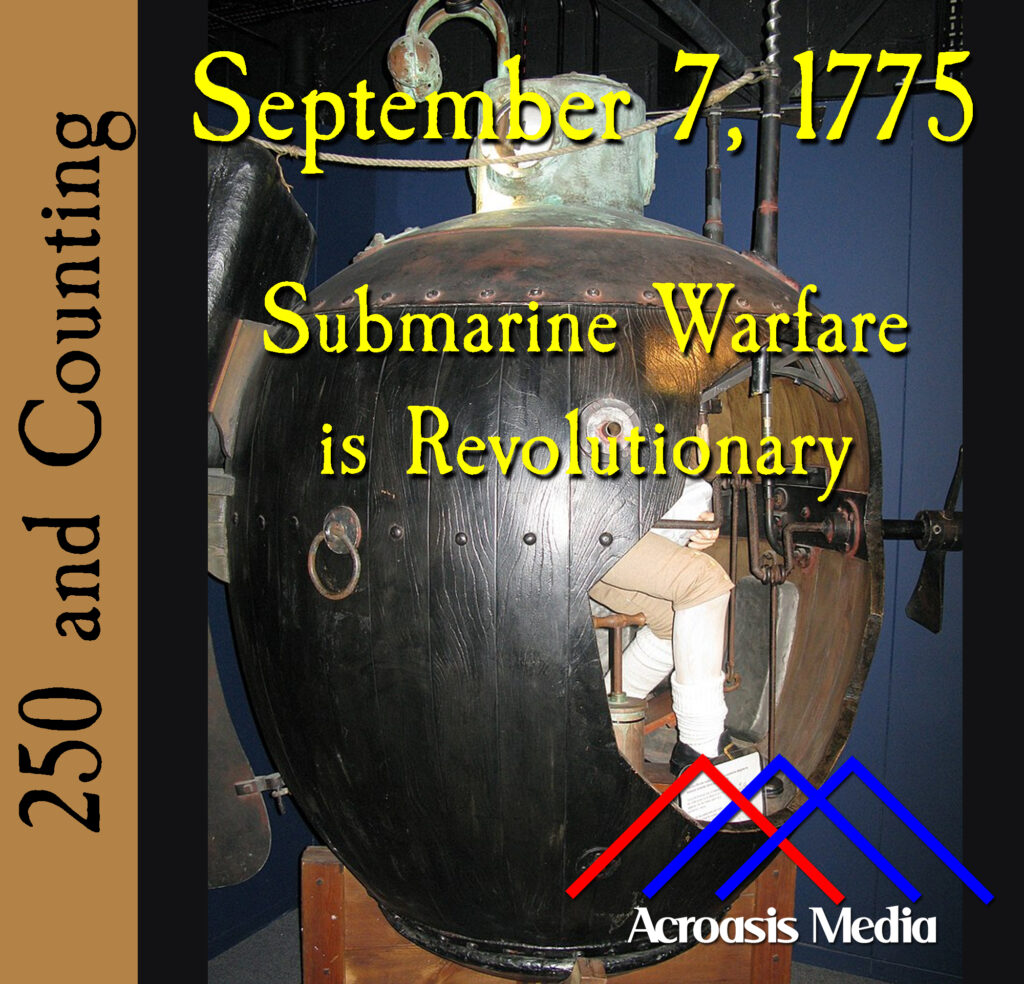
  • September 7, 1775: Submarine Warfare is Revolutionary

    Cover art for September 7, 1775: the full-size cutaway model of the American Turtle at the Royal Navy Submarine Museum in Gosport, UK

    The Turtle, or the American Turtle as it’s often called, was invented by a man who thought it should be possible to stealthily attach a bomb to a ship and then detonate it shortly thereafter, by approaching the ship from under the waterline.

    The Turtle was a brilliant idea in concept, if not in execution. There were just too many things that had to go exactly right for the turtle to successfully execute its design purpose, and when it was first tried in genuine combat on this day in 1775, unfortunately it was not successful.

    But every failure is one step closer to success, right?

  • September 5, 1775: Setback in Canada

    Cover art for September 5, 1775: Painting of the Schooner Hannah by John F. Leavitt, date unknown

    American forces began to move on Fort St. Jean in Canada. Unfortunately they ran into a couple of unexpected obstacles on the way, so they had to adjust their approach. This led to a six-week siege of the fort.

  • August 30, 1775: Your Cows or Your Life

    Cover art for August 30, 1775: Replica HMS Rose under sail off Massachusetts in 1971 on her way from Newport to Boston, photo taken by the late General William Lanagan (USMC), not copyrighted. Via Wikimedia.

    The HMS Rose was a 20-gun ship of the Royal Navy, built in 1757. When hostilities broke out between the Colonies and the Crown, the Rose was tasked with preventing smuggling off the coast of Connecticut and (especially) Rhode Island.

    She spent the first few years of the Revolution in Narragansett Bay, in the Long Island Sound, in the Hudson River and down to the Chesapeake Bay in Maryland.

    The Rose’s last action as a British naval ship was in Savannah, Georgia. She was no longer fit for battle not was she seaworthy, so she was scuttled in a channel of the Savannah River, essentially blocking it off and preventing other naval forces from reaching the city. This meant that Savannah remained in British hands until the war ended.

    In 1971 a replica was built (see the cover art), originally as a “dockside attraction.” Eventually she was purchased by Fox Studios and redressed for the film Master and Commander. Afterward she was renamed the Surprise and regained her status as a dockside attraction in San Diego, if you’re inclined to visit.

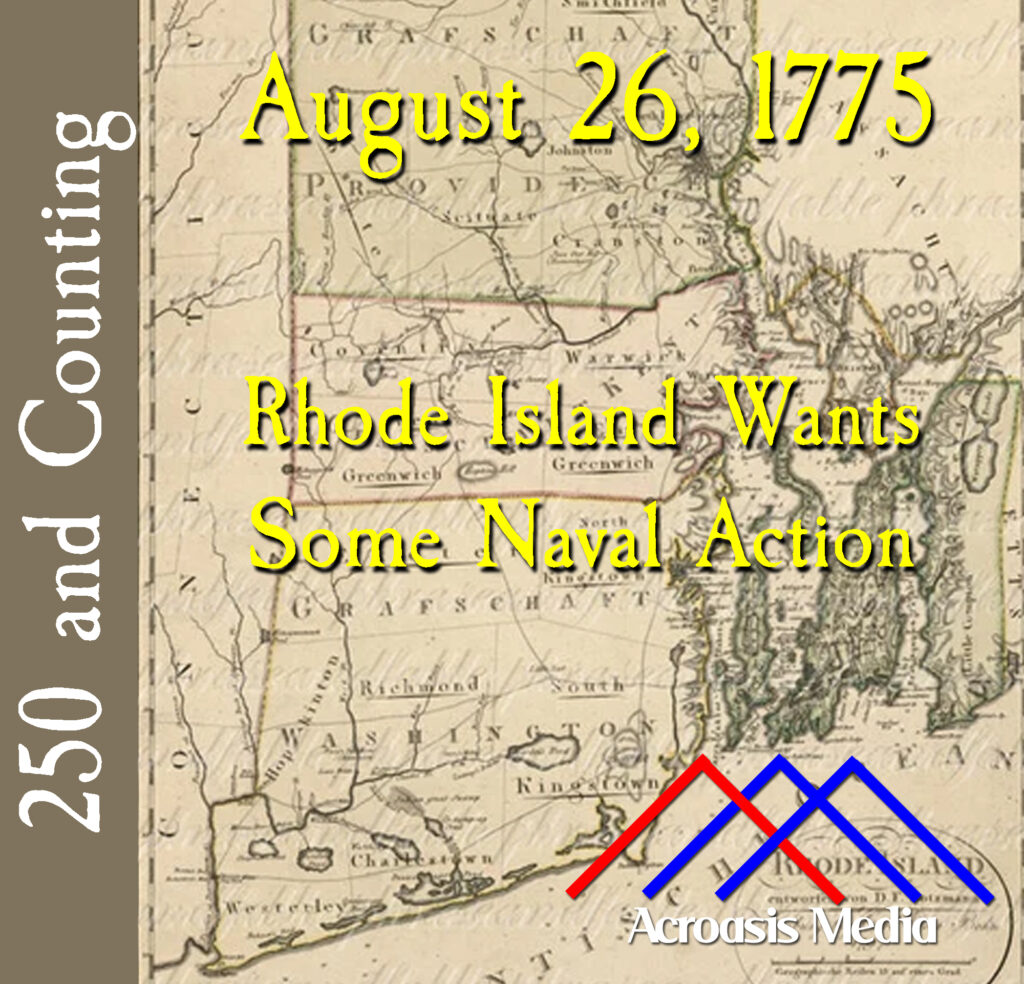
  • August 26, 1775: Rhode Island Wants Some Naval Action

    Cover art for August 26, 1775: Map of Rhode Island in 1775

    Rhode Island has been proactive about the war effort ever since the events at Lexington and Concord. And one thing you’re going to learn today is just how much coastline there is to Rhode Island, and why having a navy was important to them.

    But it’s important to get an outsider’s view of things, and this wasn’t necessarily the Continental Congress’ viewpoint. It took a long while before any real action was taken.

  • August 21, 1775: Rhode Island Cracks Down

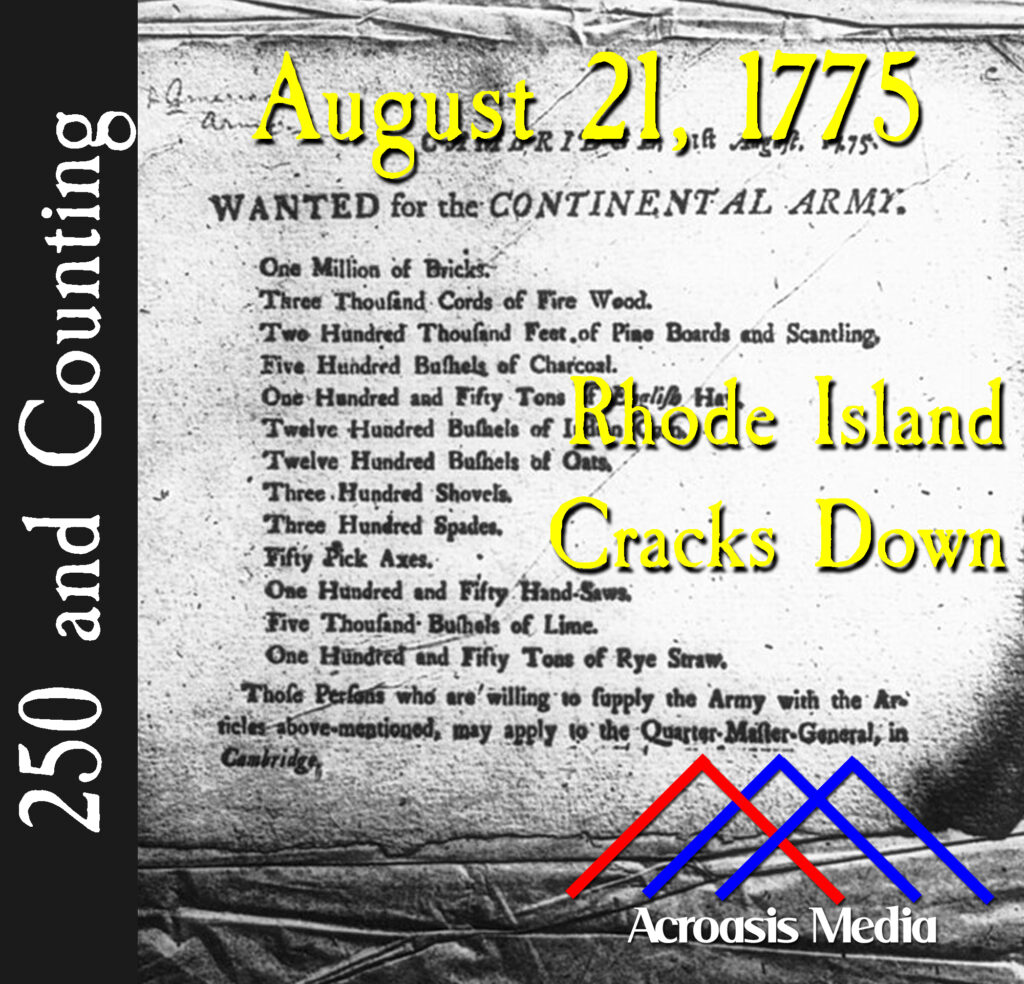
    Cover art for August 21, 1775: Public requisition of supplies for the Continental Army. Source unknown, via Wikimedia Commons.

    We have two events taking place on this day. First, Rhode Island allows the death penalty for certain activities at sea.

    Next, word goes out that the Continental Army is in need of supplies…lots of supplies. It’s looking like General Washington isn’t seeing an end to the Siege of Boston anytime soon.

  • August 14, 1775: “Stolen” Goods From Bermuda

    Cover art for August 14, 1775: Map of Bermuda from 1778, origin not known to this writer.

    There’s an episode of The West Wing in which Leo McGarry explains how, several years earlier, the President wanted to meet the Dalai Lama. The problem was that China was strongly opposed to such a meeting, so they arranged for an “accidental” meeting between the two:

    Set up a low-level meeting with someone else and leave the door open. The President wanders by, “Hey, how ya doing, Dalai Lama?”

    The point is, diplomacy can be weird. And when the Continental Army, needed gunpowder from Bermuda, it was arranged to have the gunpowder be “stolen” from their armory and somehow make its way into American hands.

    Who knew!

  • August 7, 1775: A Victory in Failure

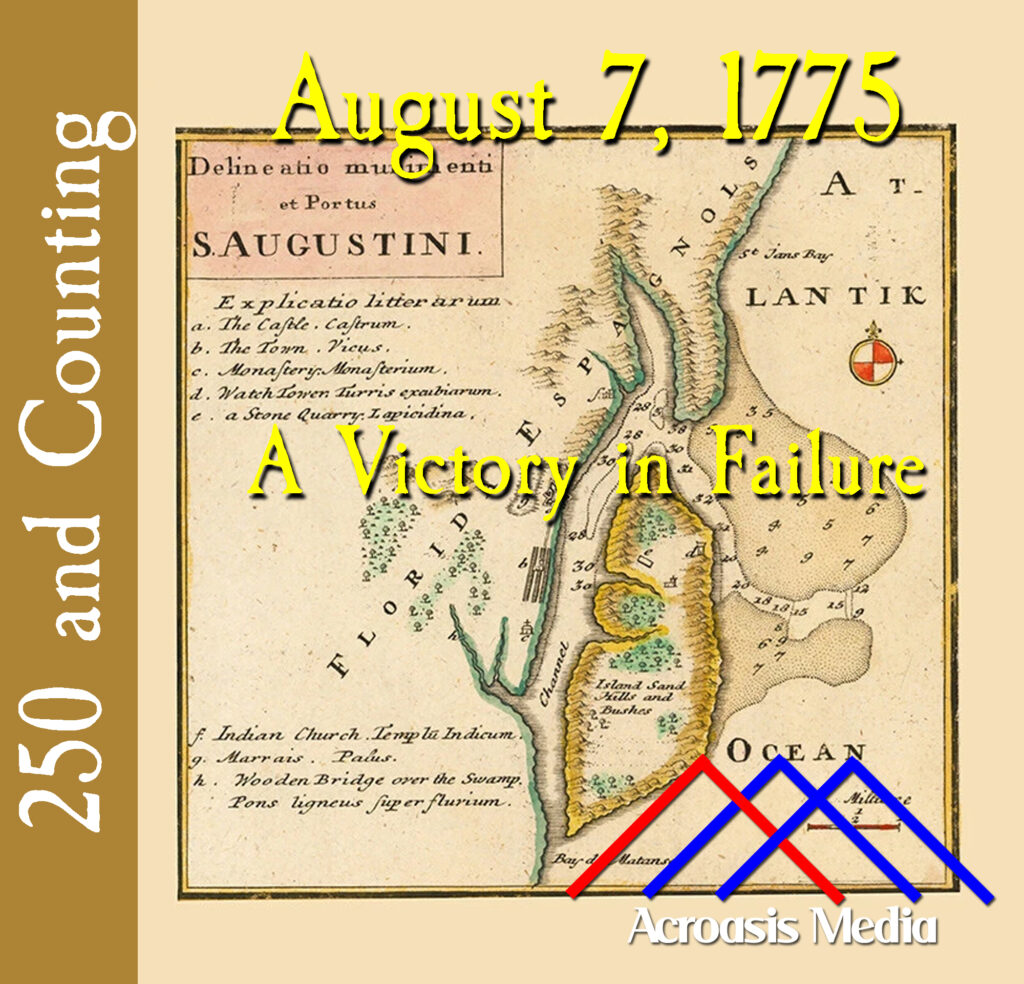
    Cover art for August 7 1775: Map of St. Augustine in 1740.

    Once again, complacency wins the day. An American ship heads to Florida to raid the British ammunition stores there, and instead stumbles on a ship carrying literal tons of gunpowder. And it’s easily captured because the crew was asleep.

    Wasn’t anyone on watch? Apparently not, or they still managed to allow the American ship to get close enough that they could get on board. EIther way, American ships weren’t worth considering, and there wasn’t any American Navy…yet. But events over the next few days could change all that.

  • August 4, 1775: A Letter of Dissatisfaction

    Cover art for August 4, 1775: Edward Thornborough, as an admiral in 1821. Painted by Samuel Lane.

    One of the reasons (we think) that the Colonial forces were able to gain small advantages over the British forces is that the Colonial Army was relatively untrained, and sometimes succeeded through dumb luck. They attempted things that “everyone knows” wouldn’t work, and surprise! It did work because nobody thought they’d be dumb enough to try it.

    The Colonies also didn’t have a lot of Navy going on just yet, and it may have been because of this that they were able to succeed at sea, as well. British ships would sail past American fishing vessels, thinking them of no consequence, and suddenly they’d find themselves outwitted by a whaling ship.

    Some British captains did manage to catch on to American tactics, though. Edward Thornborough was one of them, and he made his concerns clear in a letter written on this day in 1775.

  • July 10, 1775: The Georgian Navy

    Cover art for July 10, 1775: Historical marker in Savannah commemorating the first ordered capture in Southern waters of the Revolution.

    Hey! We have a Navy now!

    Okay, it’s only one ship, but it’s a start. And to be clear, it’s Georgia’s navy, not the navy of the Continental forces. But we’re getting somewhere.

    And what’s more, on its first day it took on a British ship, with amazing results. Listen in and learn the story.

  • June 29, 1775: Thomas Boyle, Privateer

    Cover art for June 29, 1775: Picture of Thomas Boyle, source unknown

    Thomas Boyle wasn’t born in Baltimore, Maryland, but when he was a young man he made it his home and became quite successful there, as a merchant marine and an overall businessman.

    And, of course, given Baltimore’s penchant for naming streets after historic people and events, there is a Boyle Street. It’s not very long; in fact you see the entire road in the photo below.

    In this picture the viewer is standing on Fort Avenue looking down toward Key Highway. The green structure in the background is the Baltimore Museum of Industry, and the Inner Harbor is just beyond that. Based on my research, Boyle didn’t live near this location; he’d settled in a part of town called Fell’s Point, which is on the other side of the harbor and about a mile to the east. If a person standing where the camera was for this photo turned to the right, they could probably see the entrance to Fort McHenry.