When looking at historical documents related to Joseph Healy, it appears that most of them relate to Healy in a rather ancillary manner. We know how many times he voted in Congress because someone keeps tallies of everyone in Congress. We know about his family tree because he was traced back via Ancestry.com.
Healy is the stone that was thrown in the pond; what we know about him has to be read from the ripples.
All of which is a rather long way of saying that I don’t have a lot to say here.
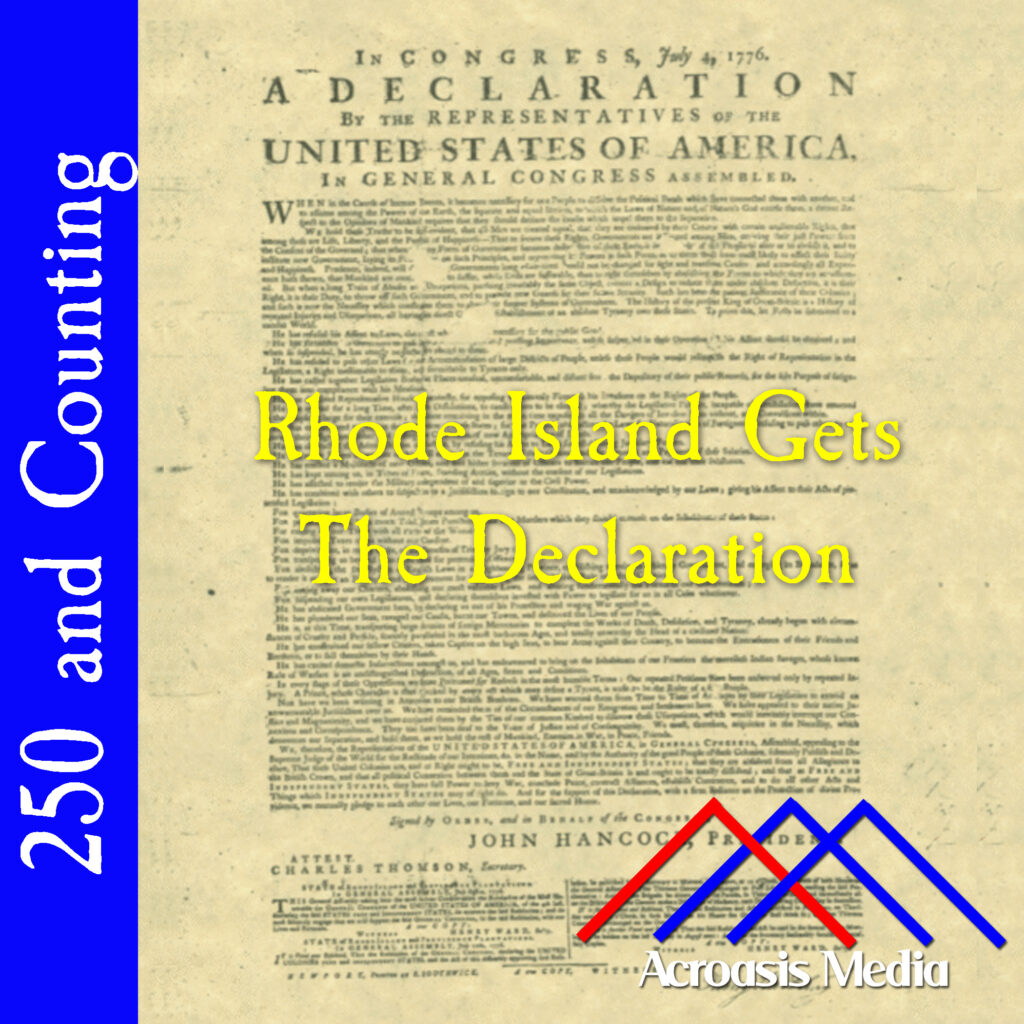
That the Southwick Broadside version of the Declaration of Independence isn’t as famous as the Dunlap Broadside shouldn’t be a surprise, since the Dunlap is the first one, and the one on which all the others are based. The the Southwick has the wrong date on it is an interesting nugget of information.
It’s worth noting, however, that while John Dunlap spent the better part of the night of July 4 setting the type, making a copy, making corrections, rinse and repeat, there are still mistakes on his as well. Some copies are on the “wrong” side of the paper (i.e. the watermark is reversed). Some have ink smudges, as though they were folded or rolled up before the ink was quite dry, and according to Ted Widmer in an Op-Ed he wrote for the New York Times (soft paywalled link), the punctuation doesn’t necessarily agree from one copy to another.
Historians have identified nineteen different versions of the Declaration of Independence printed around that time, though there may be a few more idenfied since that initial survey, which was in the late 1940s. Of those nineteen, 71 copies were known to exist. That said, when the survey was published, only 14 of those copies were the Dunlap Broadside. Now that there are 26 Dunlaps, we’re up to 84 contemporary copies of the Declaration, with another few whose provenance or source are unknown.
Interestingly, three copies of the Dunlap Broadside are in the hands of the British. One was seized by Richard Howe in New York, another accidentally fell into Howe’s hands while he was on Staten Island, and the third one was part of a larger Customs seizure from a man named Jonas Phillips, who was sending a box of documents to Great Britain from Philadelphia in late July 1776. Phillips’ note to his relative in Britain was in Yiddish, which the Customs agents thought was a code, so he seized the documents without examining them. It was only a couple of years ago that the contents were examined and identified.
Accidents of history, I tell you what.
For what it’s worth, only seven copies of the Southwick Declaration are known to exist today.
May 4th is Rhode Island Independence Day, marking the date that one of our smallest states became the first of the Original Thirteen Colonies to declare its independence from Great Britain.
Almost.
Here—as the late, great Paul Harvey would say—is the rest of the story.
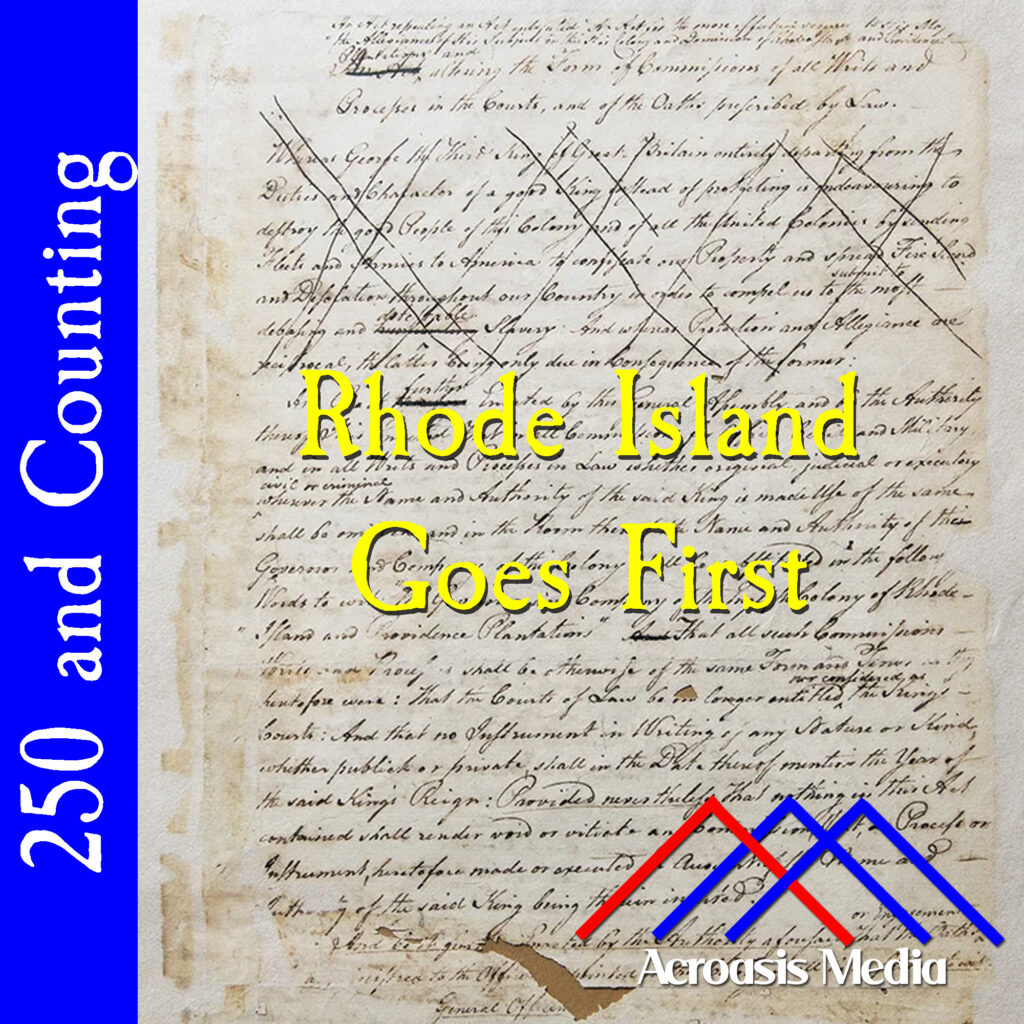
All of the colonies were required to sign oaths of allegiance to King George III, or whoever was in charge at the time. On May 4, 1776, the Rhode Island Assembly passed the Act of Renunciation, which repealed that oath. They didn’t formally declare independence; that didn’t happen until mid-July, when they approved the Declaration as written by Thomas Jefferson and his fellow delegates.
If you look closely at the cover art, you can see that there’s some material on the Renunciation that was X’ed out. Those are some accusations against the Crown that the Assembly apparently thought better of. I guess it wasn’t worth getting a new sheet of paper, then; they’d fix it in engrossing or at the printer’s.
The war was less than a year old, but heroes were already beginning to emerge, as we learn from contemporary writings. The arrival of George Washington in Providence, RI, was considered a big event each time he came through.
In fact, it was such a big deal that the website for Stephen Hopkins’ house in Providence notes that “George Washington was a guest here. Twice.”
I suppose they could have hung up two “George Washington Slept Here” signs but nobody would get it. Then again, “George Washington Slept Here” isn’t quite the trope it used to be. Leave me alone, I’m old. And get off my lawn.
Hopkins, for what it’s worth, was an important person in his own right, having been central to the development of the colony and then the early days of the state. If you visit the house, though, be forewarned that it’s not in the same place it was when Hopkins lived there; it’s been moved twice since he was there. Although, to be fair, it’s always been on that street.
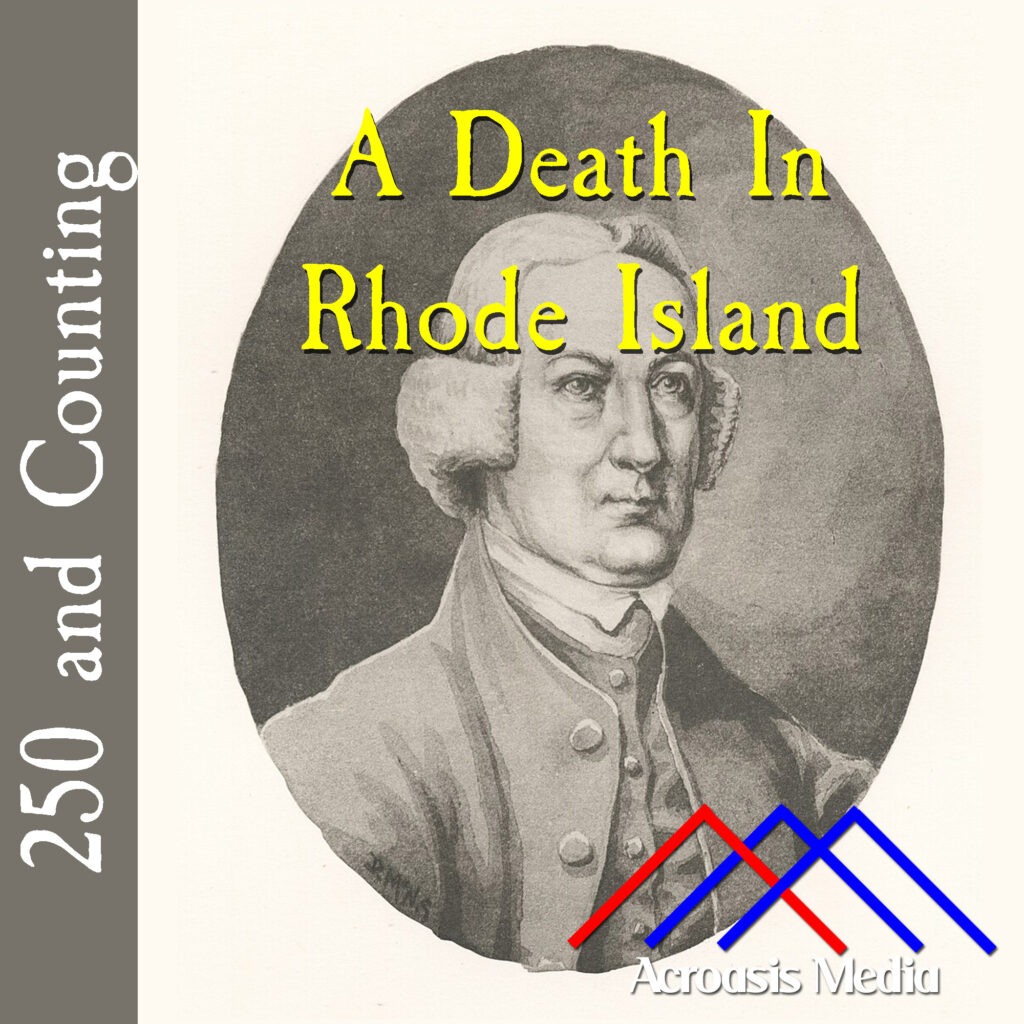
Samuel Ward Sr. was a farmer and a politician, the governor of the Colony of Rhode Island and Providence Plantations, and a Justice of that colony’s Supreme Court.
As a younger man, Ward believed in governments issuing hard money rather than paper, often battling with Stephen Hopkins over this issue. Because of this specific topic, the two men became bitter rivals and for several terms they alternated being governor of Rhode Island.
His final term as governor ended in 1767, at which he left politics to work on his farm. But in 1774 he was called back into service as a delegate to the Continental Congress. Fortunately, he and Hopkins had buried the hatchet and the two were more friendly with one another. I say “fortunately” because Stephen Hopkins was also called to join the Congress.
Ward died in Philadelphia and was buried there, but over 80 years later he was moved to the Common Burying Ground in Newport, RI and reinterred there.
Prudence Park on Prudence Island, from a 1930s-era postcard. Via Wikimedia Commons.
Prudence Island, in the Narragansett Bay off Rhode Island, didn’t have a lot of strategic value to anyone. What it DID have was livestock, and the British were hard-pressed to get supplies, especially for Boston, which had been under siege since mid-April.
And, as Mike notes during the episode, neither army was really shy about stealing what they needed to advance their cause.
While the residents of Prudence Island managed to repel the British on their second engagement, everyone just pretty much noped out of there, with only a few ever returning. So in the long run, it was a win for the British.
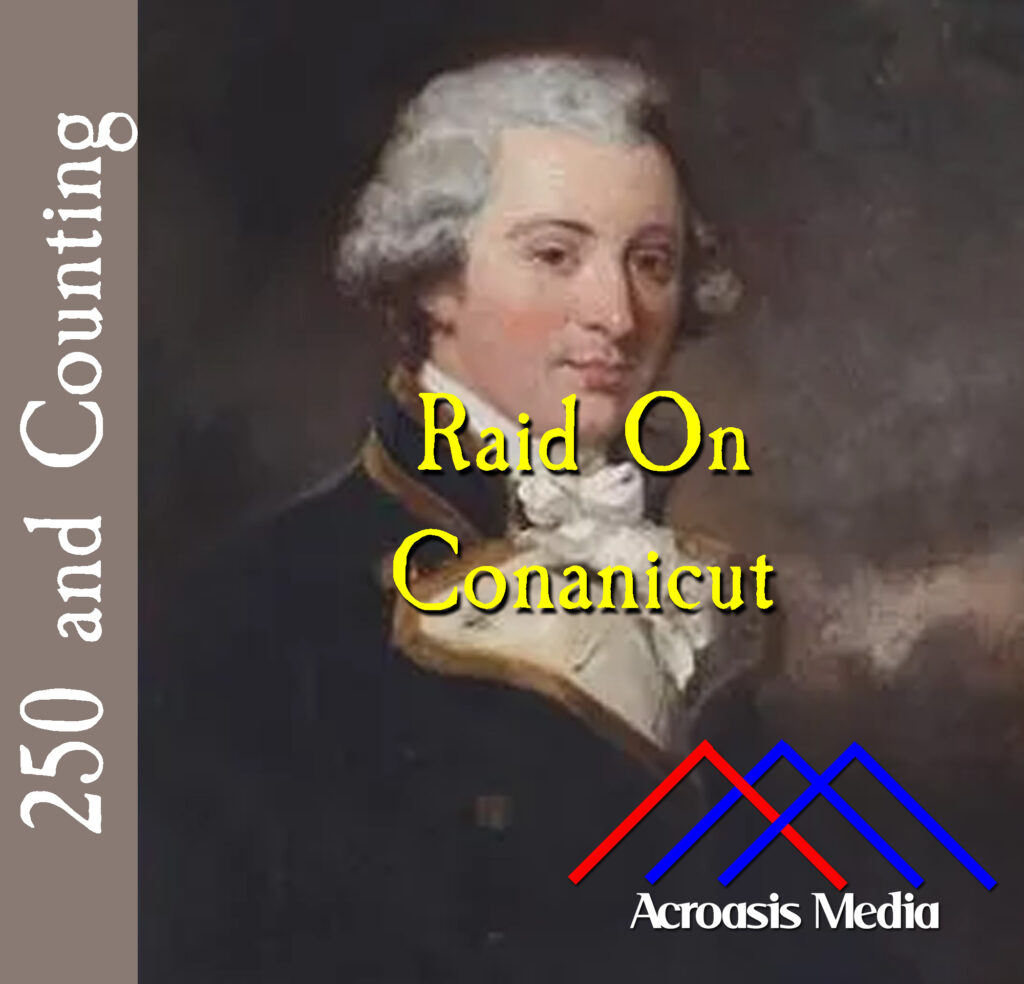
Conanicut Island isn’t much of an island to look at, but they had supplies of some kind, and the British were looking.
Admiral Graves had the task of finding supplies for the British who were under siege in Boston, and he decided to move beyond the local waters, and went into Narragansett Bay. In some towns (such as Newport, which was Loyalist) he was able to just buy supplies. But if the locals resisted, that’s when he broke out the guns.
Conanicut Island looked like a vulnerable place to get supplies. He was able to get some of what he needed, but it wasn’t the cake walk he thought it would be.
While Boston was under siege, the British were having a hard time getting food and other supplies. But they still controlled the water, so British naval vessels went in search.
Captain James Wallace was especially good at procuring supplies, largely because he harassed people until they gave in, or he would threaten to shoot up the place.
This second tactic was the one he chose for Bristol, Rhode Island, and it’s unclear how much actual damage he did to the town (reports vary wildly). But what is known is that he came in search of 200 sheep and 30 cattle, and came away with 40 sheep after he cut a deal with the town.
It’s often tough to remember that when the fighting first broke out, it wasn’t a bid for independence from Britain. It was an attempt to protect and defend rights that the Colonists thought they had as part of their relationship with Britain. Reconciliation was (amazingly) still on the table, even six months after Lexington.
So while many colonies had created their own small navies (with Congress’ encouragement), there were several in Congress who felt that creation of a navy was a step too far. They were okay with an army, but not a navy? I don’t really get it either.
When Rhode Island finally put forth a formal proposal for a Continental Navy, it met with almost universal resistance. Why? Tune in and find out.
Rhode Island has been proactive about the war effort ever since the events at Lexington and Concord. And one thing you’re going to learn today is just how much coastline there is to Rhode Island, and why having a navy was important to them.
But it’s important to get an outsider’s view of things, and this wasn’t necessarily the Continental Congress’ viewpoint. It took a long while before any real action was taken.