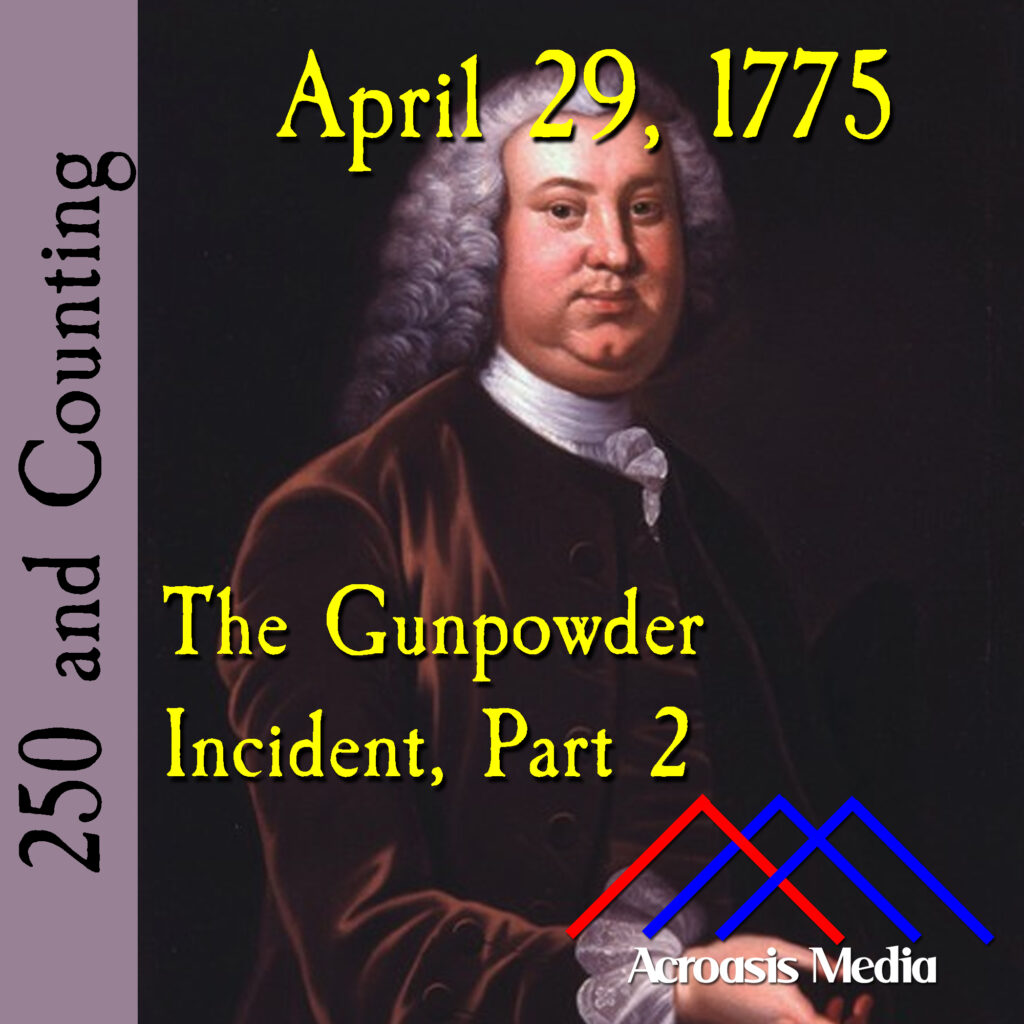
This day in American History, 250 years ago.

  • February 22, 1775

    Cover art for February 22, 1775: a map of Binghamton, NY in the early 1800s

    Back when Mike and Claude were kids, February 22 was celebrated as a national holiday, the 22nd being recognized as George Washington’s birthday. Lincoln’s Birthday was February 12, so we had two Federal holidays close together. (To be fair, Lincoln’s was always unofficially recognized.)

    Until, that is, 1968, when the Uniform Monday Holiday Act came along, and many holidays were moved to the Monday of that week. Not every state complied right away, but eventually Lincoln’s Birthday disappeared and Washington’s Birthday moved from the malleable February 22nd to the always-on-Monday Presidents Day.

    But here’s the part they don’t always tell you: George Washington wasn’t born on February 22. He was actually born on February 11, 1731 but that was under the old Julian calendar. In 1752, Britain and all its colonies switched to the Gregorian Calendar, which changed Washington’s birthday (well, everyone’s, really) by a year and 11 days, to February 22, 1732.

    Believe it or not, people did not take the calendar change well. Because it was essentially a Catholic innovation (named after Pope Gregory XIII), Protestants thought it was a Catholic plot to return them to the fold. Other people, especially in the Colonies, thought that time was being stolen from their lives, and they demanded that the “lost” days be returned. It wasn’t until public figures—including George Washington—adopted the new dates and made a big deal about doing so, that people started to calm down.

    None of this is relevant to the story you’ll hear in today’s episode, but this whole Washington’s Birthday thing doesn’t get told nearly enough. In the meantime, enjoy Mike’s story of William Seymour.

  • February 21, 1775

    Cover art for February 21, 1775: "The Residence of the late revered Rev Claudius Herrick", artist unknown, via Yale University Library

    Of all the indignities we laid upon Claudius Herrick in this episode (okay, there weren’t that many), the worst is that we misspelled his name in the cover art.

  • February 20, 1775

    Cover art for February 20, 1775: Etching of "Enterprise on her Fast Trip to Louisville, 1815"

    Until Israel Gregg came along, steamboat commerce on the Ohio river was considered impractical, largely because the currents were so strong.

    But Gregg had an interesting approach to demonstrate that it was, in fact, possible. In some portions of the river, there was a confluence with another river, which meant that there were multiple currents in the river for some distance. This is what made it hazardous in the first place.

    Gregg made a point of seeking out the currents of a specific river in each confluence, and navigating only that river’s current. So from Brownsville to Pittsburgh, Gregg used the currents of the Monongahela River. From Pittsburgh to Cincinnati, he used the currents of the Ohio River. Then he remained with the current of the Ohio to Louisville. From there he returned to Pittsburgh, running against the current of the Ohio. A few cycles of this had people convinced, and his ship, the Enterprise, became one of the first of that name to go down in history. (Specifically, it was the third in American history.)

  • February 19, 1775

    Cover art for Februay 19, 1775: "The Fall of Nelson, Battle of Trafalgar, 21 October 1805" by Denis Dighton, 1825

    When I (Claude) was younger, I read a Star Trek novel titled The Final Reflection by John M. Ford. Trek novels weren’t considered canon, and later events in the films and subsequent series kind of wiped out some of the concepts put forth in the book, but what I found fascinating was that it was told entirely from the Klingons’ point of view. (It also provided an interesting explanation regarding why Federation transporters give off a high-pitched whine.)

    Before you think I’ve digressed before I’ve even started, my point here is that today’s episode focuses on a British military figure rather than one of the Founding Fathers or other Colonial figure. We’re taking an all-too-brief look at Lord Horatio Nelson, who did have an important life event take place on this day in 1775.

    Also, when you listen to the episode, you’ll see I just have Star Trek on my mind.

  • February 18, 1775

    Cover art for February 18, 1775: the grave of William Henry Winder, in Greenmount Cemetery in Baltimore MD.

    Maryland has a peculiar place in most of America’s major events. During the Revolution, the Continental Congress hid out there for a while. During the Civil War, the state mostly sat out the war because it was a “Southern” state occupied by the Union throughout.

    But the War of 1812? Well, that was Maryland’s time to shine, and today we meet one of the military men who fought in that war, though he wasn’t especially successful in the Battle of Bladensburg.

    We did have a portrait of Winder we were going to use in the cover art until we realized that Winder is buried in Greenmount Cemetery, in Baltimore, a short distance from Claude’s home. So he ran out and snapped a photo. Several famous historic figures are buried there, including John Wilkes Booth (it’s probably the best-known unmarked grave in America), so there may have to be a few more trips over there.

  • February 17, 1775

    Cover art for February 17, 1775: a map of Albany and the surrounding area in the late 1700s.

    We’ve mentioned in the past that the intent of most of the Intolerable Acts and the Coercive Acts were designed to punish the Massachusetts Province, but it had some effect on the other colonies as well. What’s more, there was a growing worry that, if Parliament could do things like this to Massachusetts, what’s going to stop them from doing it to us?

    To that end, the city of Albany, NY, began making plans just in case war broke out. It was against the law, but their reasoning was that it was better to have a militia and not need it, than to need it and not have it.

  • February 16, 1775

    Cover art for February 17, 1775: Portrait of David Barclay

    David Barclay was a British merchant who frequently plied his trade with other merchants in the Colonies. Such trade was quite lucrative for him, so when the Stamp Act was enacted, he stood to lose a lot of money because the Colonists would simply look elsewhere for the goods he sold.

    Likewise, when the Intolerable Acts, and the Coercive Acts were enacted, Barclay stood to suffer even more.

    So Barclay came up with a plan that would allow everyone to save face and bring these acts to an end.

  • February 15, 1775

    Cover art for February 15, 1775: Portrait of Lord Horace Walpole

    Only a few people had figured it out, and it’s not clear whether they were just guessing, but by this point in time both England and the Colonies were locked into a path that would lead inevitably to a shooting war.

    To that end, Parliament approved sending over four thousand soldiers and sailors to the Colonies to help keep them in line. But it wasn’t as simple as that; there were still some people protesting the action, not that anyone listened to them.

    Today we also peek in on someone who’s watching the action and has some thoughts.

  • February 14, 1775

    Cover art for February 14, 1775: Depiction by Percy Moran circa 1909 of British Grenadiers and Light Infantry scaling today's "Breed's Hill."

    When it comes to Black people and their role in the American Revolution, the one name that most people appear to remember is that of Crispus Attucks, largely because he was the first person killed in the Boston Massacre, and that event is thought of as the beginning of the Revolutionary War, therefore it’s significant that the first person to die in the name of American freedom was a person of color.

    Other people, more fussy about events, would say that Lexington & Concord was the beginning of the war. The reasoning behind that is that it’s the first event in a series of hostile actions that took place close to one another. But the real argument is that most historical events of this nature don’t have definitive “beginning” and “ending” points; it’s much like a roll of paper towels. Sure, there are perforations marking each sheet, but you know for a fact that when you pull one off, it’s going to tear at an oddball angle and those perfectly rectangular sheets are a rarity.

    The fact is, however, that over 100 Black men fought as part of the militia in the opening battles of the Revolution. Here’s the story of one of the first.

  • February 13, 1775

    Cover art for February 13, 1775: historical marker outside the Phipps Street Burying Ground in Charlestown, Massachusetts.

    Here’s a peek behind the curtain: Mike and Claude do their own research for the individual shows, though Mike did the initial setups for the dates. So he’s the one who figured out what happened when, and then they each do the deeper research for the episodes they record.

    So Mike probably had no idea that there was a familial connection to this episode for Claude. For what it’s worth, neither did Claude, until he started looking into the story of Nathaniel Gorham. So if Mike had been recording this episode, it’s likely that he wouldn’t have had anything to say about it other than “Oh, fun coincidence.”

    We’re only sad that we couldn’t find a portrait of Nathaniel; we have no idea whether there’s a family resemblance.