Tag: California History

  • He Built This City–March 28, 1776

    Cover art for March 285, 1776: Portrait of Juan Bautista de Anza. Painted by Fray Orci; 1774. via Wikimedia Commons

    Juan Bautista de Anza is considered one of the founding fathers of Spanish California.

    He was born in 1736 in New Spain (what we now call Sonora, Mexico) into a family of military leaders. Most of his military actions involved taking on Native Americans while he explored what is now known as Arizona.

    Near the end of the 1760s Spain began to colonize Alta California, which was basically anything not considered Baja California. They took a two-pronged approach; one expedition ran up the coast at sea, which turned out to be quite difficult because the winds were going the wrong way. The other path was over land, which was a little more direct and allowed the Spanish to establish several missions along the way.

    In 1772 Anza proposed a new expedtion to Alta California, which was eventually approved by the King of Spain, and in January 1774 he set out from a place a little bit south of present-day Tuscon, Arizona. By April he’d reached Monterey, California before returning to the place he’d started.

    October 1775 brought a new start to the expedition, this time with the goal of transporting colonists to Monterey. Having done that, he continued north until arriving at the arroyo of San Joseph Cupertino, which is now known as Stevens Creek. Two days later he’d spotted the San Francisco Estuary and identified the sites for the Presidio of San Francisco and Mission San Francisco de Asis.

    Having established an overland route, Anza returned the way he’d come. Unfortunately in 1781 the Yuma Tribe closed off the trail at the Colorado River, which stayed closed until the 1820s, meaning that if you wanted to get to Alta California from Baja, for over 40 years you had to do it by sea.

  • August 5, 1775: Open Up That Golden Gate

    Cover art for August 5, 1775: photo of a drawing by Walter Francis depicting the ship San Carlos entering the bay of San Francisco on August 5, 1775. via Wikimedia. Out of frame this Photoprint reads: "Drawn for 'The Beginnings of San Francisco'".

    Meanwhile, three thousand miles away from the action…

    …the Spanish were exploring the West Coast and claiming a lot of territory in their name. It was largely exploration and planting flags, although there were some colonies established as well.

    But what’s interesting about the bit of exploration we’ll be looking at today is that, even though the Spanish had been up and down the coast for a couple of hundred years, it wasn’t until 1769 that they realized that the strait leading into San Francisco Bay was even there. Possibly because it was frequently fogged in, possibly because the area was considered hazardous to navigate.

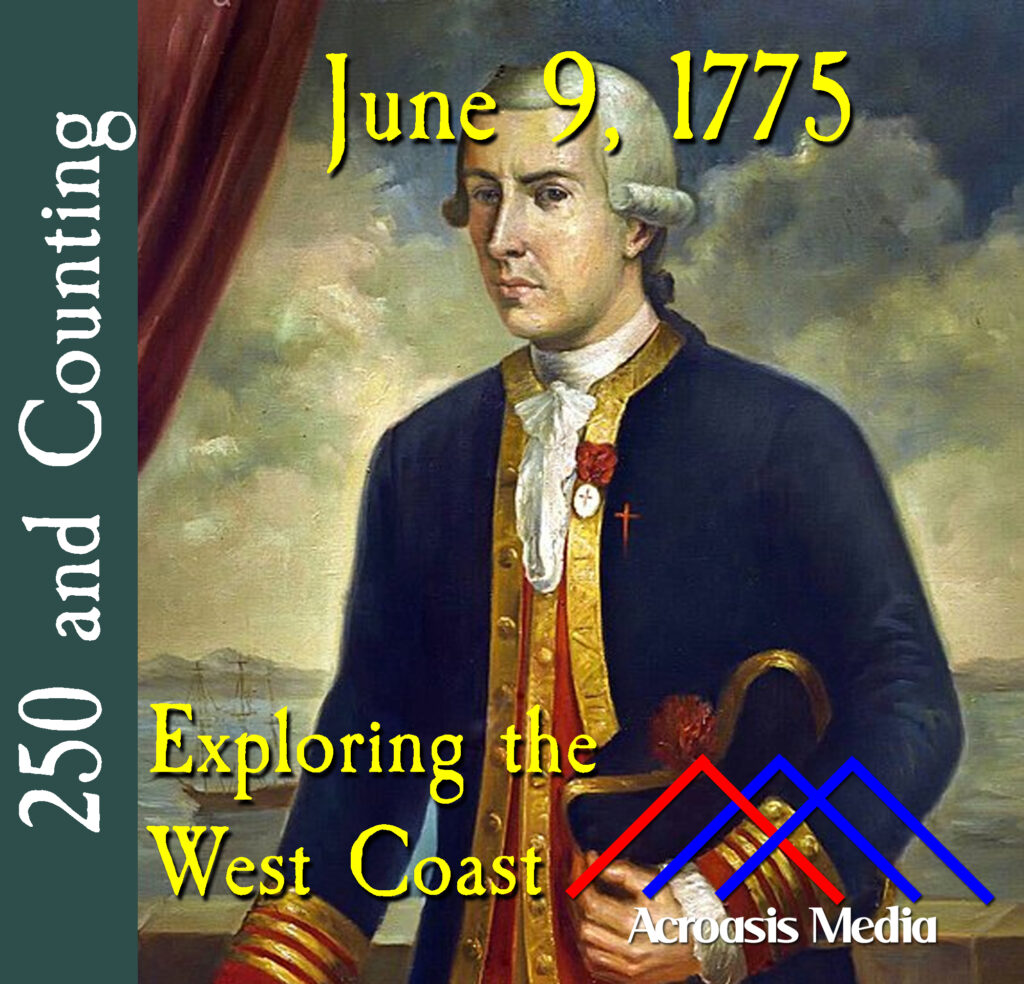
  • June 9, 1775: Exploring the West Coast

    Cover art for June 9, 1775: Juan Francisco de la Bodega y Quadra, artist unknown, circa 1785.

    We’ve spent all our time on the East Coast; let’s take a side quest to the West Coast to see what the Spanish are up to.

    We have two main players here: Bruno de Heceta, after whom at least two locations on the West Coast are named (and they’re pronounced differently, go figure), and Juan Francisco de la Bodega y Quadra.

    They sailed together, each in charge of a ship, and made it almost to Canada before Heceta headed back to Mexico and Bodega y Quadra continued on up to Alaska. Their goal was to find Russians, and in that respect they failed, but they did manage to claim a lot of territory for Spain.