Tag: Continental Army

  • The Return of Charles Lee–October 14, 1776

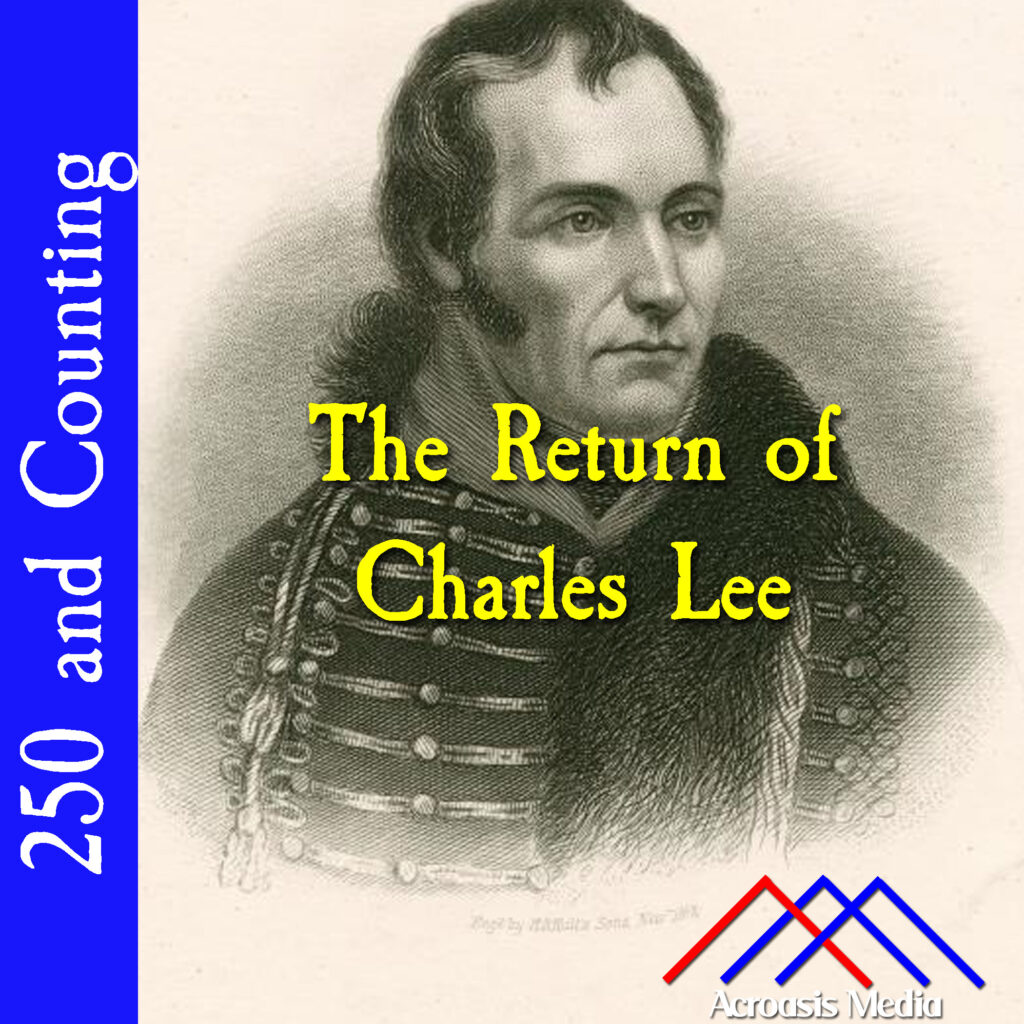
    Cover art for October 14, 1776: Portrait engraving of Major-General Charles Lee, ca 1860 by Henry Bryan Hall, based on historical sources. via New York Public Library Digital Collection.

    Charles Lee was born in Great Britain and only came to British America in 1773, when he purchased an estate in western Virginia.

    It wasn’t his first time in America; he’d fought for the British in the French and Indian War and married the daughter of a Mohawk chief.

    Lee was injured in 1758 during an attack on Fort Ticonderoga. The following year he was part of the capture of Fort Niagara and of Montreal the year after that.

    Lee returned to Europe and served in Portugal as a lieutenant colonel. In 1763 he returned to England and retired on half-pay. Two years later he served as an aide-de-camp under King Stanislaus II of Poland. He saw some action in the Russo-Turkish War but it was during a duel in Italy that he lost two fingers.

    Lee returned to England and realized that he was sympathetic to the Colonists’ cause, so he moved to America and purchased an estate in what would now be West Virginia. When the Continental Army formed, he joined up immediately, expecting to be second-in-command to George Washington (he did realize that Congress would want a native-born Commander in Chief).

    Lee took on the command of the Southern Department and was present for the Battle of Sullivan’s Island. He was given credit for the victory, though based on some accounts the win didn’t really belong to him.

    Lee was captured in December 1776 in New Jersey and released in a prisoner exchange in 1778. In subsequent battles Lee was cast in a villain role by official reports, and he was court-martialed. He was found guilty by the jury but the court reduced the final charges and suspended from the army for a year. In 1780 Lee sent a scathing letter to Congress that led to his dismissal from the army.

    He returned to Virginia but his debts piled up and he was advised to sell off his property. Unfortunately he died in 1782 before he could complete the sale and his sister Sidney Lee inherited the property. It’s not clear but he likely died of tuberculosis.

    Lee’s legacy has waxed and waned over the years, and most recently it’s in a “down” cycle, as documents have been discovered that he may have been attempting to communicate with British officers regarding a potential plan with which they might defeat the American rebellion. However, there are still many who doubt the idea that Lee was specifically acting treasonously.

  • A Fort Is Abandoned–October 5, 1776

    Cover art for October 5, 1776: Historical Marker denoting the former site of Bergen Neck Fort/Fort Delancey. Via Historical Marker Database.

    The cover art for today’s episode is the historical marker for Bergen Neck Fort, in Bayonne, New Jersey.

    As someone who was born and raised on the other side of the East River, it’s supposed to be my duty to bust on New Jersey and say something like “there’s nothing interesting going on in Bayonne” and I’d mostly be right, but I will note that Mercer Park, just a hair under a mile from this spot, is rather nice.

    I did spend a few years living in northern New Jersey, just a stone’s throw from what was then called The Meadowlands (and still is, if you’re a die-hard), and it’s really not a bad place to live. I had a decent sight-line to the Manhattan skyline, but my neighborhood had a very suburban feel to it. The town I lived in was practically Whoville during Christmas season.

    Bergen County was also home to many people who lost their lives to the attacks on the World Trade Center, since it was just across the Hudson River, so there are numerous memorials in the area. Lyndhurst, NJ (for example), which is mostly famous for a bunch of exterior scenes from The Sopranos, has one that’s made from stones reclaimed from the rubble. I moved away from the area just a couple of weeks before September 11, but I kept in touch and many people in the area were deeply affected.

    And now that I think about it, Bayonne—which is literally within sight of the former WTC buildings and the Statue of Liberty— has a truly moving memorial commonly called “The Teardrop”, which was a gift to the United States by a Russian sculptor named Zurab Tserteli. At 100 feet high, it can actually be seen from the other side of the river as well. So don’t go to Bayonne to see Bergen Neck Fort, since there’s nothing there. But if you do go, head to Harbor View Park.

    And please don’t tell anyone I have a soft spot for northern New Jersey; I could lose my NY cred for that.

  • Washington’s Desperate Letter–September 24, 1776

    Cover art for September 24, 1776: portrait of George Washington commissioned by John Hancock shortly before the Declaration was issued, painted by Charles WIllson Peale in 1776. via the Brooklyn Museum.

    George Washington was a practical man, and he realized that without a standing army, he wouldn’t stand a chance against the British.

    Sure, it’s good to have motivated people who are passionate about the cause, but when they have setbacks, they’re more likely to bail out, and that’s exactly what he was facing once the dust began to settle from his losses in New York. Many of the recruits that he had weren’t finishing out the enlistment period they’d agreed on when they first joined up, and the fact that their supplies and their pay were sporadic didn’t help matters.

    It was with this in mind that Washington wrote to Congress, strongly recommending that they make some changes to the way that the Continental Army was being administered. Improving pay would be great, but simply ensuring that pay happened on a regular basis would be even better. And, of course, if a standing army could be established, then the men would be locked in for longer periods of time, and his officers wouldn’t spend so much time training new recruits.

    Whether Congress agrees to this change…stay tuned.

  • To Stay, Or Not To Stay?–September 12, 1776

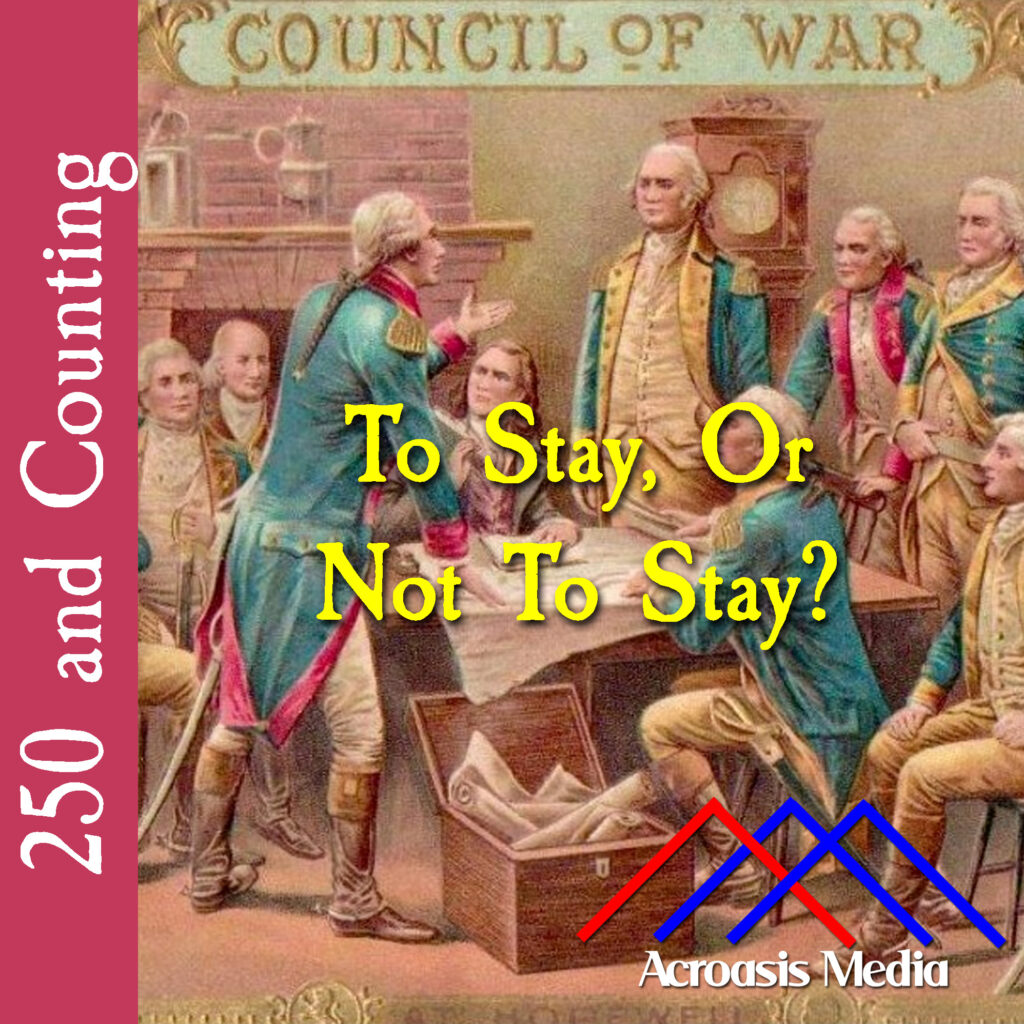
    Cover art for September 12, 1776: "Washington's Council of War at Hopewell," James Edward Kelly, 1884. Cigar Box inner label based on a relief sculpture.

    George Washington’s Council of War finally got to meet on this day in 1776, to figure out what happens next.

    The Battle of Long Island was a rout for several reasons. In addition to the Continental Army being outnumbered by roughly two-to-one, there was poor communication and a couple of tactical errors. And the only reason more soldiers weren’t captured or killed was because poor weather prevented the British from figuring out that they were escaping across the East River until it was far too late.

    So, as any good soldier would, Washington took a moment out to seek advice from his Council of War. Nathanael Greene recommended just getting out of town and regrouping elsewhere, but he also suggested burning the city down to keep it out of British hands. Washington already knew that Congress didn’t like the burning thing.

    Most of Washington’s council recommended leaving the city, but Washington still wanted to ensure that some portions of the city were fortified and made appropriate plans. Unfortunately those plans fell apart rather quickly, as we’ll soon learn.

  • Meet The New Boss–August 24, 1776

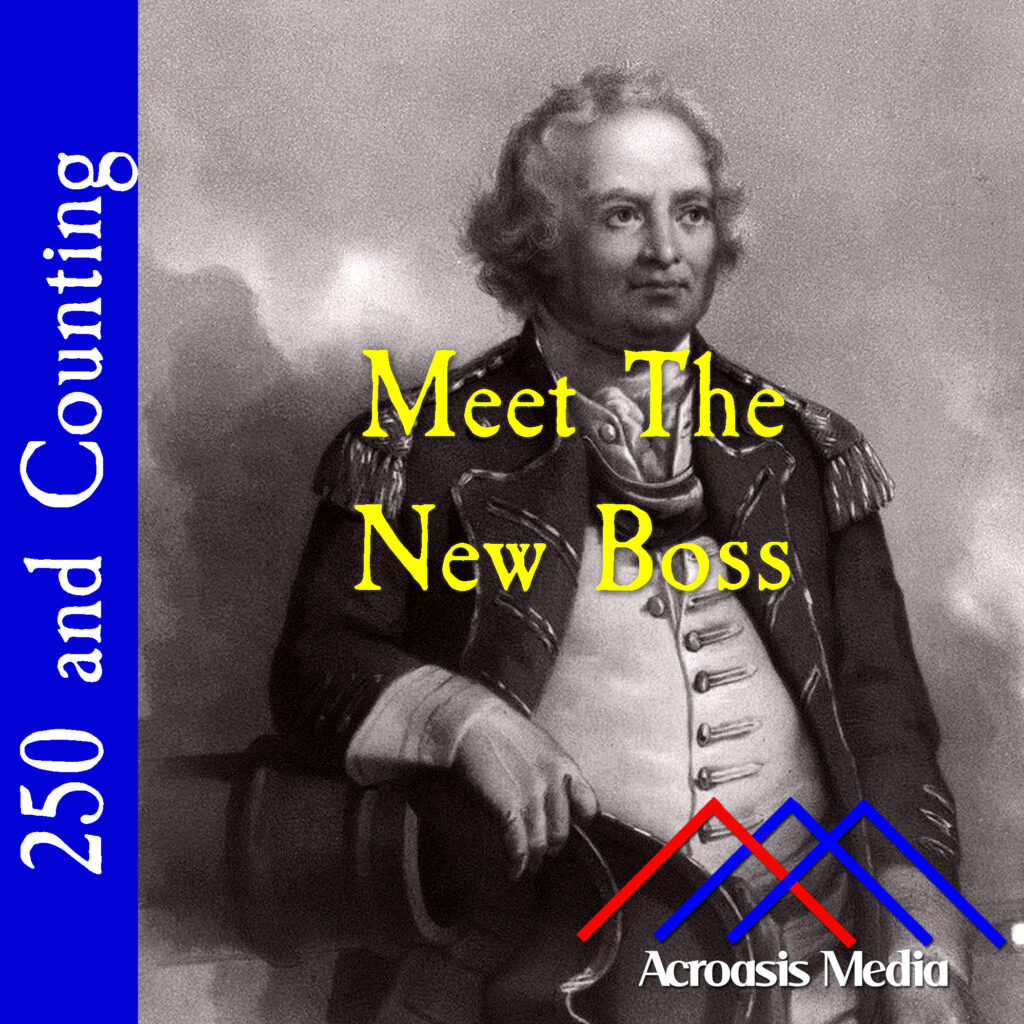
    Cover art for August 24, 1776: Engraving of Israel Putnam during the Revolution. via Library of Congress.

    That George Washington chose to add Israel Putnam to his leadership rolls in Brooklyn isn’t specifically mysterious. What is mysterious is that Putnam was added rather than used as a replacement for someone else.

    As a result of that move, there were essentially two men in charge on Long Island, with Putnam as the theater commander and General John Sullivan, who’d arrived only a couple of days earlier, in charge of ..something else?

    I’m reminded of a story from when I was a youngster and my family went up to Fort William Henry, on Lake George in upstate New York. It was built by the British during the French and Indian War, but it wasn’t built to withstand artillery, so when the battle started, the fort had to surrender pretty quickly. At any rate, one of the docents, dressed in period clothing, demonstrated how a flintlock rifle worked: he set up the powder, etc, put a musket ball into the gun (my memory is hazy on the specific details here), then he took aim, out toward the lake so nobody would get hit…and the gun misfired, the hammer simply banging down ineffectually.

    >click<

    And someone in the tour group, who may have been my mother (is the statute of limitations up yet?) said, “No wonder you lost.”

    Same thing happened on Long Island: poor planning, confusion regarding leadership roles, and being generally outnumbered.

    No wonder we lost. (oop, spoiler alert.)

  • Laying Down The Law–August 4, 1776

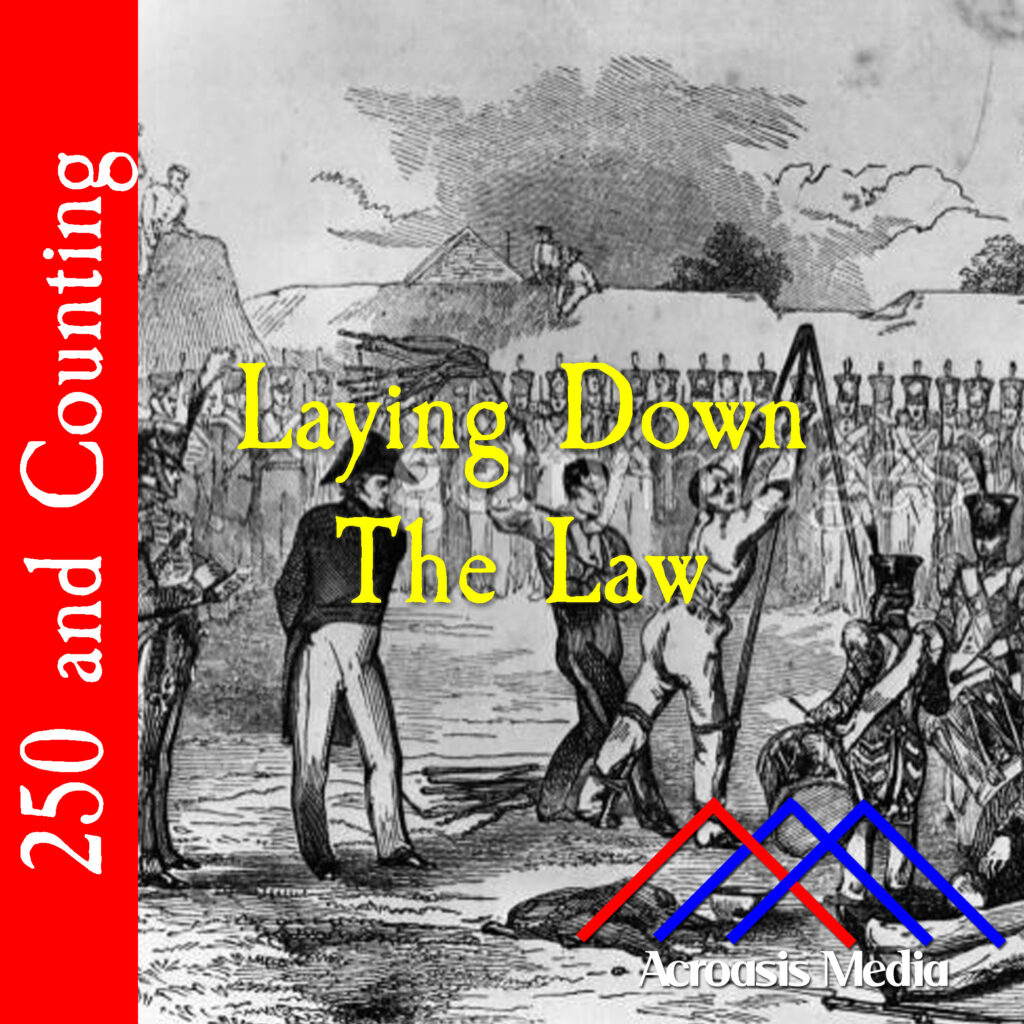
    Cover art for August 4, 1776: "Military Flogging," artist unknown, ca. 1844. via Hulton Archive.

    When it came to army discipline, George Washington had some definite opinions. The punishments we hear about were rather harsh by modern standards, but Washington had some problems with his recruits that modern armies don’t tend to have.

    Specifically, (and we’ve mentioned this before), the Continental Army had a relatively short enlistment period, which meant that soldiers were constantly turning over and by the time someone was finally in good shape as a soldier, they were gone and replaced with the next guy who had little idea of what he was doing. So Washington was constantly beset by soldiers who didn’t know how to be soldiers. This often meant that he had to lay down some harsh punishments to help ensure that his message got across.

    The punishments themselves weren’t especially unique; discipline of this nature was meted out in many places. In fact, today’s cover art is actually taken from a British flogging nearly a hundred years later. But Washington and other military leaders of the Revolution cut their teeth on British army discipline, and it didn’t look a lot different: the prisoner was strapped to a frame of some kind; the other soldiers were required to witness; and the drummer boys (at right in this image) did their best to drown out the cries of the man being punished. We had to crop this image to fit the space, but you can also see a pair of legs sticking out from the bottom right: that’s a soldier who has fainted from the stress of watching. And the man at left is a doctor, who is actually monitoring the prisoner’s health to ensure that the punishment isn’t fatal. So he’s got that going for him, which is nice.

  • It’s Only Proper–August 3, 1776

    Cover art for August 3, 1776: detail of "Rules of Civility & Decent Behaviour In Company and Conversation," from 1744, which Washington hand-copied and clearly took to heart.

    George Washington had a deep-set sense of right and wrong, and sometimes his sense of Army decorum could get in his way. Our July 14 episode demonstrated that to a certain extent.

    Other times it demonstrate the high expectations he placed on himself and others. He wanted his officers to be behavior models, especially because so many of the troops were so undisciplined. This only worked to a certain extent; it took the influence of some outside officers for the lessons to really sink in, but we won’t get to talk about that for some time.

    It’s also important to note, as I think today’s episode demonstrates, that Washington did care about the well-being of his men. Not just their physical comforts (he was always trying to get blankets, better food and such for them), but their mental and spiritual comfort as well. It wasn’t all army decorum. So he made allowances for the men to take a day to worship if they so desired, and to be exempt from fatigue duty on Sundays, “until further orders.”

    “Further orders” turned out to be until August 25, when the order was rescinded, but the fact that the order was given in the first place goes a long way.

  • British Forces Gather in NY–July 29, 1776

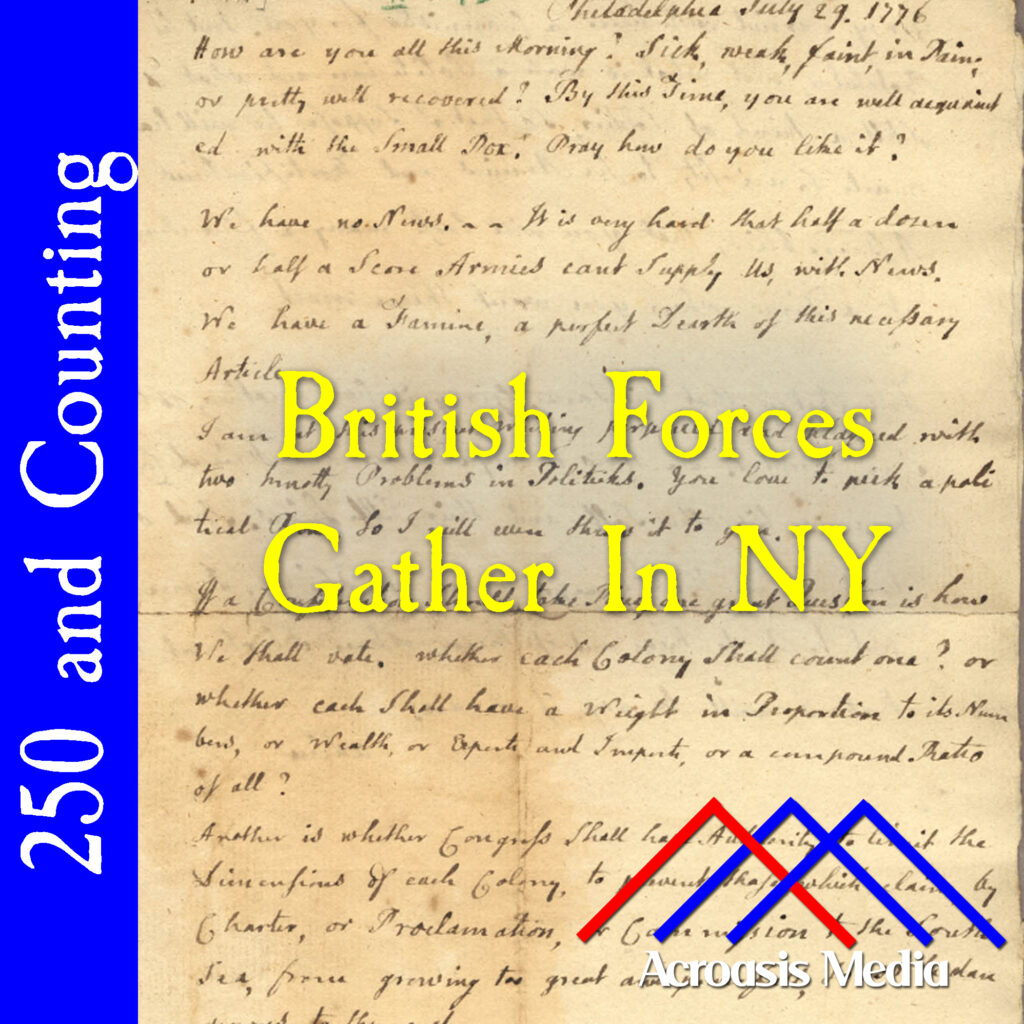
    Cover art for July 29, 1776: letter from John Adams to Abigail written on this date. Via Massachusetts Historical Society.

    The presence of the British in Staten Island wasn’t a big mystery, but within a month after they first arrived, the number of ships in New York Harbor was well over 100, and still growing.

    And, as George Washington suspected (along with many others), the British began moving up the rivers surrounding Manhattan, working their way up the Hudson River in the effort to use New York as a wedge between New England and the rest of the colonies. Specifically, if supplies couldn’t get through, then it weakens both sides of the line.

    As for New York itself, part of Washington’s problem was that he didn’t know if the British plan was to take New York City (still a small chunk of Manhattan Island at that time), or to move through Long Island. As a result he had to hedge the bet a little bit and send troops in both directions, spreading the Continental Army rather thinly. This may have forced the British to do something quite similar, but they still had Washington vastly outnumbered.

  • Cleaning Up The Act–July 28, 1776

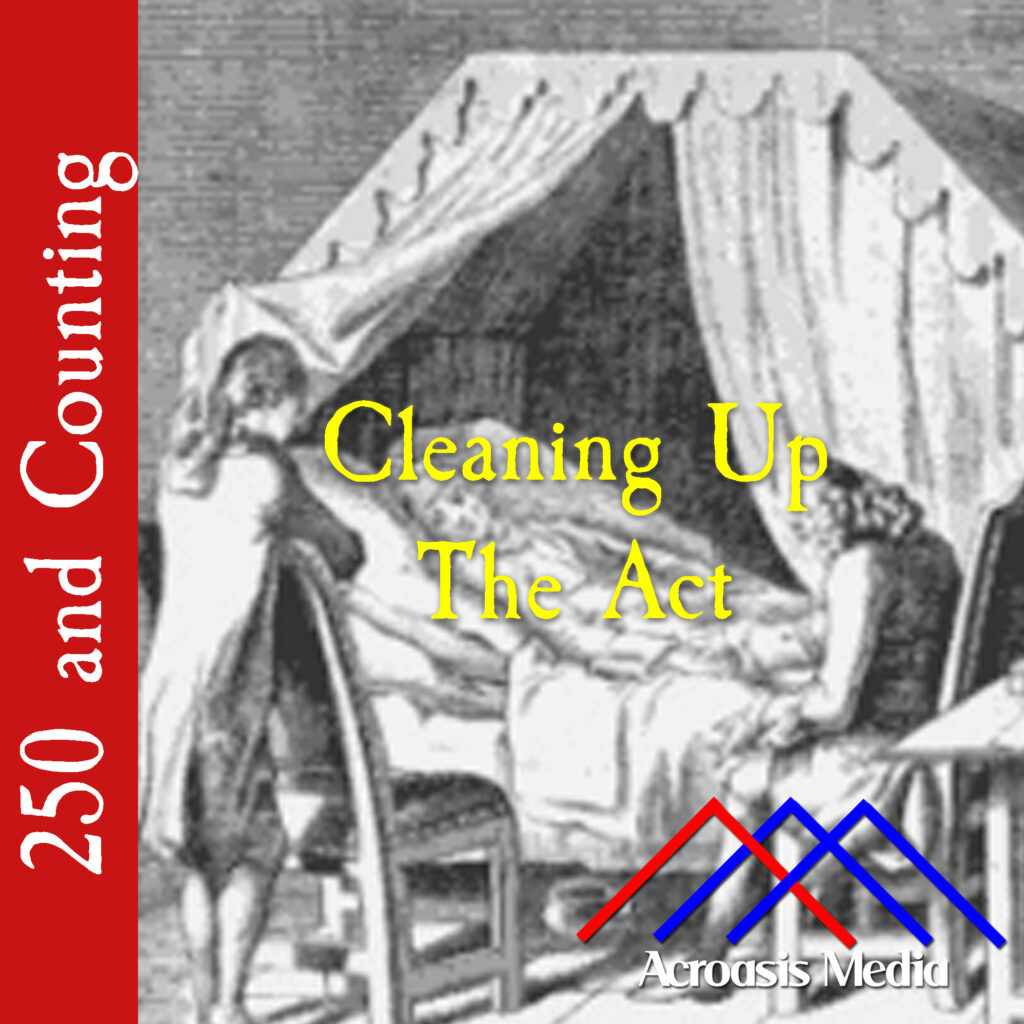
    Cover art for July 27, 1776: An anonymous engraving used to depict colonial-era medical practices.

    Hygiene in the Continental Army was practically nonexistent. As you can imagine, things got pretty ripe around camp, especially in the summer.

    And when people don’t take good care of such things, they’re probably going to wind up sick. Getting sick when you’re supposed to be on duty likely means that you’re going to do your “business” fairly close to where you’re working, This, in turn, is going to have the effect of getting other people sick while simultaneously perpetuating your own illness. This was especially true when such things took place too close to the water source, thereby contaminating that as well.

    Ain’t we got fun!

    There were a few people—the Officer grade men, primarily—who may not have known anything about bacteria, but they were able to see what and who was where, and connect the dots, so they began to take steps to help keep illness down.

    Did it help? Probably not right away, After all, the soldiers were still a rather undisciplined group, and maintaining hygiene in the Continental Army was pretty low on their personal priorities. If we had to guess, things probably abated a little bit, but didn’t really improve until the men that Silas Deane, et. al. came over and got things on track.

  • The Schuyler Is Falling–July 24, 1776

    Cover art for July 24, 1776: portrait of Philip Schuyler by John Trumbull, 1792. Currently housed at the New York Historical Society.

    Philip Schuyler was part of a prominent New York family, enough that if you have any familiarity with that state’s history, you realize that the Schuyler name keeps popping up, especially during and shortly after the Revolution. (Similarly, the names Schermerhorn and Burr also manage to crop up a lot; Burr is probably the most famous name of the three but there are more Burrs than just Aaron.)

    Schuyler was born in Albany but moved to New Rochelle when he was eight years old, shortly after his father died. He fought in the French and Indian War, and was sent to England for three years afterward to help settle some expenses related to the war.

    Philip Schuyler was elected to the Second Continental Congress but left to become a general in the Continental Army, where he was involved with the failed invasion of Quebec. His health forced him to turn command over to General Montgomery, and in 1777 he returned to Congress.

    Later in life, he served as a Semator in the First US Congress, but lost his bid for re-election to Aaron Burr. (See? Popping up everywhere.) He did return to the Senate a few years later, and remained there until he resigned due to his health.

    Schuyler died at the Schuyler Mansion in Albany on November 18, 1804, four months after his son-in-law, Alexander Hamilton, was killed in a duel (by Aaron Burr) and two days before his 71st birthday. He is buried at Albany Rural Cemetery in Menands, New York, about 500 feet away from President Chester A. Arthur. It’s really a lovely place to visit and see the graves of several notable figures, not all of whom were “big” names historically unless you like to deep-dive into such things.