Tag: Continental Army

  • When Accusation Is A Confession–July 22, 1776

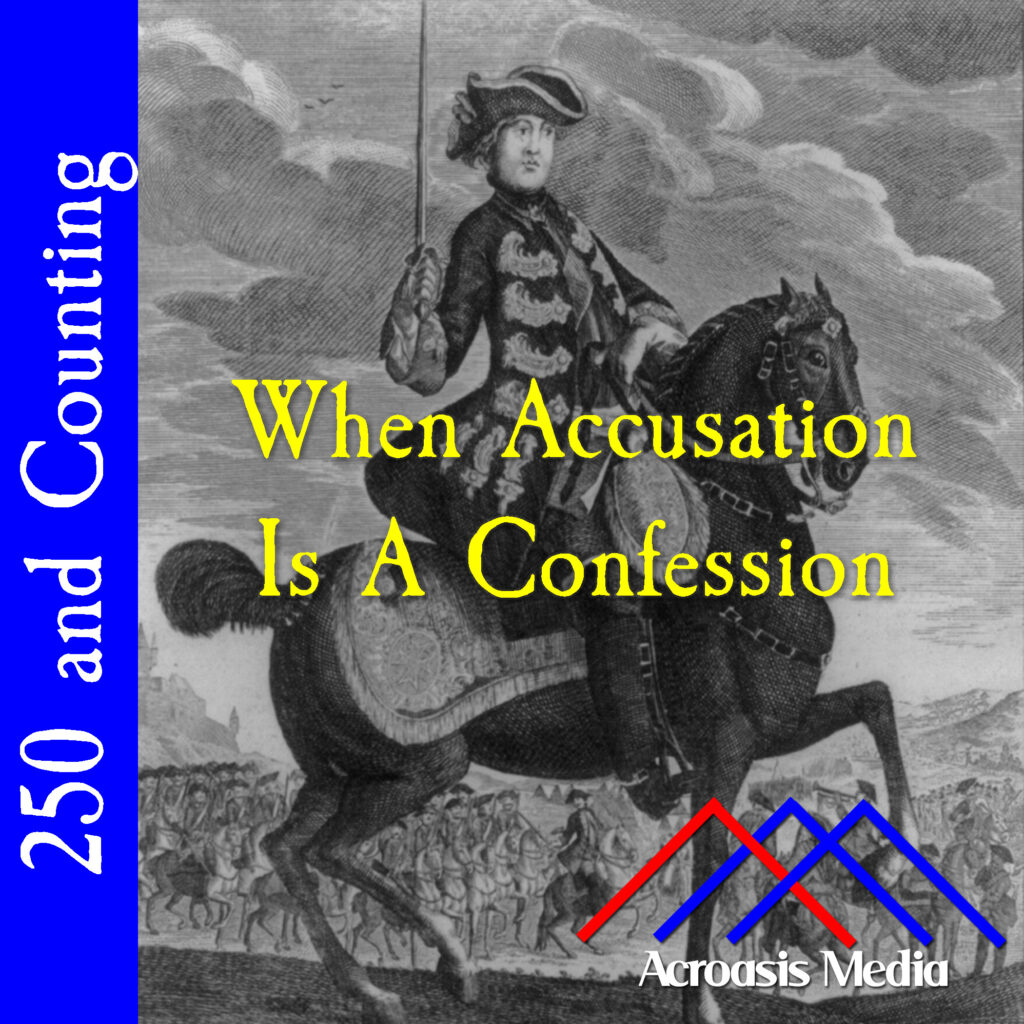
    Cover art for July 22, 1776: General Lee on Horseback, Engraved by Johann Michael Probst, 1790. via Library of Congress.

    That Charles Lee turned out to be giving information to the British is one of those things that feels obvious in retrospect.

    As Mike notes during the episode, Lee was passed over for command of the Continental Army, and even though he was still in a position of importance and command, things like that can eat away at some people.

    Now, by most accounts, and through review of existing documents, Lee generally acquitted himself well in the Southern Department and in New York, although at the time of his capture there he was writing a letter to General Horatio Gates complaining that George Washington was somehow deficient.

    However, his attitude toward the Continental Army continued to deteriorate after his release in 1778. He was held partly responsible for the outcome of the Battle of Monmouth, likely because he was rather capricious with his actions. Because he behaved insubordinately afterward, Lee was court-martialed (at his demand) and found guilty, but given the very light sentence of a year’s suspension from the army. Before the year was out, however, he wrote an angry letter to Congress that resulted in his termination of service.

    It wasn’t until the 1850s that the New York Historical Society discovered a manuscript Lee had written while he was a prisoner of war. It was addressed to both Richard and William Howe, and outlined a plan by which the British could defeat the Continental Army. Whether Charles Lee is specifically guilty of treason is still debated among historians, though he’s commonly been presented as a villain in popular culture of the past 80 years or so.

  • Congress Does Some War Business–June 5, 1776

    Cover art for June 5, 1776: "American Uniforms, 1775-1783" by H.A. Ogden, 1889, as part of a larger series documenting the evolution of American uniforms.

    Using the input of George Washington from just a few days earlier, the Second Continental Congress wasted little time putting together some Continental Army protocols to ensure that this relatively ragtag group of men would adhere to some kind of formalized behavior.

    But the Continental Army protocols they worked on also helped to establish better pay for some personnel, or set up protocol ranks for some otherwise non-officer personnel.

    And, of course, getting everyone paid was important so they talked about that as well.

    And as we creep closer to a formal declaration announcing the break with Britain, more Congressional delegates are convinced that reconciliation was always on the table, at least until quite recently. Robert Morris wrote as much to Silas Deane of Connecticut, and likewise Oliver Wolcott wrote to Roger Newberry, a Connecticut military officer, that he was of the opinion that the army is undertaking a Mighty Cause, and that as far as he could tell, the people support it.

  • Washington Has A Change Of Heart–December 30, 1775

    Cover art for December 30, 1775: Soldiers at the siege of Yorktown, by Jean-Baptiste-Antoine DeVerger (cropped), watercolor, 1781.

    Back on October 8, the Continental Army determined that Blacks were no longer to be permitted to enlist, and that existing soldiers would not be allowed to re-enlist.

    But on this date, George Washington changed his mind. Was he suddenly an abolitionist? Not a chance. He owned slaves until the day he died. This was a more pragmatic decision. It was borne of the fact that he and his staff suddenly realized that a lot of soldiers were going to end their enlistment come January. That October decision was starting to look rather short-sighted.

    Add to that the fact that word had gotten about about Lord Dunmore’s offer to free slaves who fought on the British side. Now, he really couldn’t do anything for slaves who came from anywhere other than Virginia, but the offer was still hanging out there.

    Finally, it was quite apparent that there was a growing number of Blacks, whether slave or free, who had shown interest in fighting for the Patriot cause.

    It suddenly looked like a whole lot of bodies were getting turned down by the Continental Army for no good reason.

  • September 11, 1775: One Siege Begins, Another Continues

    Cover art for September 11, 1775: "Siege of Boston" wood engraving (detail), created 1879, artist not cited. via the New York Public Library digital collection.

    As the winter of 1775 approached, George Washington had to think about the state of the siege of Boston. In short, housing and clothing thousands of men in a New England winter is a very different proposition than doing it in the summer.

    So Washington convened his War Council to discuss the possibility of breaking the siege by attacking the city from a different direction.

    Meanwhile up in Canada, General Philip Schuyler takes another run at Fort St. Jean.

  • July 29, 1775: Law and Moral Order

    Cover art for July 29, 1775: the insignia of the Army JAG Corps and the United States Army Chaplain Corps Branch Plaque (via Wikipedia)

    George Washington didn’t have a ton of military experience when he was named Commander-in-Chief of the Continental Army. But it’s clear that he gave the position a great deal of thought as he made his way from Philadelphia to Boston. When he arrived, he clearly had a lot of ideas about what an army should look like. Furthermore, he had ideas regarding the overall structure of things and the institutions that should be in place.

    Shortly after officially taking the position, Washington began petitioning Congress for various titles and positions, and groups. And it appears that Congress recognized that his ideas had merit, because there was very little that they actively turned down. (Obviously, there were some things that they were unable to provide because of shortages here and there, but they were typically behind him.)

    And today, Washington was able to get the ball rolling on two of them.

  • July 4, 1775: Washington’s First Orders

    Cover art for July 4, 1775: the first page of George Washington's first set of general orders to the Continental Army.

    As mentioned yesterday, when George Washington came to Cambridge, he found a bit of a mess there: several disorganized groups of men, with more on the way, along with supplies still in transit.

    The first thing he needed to do was to get the fighting force organized, so he began a log book of his official orders. His first set, which came out on this day in 1775, took up about five pages of manuscript. But Washington wasn’t done, not by a long shot. Every few days he’d come up with something new, but it was all reasonable and made sense in the bigger picture. It’s not as though Washington had grabbed power with no intention of relinquishing it later on; he just wasn’t wired that way.

    Eventually his book of orders grew to over 500 pages over the next couple of years.

    P.S. Happy Independence Day! Our 250th anniversary is exactly one year away, but there’s a lot of stuff before, and after, that date that we’ll need to look at in order to get the entire story.

  • July 3, 1775: Washington Takes Command

    Cover art for July 3, 1775: Washington Taking Command of the American Army, detail from an 1876 Currier & Ives print.

    On June 15, 1775, George Washington was appointed Commander of the newly-formed Continental Army.

    On July 2, Washington finally arrived in Cambridge after a few stops in Trenton, New York and presumably a couple of other places. What he found was a huge mess.

    So on July 3, he officially took command and started the work of turning this ragtag crew into some kind of organized fighting force.

  • June 30, 1775: Army Regulations Take Shape

    Cover art for June 30, 1775: Recruiting poster for the new Continental Army.

    With the army being literally only a few weeks old, it was necessary to put together some regulations for this group, to ensure consistency throughout the Colonies.

    Interestingly enough, as the rules were revised over the next several years, a pattern of using another army’s regulations as a template began to emerge. This isn’t necessarily a bad thing: take what works and build on it, yes?

    A quick note about the cover art: it’s a recruitment poster from about that time, because a true Army Manual did not emerge until the third version was published in 1779.

  • June 16, 1775: Washington Officially Accepts Command

    Cover art for June 16, 1775: George Washington accepting command of the Continental Army (detail). From a print by Currier and Ives, c. 1876.

    Yesterday, George Washington was unanimously elected Commander in Chief of the Continental Army.

    Today he officially accepted the position.

    He won’t take actually begin until early July (we’ll get to that episode in a few weeks), but take a look at this image here. He’s already in the blue coat, and his hair is whiter than it was in yesterday’s art.

    The truth about his hair color is likely somewhere in between these two images, but of course he wasn’t wearing a coat like that just yet. This art is from a hundred years later, by Currier and Ives.

    What I found interesting is that some of the people in the background look a little put out by Washington, even though they’re the ones who elected him. I think Currier and Ives were trying to convey that it was a serious event, but everyone just looks angry. John Adams (in the dark blue to the right) appears especially annoyed, and he’s the one who nominated him in the first place.

    And check out the guy to Adams’ right, staring straight at us. There’s always one guy who can’t help but look at the camera.

  • April 8, 1775: The New England Army

    Cover art for April 8, 1775: painting of members of the New England Army. Painting by Don Troiani

    Well…it’s official. It was on this day in 1775 that our assorted collection of irregular militiamen turned into a genuine army.

    The Provincial Congress in Massachusetts proposed, and adopted, a resolution that provided for a genuine army dedicated to protecting our shores against the British. That was the New England Army, but the name didn’t last long. Tune in to find out their other name.