Tag: George Washington

  • Washington Arrives In New York–April 13, 1776

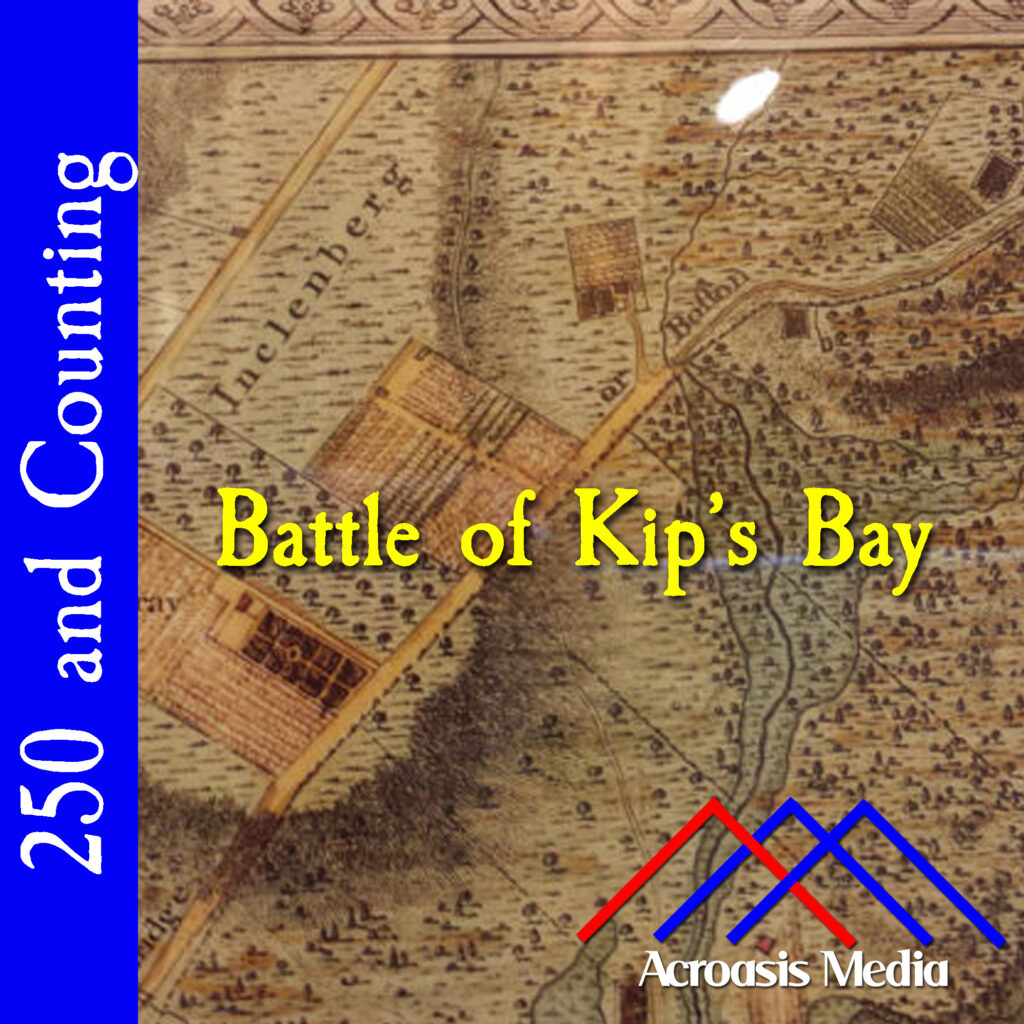
    Cover art for April 13, 1776: a 1776 map of New York City and the immediate area (detail). Fort Stirling would be just above the "A" in "Acroasis"; Fort Defiance is off the edge of the map to the south. via Library of Congress.

    When George Washington arrives in New York, things aren’t quite the way he’d like them to be, but he doesn’t really have time to worry about that.

    Construction of Fort Defiance had already begun, and before long the building of Fort Stirling would commence. Even though they were outmanned and outgunned, Washington was going to make sure that if a British victory were to happen in New York, it was going to be a Pyrrhic victory.

    About Fort Stirling: like Fort Defiance, nothing remains of the original structure. When the British evacuated the city in 1783, the locals destroyed whatever remained of the fort. It was originally named Fort Half-Moon because of its shape but it was renamed in honor of William Alexander, who was also known as Lord Stirling.

    There remains a historical marker in the ground for this fort, at the intersection of Clark Street and Columbia Heights; when traveling west on Clark Street it will be on your right, protected by an iron fence (it’s right behind the fence and easy to see). When the park was created and dedicated in 1925, the Fort Greene Chapter of the Daughters of the American Revolution donated the granite tablet that marks the fort’s site.

  • A Fort Grows in Brooklyn–April 10, 1776

    Cover art for April 10, 1776: a contemporary map of Brooklyn. Red Hook is in the center of the picture, just below the "rt" in "Fort".

    The construction of Fort Defiance in the Red Hook section of Brooklyn made perfect sense. That part of the peninsula sticks out into New York Harbor and provides an excellent view of anything that might be sailing in or out.

    Red Hook comes from the Dutch Roode Hoek, “hoek” translating to “point”, which can still be seen in modern-day maps. The whole area, what we now call Red Hook and Gowanus, was settled by the Dutch in the 1630s.

    Red Hook was some swampy land when the Dutch moved in. But the Dutch know something about swampy land, and they got straight to work, filling in lakes and re-channeling waterways. They began farming the land, including orchards of fruit trees.

    After the war broke out and the Continental Army drove the British from Boston, George Washington sent Brigadier General William Alexander to Brooklyn to see what could be done defensively. A plan was developed to build two forts along the Brooklyn Heights, about a mile and a half apart. Fort Greene would be the furthest east, Fort Defiance would be the furthest west. Across the channel on Governor’s Island, another fort would be built, so that British ships could be fired on from both sides.

    Now, when we say “fort,” we’re not talking about something made of wood or stone. Plenty of those did exist, but not here. This was more like a breastworks built of earth and stone, which had a few cannons near the top. There were three of these breastworks connected by trenches, and they took up most of the island on which they stood. (Incidentally, Mike was correct about the island not existing anymore; the space was filled in and is now part of the larger land.) This took only a few days to put together; the fort at Governor’s Island was more like what one would expect to see.

    By the time the British arrived, the Continental Army was quite ready from a defensive standpoint. But the British were much larger in number and had a Navy besides. Stay tuned; it’s going to be an exciting summer.

  • Mr. Washington Goes to Providence–April 5, 1776

    Cover art for April 5, 1776: Detail of Theodore Foster's diary relating the arrival of George Washington. via Rhode Island Historical Society

    The war was less than a year old, but heroes were already beginning to emerge, as we learn from contemporary writings. The arrival of George Washington in Providence, RI, was considered a big event each time he came through.

    In fact, it was such a big deal that the website for Stephen Hopkins’ house in Providence notes that “George Washington was
    a guest here. Twice.”

    I suppose they could have hung up two “George Washington Slept Here” signs but nobody would get it. Then again, “George Washington Slept Here” isn’t quite the trope it used to be. Leave me alone, I’m old. And get off my lawn.

    Hopkins, for what it’s worth, was an important person in his own right, having been central to the development of the colony and then the early days of the state. If you visit the house, though, be forewarned that it’s not in the same place it was when Hopkins lived there; it’s been moved twice since he was there. Although, to be fair, it’s always been on that street.

  • Washington Departs Cambridge–April 4, 1776

    Cover art for April 4, 1776: Longfellow National Historic Site, also known as the Vassall-Craigie-Longfellow House, in Cambridge, Massachusetts. Uploaded to Wikipedia by user Daderot.

    To say the Washington left the Longfellow House is putting the cart before the horse, because Washington was in it before Longfellow.

    The house originally belonged to John Vassall Jr, a Loyalist who had the good sense to get out of town when the shooting started. From July 16, 1775 until this day in 1776, Washington occupied it as his home and his headquarters. In 1791 Washington’s apothecary Andrew Craigie purchased the house and made a major addition to it, the only big cosmetic change to the house. After Craigie’s death, his widow rented out various rooms to supplement what little income she had, and one of her tenants was Henry Wadsworth Longfellow, who eventually became the owner in 1843 when it was purchased for him as a wedding gift.

    The Longfellow family was the last to live in the house; some time after his death the family established the Longfellow Trust to provide for the house’s preservation, and in 1972 the house and its possessions were donated to the National Park Service.

  • Thanks, George–April 2, 1776

    Cover art for April 2, 1776: The original strike of Washington Before Boston Gold Medal. via Boston Public Library.

    Just a few days ago, Congress passed a resolution that George Washington should be thanked for his efforts in Boston, and that a Congressional Medal should be issued to him.

    Specifically, the resolution read:

    Resolved, That the thanks of this Congress, in their own name, and in the name of the thirteen United Colonies, whom they represent, be presented to His Excellency General Washington, and the officers and soldiers under his command, for their wise and spirited conduct in the siege and acquisition of Boston; and that a medal of gold be struck in commemoration of this great event, and presented to His Excellency; and that a committee of three be appointed to prepare a letter of thanks and a proper device for the medal.

    They did do all this, but frankly striking a congressional medal (or any other type, presumably) during the Revolutionary War was kind of a low priority (in addition to the other issues Mike cites), but it did eventually get done.

    An unknown Greek poet, possibly from the 1st century CE, once said:

    Ὀψὲ θεῶν ἀλέουσι μύλοι, ἀλέουσι δὲ λεπτά.
    The millstones of the gods grind late [slowly], but they grind fine.

    Clearly this guy knew how governments operate.

  • Letters From The General–March 24, 1776

    Cover art for March 24, 1776: Reproduction of a portrait of Josiah Quincy I by John Singleton Copley. Photo uploaded to Wikipedia by user Mmangan333.

    Mike had a little fun busting on George Washington’s spelling in today’s episode, but we do have to offer a little grace here, because in 1776 efforts to standardize spelling in the English language were only just beginning to catch on.

    About a hundred years earlier, some of the language was simplified; thus, sinne became sin; logique became logic; toune to town, etc. Not long afterward, some words were tied to their Greek or Latin roots, e.g. det became debt (Latin, “debitum”) and dout became doubt (Latin, “dubitare”), and so on.

    It really wasn’t until the 19th Century that more serious efforts to standarize some English took place, as the science of phonetics began to rise. In the 1870s, societies actually began springing up that were dedicated to reforming the English language’s spelling. One such group had the editor of the Chicago Tribune as a member, so whenever his group had something they thought was good, he’d be the first one using it in print.

    In 1903 a group called the Simplified Spelling Board was formed, backed by Andrew Carnegie. Their recommendations were immediately relayed to all government agencies by President Teddy Roosevelt.

    And then between the 1930s and 1975, the Chicago Tribune (again) was at the forefront of changes to standardized spelling, thus giving the new language a huge platform on which to rest.

    Look that up in your Funk & Wagnalls, kids.

  • Meet The New Boss–March 20, 1776

    Cover art for March 20, 1776: portrait of Nathaniel Greene "painted from memory" by John Trumbull, 1792. via Yale University Art Gallery.

    While preparing to depart Boston for New York, George Washington appointed Nathaniel Greene to run things for awhile until everything was back in order.

    Fortunately for both Greene and Washington, matters straightened out rather quickly, because Greene was called to join Washington just a few weeks later.

    Nathaniel Greene was tasked with fortifying Brooklyn while Washington prepared to defend Manhattan. As a military leader, Greene had a bit of a mixed record, but more often than not it appears that he was the victim of poor timing when things didn’t go well for him.

    Later on in the war, he took on the position of Quartermaster General, which on its surface looks like a demotion, but Washington still considered him “inner circle” and Greene would sit in on War Council meetings, even though he was considered a staff officer.

    Later on, when things started looking gloomy in South Carolina and Georgia, Nathaniel Greene was put in charge of the Southern Department of the Continental Army, where he embarked on a campaign of guerilla warfare rather than pitched battles. His unconventional approach wasn’t always successful, but if the British won a battle it was at a much greater cost than it should have been.

  • Reviewing Boston–March 18, 1776

    Cover art for March 18, ,1776: Statue of Artemas Ward at Ward Circle in Washington, DC. Photo by Wikipedia user GarrisonLeMasters, 2008.

    In the aftermath of the siege of Boston, it was incumbent upon George Washington and his men to re-enter the city and take stock of its condition.

    Mike brings up Artemas Ward in today’s episode, and I’m pretty sure that was the first time his name has come up in the course of this podcast. Ward was a major general during the Revolutionary War, among others, and an effective political leader when he wasn’t being a soldier. It was Ward who sounded the alarm on Bunker Hill, and who took command of the New England area once Washington led most of the troops down to New York City. ‘

    The statue in today’s cover art can be found in the center of a traffic circle in Washington, DC, where Massachusetts and Nebraska Avenues cross one another. Ward’s great-grandson donated four million dollars to Harvard on the condition that they build a statue of Artamis, and maintain his Shrewsbury home. Harvard apparently chose to purchase a statue but did not provide enough money to provide the general with a horse. Oddly enough, because it’s a traffic circle and therefore has no obvious way for a pedestrian to get to the center (i.e., no crosswalk), it’s quite difficult to get close enough to the pedestal to read the inscription:

    ARTEMAS WARD
    1727–1800
    SON OF MASSACHUSETTS
    GRADUATE OF HARVARD COLLEGE
    JUDGE AND LEGISLATOR
    DELEGATE 1780–1781 TO THE CONTINENTAL CONGRESS
    SOLDIER OF THREE WARS
    FIRST COMMANDER OF THE PATRIOT FORCES

  • The Siege Ends–March 17, 1776

    Cover art for March 17, 1776: The first Congressional Gold Medal, given to George Washington in 1790 for his first victory of the war in Boston. 1776 Washington Before Boston Comitia Americana Second Restrike (Baker-48G) Image credit to Heritage Auctions

    It’s been 333 days since Lexington and Concord, when the British were forced to retreat to Boston and were bottled up there by Colonial forces.

    It’s been a week since the British said “enough” and decided to effect their departure from the city as soon as the weather cooperated.

    But today, the day finally came.

    It took about five hours to launch over a hundred ships, carrying thousands of soldiers, women and children from the city.

    It was Washington’s first major win and the last time the British did anything of importance in New England. The war began to move south, to New York, New Jersey, and Pennsylvania. Virginia and the Carolinas also had their share of action, as we’ll see in the coming months.

  • Preparing To Take Back Boston–March 13, 1776

    Cover art for March 13, 1776: George Washington's General Orders for this day. via Library of Congress/National Archives.

    First: let me apologize for the slight change in sound quality for today’s episode. I’m not in my usual recording space and I’m not especially happy with the equipment I brought. At worst you’ll have to put up with it just one more time.

    Next: George Washington was a gentleman through and through, so the fact that his general orders sometimes focused on the Continental soldier behavior shouldn’t be a surprise. In today’s episode he concerns himself specifically with that, but for two reasons. One is for the health and safety of the troops, but the other is because the Bostonians have been through enough, and he doesn’t want the Continental Army–the people supposedly on their side–to look like villains.

    In the meantime he’s already standing down a big chunk of soldiers and sending them to New York, where the next big battle is going to be, he thinks. (Again, he’s right, but he didn’t realize it at the time.)