Tag: Nathan Hale

  • Nathan Hale Is Hanged–September 22, 1776

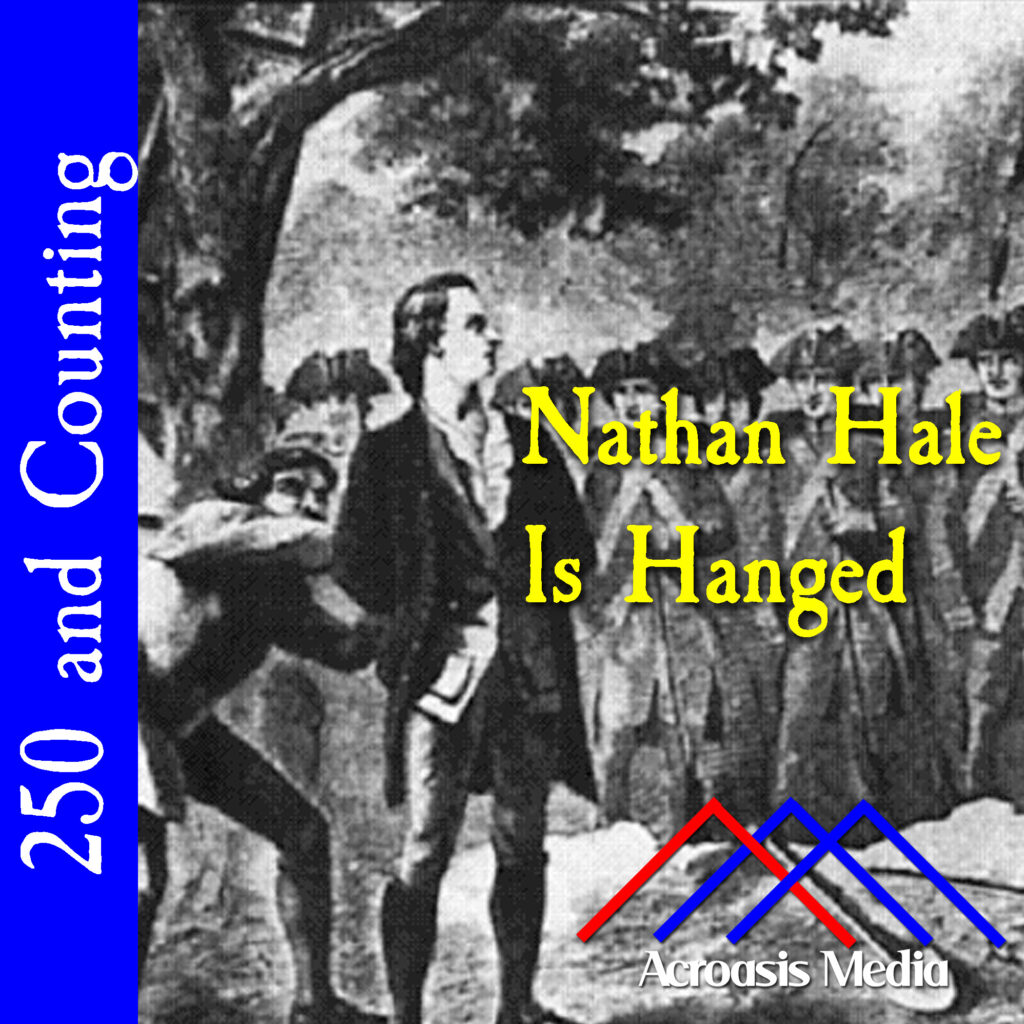
    Cover art for September 22, 1776: "The British Hang Nathan Hale in New York City, 1776", artist identified as M. Nevin. Published as a print in 1860. Via Library of Congress.

    For a long time the debate about what Nathan Hale said before he was hanged was whether he said “I regret that I have but one life to give for my country” or “I regret that I have but one life to lose for my country.”

    In more recent years, it’s emerged that what he said is probably lost to history, since contemporary accounts aren’t especially clear about it. More accurately, the most reliable-ish contemporary account is second-hand at best, so it’s a History version of the game Telephone. You kids remember telephones, right? I realize that nowadays a telephone is an app on your phone. (Leave me alone, I’m two hundred and six years old.)

    By all accounts, Hale comported himself well this day. He almost certainly said more than one sentence. Some have thought that when he said the “regret” line, he was reciting a passage from Joseph Addision’s play Cato, which includes:

    How beautiful is death, when earn’d by virtue!
    Who would not be that youth? What pity is it
    That we can die but once to serve our country.

    Many place names and buildings are named after Nathan Hale; one you may not realize comes from him is the town of Halesite on Long Island; until 1899 it was known as Huntington Harbor. In that year it was changed to honor Nathan Hale to mark the area where he first landed on Long Island from Connecticut not long before his capture.

  • Nathan Hale’s Capture–September 21, 1776

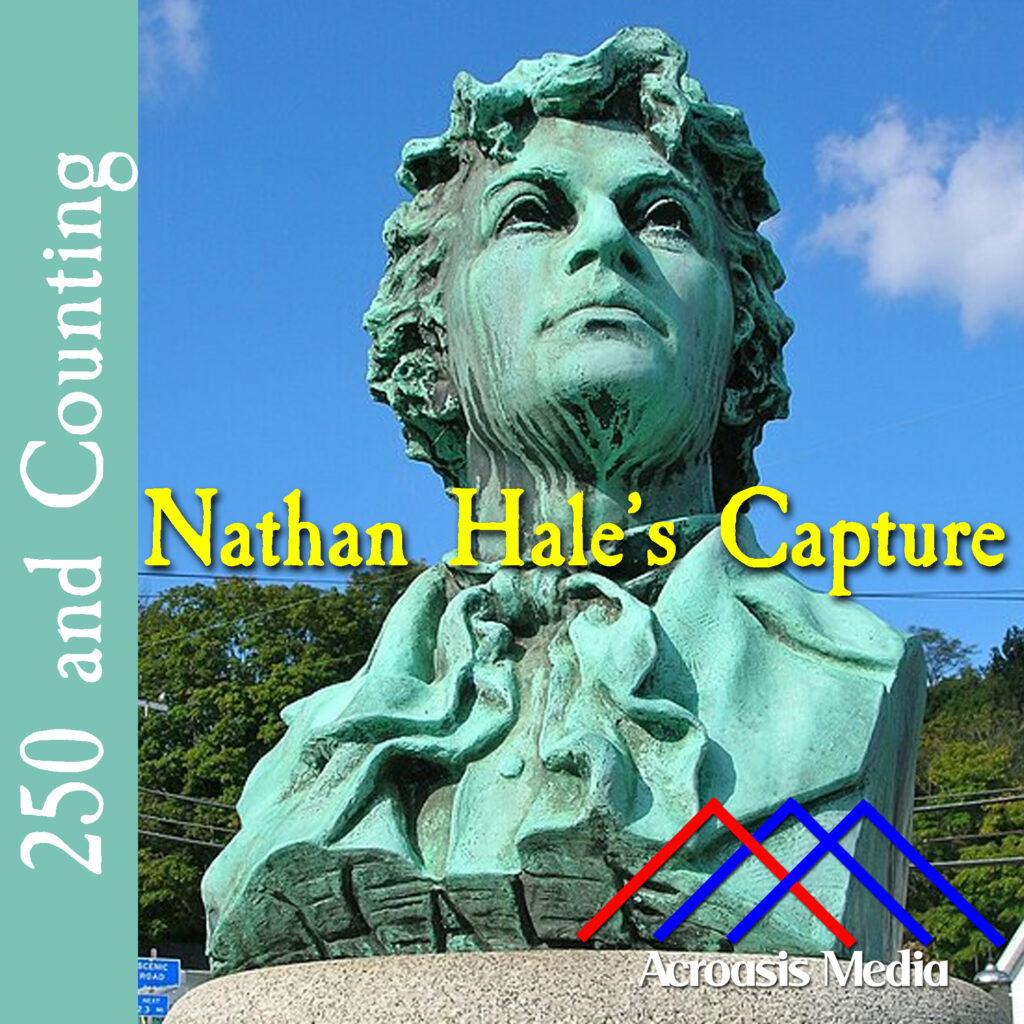
    Cover art for September 21, 1776: Bronze bust of Nathan Hale, sculpted by Enoch Smith Woods between 1885 and 1900, located in East Haddam, CT. via Wikimedia Commons.

    One of the events that took place the same day of Nathan Hale’s capture is that there was a huge fire in New York that burned about a quarter of the city.

    Now, the British thought that it was started by American saboteurs to prevent the city from falling into British hands. However, while that idea had come up, George Washington was under orders not to do so, and they therefore denied any responsibility. For their part, the Americans suggested that British soldiers were responsible for the fire (without orders to do so), to enable them to sack the city.

    There is a third possibility out there that’s been floated, and that would be that Hale was responsible for setting the fire. However, he was across the river in Queens when he was arrested, so it’s not likely at all that he was the culprit; in fact, there’s really no evidence that arson specifically was to blame for the fire. It’s not known where it started, or whether it began in more than one place. What is known is that the weather conditions (dry and windy), plus the wooden buildings and narrow roads, made it easy for the fire to spread, and when it stopped, it was as much by wind changes as any efforts by people to put it out. (Also, a large undeveloped property acted as a fire-break.)

  • Nathan Hale’s Fateful Decision–September 8, 1776

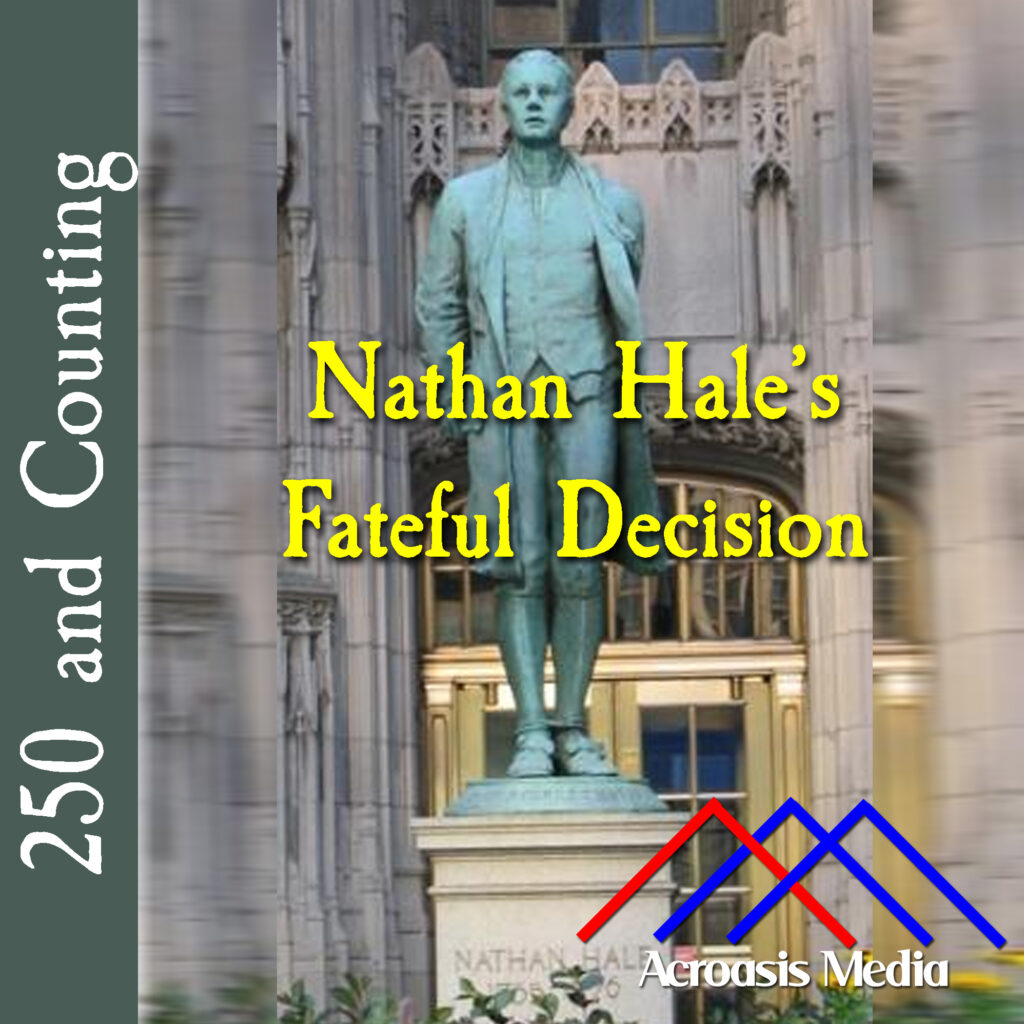
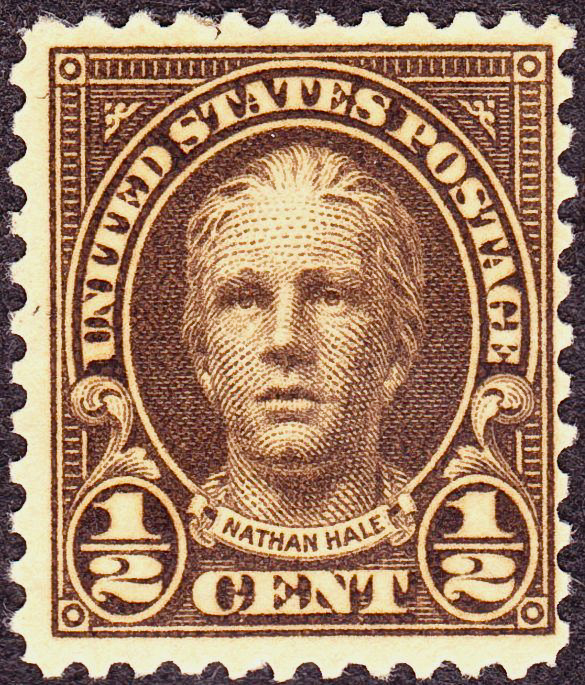
    Cover art for September 8, 1776: Statue of Nathan Hale at the Tribune Tower in Chicago by Bela Pratt. This statue is probably the model for two postage stamps issued in the 1910s. via Wikimedia Commons.

    There are lots of images of Nathan Hale that have him looking like a middle-aged fellow, and then there are others that have him looking like some kind of idealized young man, with a prominent jaw and youthful good looks.

    The fact is, nobody today is 100% sure what he looked like, because no contemporaneous images of him have been found. The best we have is a description written by a fellow soldier of his, Lieutenant Elisha Bostwick. Bostwick wrote:

    I can now in imagination see his person & hear his voice—his person I should say was a little above the common stature in height, his shoulders of a moderate breadth, his limbs strait & very plump: regular features—very fair skin—blue eyes—flaxen or very light hair which was always kept short—his eyebrows a shade darker than his hair & his voice rather sharp or piercing—his bodily agility was remarkable. I have seen him follow a football and kick it over the tops of the trees in the Bowery at New York, (an exercise which he was fond of)—his mental powers seemed to be above the common sort—his mind of a sedate and sober cast, & he was undoubtedly Pious; for it was remark’d that when any of the soldiers of his company were sick he always visited them & usually Prayed for & with them in their sickness.

    Hale was twenty-one years old in 1776, so the images of him as an older man are almost certainly incorrect. The statue used in today’s cover art is one of several copies cast in 1912 from a sculpture by Bela Pratt. (Baltimoreans note: Bela Pratt was a distant cousin of Enoch Pratt, the man who founded the city’s libraries.) In addition, Pratt’s sculpture was the model for two postage stamps issued in 1925 and 1929.

    We know nowadays that Hale’s efforts to infiltrate the British didn’t work out very well, and Mike and I will return to his story in a few days to tell you specifically how it shook out, and a long-standing controversy over his last words—what did he say, and how did he say it?