Tag: North Carolina History

  • Battle of the Black Hole–September 19, 1776

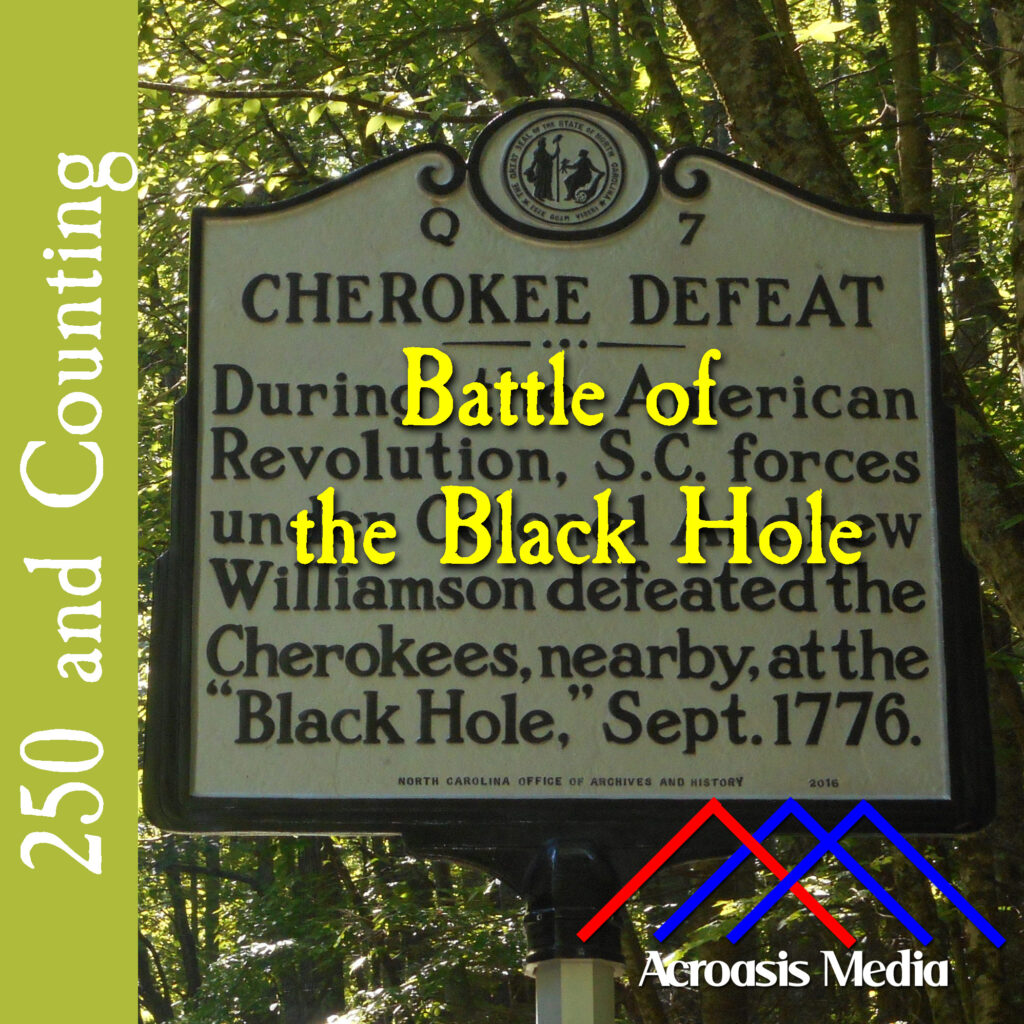
    Cover art for September 19, 1776: Historical Marker noting the location in Wayah Creek (west of Franklin, NC) where the Battle of the Black Hole took place. via NC Department of Natural and Cultural Resources.

    The Battle of the Black Hole, also known as the Battle of Coweecho River, lasted about two hours and had surprisingly few casualties, considering its location and just how fierce the fighting was.

    Colonel Andrew Williamson essentially marched into an ambush in a deep gorge, and had to fight their way out. They began by using a circular formation because they found themselves surrounded. But because they were in such a tight spot geographically, they realized that the only way out is through, as the expression goes. Williamson led a bayonet charge, which drove out the Cherokees, who were low on ammunition anyway.

    Four Cherokees were killed altogether, and eleven militiamen were killed, plus twenty-four men were wounded.

    Interestingly, the exact location of the battle is not known, but based on contemporary accounts, historians have placed it at or near Wayah Gap in Macon County, NC. For some time there was an argument that it took place further north, in Swain County, a place called “Indian Grave Gap.” But given the militia groups’ respective destinations as they moved, this location doesn’t make sense.

    The fact is, much of the correct information for this battle had to be painstakingly teased from contemporary reports. At one point it was thought that it was General Rutherford’s men who had fought the battle, but that was based on a single article written nearly a hundred years later. Furthermore, that article was based on sketchy research.

    So the Battle of the Black Hole was brief, it was relatively bloodless, and it was the last battle in the Cherokee-American War that would take place in North Carolina, though many more were to come in other states.

  • Cornwallis Arrives In Halifax, NC–May 11, 1776

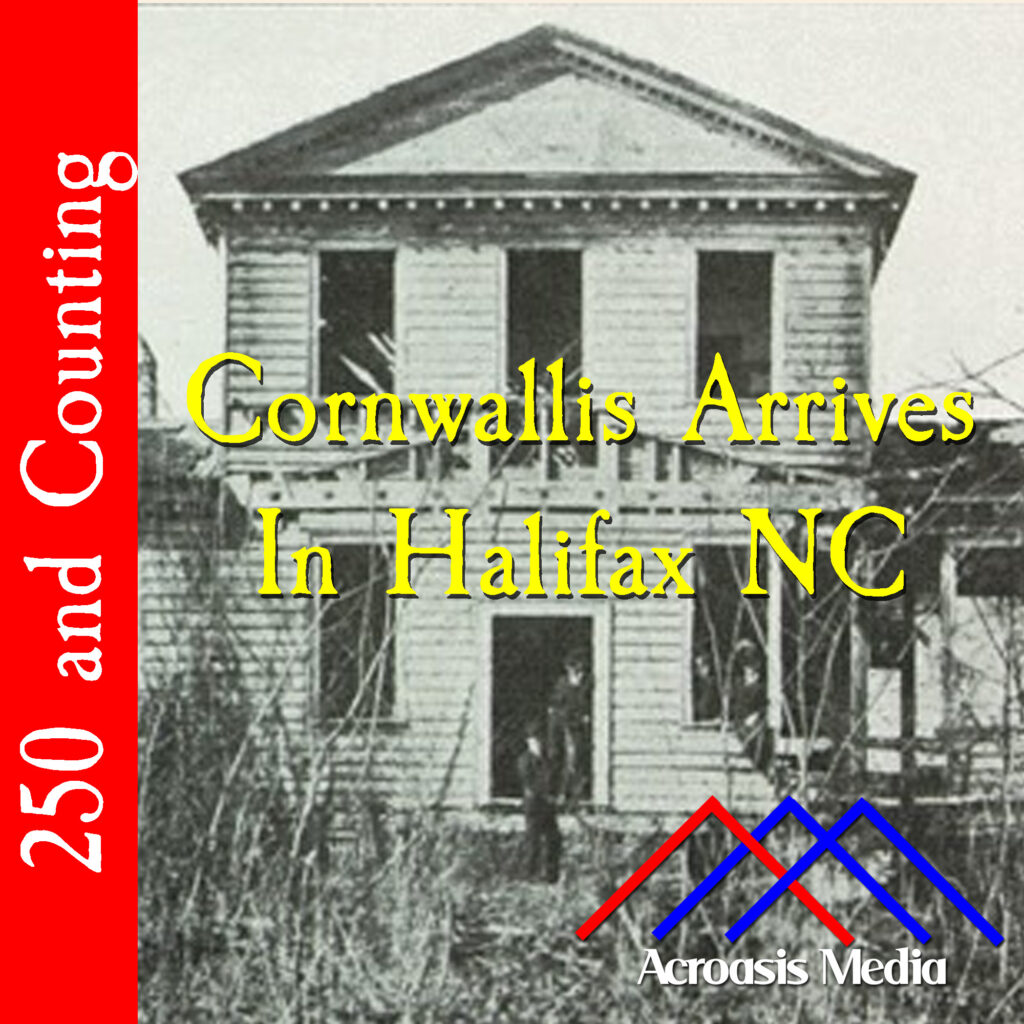
    Cover art for May 11, 1776: The ruins of The Grove, the house where Mary Montfort Jones lived at the time of Cornwallis' occupation. The photo was published in 1912.

    Ugh. Before I tell you any more about The Grove, I have to take care of a couple of corrections.

    If you’ve listened to the episode already, you might be a little confused about Mike telling you that you’d be in Nova Scotia. Obviously he got his Halifaxes crossed.

    Second, after I’d completed today’s episode and finished all the post-production stuff, I discovered that Willie Jones’ first name isn’t pronounced the way I thought it was. While most people would make the same error I did and say it as “Will-E”, it’s actually pronounced “Wylie”. A reasonable mistake but I should have paid closer attention. I did see one place where it was spelled “Wyley” but didn’t make the connection. mea culpa.

    And yes, I do have a little more information about The Grove. A few years earlier, a young man named John Paul, who had recently turned up in America after having fled Scotland, spent some time at The Grove as a guest of the Jones family. Shortly thereafter he was granted some land in Frederick County, Virginia. At around this time, John Paul began appending “Jones” to his name, apparently in honor of Willie.

    And, of course, shortly thereafter he became a lieutenant in the newly-minted Continental Navy.

  • Reorganizing in North Carolina–April 22, 1776

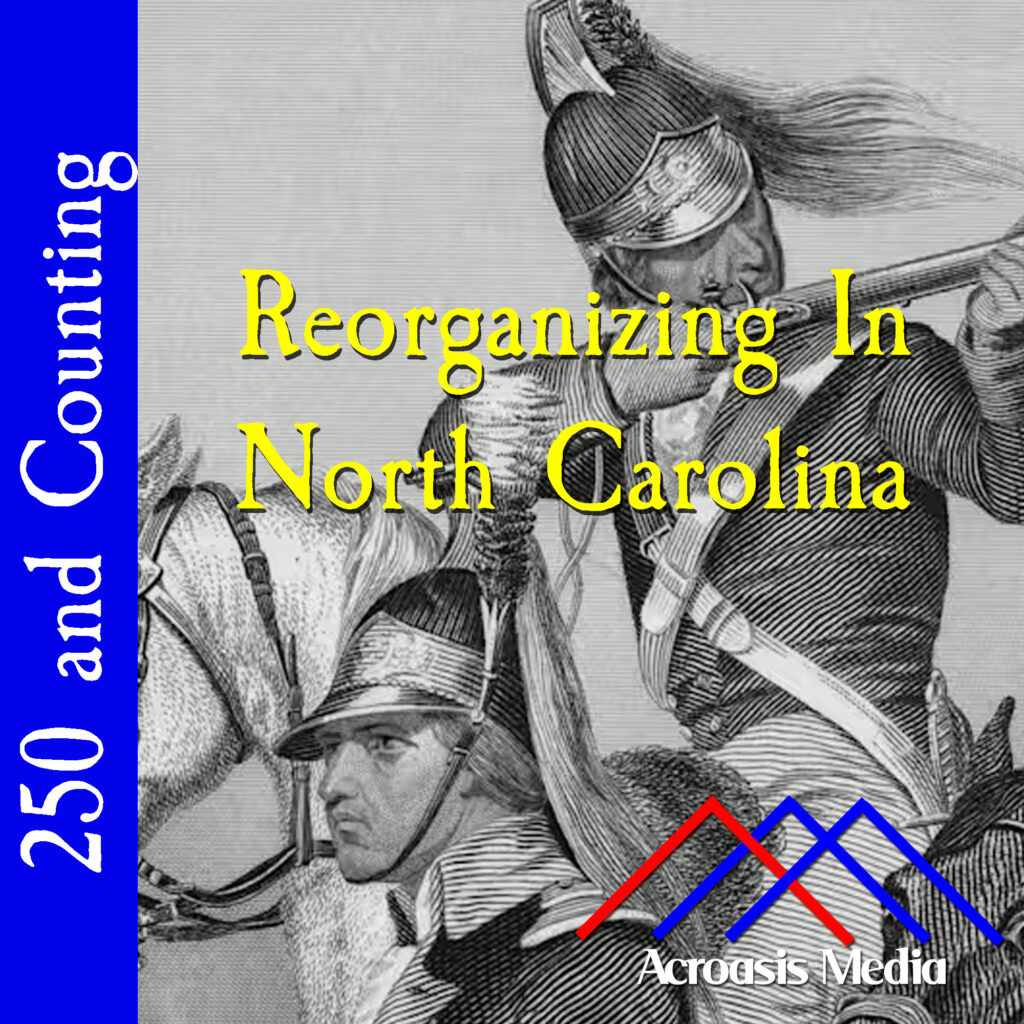
    Cover art for April 22, 1776: detail from "Lee's Cavalry Skirmishing at the Battle of Guilford" by American artist Alonzo Chappel, created ca 1858.

    North Carolina’s Orange County Regiment went through a lot of change in a very short amount of time. First they were divided, then reabsorbed into a different group, all in the span of about two weeks.

    Fortunately things stablilized for them then, but the resulting Hillsborough District Brigade of militia saw a lot of action over the next several years in the Carolinas and in Georgia. By the time the war ended, Hillsborough was one of the few groups still standing. But chances are, if there was an important battle in that part of the world, this group was part of it.

  • The Halifax Resolves–April 12, 1776

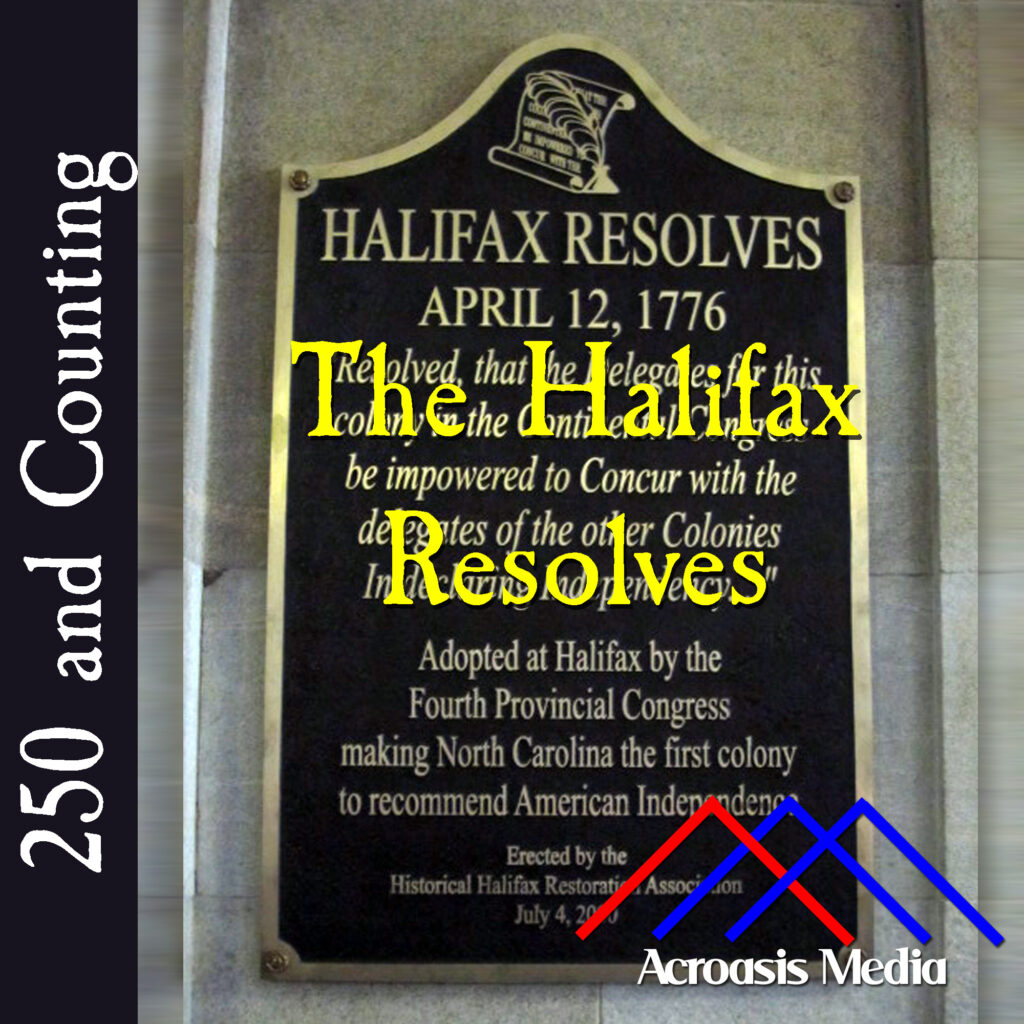
    Cover art for April 12, 1776: a commemorative plaque in the North Carolina State Capitol marking the anniversary of the Halifax Resolves.

    The Halifax Resolves was the first official action in which Independence from Great Britain was actually called for and approved.

    I have to admit that in earlier years, when driving up and down Interstate 95, when I got to Halifax County in North Carolina, I’d see a sign saying that this county is “Where the Spirit of Independence Was Born.”

    And this didn’t make a lot of sense to me: Most of the action early on was in Boston. Philadelphia is where the Declaration was written and signed. Richard Henry Lee, who proposed Independence, was from Virginia. How does Halifax County get to make this claim?

    Listen, my children, and you shall hear.

  • William Tryon Isn’t Popular–March 22, 1776

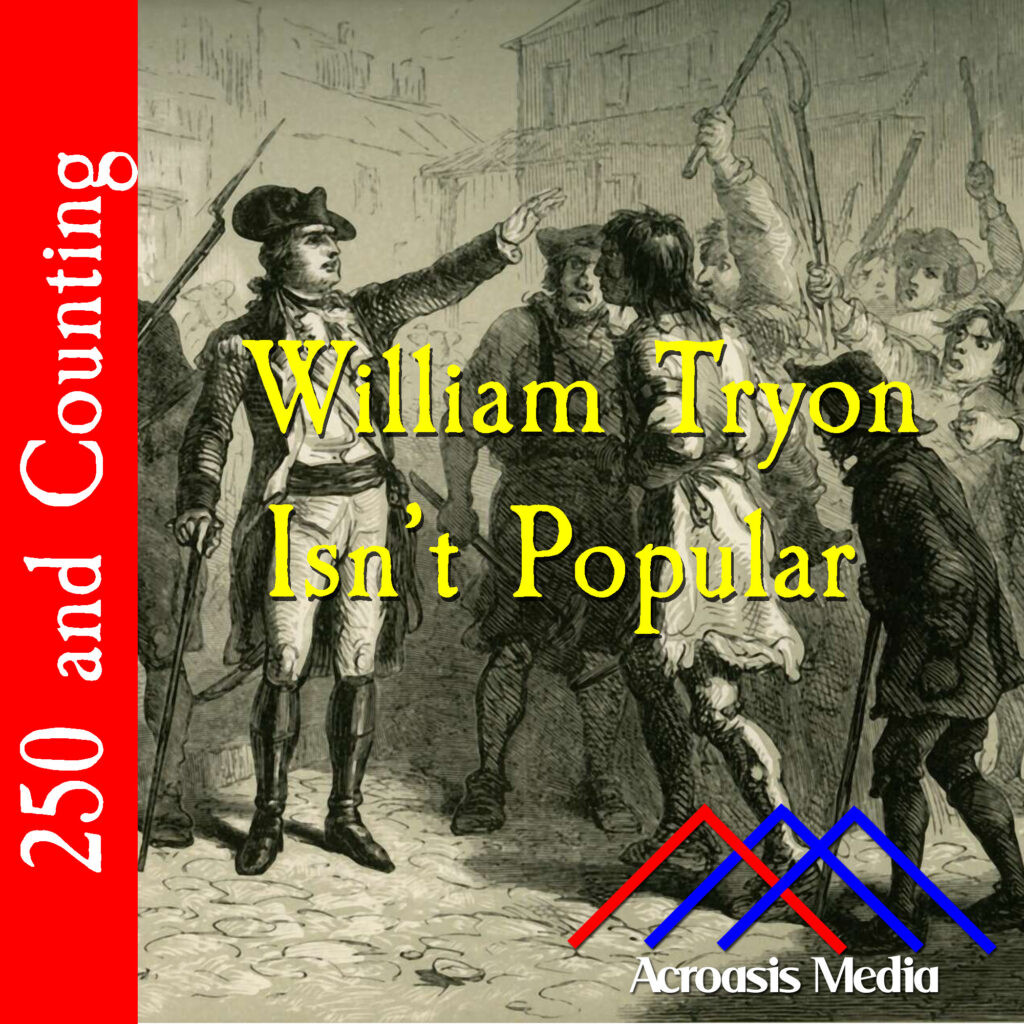
    Cover art for March 22, 1776: "Governor Tryon and the Regulators." Alexander Bobbett's 1877 line engraving based on an earlier illustration by the prominent American artist Felix Octavius Carr Darley (F.O.C. Darley) in 1876.

    To be perfectly clear, William Tryon was never popular on this side of the pond.

    When he was appointed Lieutenant Governor in North Carolina in 1764, he wasn’t able to move into the usual housing for a man of that title because the previous inhabitant refused to move out.

    When the Stamp Act was enacted in 1765, there was a great deal of opposition in North Carolina, so he refused to allow meetings of the Assembly in order to prevent them from voting for a resolution formally opposing it.

    When he was appointed Royal Governor, he made plans for an elaborate new Governor’s Mansion that cost twice the amount of money allotted for it. Then he hired laborers from Philadelphia to construct it, saying that North Carolinians didn’t have the necessary skills.

    The 1771 Regulator Uprising that Mike talks about in today’s episode was the last straw for William Tryon in North Carolina, and many historians view it as the first sign that a true revolution was coming. Within a month of that event, he left North Carolina and headed for New York, where things, as you’ll hear, didn’t go any better.

  • The NC Royal Governor is Defiant–March 2, 1776

    Cover art for March 2, 1776: miniature portrait of Josiah Martin, artist unknown, ca. 1775. via Wikimedia

    Oh, that Royal Governor Josiah Martin. He might be defiant, he might be delusional. He might be in denial.

    What he was not, apparently, was cognizant of the effect that the Battle of Moore’s Creek Bridge had on Loyalist morale. Or, perhaps he did. At any rate, his order to raise the British flag anywhere a flag could be raised was more performative than anything else.

    This was Martin’s second big push to restore North Carolina to British control, but it wasn’t his last. Many months later the Carolina Campaign began. It went on for a long time and they very nearly succeeded. However, Martin finally had to leave, first for Long Island and then for Britain.

  • The Battle of Moore’s Creek Bridge–February 27, 1776

    Cover art for February 27, 1775: Historical marker located near the restored bridge. Image via revolutionarywar.us

    As Revolutionary battles go, the Battle of Moore’s Creek Bridge was relatively minor. It didn’t last very long, there weren’t a ton of losses on either side (though definitely more on the Loyalist side), and it led to the capture of hundreds of Loyalists.

    However, it changed the way the British viewed the Carolinas through the rest of the war. Overall, the perception was that the Carolinas were poor, and weak, and a stronghold of Loyalist sympathizers. And this was an easy assumption to make, especially when you think back to the Siege of Ninety-Six and the way that finally ended. British confidence was pretty high at that point, especially given the fact that it ended pretty much in a draw.

    But the lasting effect of The Battle of Moore’s Creek Bridge was more in the way it affected recruitment of Loyalist troops, in that the numbers plummeted. And, only about two months later, North Carolina delegates were among the first to vote for Independence.

    To read about the battle in greater detail, check out this website, which is also the source of today’s cover art.

  • Things Heat Up in Wilmington–February 15, 1776

    Cover art for February 15, 1776: A map depicting troop movements in mid-February of 1776. Base map originally published in 1794, from the North Carolina Collection at UNC; overlay created by Wikipedia contributor Thomas Kitchin.

    We should confess that by the time we actually get to the Battle of Moore’s Creek Bridge, it’s not going to be as big a battle as anyone thought it was going to be. But the buildup was something else again. It seemed pretty clear to everyone involved that this was going to be epic and a veritable cast of thousands would be involved.

    But, things happen. Motivations change. Cynicism and even capriciousness sets in. And there’s still a battle, but it involves hundreds, not thousands. So from a battle standpoint, it wasn’t a lot. But by many other standards, which we’ll explore a little further down the line, there was a huge lasting impact.

  • Troop Movement in North Carolina–February 11, 1776

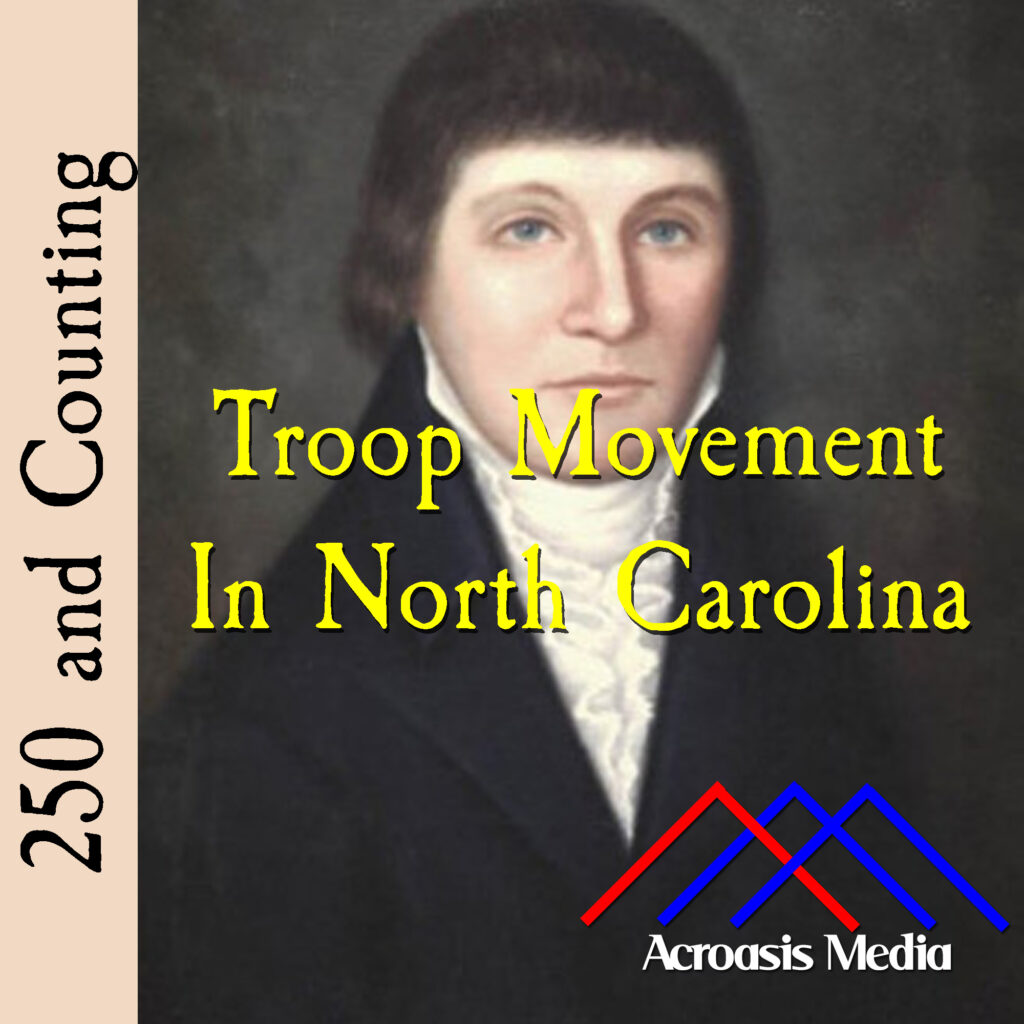
    Cover art for February 11, 1776: image believed to be a portrait of Richard Caswell as Governor of North Carolina. via Wikimedia.

    Richard Caswell was in charge of the Minutemen in New Bern, North Carolina until the Battle of Moore’s Creek Bridge. Not long after that, the Provincial Congress did away with the Minutemen in favor of a more broadly-trained milita. From that point, his position in the Continental Congress was pretty much over for good.

    Caswell remained active in the military throughout the Revolution, and was in charge of the Provincial Congress when it came time to write their first State Constitution. Shortly thereafter he became the state’s first governor. And after a couple of one-year terms, he stepped down from that position, since he was term-limited. But he remained active in state politics until he died in 1789 at the age of 60.

  • Common Sense Comes to NC–February 10, 1776

    Cover art for February 10, 1776: Portrait of John Penn, ca. 1776. Artist unknown. Now at the Guilford Courthouse National Military Park. via Wikimedia.

    As the ideas behind Common Sense spread through the country, it’s an interesting coincidence that Common Sense came to both North and South Carolina a day apart. What’s curious is the way it caught on very quickly in South Carolina, but was more of a slow burn in North Carolina.

    It’s possible that the difference is as simple as Christopher Gadsden presenting the pamphlet orally before the Provincial Congress, whereas John Penn took more of a backdoor approach, giving a copy to a colleague and hoping word gets out. Sure enough it did, and while there was no hard line of “Wow! We need to act on this!,” it proved to be quite the influential pamphlet that led to a gradual changing of minds regarding whether or not the Colonies should be free from England.