Tag: Patrick Henry

  • A More Organized War–February 13, 1776

    Cover art for February 13, 1776: a posthumous portrait of Patrick Henry by Thomas Sully, 1815. Sully was clearly cribbing much of this painting from a portrait of Captain Cook by his brother, made 20 years earlier.

    So nearly a year ago, in March 1775, Patrick Henry said “Give me Liberty or give me death.” Today the Continental Congress said “Bet,” and sent him to lead troops in Virginia.

    That was a coincidence, of course: practically anyone who showed any real leadership skills was given the opportunity to lead troops. Henry had the leadership and the oratory skills to get his troops into shape.

    We mentioned the various committees and their reports today. One of them was the committee that was directed to draft an address to the Colonies. John Dickinson wrote the first draft; James Wilson wrote the second. His version was much like the first, except he added the part about preparing for eventual separation from England. Dickinson was still mostly in denial about that but while Wilson wasn’t a strong personality, he was pragmatic in the end and figured he could see that ending coming.

  • Protecting the Chesapeake–December 19, 1775

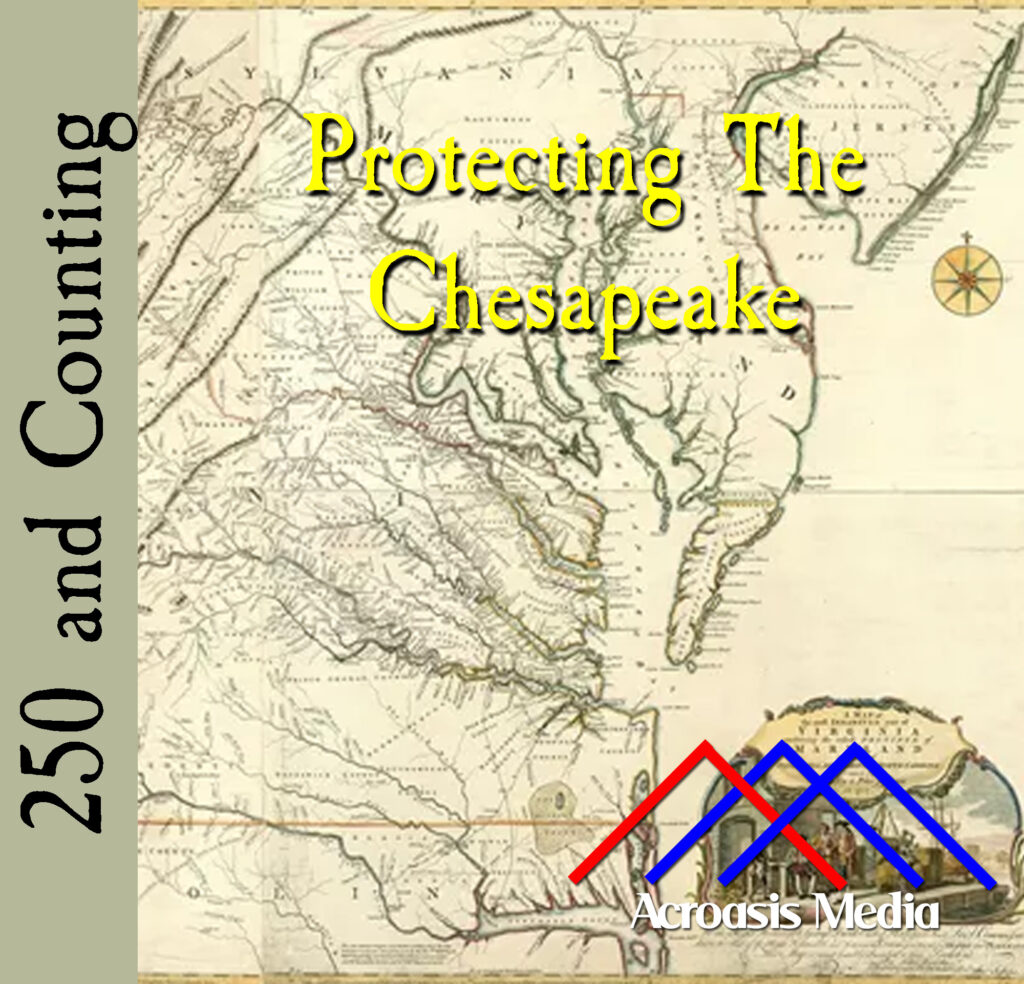
    Cover art for December 19, 1775: The Fry-Jefferson Map of the Chesapeake Bay area, commissioned in 1750 and completed in 1753.
    The Fry-Jefferson Map of the Chesapeake Bay area, commissioned in 1750 and completed in 1753. This was also one of the first maps of the area that had the “North is Up” orientation.

    The Great Chesapeake Bay, which is protected by the Delmarva Peninsula (DELaware, MARyland, VirginiA, get it?) is a watershed area that is hugely important for these three states, plus New York, Pennsylvania and New Jersey.

    Because of its importance, there are sensor buoys all over the place, measuring water temperature, salinity levels, turbidity (how clear the water is), air pressure and maybe a dozen other factors. They’re connected to NOAA (National Oceanic and Atmospheric Administration), and you can actually get the data for your own research here. I’ve actually used it in the classroom to demonstrate how bad weather can affect things like salinity, or how fertilizer-laden water runoff from farms can lead to algae blooms.

    It’s been called “Chesapeake” for so long that historians and etymologists aren’t quite sure where it derives from. It could be a corruption of the Algonquin word Chesepiooc; it could refer to the Chesepian people a tribe from the modern-day Hampton Roads area of Virginia. According to Wikipedia it’s the seventh-oldest place name in the US, but they weren’t telling what #1 through #6 are.

    It’s also—especially in the 18th Century—rather hard to defend. And while the Continental Congress dragged its feet a little bit to get the Navy raised, the more-nimble Virginia Convention commissioned a few ships of their own. Their first was a ship aptly named the Patriot.

  • July 17, 1775: The Third Virginia Convention

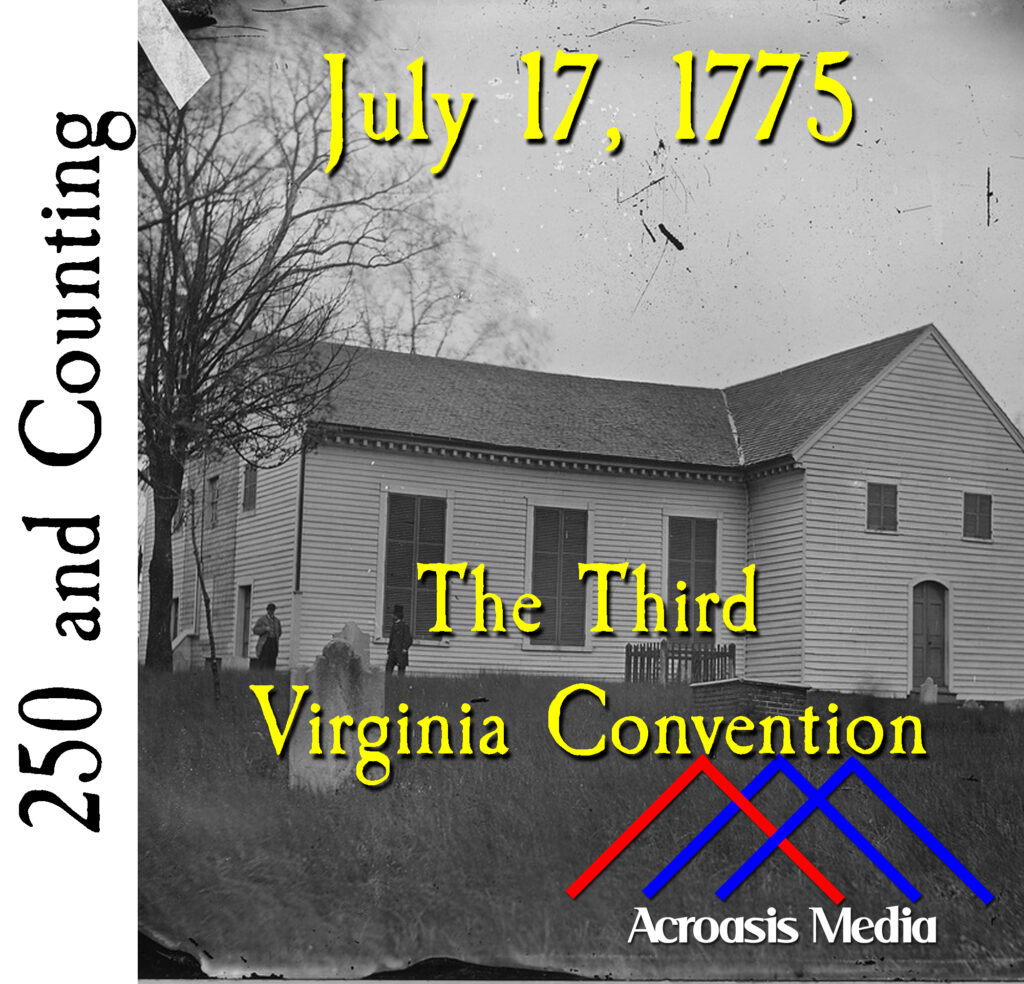
    Cover art for July 17, 1775: an 1860 photo of St. John's Church in Richmond, site of the Second and Third Virginia Conventions. Photo by Matthew Brady.

    Given the fact that the existing government of Virginia was technically extra-legal, it’s a little amusing to think that they themselves felt the need to conduct extra-legal activities of their own. A more cynical mind would think that they were hedging their bets, so that if anything Revolutionary were to come up and the British started rounding up people, they could say, “That wasn’t us…it was that Virginia Convention crowd!”

    A more cynical mind would think that. Heh.

    But the various conventions, while not having large agendas, did have important ones, and they managed to help the colony get their act together and improve their overall effectiveness during the Revolution.

  • May 4, 1775: How the Gunpowder Incident Ended

    Cover art for May 4, 1775: portrait of Patrick Henry by Thomas Sully, circa 1851. There's another version by another artist emulating this one wherein Henry's eyes are rather sunken and dark.

    As we noted a few days ago, both Payton Randolph and George Washington managed to quell a couple of militia-based riots which would have resulted in the torching of the Royal Governor’s mansion. Both of those riots came from Fredericksburg.

    What nobody counted on, however, was that militia from other parts of Virginia had the same idea to march on Williamsburg and wreak a little havoc. They were led by Patrick Henry, who (let’s face it) extorted payment for the missing gunpowder from Lord Dunmore, and then took off for Philadelphia to deliver the money.

    Dunmore called him out on it, declaring Henry an outlaw, and the Virginia citizens acted accordingly. I’ve said too much here; listen in to see what they did.

  • March 23, 1775: A Wedding Announcement and a Birthday Celebration

    Cover art for March 23, 1775: Portrait of Dr. William Foushee, ca. 1820 (public domain image; attribution on the image is to someone named "Eugene")

    This show isn’t just about the big moments in American history, though we’ve been giving you those. We also take the time to look at some of the smaller things, which may have an effect later on down the line. And today we can mark two of those events.

    First up is a wedding taking place in Southampton County in Virginia, across the bay from Williamsburg. The bride was an educated woman who carried on that tradition afterward, and the groom was a future mayor of Richmond, the city’s first, in fact.

    Meanwhile, up in Pennsylvania, America’s first botanist was celebrating a birthday. Unfortunately it was one of his last.