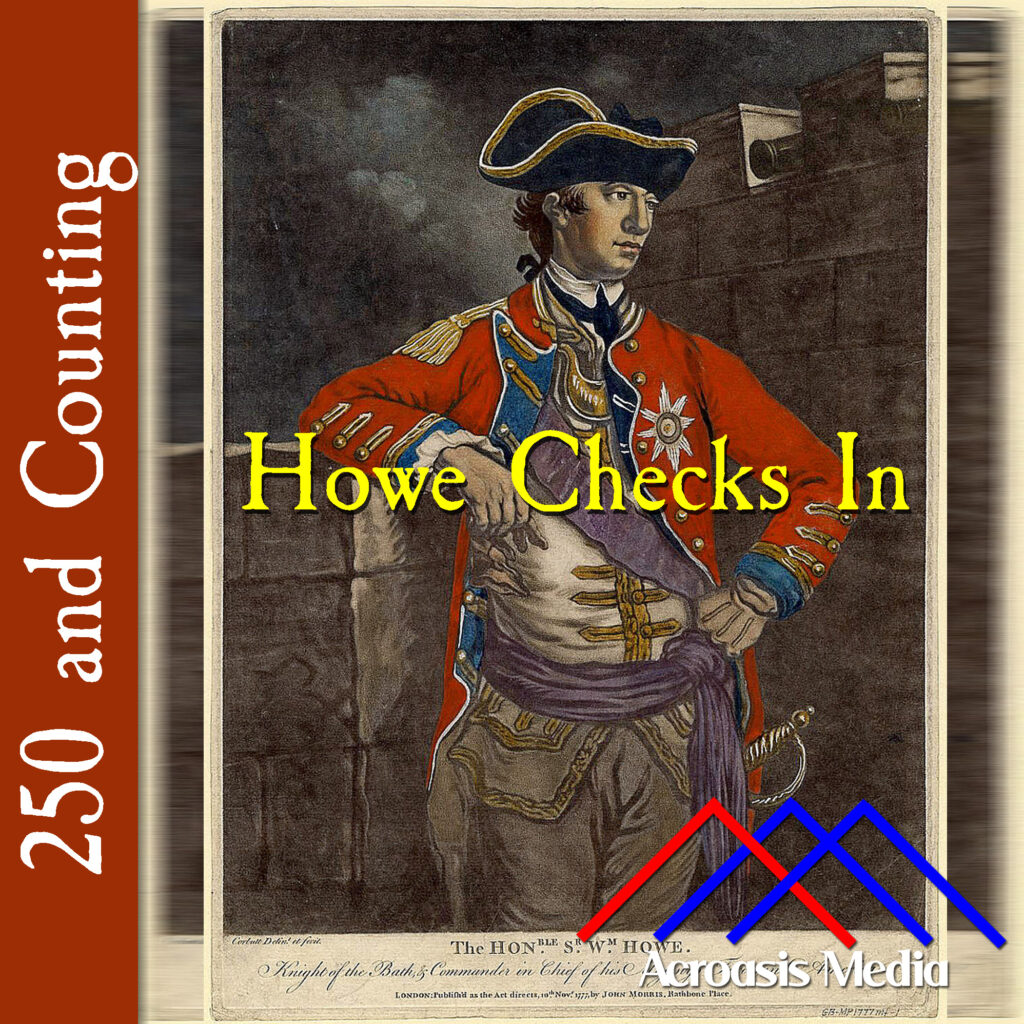
William Howe had already been in New York for a little over a week when he wrote to George Germain from his Staten Island headquarters.
Not everyone had yet arrived from Halifax, of course; it was a long trip and the ships moved at different speeds. Howe took the time to detail what troops and ships had already arrived in New York, and what was still enroute, and that he was awaiting some more reinforcements before acting in full.
I presume that he was as detailed as he was because he was dispatching the letter to George Germain immediately via a packet ship, and the American Navy wasn’t really in a position at that point to intercept anything; otherwise they would have had a lot of actionable information about troop movements and their plans.
On the other hand, George Washington (and a few others) had already figured out what the British were up to, but at this point they were at a little bit of a loss regarding how they were going to counter it.
Part of the problem was that the troops were still fighting more or less defensively. They didn’t have a specific cause to fight for. But in another couple of days, they would have that. It wouldn’t really help in the short run here, but it worked wonders in the end.
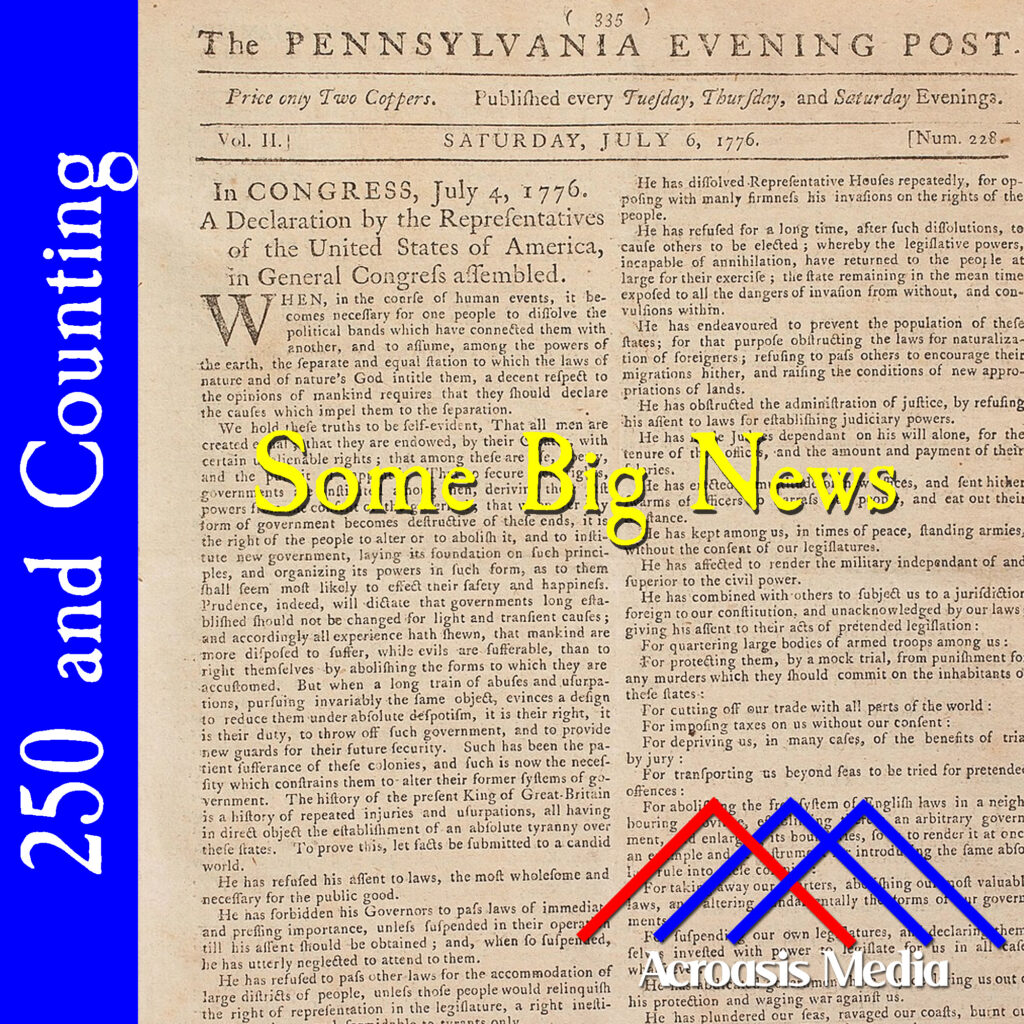
The Pennsylvania Evening Post is an interesting study in media relations and what a publication sometimes has to do in order to survive.
The Post was America’s first daily newspaper, but early on it published three times a week, on Tuesdays, Thursdays and Saturdays. They were generally supportive of the Revolution and published pro-Patriot articles.
As Mike explains, it was through a quirk of their publishing schedule that the Post was able to publish the text of the Declaration of Independence before anyone else, but the war got worse before it got better, and as things progressed into 1778 and the British occupied Philadelphia, they simply shifted gears, publishing Loyalist opinions and British-positive stories. All the other Patriot newspapers in town ceased operating. The crazy part of this is, because of their sudden political shift, the Supreme Executive Council of the Commonwealth of Pennsylvania placed its publisher, Benjamin Towne, on a list of traitors. Because the other printers had not returned to the city, the list was printed in The Post!
Some of this activity did lead to public controversy and a drop in revenue. Towne resorted to selling the newspaper via hawkers (the people on street corners in old movies hollering “Extra! Read all about it!” and such), but the Pennsylvania Evening Post ultimately shut down in 1784.
In the biography of Bernard Smith in today’s episode, it was noted that he spent a couple of years as the Collector of Customs in 1809 and 1810. Which set up the question for me: what does a Collector of Customs do?
My guess wasn’t too far off, tell the truth. The Collector of Customs assesses import duties and tariffs, enforces trade laws and regulates goods moving across international borders. My research didn’t turn up where he worked, but it could have been in New York. On the other hand, the Customs House in Linwood (near Atlantic City) was fairly new at the time so that could have been the location. At that time, tariffs and duties were the primary source of revenue for the US Government. Federal income taxes weren’t levied until 1861 for a few years, and then permanently in 1913.
At any rate, after Bernard Smith put in his time with the Sixteenth Congress, he was register of the land office in Little Rock, Arkansas, then secretary to the governor of Arkansaw, and finally an agent to the Quapaw Nation until his death in 1835, shortly after his 59th birthday.
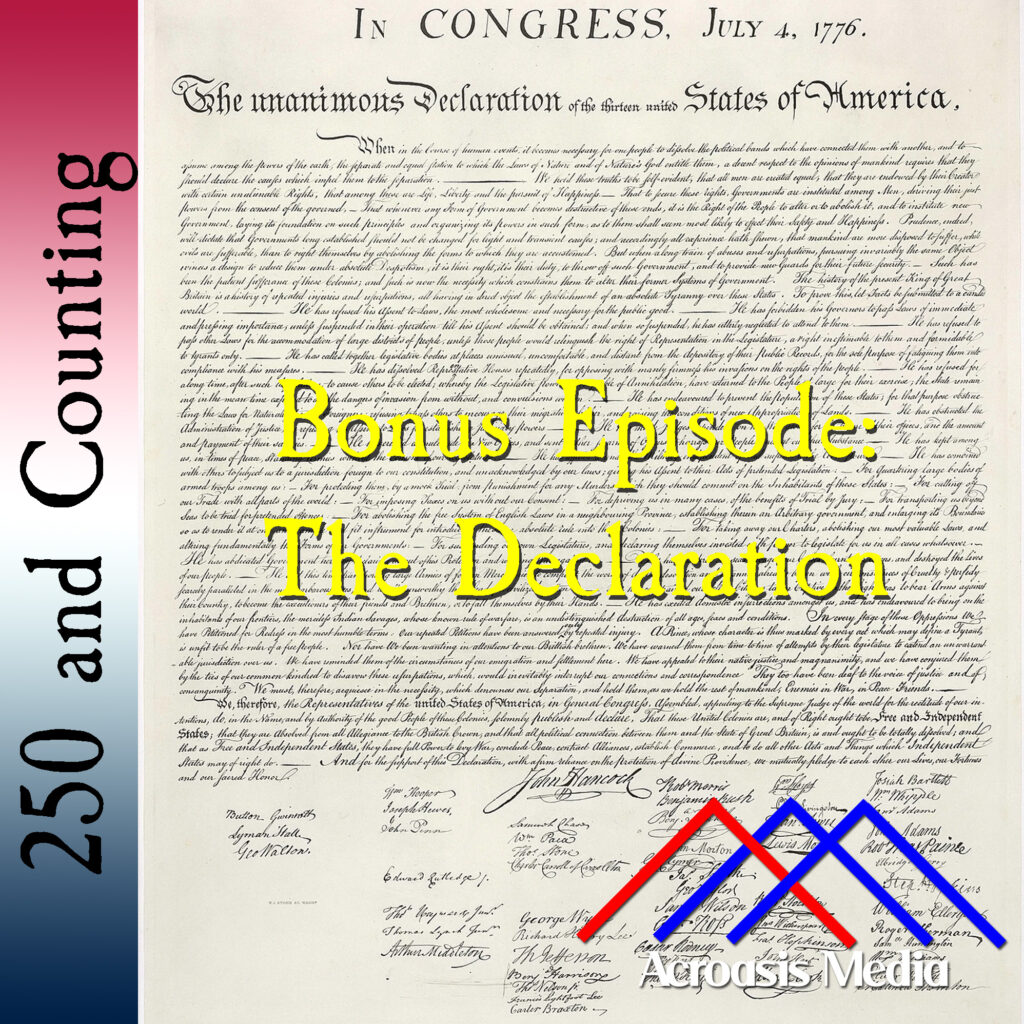
The unanimous Declaration of the thirteen united States of America,
When in the Course of human events, it becomes necessary for one people to dissolve the political bands which have connected them with another, and to assume among the powers of the earth, the separate and equal station to which the Laws of Nature and of Nature’s God entitle them, a decent respect to the opinions of mankind requires that they should declare the causes which impel them to the separation.
We hold these truths to be self-evident, that all men are created equal, that they are endowed by their Creator with certain unalienable Rights, that among these are Life, Liberty and the pursuit of Happiness.—That to secure these rights, Governments are instituted among Men, deriving their just powers from the consent of the governed,—That whenever any Form of Government becomes destructive of these ends, it is the Right of the People to alter or to abolish it, and to institute new Government, laying its foundation on such principles and organizing its powers in such form, as to them shall seem most likely to effect their Safety and Happiness. Prudence, indeed, will dictate that Governments long established should not be changed for light and transient causes; and accordingly all experience hath shewn, that mankind are more disposed to suffer, while evils are sufferable, than to right themselves by abolishing the forms to which they are accustomed. But when a long train of abuses and usurpations, pursuing invariably the same Object evinces a design to reduce them under absolute Despotism, it is their right, it is their duty, to throw off such Government, and to provide new Guards for their future security.
Such has been the patient sufferance of these Colonies; and such is now the necessity which constrains them to alter their former Systems of Government. The history of the present King of Great Britain is a history of repeated injuries and usurpations, all having in direct object the establishment of an absolute Tyranny over these States. To prove this, let Facts be submitted to a candid world.
He has refused his Assent to Laws, the most wholesome and necessary for the public good.
He has forbidden his Governors to pass Laws of immediate and pressing importance, unless suspended in their operation till his Assent should be obtained; and when so suspended, he has utterly neglected to attend to them.
He has refused to pass other Laws for the accommodation of large districts of people, unless those people would relinquish the right of Representation in the Legislature, a right inestimable to them and formidable to tyrants only.
He has called together legislative bodies at places unusual, uncomfortable, and distant from the depository of their Public Records, for the sole purpose of fatiguing them into compliance with his measures.
He has dissolved Representative Houses repeatedly, for opposing with manly firmness his invasions on the rights of the people.
He has refused for a long time, after such dissolutions, to cause others to be elected, whereby the Legislative Powers, incapable of Annihilation, have returned to the People at large for their exercise; the State remaining in the meantime exposed to all the dangers of invasion from without, and convulsions within.
He has endeavoured to prevent the population of these States; for that purpose obstructing the Laws for Naturalization of Foreigners; refusing to pass others to encourage their migrations hither, and raising the conditions of new Appropriations of Lands.
He has obstructed the Administration of Justice by refusing his Assent to Laws for establishing Judiciary Powers.
He has made Judges dependent on his Will alone for the tenure of their offices, and the amount and payment of their salaries.
He has erected a multitude of New Offices, and sent hither swarms of Officers to harass our people and eat out their substance.
He has kept among us, in times of peace, Standing Armies without the Consent of our legislatures.
He has affected to render the Military independent of and superior to the Civil Power.
He has combined with others to subject us to a jurisdiction foreign to our constitution, and unacknowledged by our laws; giving his Assent to their Acts of pretended Legislation:
For quartering large bodies of armed troops among us:
For protecting them, by a mock Trial from punishment for any Murders which they should commit on the Inhabitants of these States:
For cutting off our Trade with all parts of the world:
For imposing Taxes on us without our Consent:
For depriving us in many cases, of the benefit of Trial by Jury:
For transporting us beyond Seas to be tried for pretended offences:
For abolishing the free System of English Laws in a neighbouring Province, establishing therein an Arbitrary government, and enlarging its Boundaries so as to render it at once an example and fit instrument for introducing the same absolute rule into these Colonies:
For taking away our Charters, abolishing our most valuable Laws and altering fundamentally the Forms of our Governments:
For suspending our own Legislatures, and declaring themselves invested with power to legislate for us in all cases whatsoever.
He has abdicated Government here, by declaring us out of his Protection and waging War against us.
He has plundered our seas, ravaged our coasts, burnt our towns, and destroyed the lives of our people.
He is at this time transporting large Armies of foreign Mercenaries to compleat the works of death, desolation, and tyranny, already begun with circumstances of Cruelty & Perfidy scarcely paralleled in the most barbarous ages, and totally unworthy the Head of a civilized nation.
He has constrained our fellow Citizens taken Captive on the high Seas to bear Arms against their Country, to become the executioners of their friends and Brethren, or to fall themselves by their Hands.
He has excited domestic insurrections amongst us, and has endeavoured to bring on the inhabitants of our frontiers, the merciless Indian Savages whose known rule of warfare, is an undistinguished destruction of all ages, sexes and conditions.
In every stage of these Oppressions We have Petitioned for Redress in the most humble terms: Our repeated Petitions have been answered only by repeated injury. A Prince, whose character is thus marked by every act which may define a Tyrant, is unfit to be the ruler of a free people.
Nor have We been wanting in attentions to our British brethren. We have warned them from time to time of attempts by their legislature to extend an unwarrantable jurisdiction over us. We have reminded them of the circumstances of our emigration and settlement here. We have appealed to their native justice and magnanimity, and we have conjured them by the ties of our common kindred to disavow these usurpations, which, would inevitably interrupt our connections and correspondence. They too have been deaf to the voice of justice and of consanguinity.
We must, therefore, acquiesce in the necessity, which denounces our Separation, and hold them, as we hold the rest of mankind, Enemies in War, in Peace Friends.
We, therefore, the Representatives of the united States of America, in General Congress, Assembled, appealing to the Supreme Judge of the world for the rectitude of our intentions, do, in the Name, and by Authority of the good People of these Colonies, solemnly publish and declare, That these United Colonies are, and of Right ought to be Free and Independent States; that they are Absolved from all Allegiance to the British Crown, and that all political connection between them and the State of Great Britain, is and ought to be totally dissolved; and that as Free and Independent States, they have full Power to levy War, conclude Peace, contract Alliances, establish Commerce, and to do all other Acts and Things which Independent States may of right do. And for the support of this Declaration, with a firm reliance on the protection of divine Providence, we mutually pledge to each other our Lives, our Fortunes and our sacred Honor.
New Hampshire: Josiah Bartlett, William Whipple, Matthew Thornton Massachusetts:Samuel Adams, John Adams, John Hancock, Robert Treat Paine, Elbridge Gerry Rhode Island: Stephen Hopkins, William Ellery Connecticut: Roger Sherman, Samuel Huntington, William Williams, Oliver Wolcott New York: William Floyd, Philip Livingston, Francis Lewis, Lewis Morris New Jersey: Richard Stockton, John Witherspoon, Francis Hopkinson, John Hart, Abraham Clark Pennsylvania: Robert Morris, Benjamin Rush, Benjamin Franklin, John Morton, George Clymer, James Smith, George Taylor, James Wilson, George Ross Delaware: George Read, Caesar Rodney, Thomas McKean Maryland: Samuel Chase, William Paca, Thomas Stone, Charles Carroll of Carrollton Virginia: George Wythe, Richard Henry Lee, Thomas Jefferson, Benjamin Harrison, Thomas Nelson Jr., Francis Lightfoot Lee, Carter Braxton North Carolina: William Hooper, Joseph Hewes, John Penn South Carolina: Edward Rutledge, Thomas Heyward Jr., Thomas Lynch Jr., Arthur Middleton Georgia: Button Gwinnett, Lyman Hall, George Walton
I don’t know if we ever mentioned this, but People of a Certain Age may remember that back in the Bicentennial Days, on our television every night during the 8:00 PM hour there was a one-minute (two, if you count the commercial) which offered up some snippet of history from that day 200 years previous, told to us by a famous person (whose identity changed every day).
Does that sound familiar? It should. The “Bicentennial Minute,” as it was usually called, ran from July 1974 to 1976, and was meant to end on July 4, 1976, but instead ran through the end of that year. So they did 912 episodes. At any rate, this was the inspiration for 250 and Counting. I wanted to revive the Bicentennial Minute in podcast form.
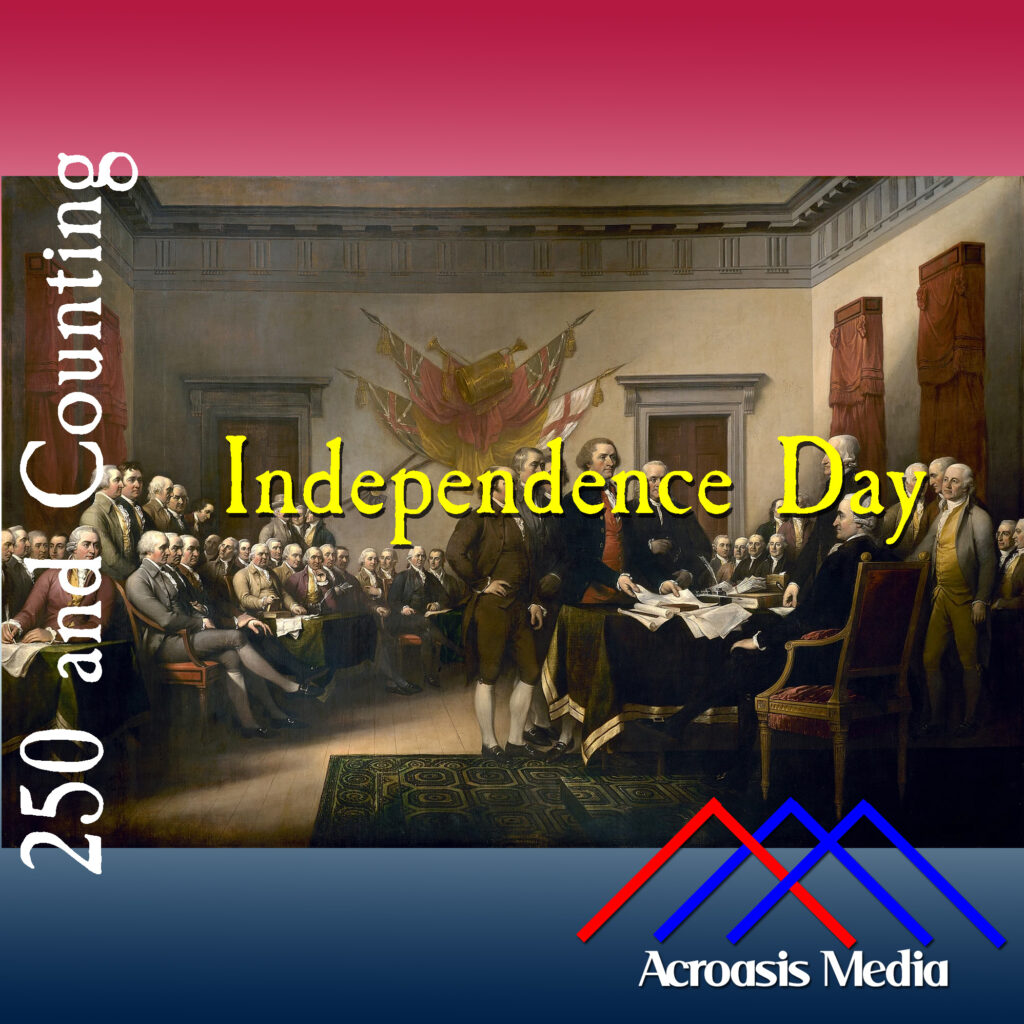
Now, there was a lot of anticipation as we got closer to July 4, 1976/1776, because after all, that was the big day, yes? The July 4 episode was narrated by First Lady Betty Ford. But of course, the Lee Resolution had already been approved, the editing of the document was yesterday, the signing of the finished Declaration wouldn’t happen for some time…all there was for Independence Day was the vote to approve the Declaration as edited, so it wound up being a little anticlimactic. (We did try to warn you about not getting too excited. Learn From My Fail and all that.)
Mike and I have committed to 729 episodes, from January 1, 2025 through the end of this year. After that, who knows? Maybe we’ll keep it up, maybe we’ll move on to another project. That largely depends on your level of interest. But there’s still lots of American History to look into as word gets out about this bold step our Founding Fathers took, and the repercussions for the war. We still have a couple of major battles to deal with (Long Island and Trenton, NJ come immediately to mind), the launching of the first military submarine attack, the Cherokee-American Wars are heating up, and so much more. We hope you’ll continue to ride with us. And thank you for riding so far.
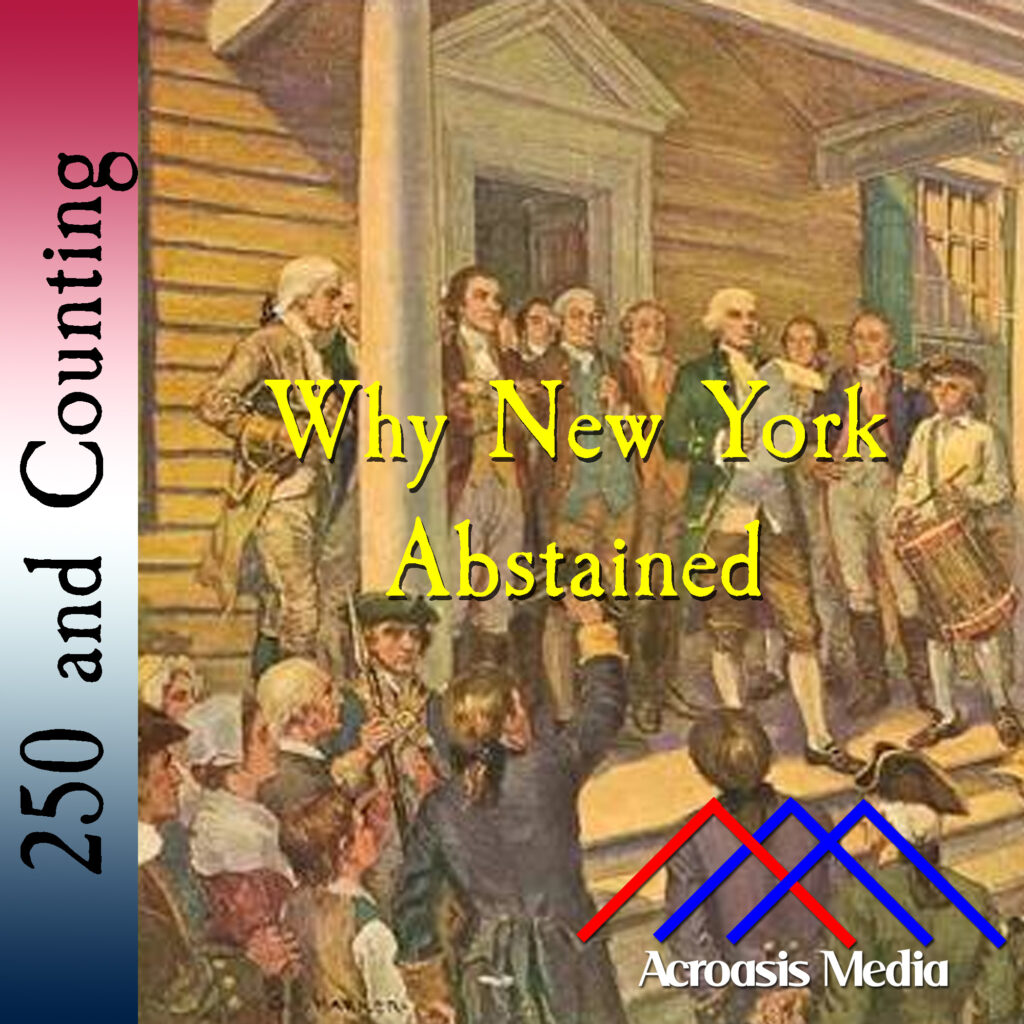
In the play/film 1776, with nearly every vote cast throughout the show, a delegate from New York (Lewis Morris) steps up to announce New York’s abstention from the vote, “courteously.”
It’s played for comedy, and at one point even the explanation is rendered comedic, when Morris tells the assembled delegates that the members of the legislature in New York “speak very fast and very loud, and nobody listens to anybody else with the result that nothing ever gets done.” He also says that the New York legislature has never given him explicit instructions. Now, the first thing may or may not be true (I’m from New York, so it’s possible), but the second item is not, as you learn in today’s episode.
When it came to the question of Independence, New York did, in fact, abstain. And they were probably courteous about it besides. But New York’s abstention from the votes, over and over, were derived from explicit instructions, not their absence.
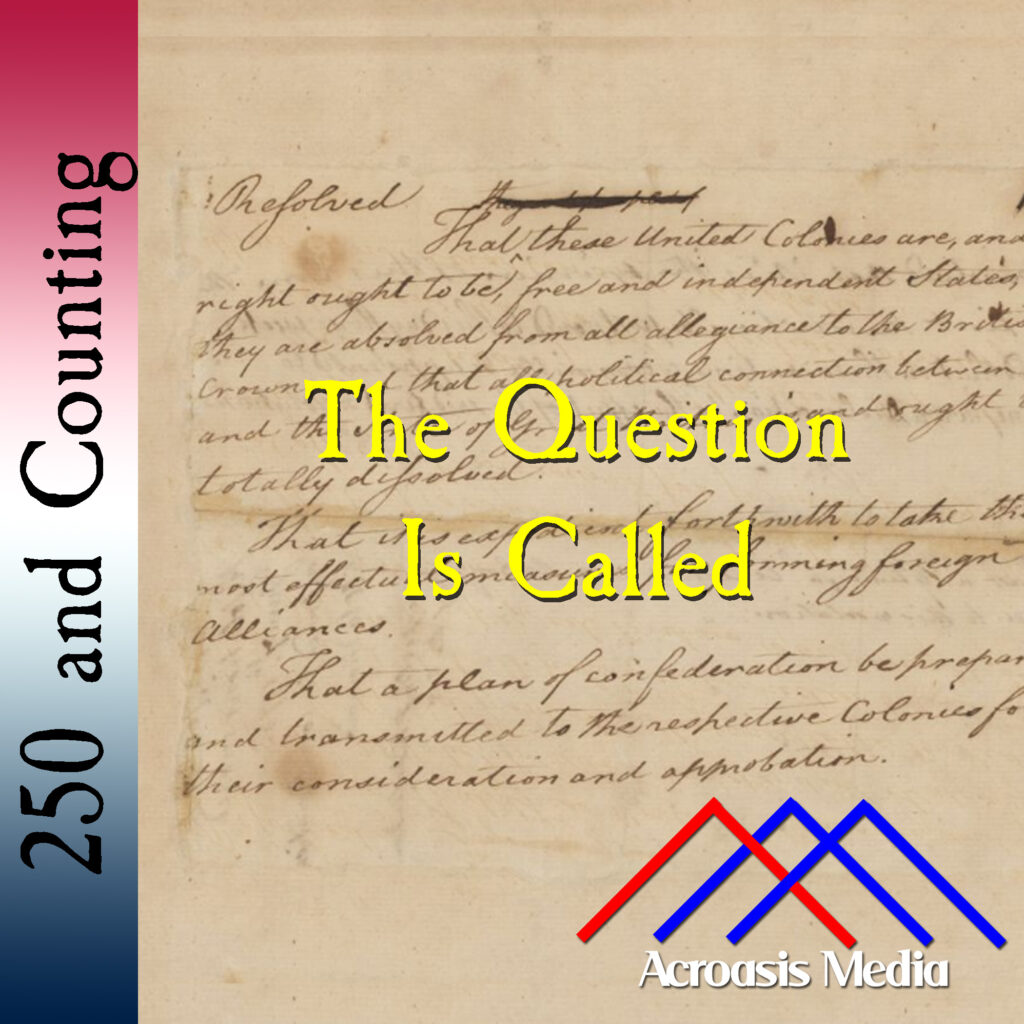
It’s been twenty-five days since the Lee Resolution was introduced, asking the delegates of the Continental Congress to vote for Independence from Great Britain. Some of the delegates returned to their homes to get the formal instructions in the affirmative, others stayed behind and worked on drafting a Declaration.
Finally all the stars have aligned, and the votes come in: twelve in favor, none against, and one abstention. (In tomorrow’s episode we’ll talk about why that abstention happened.)
This was a huge move on the part of the Continental Congress; people like to say that it hadn’t been done before, but that’s not quite correct. San Marino broke away from the Roman Empire in the year 301. But since then it had only happened five times, and while one or two of the others also involved bloodshed, the other new nations weren’t under threats of treason and the punishments associated with that particular crime. So it wasn’t quite unique, but it also wasn’t something that was common. And breaking away from the British Empire? Well, that had certainly never been done before.
In being asked to vote for Independence, these men were literally putting their lives on the line, and that’s the thing it’s important not to forget.
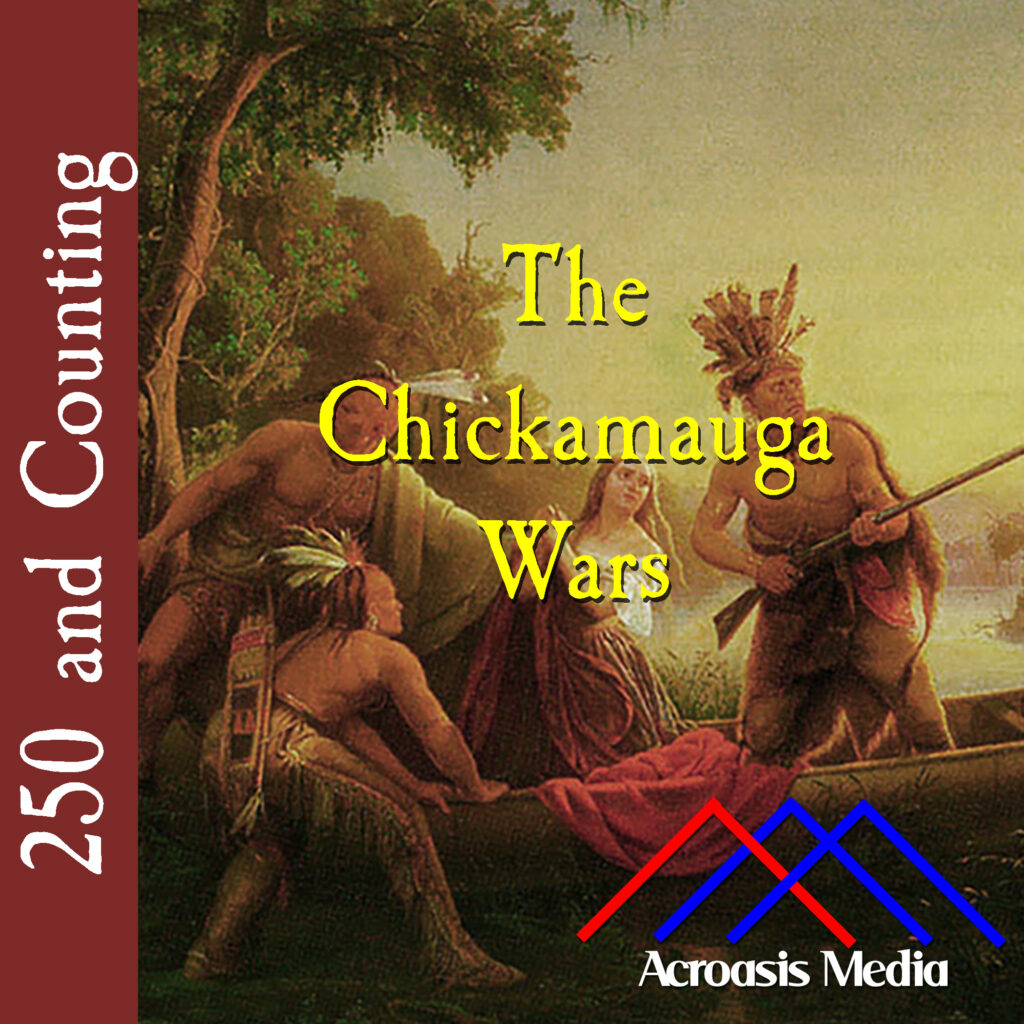
The Chickamauga Wars, also known as the Cherokee-American Wars, was really just an escalation of the hostile relationship between Americans and the Cherokee tribe.
The problem really started during the French and Indian War, which ran from 1758-1761. During that war, British forces simply destroyed many Cherokee towns, which were never reoccupied. Some treaties were signed after the war, and then boundaries established, but the colonists resented those boundaries. They showed their resentment by largely ignoring them, forcing officials in charge of Indian Affairs to put together new treaties with new boundaries. Go figure, those didn’t work either.
Things got ugly in 1773 when Daniel Boone led about 50 settlers through the Cumberland Gap. Natives from several tribes descended on a foraging/scouting party, capturing them and then ritually torturing them to death. Among the dead was Boone’s son James.
Tensions continued to rise until this day in 1776, when they escalated into full-scale raids and battles which came in fits and starts, and then would settle into long periods of no activity.
This went on into the 1790s before the Army came in with a major offensive, forcing the Cherokees to back down and seek a peace treaty, formally ending the Chickamauga Wars.
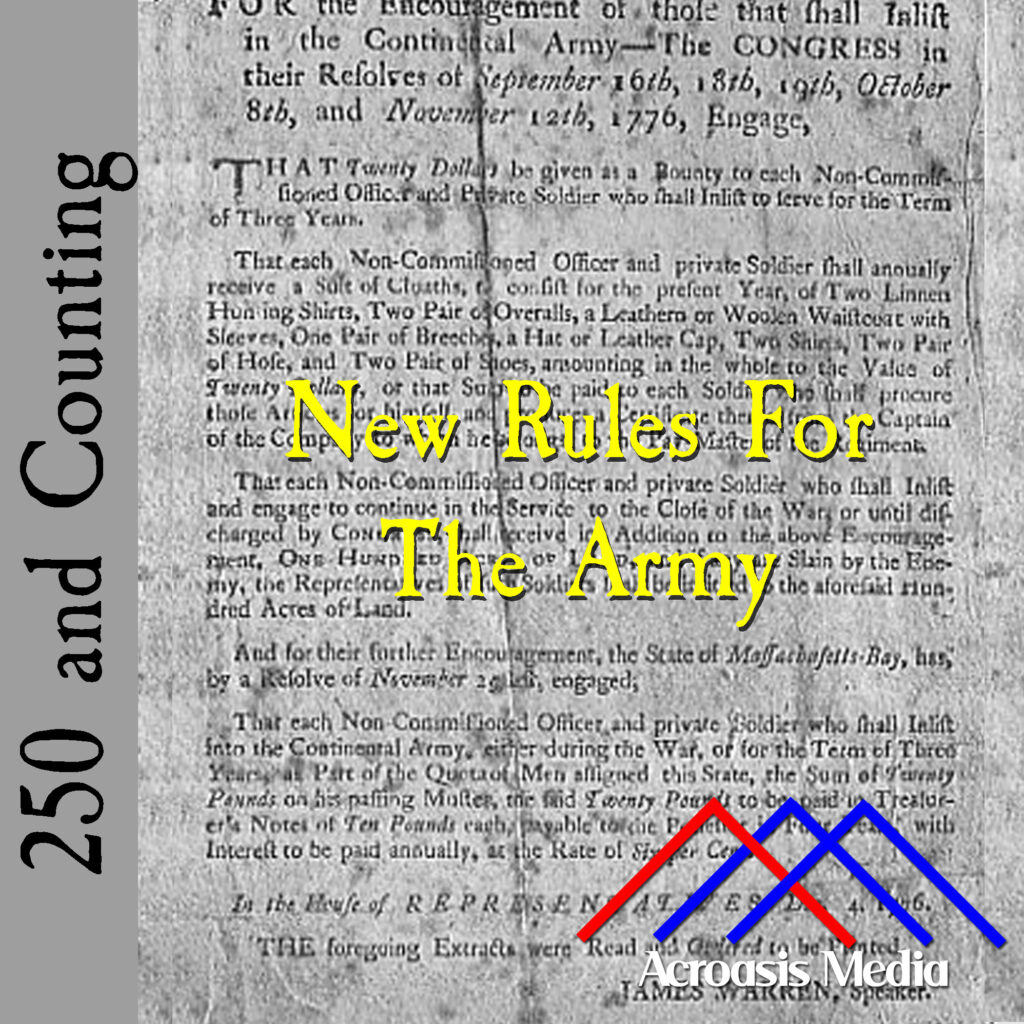
Setting new Continental Army rules was oftentimes rather tough, because at that time the enlistments were relatively short. Soldiers would get trained, of course, but because they were undisciplined they didn’t always stay trained, and then their enlistment would be up and now it’s time to train the next set of guys and hope some of it sticks.
The Continental Army rules that were approved today were designed to affect soldiers’ overall behavior, perhaps in the hope that comporting themselves appropriately would lead to a more disciplined man in general. This met with limited success (that is, not much).
Interestingly, when Baron von Steuben came along later in the year, the company that he led was visibly different from the others encamped at Valley Forge, with regard to drills, self-policing and preparedness, and it was likely this that caught George Washington’s eye and led to von Steuben writing the manual that Mike cites in today’s episode.
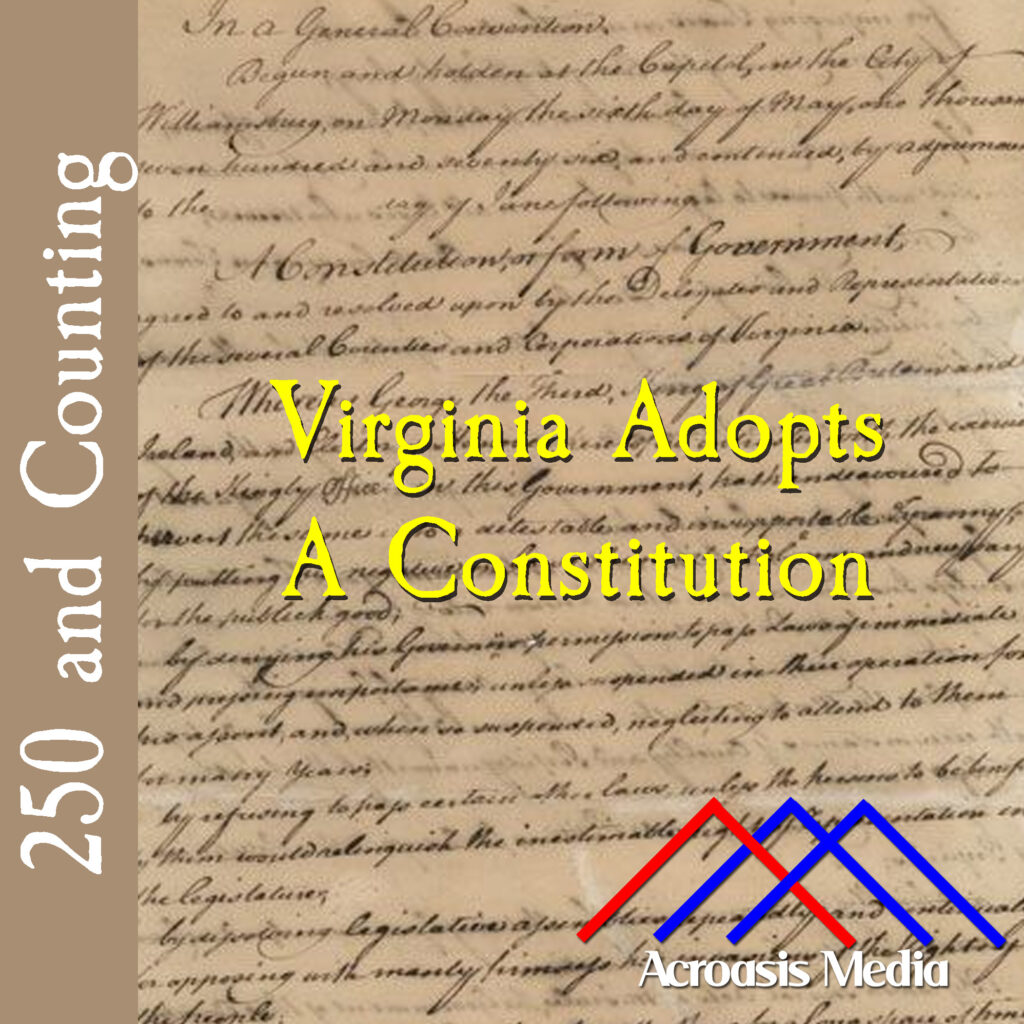
The Constitution of the Commonwealth of Virginia, more commonly known as the Virginia Constitution, was formally adopted on this day in 1776, after months of work.
Most of the credit for its overall structure goes to James Madison and George Mason, both of whom also worked on the US Constitution in later years. And like any good living document, it’s been through several large-scale amendments, in 1830, 1851, 1864, 1870, 1902 and 1971. Nearly all of these were in response to periods of major regional or social upheaval in Virginia. (Gee…I wonder what happened in 1864 that necessitated a Constitutional Convention?) In between, there have been minor amendments to ensure that the Virginia Constitution conforms to changes in Federal law. For instance, an amendment was passed in 2006 defining marriage as being a union “between one man and one woman” (because they didn’t learn anything from the Loving v. Virginia decision?)but was subsequently overturned by Obergefell v. Hodges in 2015.
The Virginia Constitution is still subject to criticism that the legislature may still be too powerful, but it’s actually easier to amend the document through citizen votes than through a Constitutional Convention. Go figure.