When the Second Continental Congress convened in May, there was a large faction of delegates who thought that peace with England was still possible, and made a specific effort to draft a message of reconciliation with King George III.
They finished their document and presented it to the whole body of Congress on this day in 1775, which approved it and it was subsequently prepared and sent to Great Britain. In a few weeks we’ll talk a little bit about what happened at the other end.
Note: I realize that the file reads “July 7,” as did the headline on this post originally. That was a typo that got carried over from one to the other via copy and paste. This was in fact the July 5 file and apologies for any confusion.
As mentioned yesterday, when George Washington came to Cambridge, he found a bit of a mess there: several disorganized groups of men, with more on the way, along with supplies still in transit.
The first thing he needed to do was to get the fighting force organized, so he began a log book of his official orders. His first set, which came out on this day in 1775, took up about five pages of manuscript. But Washington wasn’t done, not by a long shot. Every few days he’d come up with something new, but it was all reasonable and made sense in the bigger picture. It’s not as though Washington had grabbed power with no intention of relinquishing it later on; he just wasn’t wired that way.
Eventually his book of orders grew to over 500 pages over the next couple of years.
P.S. Happy Independence Day! Our 250th anniversary is exactly one year away, but there’s a lot of stuff before, and after, that date that we’ll need to look at in order to get the entire story.
On June 15, 1775, George Washington was appointed Commander of the newly-formed Continental Army.
On July 2, Washington finally arrived in Cambridge after a few stops in Trenton, New York and presumably a couple of other places. What he found was a huge mess.
So on July 3, he officially took command and started the work of turning this ragtag crew into some kind of organized fighting force.
As you listen to today’s episode, it’ll become clear that Mike had way too much fun writing and recording this one. But then again, I wrote the title, so.
There are plenty of jobs out there that are kind of obscure, in the sense that it’s a job that somebody has, but you never really thought about. For instance, did you know that with some high-end perfumes, the labels are put on manually? Someone’s out there sticking the labels on the bottles, because either the bottles don’t go through the machinery politely, or the levels of quality are low when they’re applied mechanically. So it’s easier to have someone stick on the labels.
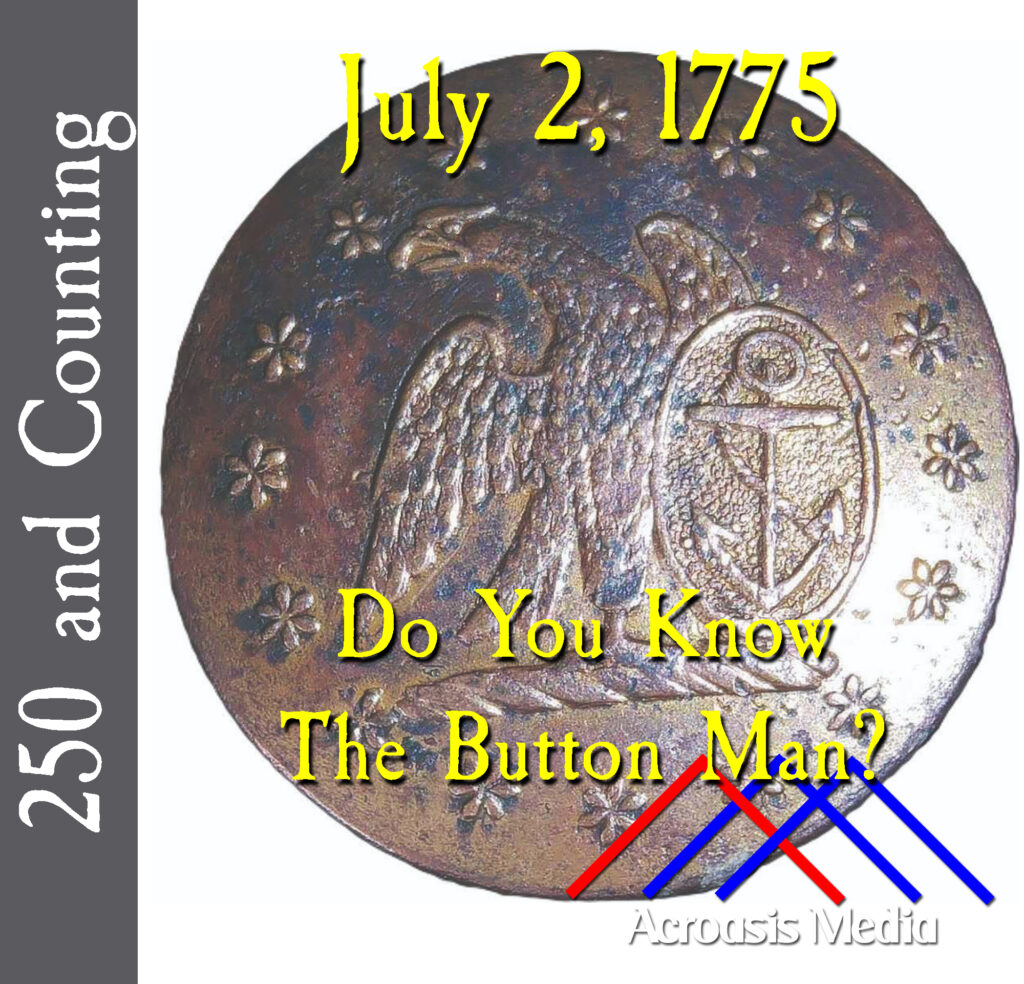
“Buttonmaker” is also a likely profession in this realm, largely because it is so automated these days. But back in the Colonial days, it was a specialty profession, especially since Aaron Peasley, the subject of today’s episode, refined the die sinking procedure used to make buttons then. And except for the specific means of creating the die (it’s done using electrical discharges nowadays), the overall technique hasn’t changed much.
But his talent didn’t end there. Listen in and see what else he did.
Additional note: the closeup photo of the button used in the cover art comes from a fascinating article written by 2ndLt. Kevin Rosentreter, USMC, who also took the photo.
Mike and I alternate on the writing and recording, but the final steps of the show, including the artwork and the show notes, are entirely my responsibility.
Fun Fact: I say “Cephas Thompson” several times during this podcast, mostly because it’s fun to say.
He wasn’t a formally-trained painter, but he had a good eye and some natural talent, and during his career he painted over 600 portraits, with roughly a fourth of those made entirely in Bristol, Rhode Island.
Even after retiring from the itinerant artist life, he continued to work in Middleborough, Massachusetts until his death.
With the army being literally only a few weeks old, it was necessary to put together some regulations for this group, to ensure consistency throughout the Colonies.
Interestingly enough, as the rules were revised over the next several years, a pattern of using another army’s regulations as a template began to emerge. This isn’t necessarily a bad thing: take what works and build on it, yes?
A quick note about the cover art: it’s a recruitment poster from about that time, because a true Army Manual did not emerge until the third version was published in 1779.
Thomas Boyle wasn’t born in Baltimore, Maryland, but when he was a young man he made it his home and became quite successful there, as a merchant marine and an overall businessman.
And, of course, given Baltimore’s penchant for naming streets after historic people and events, there is a Boyle Street. It’s not very long; in fact you see the entire road in the photo below.
In this picture the viewer is standing on Fort Avenue looking down toward Key Highway. The green structure in the background is the Baltimore Museum of Industry, and the Inner Harbor is just beyond that. Based on my research, Boyle didn’t live near this location; he’d settled in a part of town called Fell’s Point, which is on the other side of the harbor and about a mile to the east. If a person standing where the camera was for this photo turned to the right, they could probably see the entrance to Fort McHenry.
It feels like we’re selling the day a little short, but not every day has to be Bunker Hill. Also, we’re discovering (and we hope you are, too) that sometimes it’s the smaller moments between the bigger ones that give us better insight into the hearts and minds of the people who lived during that time.
Today’s artwork is a portrait of Jonathan Trumbull (brother of John Trumbull, the guy who painted so many of the Founding Fathers), but this painting—which was created in 1880, long after he died—appears to show him as he was around the time of the Revolution. Compare that to the image we used for him back in April (right), which showed him in his later years as Governor of Connecticut.
“Schuyler” is one of those names in New York history that pops up quite frequently, partly because they were a prominent family. But it’s also one of those names that you may suddenly realize you’ve heard many times. “Schermerhorn” is another one (no kidding).
So is “Burr,” for that matter, as in Aaron and family. Several Burrs are buried very close to the Long Island town where I grew up. I have childhood memories of passing a cemetery in Smithtown and seeing BURR on a few of the tombstones. It wasn’t until later that I learned it was the same family.
As far as the Schuylers, they were originally from the Albany area but after his father died he was raised in the New Rochelle area. Most of his military experience derived from fighting on the side of the British in the French and Indian War. Later in his life he lived on his estate in Saratoga, just north of Albany. He spent some time as a member of Congress and is also known for being Alexander Hamilton’s father-in-law.
In 1775, New York didn’t have a Times Square, nor a Statue of Liberty, nor even a Brooklyn Bridge. Bagels hadn’t made it to the new world, and pizza wasn’t a thing yet.
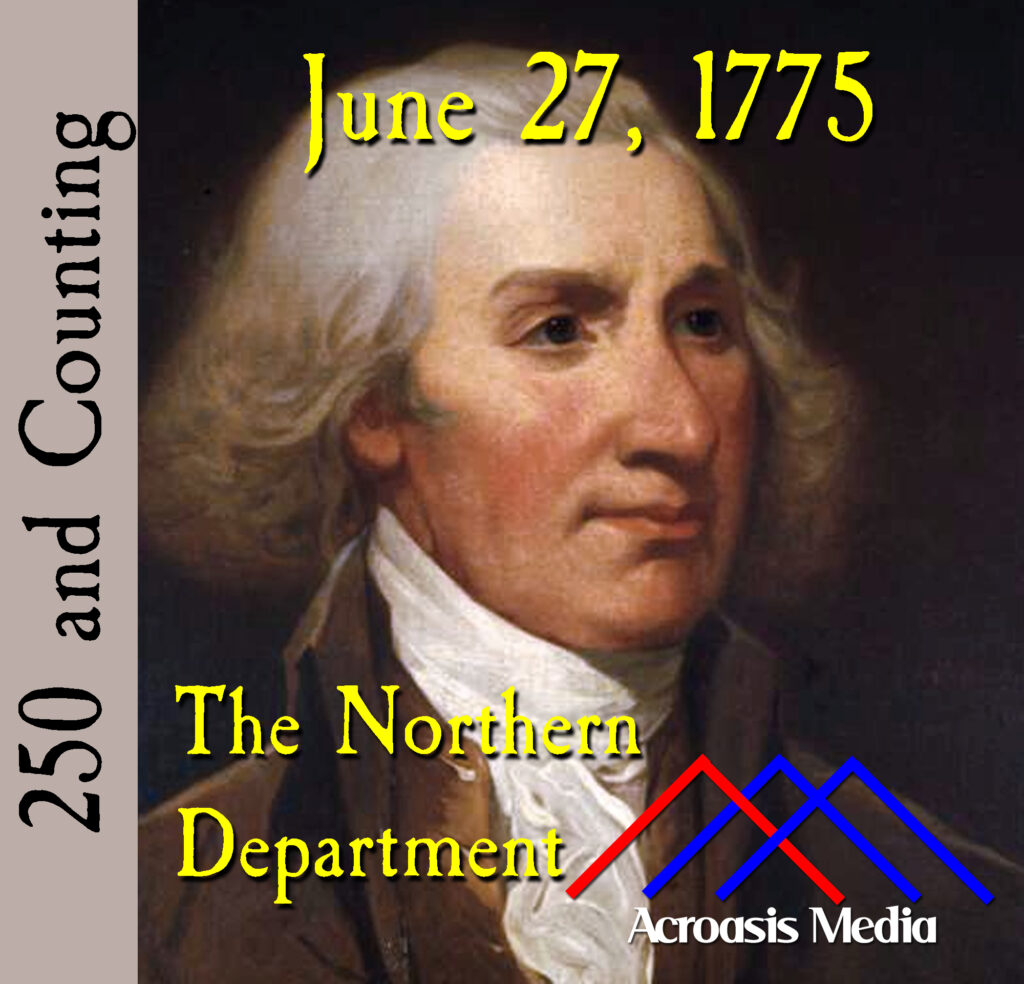
So why did George Washington feel it necessary to stop in New York City on his way to Boston?
Short answer: he knew that some of the locals were nervous about his taking command of the army.
Longer answer: oh no, you don’t. You’re going to have to listen to Mike tell you.