Word spread rather quickly about the events at Lexington and Concord, and everybody mobilized to be ready for when (rather than if) hostilities broke out.
Most people were arming themselves and avoiding confiscation of supplies by the British, but in South Carolina they turned the tables and did a little confiscating of their own.
Word was already getting out about the fighting in and near Boston. While Virginia hadn’t been much of a concern to anyone until then, the British wanted to ensure that there wouldn’t be any trouble.
So in the middle of the night, they removed the gunpowder from the magazine at Williamsburg. Oddly, as we’ll learn shortly, this wasn’t a popular move on their part.
This is the big one, and it’s a date that many people don’t remember, but today is the day that the Revolutionary War officially began.
Oh sure, there were a few skirmishes here and there, which we’ve already discussed in earlier episodes. But this was the true tipping point from which nobody could recover or walk back.
Looking through social media the past couple of days, it’s heartwarming to see the number of events commemorating the 250th anniversary of things like Paul Revere’s ride, and the sheer number of people who are participating, even if they’re doing something relatively simple such as putting two lights in a high window of their homes.
We don’t recommend that you spend today shooting at British people wearing red, though.
Once in awhile, we fear that students of history don’t necessarily put things into the appropriate perspective when it comes to dates. We offer them some facts regarding what happened and when, but the events still kind of mush together.
That’s how we get the Simpsons joke: “Let’s take a look back at the year 1928- the year when you might have seen Al Capone dancing the Charleston on top of a flagpole!”
To that end, students might place the Boston Massacre, say, as quite close in the timeline to the start of the Revolutionary War, when in fact they happened several years apart. But at this specific period of time, things were in fact moving quickly and closely together: Colonies were lining up behind Massachusetts, various areas began to prepare for all-out war, General Gage was doing his best to control the colonists based on the orders that were sent to him several weeks earlier from London, and Lord North was in fact hoping to provoke the colonists into doing something that would give him a reason to crush them hard.
So when word got out that the British were coming up the Charles river to make a move on Concord and Lexington, Colonist spies were wise to it and they got the word out as fast as they could. Listen, my children, and you will hear.
War was coming closer, but nobody knew just how close. Two committees came together in Concord to make plans. They arranged for certain munitions to be moved around, for others to be prepared for action, and to ask people to lead combat units. And if those people said “No Thanks,” who the backup person would be.
Then they all went out to a nearby tavern, as you do when planning a revolution.
But nobody could suspect that the time from then to the war was measurable in hours by then, not by weeks.
In retrospect, we feel like we may be picking on this historic site a little bit. In fact, the park surrounding the ruins of Fort Pownall are quite nice for hiking, biking, picnics and, as we mentioned, there are historical markers all over the place so you do get a sense of how important this particular site was.
At any rate, on April 5 we told you about a detachment sent to the fort to disarm the place; today was the day that they arrived and succeeded, because even if spies knew about it (and they almost certainly did), word was not going to get to the fort in time to prevent what was going to happen.
N.B. for those of you who download the episodes as they come out, apparently the audio didn’t attach to this post correctly. Our apologies. It should be in your feed now.
(Note: it’s in the alt text for the image, but in the interest of broader accuracy and general transparency, we know that this artwork isn’t the symbol for an American abolitionist society but rather a British one. But this is one of those cases where the story works better than the truth, and we found it to be a powerful image that underlines the intent of the tale. In short, let it go this once, OK? –CC)
It might come as a surprise to you that societies dedicated to the elimination of slavery in America came about as early as this, especially inasmuch as we had other things on our mind, such as the largest army in the world putting us in their sights. It might also come as a surprise that the one that came first in America, exists still, but with a different focus. Tune in and learn their story.
It seems fitting that groups like this changed names and designations quickly, given that events in the Colonies were also moving quickly. In two events this week, we’ve told you stories of armies that were raised to defend individual colonies but quickly became part of the Continental Army. The Light Dragoons of North Carolina would be one of those groups.
Likewise, the rest of this episode is a throwback to TWO earlier episodes, as the activities are formally recorded in the Virginia Gazette.
First off: apologies for the late posting. I had a very rough night last night, and there was no element of today that was my own. We’ve all had days like that, I think, and I thank you for your forbearance.
A lot of people get their American History from the play 1776, and it’s mostly accurate with the facts, if not necessarily with the people involved or the specific dates. And that’s also why it gets cited here as often as it does: we hope that the common cultural touchstone provided by the play demonstrates to you that it wasn’t entirely made up, though the writers did play a little fast and loose to make for a good story.
As a result of this play, most people think that Virginia came up with the whole Independence thing first, and there’s a kernel of truth in it: the activity leading to the Declaration did emerge from the Lee Resolution, but North Carolina was the first to send delegates to the Continental Congress with instructions to call for independence, through something called the “Halifax Resolves.”
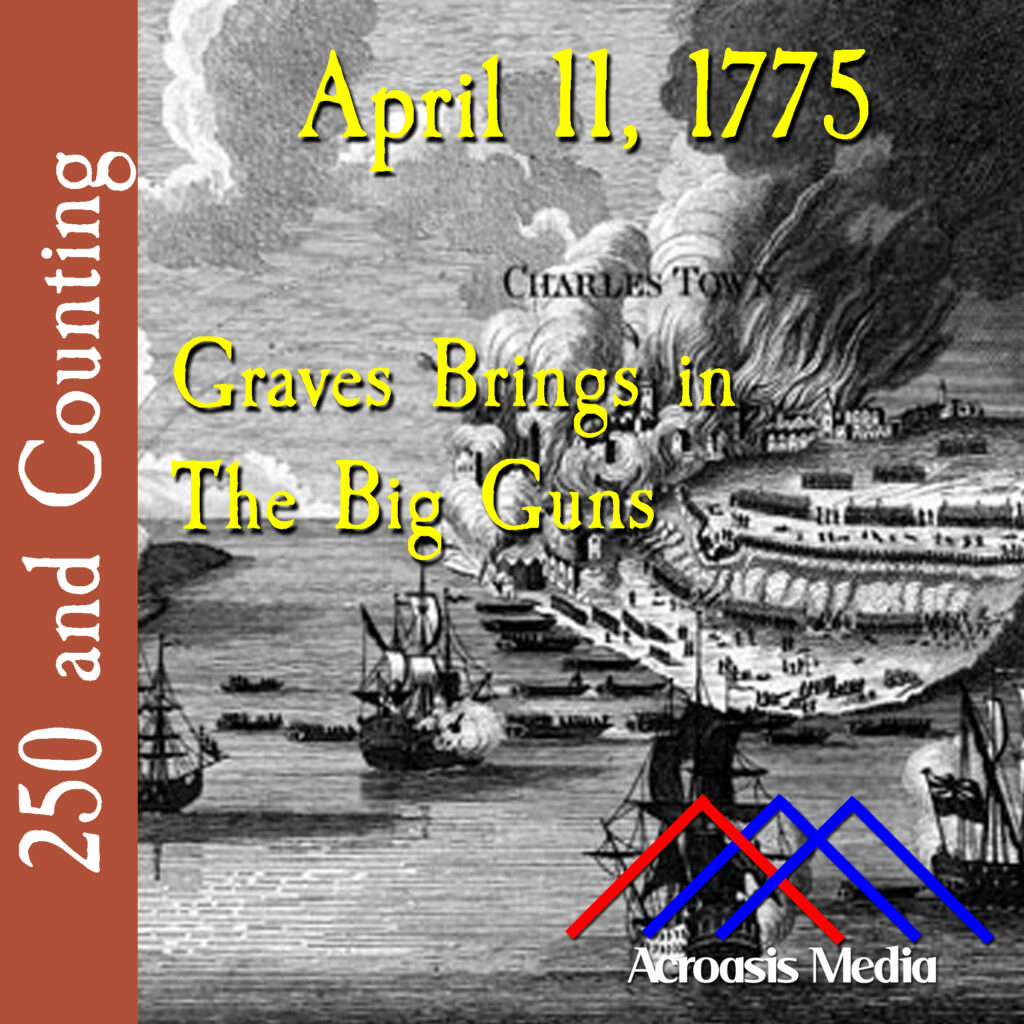
When the HMS Somerset first reached Boston, she was an old, leaky, weathered mess. Admiral Graves asked for permission to repair it, and while the work was slow at first, the sailors actually managed to get the important parts of the work completed. By this day in 1775, the ship was considered seaworthy and capable of doing more from its perch in the harbor, so Graves moved it into the place of two other ships, largely to demonstrate that he could do it, and safely.
Had the lookouts been more alert when the battles of Lexington and Concord first broken out, the outcome could have been quite different.