Author: Claude Call

  • April 7, 1775: Francis Cabot Lowell

    Cover art for April 7, 1775: a silhouette of Francis Cabot Lowell. There are no portraits extant of Lowell, so this profile is typically used to represent him.

    It’s cake and candles today for Francis Cabot Lowell, a manufacturer who helped modernize the textile industry in the United States, largely through industrial espionage: in the middle of a trade war with Europe, Lowell visited England and memorized the processes they were using so that he could bring them back to this side of the pond, helping us to break the hold on imported goods from Europe by innovating the cradle-to-grave manufacturing process for fabrics.

    Yet, despite his prominence in the industry, and despite the statue that stands in his name in the town of Lowell, Massachusetts, the silhouette seen in today’s cover art is the only hint that we have regarding what he might have looked like. There are no portraits extant that we know of.

  • April 6, 1775: Stop the Presses!

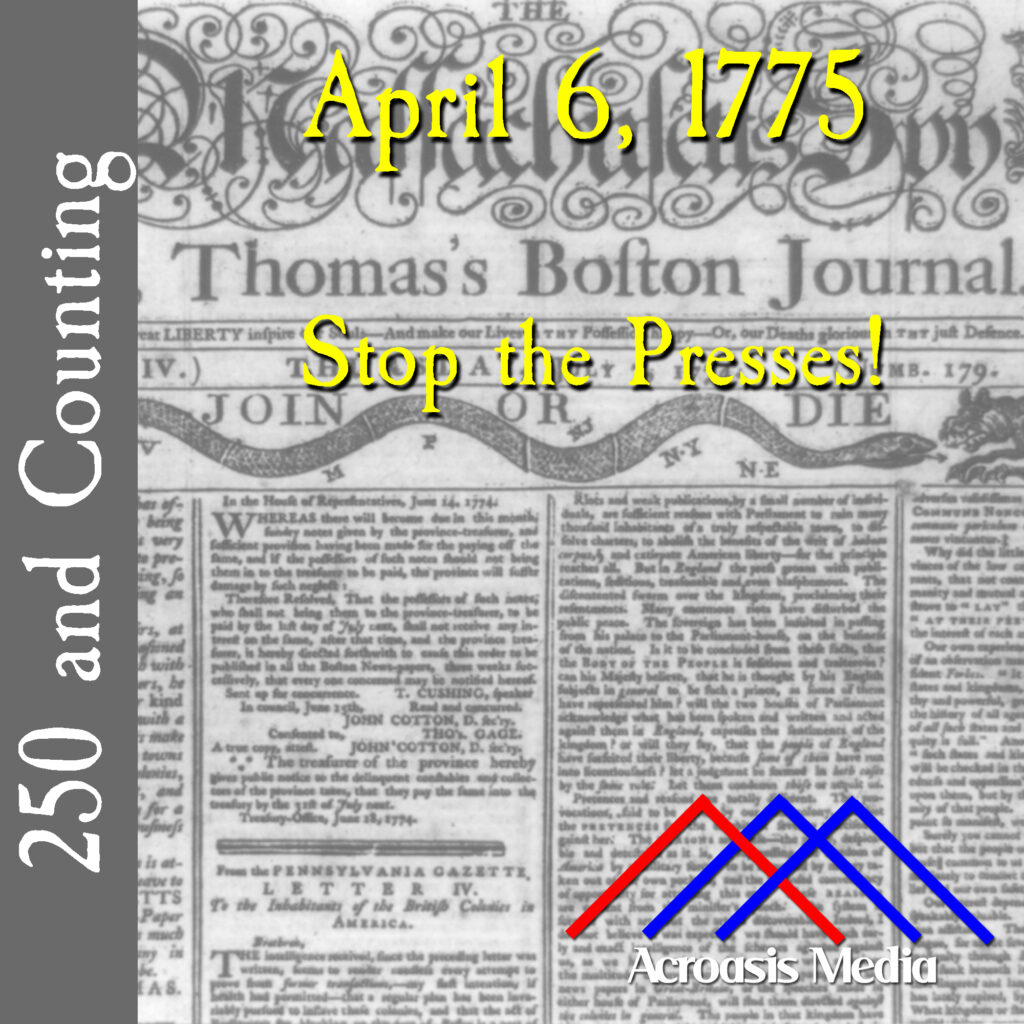
    Cover art for April 6, 1775: Detail of the front page of the Massachusetts Spy, July 7, 1774.

    In past episodes (quite recently, in fact) we’ve talked about the Colonists’ need to move caches of gunpowder and other weaponry when they got wind of an imminent British seizure.

    By the time April of 1775 rolled around, it wasn’t just the explosive weapons that the British were after; it was the press as well. And the more you hear about the specific things that the British imposed on the Colonies as events moved closer to all-out war, the more obvious their need to appear in the Bill of Rights becomes. (Whatever you think of any specific Amendment, it’s not too tough to see the reasoning that went into its inclusion if you look at it from a contemporary standpoint rather than a modern-day one.)

    This it was that on this day, the Colonists heard that the British were going to move in on restricting a free press, so the Massachusetts Spy simply up and left so there would be nothing to seize.

  • April 5, 1775: The British Gear Up For War

    Cover Art for April 5, 1775: A 2007 photograph of the Old Powder House in Nathan Tufts Park, Somerville, Massachusetts. Photo by Erik Edson, via Wikimedia Commons.

    Up until now, we’ve presented General Thomas Gage as rather a hard liner who was looking to subjugate the Colonies somehow. Nothing could be further from the truth.

    The fact is, he like being a light-hearted guy, and when he became the Royal Governor of Massachusetts, he discovered exactly what kind of mess he’d stepped into. At that point, anything he did would only make matters worse.

  • April 4, 1775: America’s First Female Pharmacist

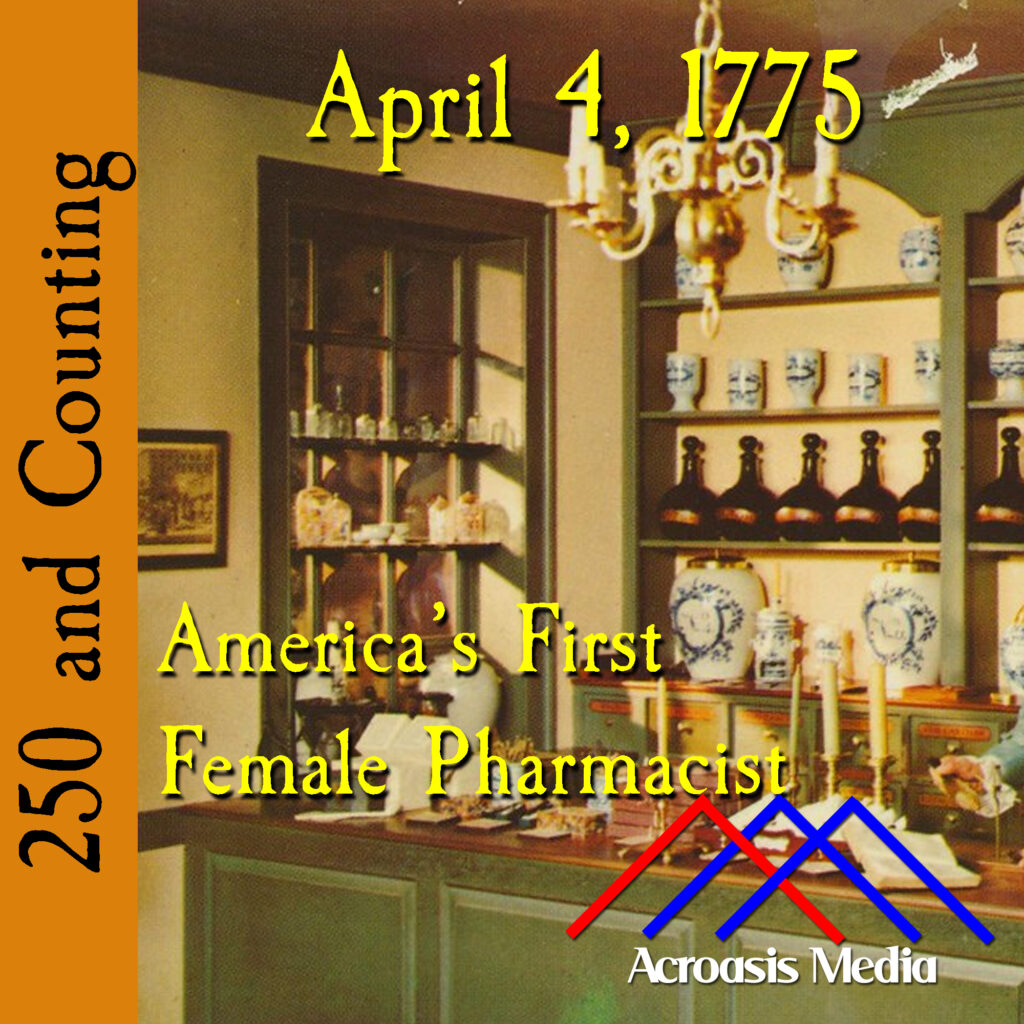
    Cover art for April 4, 1775: a reproduction of an 18th Century Apothecary shop in Williamsburg, VA.

    The title kind of buries the bigger story, but we wanted to ensure that you understood what a big deal Elizabeth Gooking Greenleaf was.

    Elizabeth was dead by the time 1775 rolled around, but her family continued to run the apothecary shop for many years, and they were instrumental in ensuring that the Massachusetts Patriots were equipped with medical supplies should war break out.

    Today there is a chain of pharmacies in the midwest called GreenLeaf Apothecary, but there’s no connection we could find between this and the original, except perhaps as homage.

  • April 3, 1775: The New York General Assembly Hangs It Up

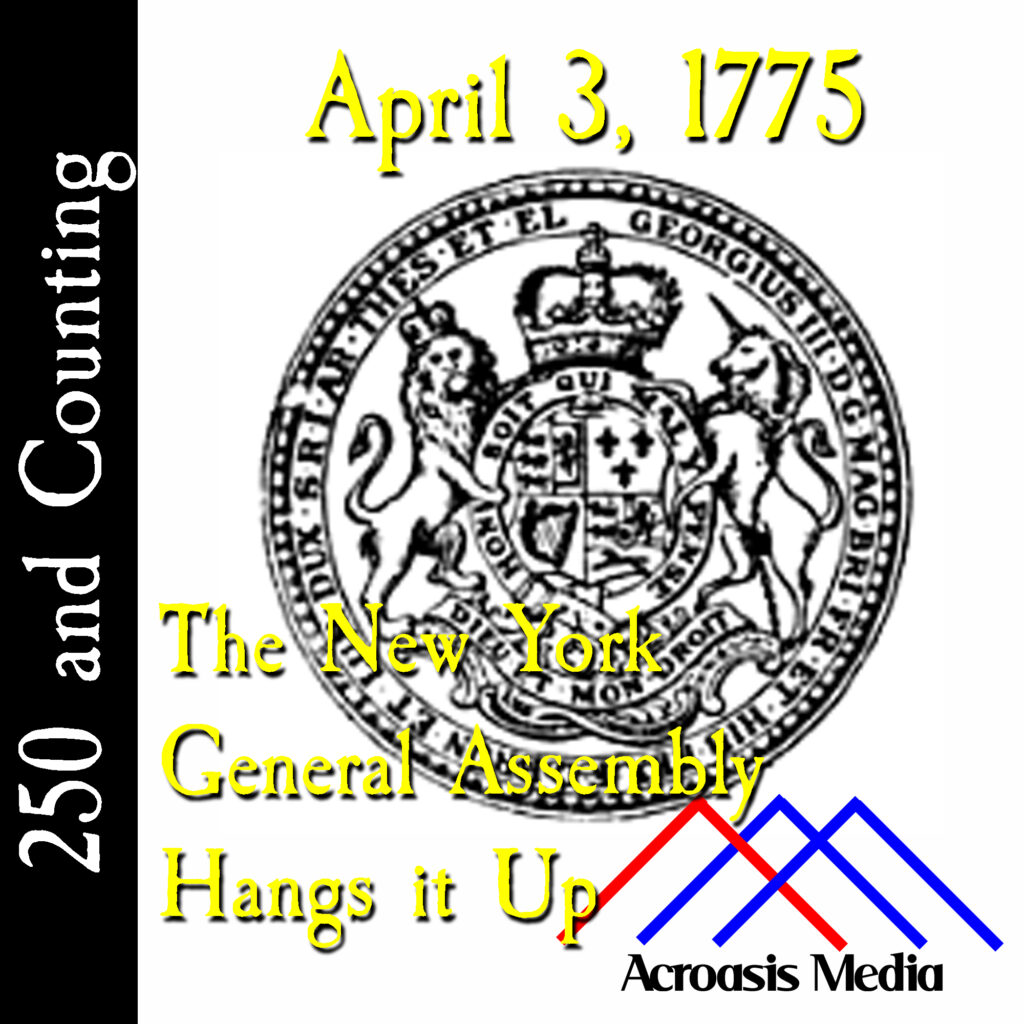
    Cover art for April 3, 1775: Seal of the Province of New York from 1767 until independence. From Eugene ZIeber's Heraldry in America, 1909 edition.

    In the play and film 1776, one of the delegates from New York says that in the state legislature, everybody talks very loud and very fast and never seems to get anywhere. This may or may not be true, but the fact is, they did have some specific instructions for their delegates to the Second Continental Congress. One of them was that New York would be expected to oppose independence for as long as possible. That was probably because they were looking at Vermont as a model and preparing to declare themselves an independent nation.

    Claude is originally from New York, and he’s of the opinion that most New Yorkers still think of themselves as members of a separate nation. But that’s a different debate.

  • April 2, 1775: Calvin Jones–Physician, Soldier, Benefactor

    Cover art for April 2, 1775: Portrait of Calvin Jones (details not known to us at time of publication)

    Calvin Jones may have looked like an unassuming fellow, but that unassuming look concealed a very powerful mind and a strong moral compass.

    And today we’ve got Cake and Candles for him, since this day in 1775 was the date of his birth. Jones was a physician before his teenage years ended, and he began to design criteria that would separate good doctors from bad ones. He organized militias even though he was under no orders to do so. And then when the War of 1812 broke out, he became a major general with a reputation for excellence, to the point where nobody really worried about whether North Carolina would fall to the British.

    After the war he basically helped shepherd the development of a brand-new field of medicine, and after his death, much of his land became Wake Forest University. What’s more, it was because of Jones that the school has a head-scratcher of a name rather than an incomprehensible one.

  • April 1, 1775: Thomas Gage is Steps Behind

    Cover art for April 1, 1775L Thomas Gage telling his troops to allow children to use Boston Common for sledding and ice skating.

    We’ve said it before and we’ll say it again: Thomas Gage was kind of a weird bird. In our cover art he’s defending children who were using Boston Common for sledding and skating. This was just a couple of months before today’s events.

    But other times, he was a little on the lazy side, often looking for clues that aren’t there, and letting other peoples’ opinions get the better of him. It’s entirely possible that the best idea Gage ever had was whatever he’d been told most recently. His decisions appear on their surface to be expressions of concern for the Colonists. Do with that what you will.

  • March 31, 1775: Mercy Otis Warren, Ignoring the Rules

    Cover art for March 31, 1775: photo of the statue of Mercy Otis Warren that stands outside the County Courthouse in Plymouth, Massachusetts. Photo by Kenneth C. Zirkel,. Other than cropping to fit, used without changes under the Creative Commons License.

    Today’s episode marks the end of Women’s History Month. We’ve noted a few episodes since this adventure first started that involved women taking political action as groups, but Mercy Otis Warren was one of the most influential individual women to take a political stand in the Revolution era.

    She was self-educated, and married a man who was both enlightened and politically active himself, and she used her position as her husband’s hostess to develop and maintain connections of her own. She was also able to use what she learned to develop some of the pieces she wrote, whether they were factual or thinly-disguised fiction pieces.

    Claude and his wife Shannon did the extra-touristy thing of visiting Plymouth, Massachusetts during Thanksgiving weekend several years ago, and we did see the Mercy Otis Warren statue, but frankly at that time we still had a lot to learn about her. (If you go, be warned that Plymouth Rock is even more disappointing than everyone tells you it is.)

    And because it’s an episode celebrating Mercy Warren, we talked Shannon into recording the episode. Enjoy.

  • March 30, 1775: King George III Restricts Trade

    Cover Art for March 30, 1775: Portrait of King George III, ca 1790,

    In the past we’ve talked about the New England Restraining Act; today was the day that King George III actually put it into action.

    To mark that day, Mike takes you through some of the details of the act and its impact on the trade in the Colonies, and the political impact in Britain.

  • March 29, 1775: The Brits Head to Roxbury

    Cover art for March 29, 1775: The Auckward Squad, painted by George Cruickshank, ca. 1780

    There are plenty of scholarly books and articles out there regarding American History, but there are elements of British history that stick out, too. General Gage giving the order today that his troops begin to march on Roxbury. It was a relatively small gesture at the time, but many, many colonial events can be traced to that particular action.

    And as a result the Colonists determined that Britain can’t move numbers of men like that again without bumping into a few flintlocks along the way.