Category: Correspondence

  • Henry Knox Wants To Get Tough–May 16, 1776

    Cover art for May 16, 1776: Portrait of Henry Knox by Gilbert Stuart, 1806.

    If the name Henry Knox sounds familiar to you, give yourself a prize. Knox was the man in charge of the Noble Train of Artillery, in which large amounts of ordinance were taken from Fort Ticonderoga and transferred to Boston. The presence of the new guns, with greater range than either side had at that point, led to the British finally evacuating the city a relatively short time later.

    But by this point Knox was back in New York, only he was in the city rather than the upstate area, and he could see that reconciliation was a pipe dream at best. So he wrote to John Adams to stress the importance of eventual independence.

    It is not recorded whether Adams replied “No duh,” since he’d been making the same arguments to the Second Continental Congress for some time.

  • Words From Ward–May 9, 1776

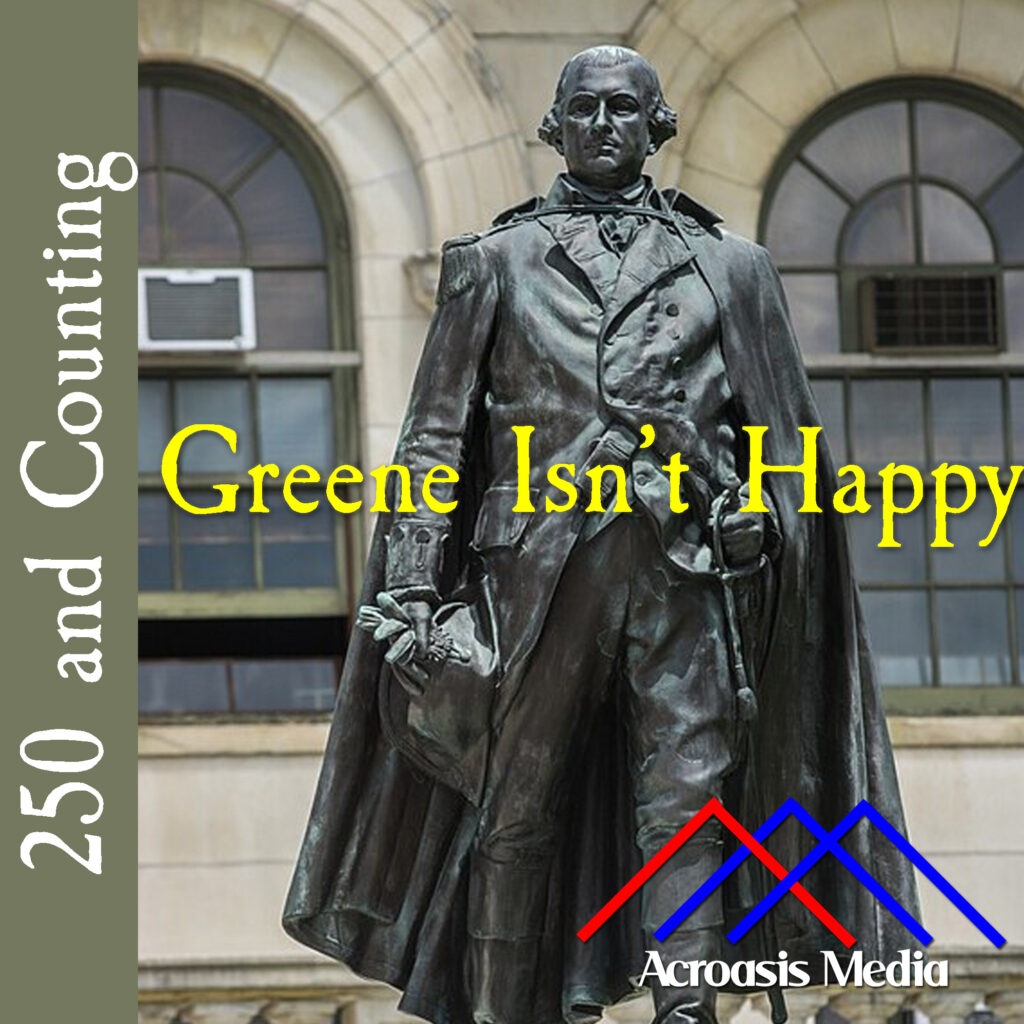
    Cover art for May 9, 1776: Statue of Artemas Ward that stands in Washington DC, just a few blocks northwest of the National Cathedral.

    Artemas Ward was the man left in charge of things when Washington made his trek to New York, so you know that this was a man that Washington trusted. As a result they corresponded with one another frequently.

    So it only makes sense that once in a while, the two would write to one another on the same day, and this was one of those days. Washington wrote to Ward his concern that the British would return to Boston and therefore the city should be fortified to protect against such an event, and Ward wrote to Washington about a pair of ships that had been captured in the Bay just a couple of days earlier.

    In an astonishing coincidence that would stun even Robert Ripley, Abigail Adams’ letter to John Adams from May 7 addresses both of these issues.

    For what it’s worth: Ward Circle, where the statue from today’s cover art is located, is in the middle of a peculiar looking traffic circle on Massachusetts Ave NW. There are no pedestrian crossings that will get you close to it, so if you do choose to make that particular pilgrimage, stop off at the National Cathedral first and ask for divine intervention, ’cause the traffic can easily make that a nightmare to cross.

  • Abigail, On Power–May 7, 1776

    Cover art for May 7, 1776: portrait of Abigail Adams, 1764, by Benjamin Blyth. Photographed by Claude Call at the Massachusetts Historical Society.

    Abigail Adams had some thoughts when it came to arbitrary power, and how fragile it is.

    But you get all that from the episode itself. Instead, here in the show notes, I’m going to point out that I’m the one who took the photo used for today’s cover art.

    The painting hangs at the Massachusetts Historical Society, and because they keep it relatively dim there, you can see the reflection of the stairwell leading down to the main entrance. The white spot over Abigail’s head is the reflection of a light across the gallery, which is maybe 15 feet across. I’m standing at a slight angle so I’m not part of the reflection. (It’s also partially cropped here; I’m not that bad a photographer.)

    The painting was donated to the Society by one of John and Abigail’s descendants, who is coincidentally also named John. The docent I spoke with didn’t know whether there was a family tradition of naming sons “John” as homage to our Founding Father, but he conceded it’s certainly likely.

    The letter cited in today’s episode is part of the MHS collection, though it wasn’t on display the day Mike and I visited. MHS has literally thousands of Adams Family documents, and there are people there who work only with those documents. That’s their only job!

  • Samuel Adams Is Spoiling For A Fight–April 30, 1776

    Cover art for April 30, 1776: Portrait of Rev. Samuel Cooper by John Singleton Copley, ca. 1750.

    Reverend Samuel Cooper has an interesting item in his family history. His grandfather was Samuel Sewall, a judge in the Province of Massachusetts Bay who was involved with the Salem witch trials in 1692-3. Now, to be fair, Sewall did apologize for his part in that bit of foolishness, and he’s also known for writing an essay in 1700 criticizing slavery.

    As far as Cooper himself, he was an active Patriot of the Revolutionary Era, who was good friends with many of the Founding Fathers. According to our friends at the Massachusetts Historical Society, when letters written by Governor Thomas Hutchinson and Lt. Governor Andrew Oliver were stolen in 1773, they wound up in Benjamin Franklin’s hands.

    Franklin in turn sent them to Samuel Cooper, who gave them to Thomas Cushing, the speaker of the Massachusetts assembly. Samuel Adams was the clerk of the Assembly and got to see them. They all knew that the letters were a bit of a bombshell (essentially, Hutchinson and Oliver were misleading Britain regarding conditions in the colonies), but because they were under strict orders not to copy or publish them, their hands were tied.

    Samuel Adams, however, came up with the idea of leaking the contents by way of a propaganda campaign in the Assembly that didn’t actually disclose the letters themselves. That was enough to create a political firestorm in Massachusetts, which led to General Gage implementing the Coercive Acts.

    Who stole the letters in the first place? It’s still not clear.

  • Gates Moves Up Quickly–April 27, 1776

    Cover art for April 27, 1776: Horatio Gates, by Gilbert Stuart, 1793. via the Metropolitan Museum of Art.

    Horatio Gates did move up quickly through the ranks, and partially because he knew George Washington well, but it was also because he had a pretty good handle on getting things done.

    As an Adjutant General, Gates was the man who ran the administrative side of the Continental Army, and is now thought of as the US Army’s first Adjutant General. He handled a lot of the logistics of keeping records and ordering supplies, and offered Washington wise counsel when it came to the Siege of Boston. In that respect it appears that he prevented Washington from acting rashly now and then.

    But Gates was anxious to get a field position, and just a few weeks after this date, he was assigned to the Canadian Department with the new rank of Major General. Some intramural disputes followed as the Continental Army began to retreat from Canada, but were quickly settled.

    Unfortunately Gates’ ambition got the better of him, and as the year wore on, he left his troops to attempt to talk the Congress into having him replace Washington as Commander in Chief.

    Later, Horatio Gates was present when General Burgoyne surrendered at Saratoga. He tried to parlay this into political gain, but his status began to falter for the rest of the war, to the point where he was nearly court-martialed. Shortly thereafter he retired and lived in Virginia, and then New York City, until his death in 1806. He was buried in the Trinity Church graveyard in lower Manhattan, but the exact site of his grave is unknown.

  • George Washington Has Concerns–April 26, 1776

    Cover art for April 26, ,1776: Portrait of Jonathan Trumbull and his wife Faith in 1783. This was painted by their son John. The original hangs in Yale University's Art Gallery.

    Jonathan Trumbull was first and—for a while—the only Colonial Governor to support the American Revolution. (Most of the other colony leaders either didn’t hold that title, or remained quiet, as if hedging their bets.)

    Througout the Revolution, Trumbull supported the troops in general and George Washington in particular, and was often a close advisor to Washington on military matters.

    So it was a little bit of a surprise when Washington wrote to Trumbull, noting some of the problems he’d had with Trumbull’s recent decision to move a bunch of soldiers northward.

    On a side note: there aren’t a lot of portraits of Govenor Trumbull around. That’s one of the reason I’ve used this picture before. The other reason is that I just think it’s neat.

  • Thomas Stone Writes Home–April 25, 1775

    Cover art for April 25, 1776: portrait of Thomas Stone by Robert Edge Pine, 1785.

    Thomas Stone was a delegate to the Second Continental Congress who served with strict instuctions to “arrive at a happy settlement and lasting amity” with the Mother Country. What’s more, he and his fellow delegates were told not to vote for any proposition that declared independence.

    Fortunately, just a few days before Richard Henry Lee put forth the resolution for Independence in early June 1776, the Maryland government removed that restriction, so the delegates could vote however they wanted. And yes, they did vote.

  • Letters From New England–April 21, 1776

    Cover art for April 21, 1776: Page Four of the letter Abigail Adams sent to her husband John on this day. via Massachusetts Historical Society.

    When Henry Knox wrote to George Washington apologizing for getting to Noweich,Connecicut so late, he had a pretty good excuse: he spent a bunch of money on hiring people to move materials down; and those people had trouble getting the job done.

    But then Henry Knox also tells the story of leaving the caravan briefly to look at Newport RI and determine whether it’s defensible. Imagine how he felt when, after he spent two days figuring out the five best places to stand when defending Newport, he has to explain why he lost those two days afterward. But he did take the time to frame it as an activity that surely would make the Commander-in-Chief look better.

  • Washington Writes A Protest Letter–April 17, 1776

    Cover art for April 17, 1776: detail of the letter from Washington to the NY Committee of Safety. via Village Preservation, a group dedicated to preserving the heritage and cultural history of the Greenwich Village area.

    One of the things I really appreciate about reading documents from this era is just how polite they were; George Washington’s letter to the NY Committee of Safety, when you read between the lines is an admonition wondering if that august body had lost their damn minds.

    One of the best examples of this is the Declaration of Independence itself. As Aaron Sorkin describes it in an episode of The West Wing:

    [N]ever has a war been so courteously declared. It was on parchment with calligraphy, and “Your Highness, we beseech you on this day in Philadelphia to bite me, if you please.”

    However, we’re getting ahead of ourselves; that doesn’t happen for another couple of months (and not when you think!).

    At any rate, Washington was correct in his assessment that it didn’t make a ton of sense for New York to supply the British while at the same time opposing them. At the same time he didn’t accuse them directly; he played it very cool and suggested that the NY Committee of Safety could get a lot of credit if they’d do as he suggested.

  • John and Mercy–April 16, 1776

    Cover art for April 16, 1776: portrait of Mercy Otis Warren by John Singleton Copley, ca 1763. via Museum of Fine Arts in Boston.

    Mercy Otis Warren doesn’t get nearly enough love in our history books, and barely enough of it here, besides. Having said that, our episode a little over a year ago was a fun little tribute.

    Mercy Otis Warren was a playwright, a pamphleteer and a poet before, during and after the Revolution. Some of her plays were thinly veiled attacks on the British. She was self-taught and pretty brilliant at it, considering that she was one of the first to advocate for a Bill of Rights (though nobody knew she’d written the piece advocating one until her great-great-grandson found a document tying the pamphlet to her).

    And while this episode focuses on correspondence between her and John Adams, she frequently exchanged letters with George Washington, John Hancock, Patrick Henry, Samuel Adams, and Thomas Jefferson. But her best relationship was with John Adams, who she looked to as a wiritng mentor. It was at his suggestion that she began writing a history of the Revolution while it was still being fought. She didn’t need primary sources to write her history, she was the primary source. At worst, she was getting it second-hand from the members of the Continental Congress and local leaders.

    Mercy was married to James Warren, and I mention that here because oftentimes she’s thought to be the widow of Dr. Joseph Warren, who died at Bunker Hill. In fact, despite having the same name, Joseph was not related to James, nor to Mercy.

    Incidentally, Mike gives a shout-out to the Massachusetts Historical Society, which is a fascinating repository of documents and items related to the history of the state, but which has a special lens on the Revolution, especially this year. So I figured I’d do the same here, along with a link. If you’re in town, it’s not to be missed. And it’s free, though donations are encouraged. Go check them out and from there it’s a short walk to Fenway Park, where you can catch a Red Sox game. (Alas, they were playing away games while we were in town.)