To be clear, the actual burning of Falmouth took place on October 18, but the events that led directly to it happened on this day.
Captain Henry Mowat had been captured by patriots in Falmouth some time earlier. When he returned, he brought five gunships with him. When he demanded that the locals swear allegiance to King George III, he gave the command that laid waste to the town.
We actually touched on this once before, but George Washington was known for being quite the gentleman, but he did have a temper, especially when things weren’t handled in a gentlemanly way. Cross the lines of civility and he was hoisting the Jolly Roger, my friend.
In a previous episode we noted that Washington wrote to General Gage about the treatment that captured American soldiers were receiving. In it was a thinly-veiled hint that he had prisoners too. And he’d be more than happy to treat them the way the British were apparently treating American soldiers. It’s not clear whether this had the desired effect. What is clear is that when something didn’t meet his expectations, he was going to make himself heard.
And by this date, Washington had a few things that needed to be addressed by the Massachusetts General Court. That sounds like a legal body but it was, in fact, the provincial government at that time. There were some things that the Continental Congress handled for the army, but the General Court took care of much more at that time. Unfortunately for Washington, the General Court was—in his opinion—dragging its feet and needed a nudge in the right direction.
And Washington was only too happy to provide that nudge.
Anyone who’s been to Boston in the modern day has a hard time recognizing that the city of Boston was just the segment in the top center of the map. The area called Boston Neck is clearly marked at the bottom left, and wasn’t part of the city. The Continental Army’s line ran about where the blue line ends. (The blue line is modern-day Washington Street.)
It was the city having that kind of geography that made the Siege of Boston relatively easy for the Patriots. Unfortunately for them, the British were still able to use the surrounding waterways.
This made the siege not the battle of attrition that it could have been, since supplies were able to get in via water. Consequently it was an ongoing battle of wits, as we learn today.
The cover art for today’s episode may be one of the most famous art pieces depicting an event of the American Revolution, and it happened under the Liberty Tree, which is clearly marked here.
This event, the tarring and feathering of Loyalist John Malcolm, took place about 18 months earlier and shows Malcolm already tarred and feathered, and now he’s having (also marked) tea poured into his mouth. The Stamp Act is nailed to the tree, upside down. Really, there’s a lot to unpack in this picture. So it makes sense that people were upset that the tree had been cut down.
It was another net win for the Americans as the HMS Falcon, which had originally been assigned to the Colonies to enforce the Intolerable Acts, took a run at stealing livestock in order to provision the British who were stuck in Boston during the siege.
Unfortunately for them, the Colonists were wise to their moves and took appropriate action…more than once.
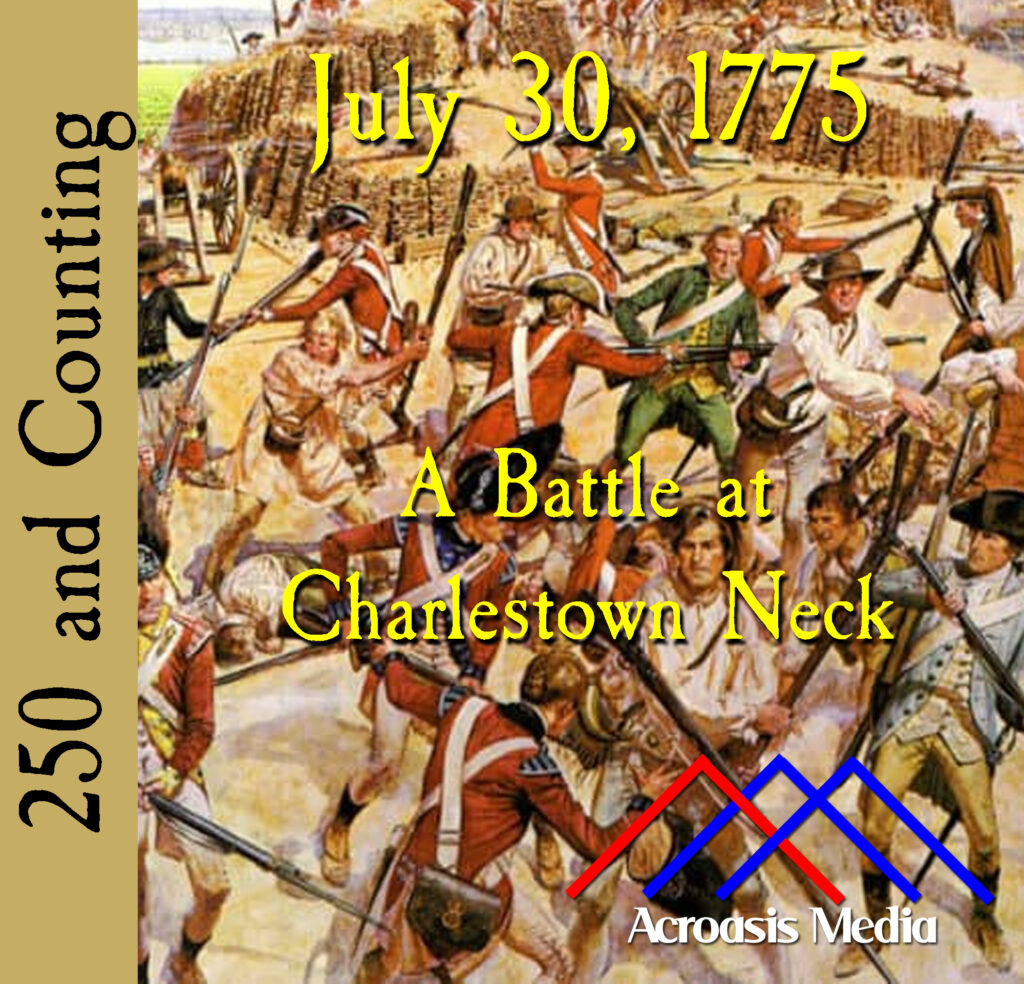
Boston had been under siege since Lexington and Concord. Of course the British felt that they needed to break out of it from time to time, and today was one of those attempts.
Now, this was a success for the Continental Army, but the fact is, few people realized at that time just how close they were to losing that battle, and badly. But that’s for a couple of days from now, on August 1st.
Coincidentally, August 1st is the day that this podcast begins airing on Hamilton Radio!
Tune in to HamiltonRadio.net to hear our show, and a bunch of others. We’re in good company over there.
Oof, that’s a mouthful of title. Oh well, what’s done is done.
As noted in today’s episode, James Warren was not related to Joseph Warren. On the other hand, he is related to Mercy Otis Warren, because he’s her husband.
James and John Adams had a few ideas in common; the hard part was convincing a few others that they were in the right.
Meanwhile, did you know there’s another Long Island? That sort of thing really plays havoc with our research. This one is in the Boston Bay, and it’s a familiar story because something similar happened a few weeks ago. But tune in anyway.
As you listen to today’s episode, it’ll become clear that Mike had way too much fun writing and recording this one. But then again, I wrote the title, so.
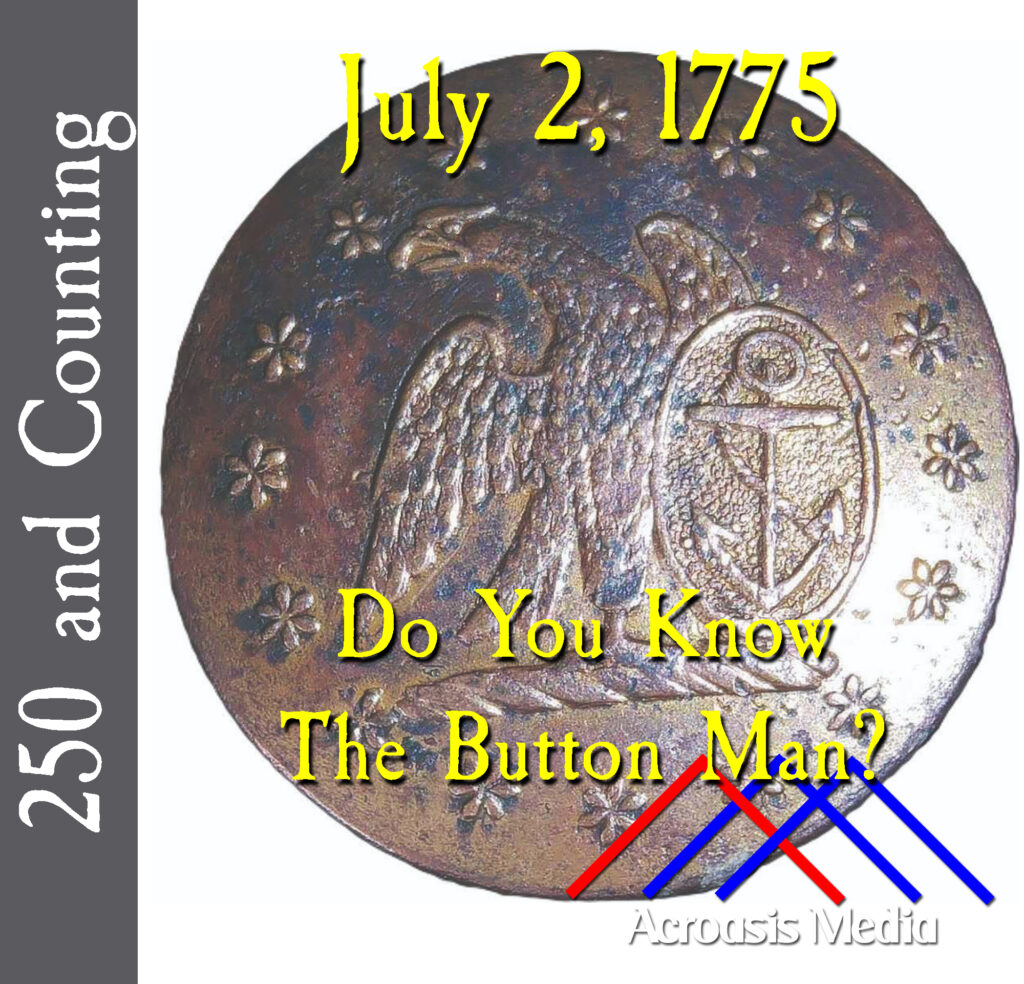
There are plenty of jobs out there that are kind of obscure, in the sense that it’s a job that somebody has, but you never really thought about. For instance, did you know that with some high-end perfumes, the labels are put on manually? Someone’s out there sticking the labels on the bottles, because either the bottles don’t go through the machinery politely, or the levels of quality are low when they’re applied mechanically. So it’s easier to have someone stick on the labels.
“Buttonmaker” is also a likely profession in this realm, largely because it is so automated these days. But back in the Colonial days, it was a specialty profession, especially since Aaron Peasley, the subject of today’s episode, refined the die sinking procedure used to make buttons then. And except for the specific means of creating the die (it’s done using electrical discharges nowadays), the overall technique hasn’t changed much.
But his talent didn’t end there. Listen in and see what else he did.
Additional note: the closeup photo of the button used in the cover art comes from a fascinating article written by 2ndLt. Kevin Rosentreter, USMC, who also took the photo.
Mike and I alternate on the writing and recording, but the final steps of the show, including the artwork and the show notes, are entirely my responsibility.
There are lots of times when historians have to pull a lot of small pieces together to get a decent picture of events. They use oddball clues such as artifacts in paintings to determine someone’s state of health, for instance. They have to take into account that published reports could be propaganda in nature.
But once in a while, something turns up that was written more or less at the time it happened, and what’s more it was written by someone who doesn’t necessarily have an agenda.
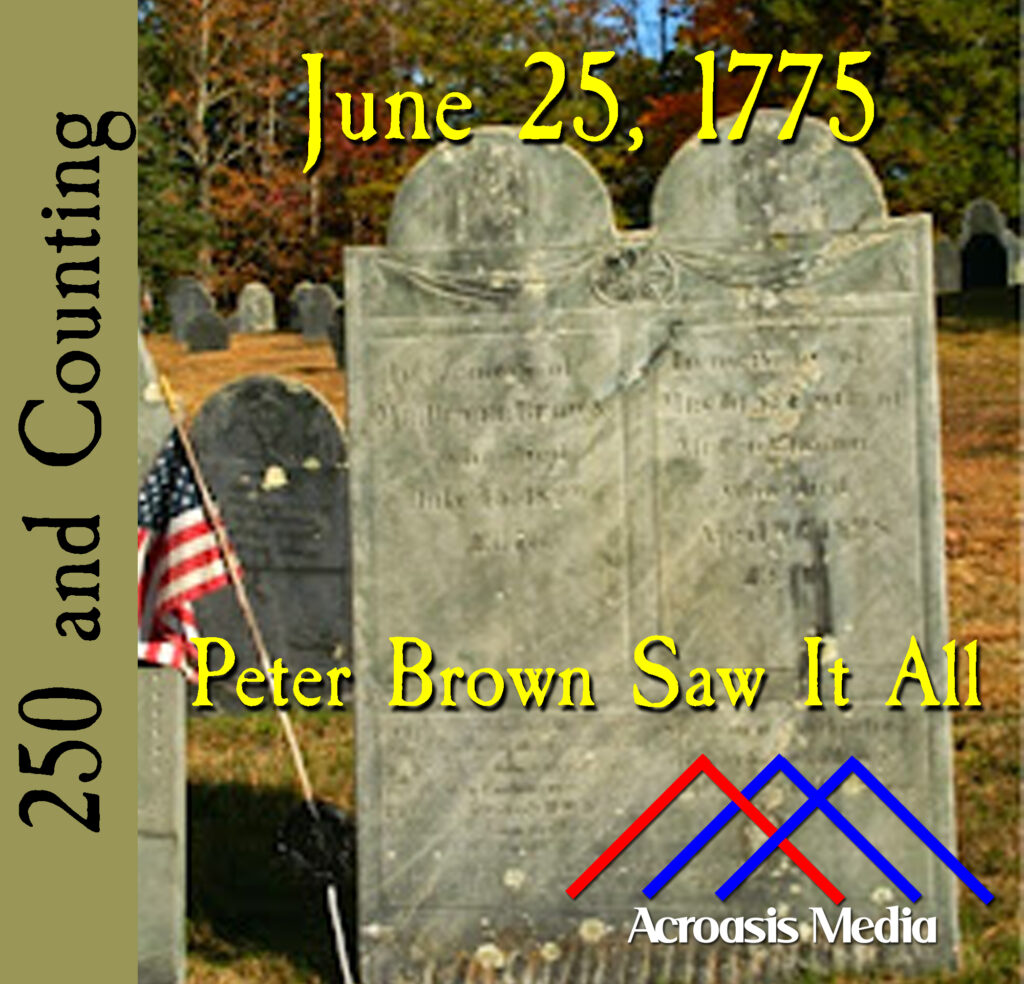
And in this case, nobody even knew it existed until a hundred years later. Exactly a hundred years later, in fact. A young soldier named Peter Brown wrote a letter to his mother just a few days after the Bunker Hill battle to tell her what happened. He spared few details and told a rather complete story of a couple of days’ worth of activity. And while he did mail the letter, and his mother did receive it, it mostly lay in family archives until 1875, when a descendant found it and realized that it might be important.

![Cover art for October 6, 1775: Seal of the Commonwealth of Massachusetts. Basic design adopted by Governor John Hancock and the Council on December 13, 1780 [1], present design adopted in 1901, rendered by E.H. Garrett](https://250andcounting.com/wp-content/uploads/2025/10/1775-10-06-cover-1024x984.jpg)