Josiah Quincy—who we’ve talked about before; remember that portrait?—would have been one of the more prominent men we speak of when we use venerated tones about the Founding Fathers, had it not been for the fact that he died just as the war was getting started.
The testimony of John Robins is what teachers like to call “primary sources”. It’s a document prepared by someone contemporary to an event, and even if the narrator is unreliable, we learn much more from it than from, say, something that was written long after the fact.
In the case of John Robins’ testimony regarding events at Lexington and Concord, the events were still fresh in his mind, having happened only a few days earlier. And because it derived from an official proceeding, that document was reasonably well-preserved and serves as a fascinating window into one of the most important events of our history.
And as for Robins himself, he was a relatively common man who happened to be part of the militia that day and might have been otherwise forgotten.
I (Claude) suppose that I should note that for a few days last week I sounded a little odd. You’re not wrong; I was not in my usual recording space and not using my usual recording equipment; what’s more I was plagued by allergies and sounded a little rough on top of the funky acoustics. I hope it didn’t bug you too much.
Anyway.
Today, the Massachusetts Provincial Congress takes the time to organize its militiamen into a decent army. Meanwhile in New York, word gets out about Lexington and Concord, and people in that colony have a big decision to make.
In the aftermath of the battles at Lexington and Concord, the Massachusetts Provincial Congress held a series of hearings to determine who fired the first shot.
The purpose of the hearings was partially to find out exactly what had happened, but it had another purpose: if it turned out that the British had fired first, then the Assembly could turn to England and say “SEE? It wasn’t us!”
Even 250 years ago, Congressional hearings had a second agenda attached to them. (*sigh*) In the end, despite getting lots of testimony, the answer was still somewhat murky. But the Assembly still had enough information to give reconciliation one last shot.
This is the big one, and it’s a date that many people don’t remember, but today is the day that the Revolutionary War officially began.
Oh sure, there were a few skirmishes here and there, which we’ve already discussed in earlier episodes. But this was the true tipping point from which nobody could recover or walk back.
Looking through social media the past couple of days, it’s heartwarming to see the number of events commemorating the 250th anniversary of things like Paul Revere’s ride, and the sheer number of people who are participating, even if they’re doing something relatively simple such as putting two lights in a high window of their homes.
We don’t recommend that you spend today shooting at British people wearing red, though.
Once in awhile, we fear that students of history don’t necessarily put things into the appropriate perspective when it comes to dates. We offer them some facts regarding what happened and when, but the events still kind of mush together.
That’s how we get the Simpsons joke: “Let’s take a look back at the year 1928- the year when you might have seen Al Capone dancing the Charleston on top of a flagpole!”
To that end, students might place the Boston Massacre, say, as quite close in the timeline to the start of the Revolutionary War, when in fact they happened several years apart. But at this specific period of time, things were in fact moving quickly and closely together: Colonies were lining up behind Massachusetts, various areas began to prepare for all-out war, General Gage was doing his best to control the colonists based on the orders that were sent to him several weeks earlier from London, and Lord North was in fact hoping to provoke the colonists into doing something that would give him a reason to crush them hard.
So when word got out that the British were coming up the Charles river to make a move on Concord and Lexington, Colonist spies were wise to it and they got the word out as fast as they could. Listen, my children, and you will hear.
War was coming closer, but nobody knew just how close. Two committees came together in Concord to make plans. They arranged for certain munitions to be moved around, for others to be prepared for action, and to ask people to lead combat units. And if those people said “No Thanks,” who the backup person would be.
Then they all went out to a nearby tavern, as you do when planning a revolution.
But nobody could suspect that the time from then to the war was measurable in hours by then, not by weeks.
I (Claude) remember once reading something about how it’s not so much the dates on the tombstones so much as it is the dash in between the dates. Because the dates represent singular events, but a lot of stuff happened during the dash.
And while that sentiment is often so much glurge, it does get me to thinking sometimes about the legacies left behind by tombstones. These were people who wanted to be remembered somehow. That’s not to say that people who choose to be cremated or buried at sea or dispensed with by some other means don’t want to be remembered; they just don’t seem to care whether there’s a marker saying I WAS AND NOW I’M NOT. These are largely the types who feel that you’re forgotten when your name is spoken for the last time, or when the last person who remembers you is, themselves, dead.
Sylvester Maxwell, to me, is in an odd place. We have his name and we know a few things about him, but we don’t have a good handle on who he was. He could be any one of hundreds of stones we pass in any given cemetery.
I’m getting maudlin here; I apologize. And I’m on vacation! In a beach condo! I gotta lighten up!
Okay, then: for all that, Mike has a story for you about Sylvester Maxwell. And there is something rather notable about his life, that he’ll tell you about.
Enjoy. I’m going to see if I can get some Vitamin D the natural way.
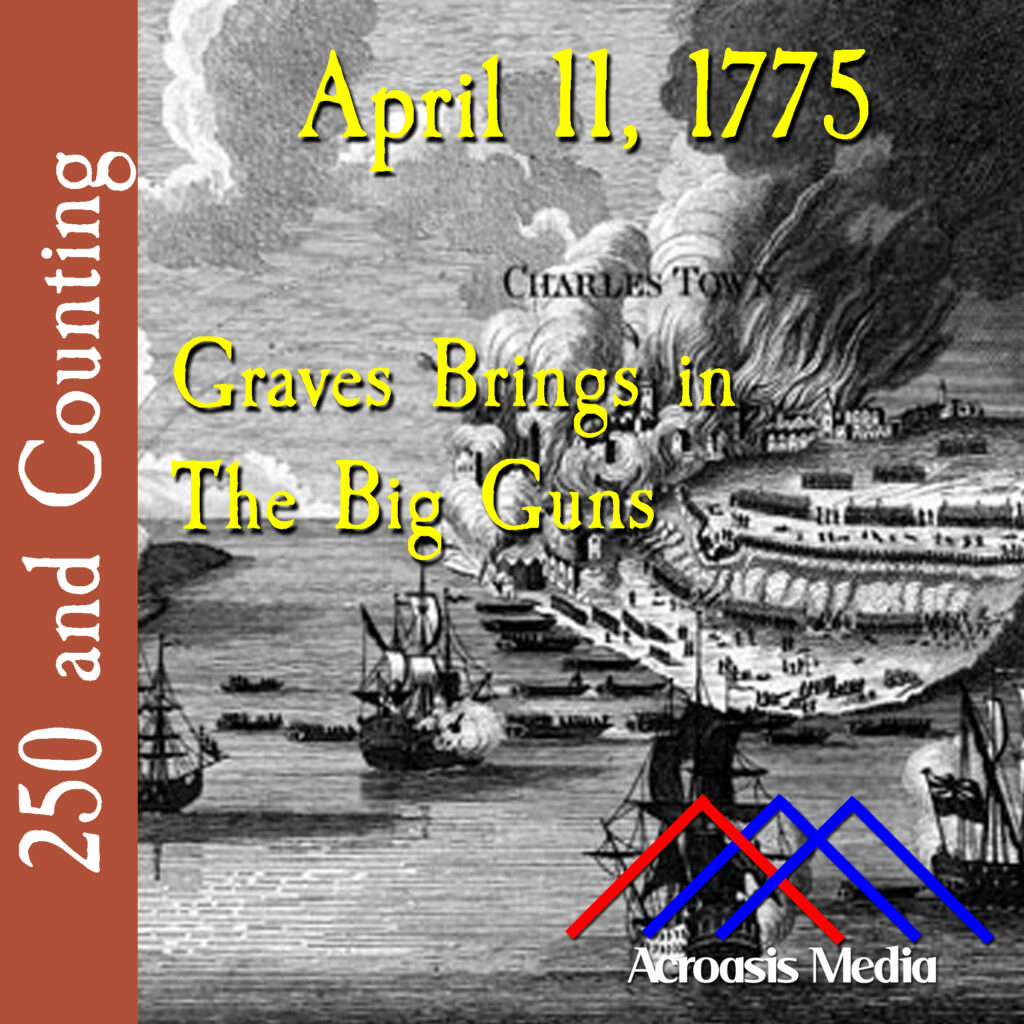
When the HMS Somerset first reached Boston, she was an old, leaky, weathered mess. Admiral Graves asked for permission to repair it, and while the work was slow at first, the sailors actually managed to get the important parts of the work completed. By this day in 1775, the ship was considered seaworthy and capable of doing more from its perch in the harbor, so Graves moved it into the place of two other ships, largely to demonstrate that he could do it, and safely.
Had the lookouts been more alert when the battles of Lexington and Concord first broken out, the outcome could have been quite different.