This isn’t the first time you’ll see a statement like this, but the bottom line is: the history books aren’t 100% correct. Sure, the Shot Heard Round The World was at Lexington and Concord. But that’s not where the fighting started.
Nearly two weeks before Concord, there were small battles going on in Assonet, Massachusetts, near the Rhode Island border.
Well…it’s official. It was on this day in 1775 that our assorted collection of irregular militiamen turned into a genuine army.
The Provincial Congress in Massachusetts proposed, and adopted, a resolution that provided for a genuine army dedicated to protecting our shores against the British. That was the New England Army, but the name didn’t last long. Tune in to find out their other name.
It’s cake and candles today for Francis Cabot Lowell, a manufacturer who helped modernize the textile industry in the United States, largely through industrial espionage: in the middle of a trade war with Europe, Lowell visited England and memorized the processes they were using so that he could bring them back to this side of the pond, helping us to break the hold on imported goods from Europe by innovating the cradle-to-grave manufacturing process for fabrics.
Yet, despite his prominence in the industry, and despite the statue that stands in his name in the town of Lowell, Massachusetts, the silhouette seen in today’s cover art is the only hint that we have regarding what he might have looked like. There are no portraits extant that we know of.
In past episodes (quite recently, in fact) we’ve talked about the Colonists’ need to move caches of gunpowder and other weaponry when they got wind of an imminent British seizure.
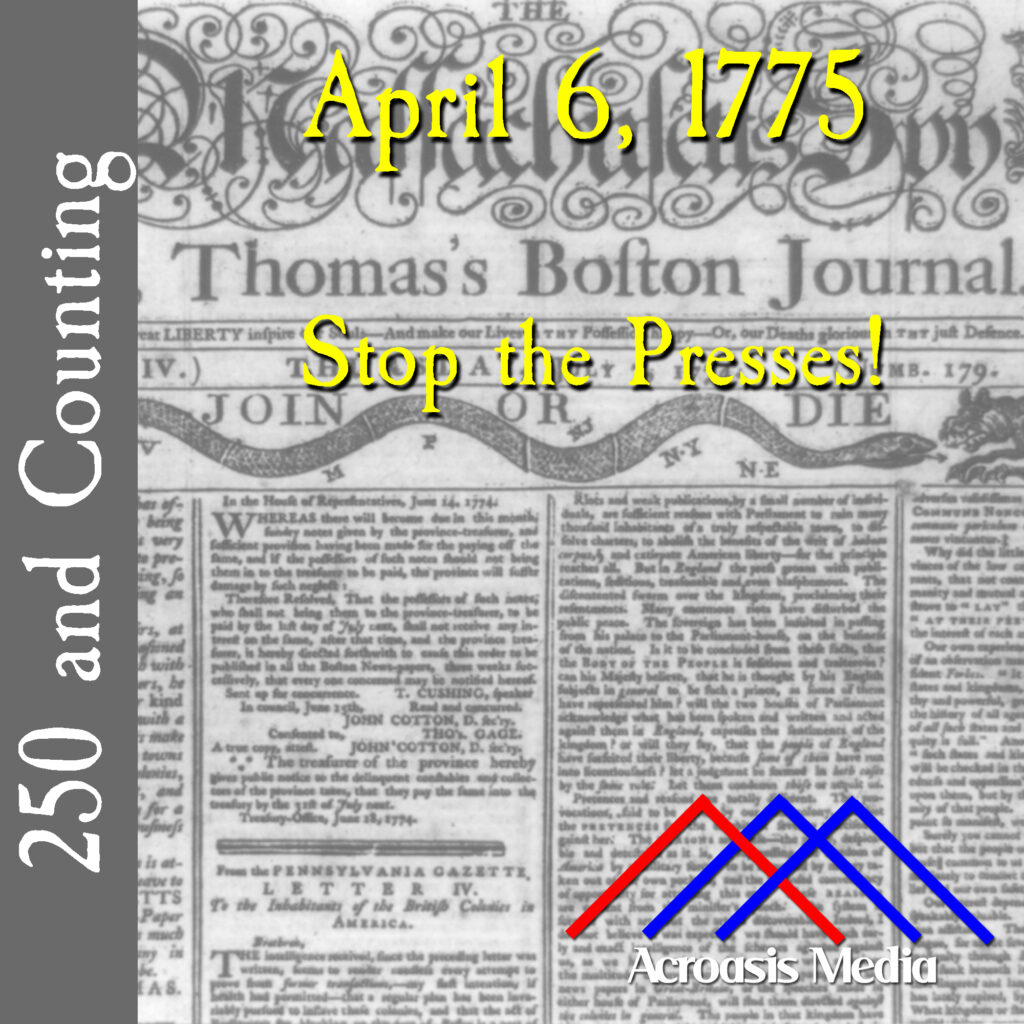
By the time April of 1775 rolled around, it wasn’t just the explosive weapons that the British were after; it was the press as well. And the more you hear about the specific things that the British imposed on the Colonies as events moved closer to all-out war, the more obvious their need to appear in the Bill of Rights becomes. (Whatever you think of any specific Amendment, it’s not too tough to see the reasoning that went into its inclusion if you look at it from a contemporary standpoint rather than a modern-day one.)
This it was that on this day, the Colonists heard that the British were going to move in on restricting a free press, so the Massachusetts Spy simply up and left so there would be nothing to seize.
Up until now, we’ve presented General Thomas Gage as rather a hard liner who was looking to subjugate the Colonies somehow. Nothing could be further from the truth.
The fact is, he like being a light-hearted guy, and when he became the Royal Governor of Massachusetts, he discovered exactly what kind of mess he’d stepped into. At that point, anything he did would only make matters worse.
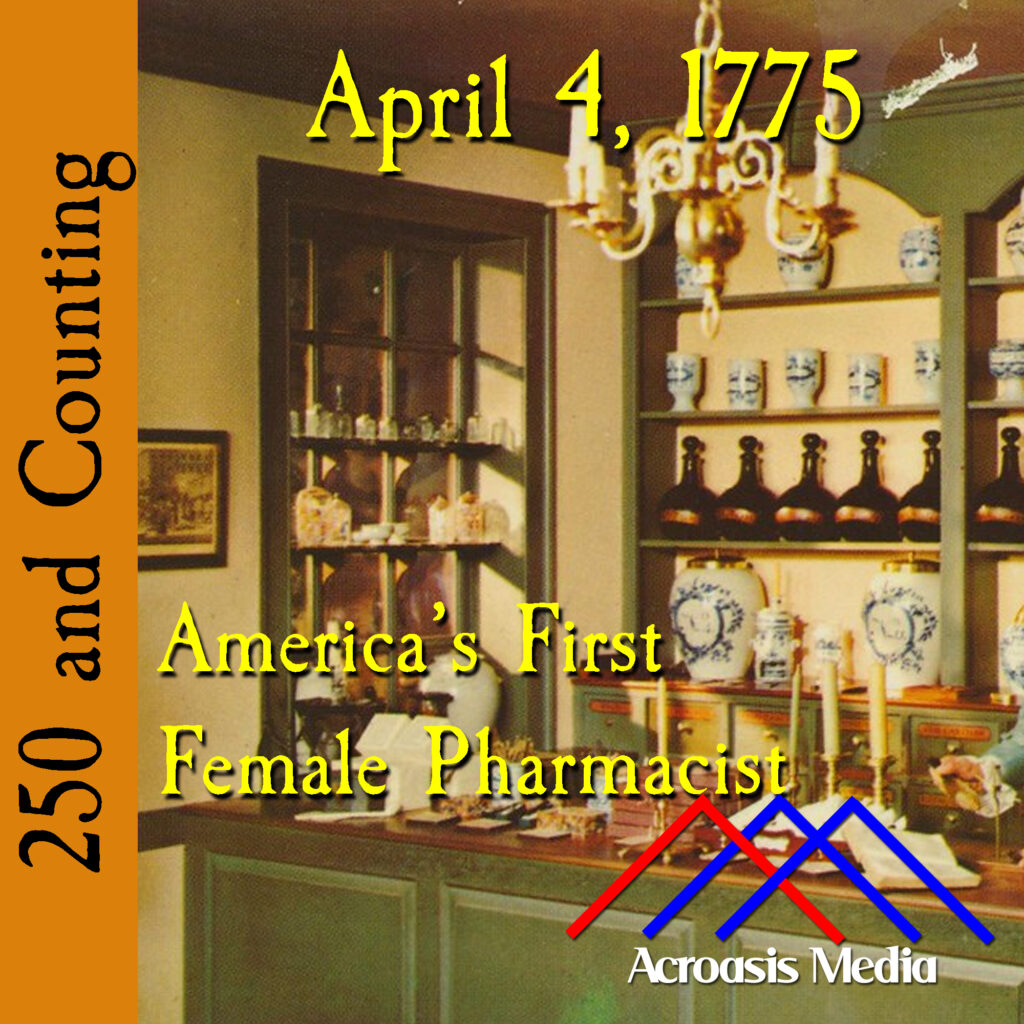
The title kind of buries the bigger story, but we wanted to ensure that you understood what a big deal Elizabeth Gooking Greenleaf was.
Elizabeth was dead by the time 1775 rolled around, but her family continued to run the apothecary shop for many years, and they were instrumental in ensuring that the Massachusetts Patriots were equipped with medical supplies should war break out.
Today there is a chain of pharmacies in the midwest called GreenLeaf Apothecary, but there’s no connection we could find between this and the original, except perhaps as homage.
Today’s episode marks the end of Women’s History Month. We’ve noted a few episodes since this adventure first started that involved women taking political action as groups, but Mercy Otis Warren was one of the most influential individual women to take a political stand in the Revolution era.
She was self-educated, and married a man who was both enlightened and politically active himself, and she used her position as her husband’s hostess to develop and maintain connections of her own. She was also able to use what she learned to develop some of the pieces she wrote, whether they were factual or thinly-disguised fiction pieces.
Claude and his wife Shannon did the extra-touristy thing of visiting Plymouth, Massachusetts during Thanksgiving weekend several years ago, and we did see the Mercy Otis Warren statue, but frankly at that time we still had a lot to learn about her. (If you go, be warned that Plymouth Rock is even more disappointing than everyone tells you it is.)
And because it’s an episode celebrating Mercy Warren, we talked Shannon into recording the episode. Enjoy.
In the past we’ve talked about the New England Restraining Act; today was the day that King George III actually put it into action.
To mark that day, Mike takes you through some of the details of the act and its impact on the trade in the Colonies, and the political impact in Britain.
There are plenty of scholarly books and articles out there regarding American History, but there are elements of British history that stick out, too. General Gage giving the order today that his troops begin to march on Roxbury. It was a relatively small gesture at the time, but many, many colonial events can be traced to that particular action.
And as a result the Colonists determined that Britain can’t move numbers of men like that again without bumping into a few flintlocks along the way.
We’ve spent a lot of time talking about events in Virginia lately, but that doesn’t mean that the folks in Massachusetts weren’t getting things done. It just means that they weren’t making a big deal about it.
For the past several weeks, they’d been working on the down-low to make plans in case the British took any action that they might find too intrusive, from simple confiscations to an all-out shooting offense. (Of course that was still on the table; nobody had forgotten the Boston Massacre.)
It wasn’t until this day in history that they made their resolution publicly known. And in the wake of Patrick Henry’s very recent proclamation, nobody would be surprised if things escalated sooner rather than later.